Pacific Shipping And Cruising Yachts
pp. 99-109 · Read in the full issue
Rabaul, New Guinea, doesn’t get as many cruise ships as did before the war but when it does, catering for tourists on oard becomes a community effort.
HEN the P&O liner Himalaya called there in early November ic course of a cruise to the Far , just about everyone in the town me involved in looking after her 0 passengers. was estimated that £5,000 was t by the visitors on their 9-to-5 , plus another £2,000 spent on s. Even the Administration got a -off —they charged people who e their cars available for tours for a temporary licence to carry engers. ver 80 cars carried tourists on t-seeing tours without incident or lap, and although there were re s of gross profiteering by some /es, the visitors seemed to enjoy iselves. After the vessel left, her ter sent a radio message thanking aul residents for their “wonderful fltality”.
We’Ll Be Mining The Sea
)OR; It looks now that Austra m crops that depend on phos :e from Nauru and Ocean Island ’t wither on the vine when those flies are exhausted. They’ll be ing what they need from dules” on the sea floor. ; is estimated that at present rate consumption, Nauru and Ocean deposits will be worked out in
40 years, but thanks to the efforts of oceanographers who have been very busy in the Pacific since the International Geophysical Year started them off in 1957, the ocean bed will probably, by then, be paying dividends.
These nodules form on the sea floor, usually around a small piece of clay or a whale’s tooth. Some of them contain as much as 30 per cent, phosphorus pentoxide from which fertilisers are made.
Others contain minerals such as manganese, nickel, copper, etc. If the sea bed is ever mined, it is ex pected that it will be for all these minerals—and that the phosphate re covered will be only one of the reasons for going into production.
According to the experts, there would be no great engineering diffi culties in dredging the ocean floor; and when or if the time comes, the Pacific Ocean bed will pay much bigger dividends than that of the Atlantic. • FOOD, TOO: As well as minerals the sea in future is likely to be made to give up more food.
Two German oceanographers recently spent 4i months in Australia, New Guinea and Philippines waters mak ing a survey for the University of
Kiel on how the oceans of the world can help feed the world’s exploding populations. They are optimistic about the results of their investiga tions, particularly for nations like India and Indonesia which have al most exhausted the possibilities of getting more food from the land.
• Rabaul Launches One:
The largest craft built in Papua-New Guinea since the war was launched at the Toboi Shipbuilding Co.’s yard at Rabaul at end of September.
Christened Jason by the wife of the District Commissioner, Mrs. I. R.
Foldi, who cracked the traditional bottle of champagne over the bows, the 54-ft. craft is to the order of a New Ireland Chinese businessman.
Chinese owners and builders followed the European champagne and speeches with some traditional Chinese fireworks to ward off devils and other marine evils.
• Aust. - South America
SERVICE: One of the most neglected trade routes in the world is that be tween Australasia and South America.
This will be remedied shortly when the Swedish Orient Line routes some of its vessels through ports in the western and northern parts of the South American continent (including Callao, Peru), then through the Panama Canal and Caribbean to Europe. In addition, an Australian company, Wm. Heale Pty. Ltd., will inaugurate a service from Australia to ports in Argentina, Uruguay and Brazil. (Over)
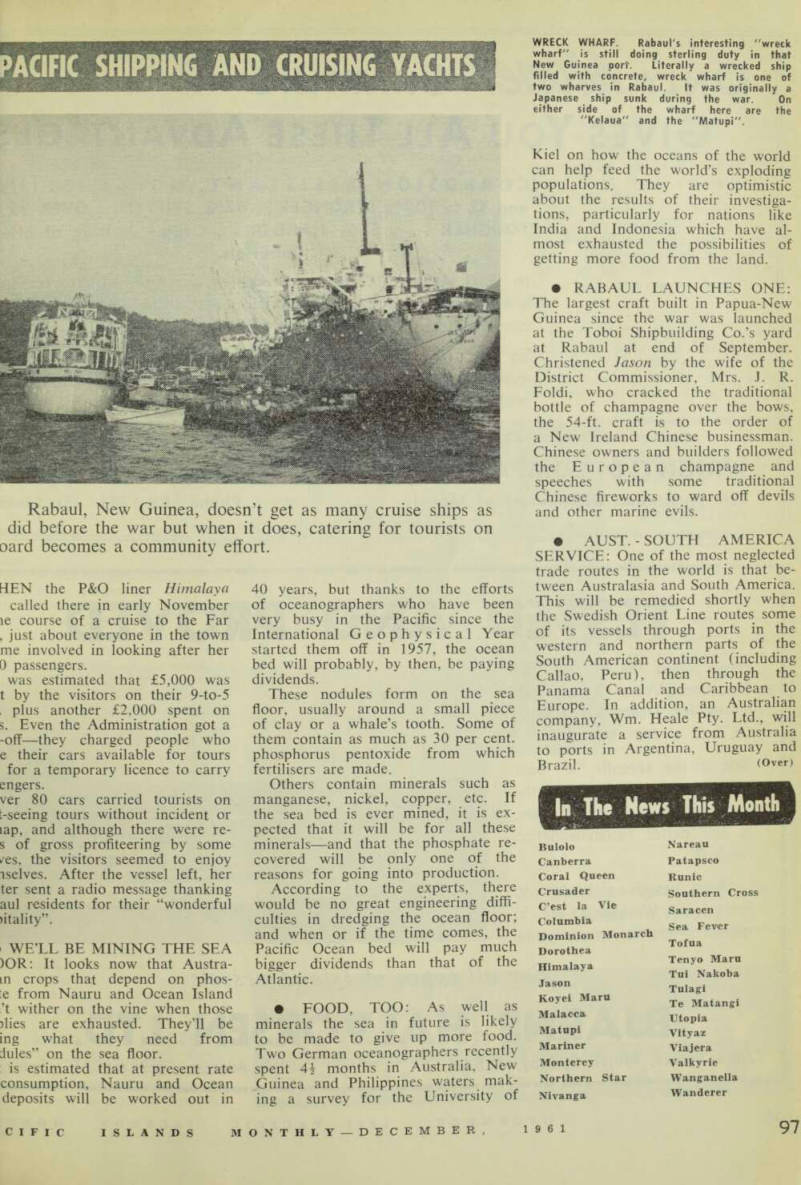
WRECK WHARF. Rabaul's interesting "wreck wharf" is still doing sterling duty in that New Guinea port. Literally a wrecked ship filled with concrete, wreck wharf is one of two wharves in Rabaul. It was originally a Japanese ship sunk during the war. On either side of the wharf here are the
"Kelaua" and the "Matupi".
Coastwatchers’ Light
T OUT: A freak bolt of light struck the 90 ft. high Coast iers’ lighthouse at Madang, New ;a, on November 18 and put the out. first it was thought that damage le rotary mechanism was ex e but it was back in operation within two days. e lighthouse—which serves air as well as ships sailing along reef-bound coast—is a memorial he Coastwatchers who made ■y in the SW Pacific during the var. The tall column that sup the revolving light is shaped a torch and has been a noted nark on the New Guinea coast it went into operation a couple ars ago.
That Two Weeks
UGHT: Samarai, Papua (one le many “Pearls of the South ic”), which is a tiny island at extreme eastern point of the tory, usually has an oversupply tin rather than the reverse. But itly it did not rain for two s—and that, for Samarai, was a ght. It was temporarily relieved 3P vessel Bulolo which called on November 19 and dis ced 150 tons of water into a at the wharf.
Hammer And Sickle In
A: The Russian vessel Vityaz h has been engaged in oceano hic work in the Pacific for the few years, arrived in Suva for
bunkering and stores on November 17. She left four days later.
She is manned by a crew of 66 and carried 26 technicians and 41 scientists. Vityaz was in Suva last about two years ago. • SO NEAR AND YET SO FAR: The people of the big Samoan island of Savai’i in November got their first view of Canberra, the 45,000-ton pride of the P&O-Orient fleet.
Her Master, heading south from Honolulu, brought her in close so that the 3,000-odd people she carried could get a look at Savai’i. Savai’i returned the compliment and had a fine view of the giant vessel as she steamed past, all her plate-glass and aluminium gleaming in the sunshine.
The Union Steam Ship Co.’s Tofua (5,200 tons gross) is about the largest passenger vessel calling regu larly at Western Samoa’s main port of Apia (on the island of Upolu),
but residents of certain parts of Savai’i, the other big island, fre quently see large ships on the Auckland-Honolulu run passing by.
• Japanese On Beqa Reef:
The number of Japanese fishing vessels decorating South Pacific reefs increased by one in November when Koyei Maru No. 2 ran aground on Beqa Reef, Fiji.
The mother-ship, Tenyo Maru, radioed for assistance and Suva tug Tui Nakoba went out with a repair party. However, when bad weather came up, her crew abandoned Koyei Maru and returned to Suva on the tug.
O Wanganella To Fiji,
MAYBE: Suva was scheduled to have five cruise ships call in 1962 but up to beginning of December it was doubtful if the cruise of the
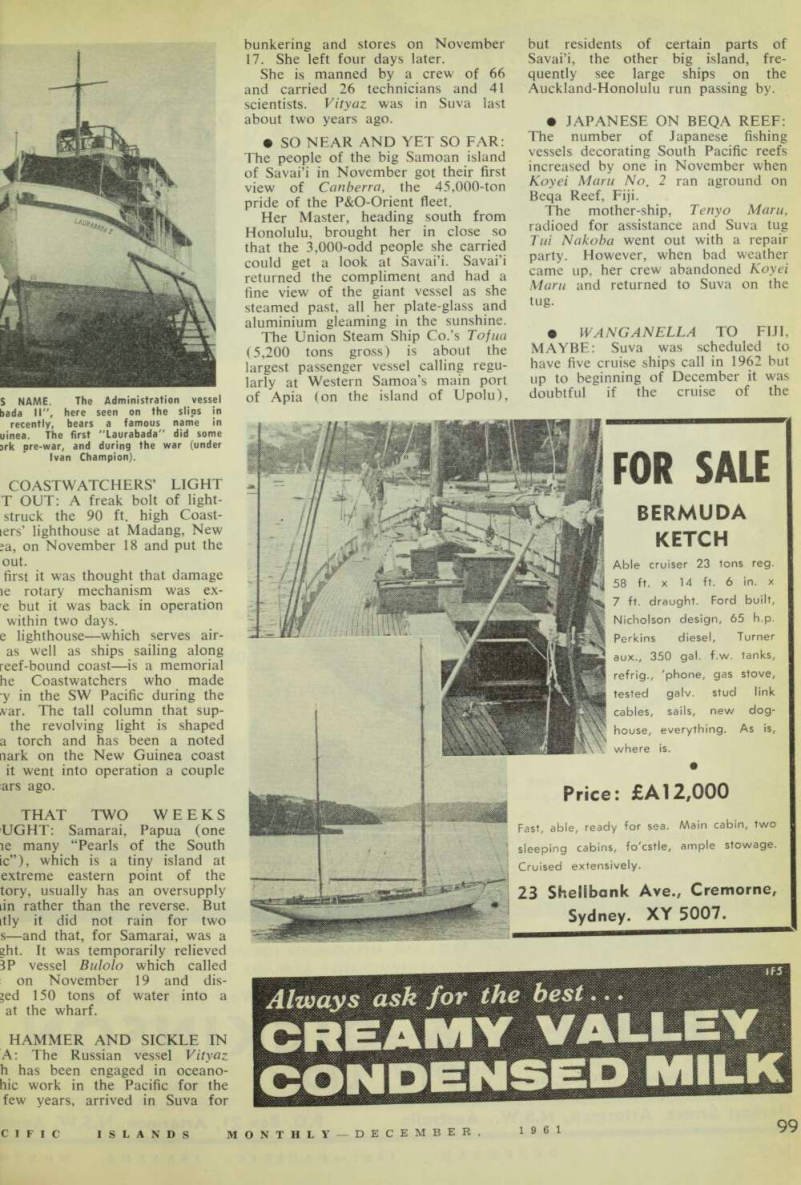
[?]S NAME. The Administration vessel [?]bada II", here seen on the slips in recently, bears a famous name in [/]uinea. The first "Laurabada" did some [?]rk pre-war, and during the war (under Ivan Champion).
>-Tasman passenger vessel Wan lla would be carried out as origin planned (Suva July 9-10, 1962). anganella, which has become vn to a generation of trans nan trippers, was part of one of :ralia’s take-overs in the last year her arrangements for a while : difficult to sort out. Bitumen Oil Refineries Ltd. took over dart Parker Ltd., her original ers, some months ago. Bitumen Oil then sold Wanganella to Mc aith McEachran but this firm still loyed Huddart Parker Ltd. as its for running the vessel, t end of November Mcllwraith appointed the Union m Ship Co. of NZ general pas er and cargo agents and an iced that the vessel would not be drawn from the Tasman service December 26, as previously an nced. Wanganella will continue in service, but the fate of the Fiji ■winter cruise is not so certain, t was announced by Huddart cer before they were taken over; new owners of the vessel may or r not go on with the plan.
• Tenders For Runic: The
w Savill shipping company will in tenders shortly for purchase of Runic as she lies on Middleton f, about 120 miles north of Lord
Howe Island. Runic has been there since February 19, 1961, when she went up in bad weather. Tremendous efforts were made to get her off but to no avail.
Subsequently, a company, Botany Bay Shipping Co., sent men out to board her. According to them, Shaw Savill had abandoned her; they said they were representing a Far Eastern salvage company and that they would refloat her.
Shaw Savill disputed their right to be on her, claimed that they were trespassers and stated that they were satisfied that Shaw Savill were still the owners. No legal action was taken to eject them but after the Botany Bay men had been there for some time, they packed up and left.
It is assumed that they found that they could not refloat her.
Replacement cost of Runic is esti mated to be £2,000,000 and she may be worth, as scrap, between £250,000 and £500,000.
Another Shaw Savill vessel that won’t be seen any more in the Southern Hemisphere after March is the Dominion Monarch. This 26,000 tons vessel was built in 1939, and at 22 is considered too old to be
NEW HEBRIDES SCENE. This is all that was left of the small New Hebrides trading vessel "Tebakor" recently (owned by M. A.
Houdie, of Vila) after she had broken up on Tanna while Mr. Reece Discombe was attempting to salvage her. Mr. Discombe almost had her in the water when the sea changed and smashed her to pieces.
"Tebakor" was in the news in July when she drifted for 12 days while en route from Erromanga to Vila with 11 men and two women aboard. Photo below, also taken by Reece Discombe, shows the British Administra tion touring vessels "Mangaru" and "Euphrosyne II". Both were constructed this year.
iomic under present day con ns. le was built for the Southampton ley via South Africa service and pt for war service has been con :ly on this run. In these days i the accent is on One-Class, lomy and Tourist travel, perhaps union Monarch, with her all first ; luxury accommodation, could be rded as an anachronism. None iss, people who had the pleasure ravelling on her will regret the rture of this fine vessel from this of the world. hen she reaches Southampton in 1, 1962, she will either be sold e sent to the breakers. Her place be taken by the company’s new assenger vessel, Northern Star, :h leaves the UK on her maiden ige in July, 1962, and thereafter, her sister ship, Southern Cross, make four round - the - world iges a year.
P Ng Wharves “In Turn”:
mse there is only one wharf der available in Papua at present, »orts which want wharves have to their turn. Samarai wharf is be renovated at present (it was ntly rammed by an overseas ), and as Samarai is Papua’s most ortant copra shipping port, this is ddered to be essential. When this k is finished Abau, Marshall oon and Kiruku will “get a go”.
I More Fiji Fish-Freezing:
apanese businessman, Mr. I. Saito, esenting a fishing organisation ed Fiji in November. He was in igating sites for possible fish zing works at Suva or Lautoka. left the Colony for Papeete, iti, on November 19. (Mr. Saito’s ;rprise is not to be confused with Pacific Fishing and Canning Co.’s ect for fish canning at Levuka.)
> Tulagi Delivers A Bus;
re were tense hours during the /ember call of BP vessel Tulagi Norfolk Is. when just about the fie population gathered to see ;ther the island was to have a big r 30-seater bus (the island’s first) whether it would end in the drink, fiiere is no harbour at Norfolk nd and weather conditions on this asion were bad off the Kingston horage. For three days Tulagi ed so badly it was impossible to ;e the bus from the decks and put safely overboard into a lighter, ptain Frank Sadler decided to wait ;rnight for a final attempt and just 2r dawn on November 16 the big was made and the bus finally ched Kingston jetty—much to
everybody’s relief. It had been imported by Mr. I. Hamilton, licensee of the Paradise Hotel, for taking hotel guests on tours.
O Nivanga Delivery: Cap-
tain G. Douglas, Marine Superin tendant of the Gilbert and Ellice Islands Colony was in Hongkong early November with the G&E crew which will deliver the new Colony vessel Nivanga which has been built by the Hongkong and Whampoa Dock Co. Captain Douglas took the former Colony ship Nareau to her new owners in Majuro, Marshall Is., from where he and his crew pro-
ceeded to Guam and flew the rest of the way to Hongkong via Manila, He will now go on leave; the delivery voyage of the new vessel will be under the command of Captain Warrington Strong,
Dthe Long Drift: The Dis
covery on an empty gas-cylinder on Fulaga, one of the remoter of the Lau islands, in the Fiji Group, got a lot more publicity than such an object usually gets.
The Fijians who found it washed up on their beach thought it was a bomb and informed Suva. A RNZAF plane was sent out to look and the empty
ylinder was discovered. What remarkable about it was that it been made by the Danish firm of ingas, and delivered with a large gnment of similar cylinders to tiilean firm in mid-1958. It is imed that during the violent quakes and floods in Chile in last year, this particular cylinder nto the Pacific Ocean and began mg drift to Fulaga. ic story of the cylinder’s drift featured on Copenhagen tele i recently—and no less a person Mr. Thor Heyerdahl was got \ to explain to viewers why it yhat it did.
Medals For Solomon Is
DERS: Two Solomon Islanders ved Royal Humane Society ds recently. They were Habert va, who was awarded the Bronze il and certificate; and Joseph usia, who received a testimonial, muary this year, both were with ather labourers as crew of a eboat unloading cargo from RCS I Queen at Kira Kira archorage, . Heavy seas were running and vhaleboat swamped. Two of the could not swim and one, a deaf , was supported by Aitewa and asia who succeeded in getting him •e. The other non-swimmer was calling for help, and Aitewa im ately went back to him. A g undertow carried both men out a but they were eventually picked exhausted, by a boat launched another ship.
Another Australia-New
NEA SERVICE: The owners of Austasia Line have expressed selves very pleased with the sup-
port they have received from Aus tralian shippers since they began an Australia-PNG-Borneo-Sarawak ser vice with MV’s Matupi and Malacca in May, 1960. Because these vessels went on to Borneo, etc., after dis charging cargo in Territory ports, it had not been possible to carry cargoes from P-NG southbound. However, commencing with the Malacca on its November sailing from Australian ports, two sailings out of three will terminate at Lae, NG, and cargo from Territory ports for Australian dis charge will thereafter be accepted.
• Crusader Gets Going:
MV Saracen, owned by the Crusader Shipping Co., arrived in Vila, New Hebrides, on November 16 and opened a new link with New Zealand.
Saracen and the other ship of the line, Crusader, will maintain a service between Auckland and San Francisco with calls at Vila, New Hebrides, and Noumea, New Caledonia. General cargo, refrigerated cargo and timber will be carried.
News of Cruising Yachts
• DOROTHEA, the 31 ft. cutter sailed lonehanded by Peter Tangvald of the Royal Norwegian Yacht Club, arrived Honolulu in November; he was 28 days out from Tahiti. • VAIJERA, the 30 ft. ketch owned by James Friedrichsen, also arrived in Honolulu from Tahiti about the only two new arrivals in a month that turned usually blue Hawaiian waters cold, grey and wind swept and did not encourage yacht cruising. • VALKYRIE, which for a num ber of years has been used for charter work in Hawaii by skipper Fred
Ericson, erupted into flames in mid- November off Barber’s Point, Oahu.
The vessel burned too quickly for those on board to get to life jackets and one passenger was drowned be fore a US destroyer from nearby Pearl Harbour could get close enough to pick up survivors. Cause of the fire is unknown. • UTOPIA: A letter from Fred J. Peterson, owner of this big 65 ft. schooner which was seen in Tahiti, Samoa, Tonga, Fiji and the Solomons a few years ago in the course of a long round-the-world voyage, fixes his address as Sturgeon Bay, Wisconsin, where his business interests are.
Utopia was of unconventional design, having steel bottom and wood top
Marika Natavua displays the gas [?]er that apparently floated to Fiji from [?]South America. See story above.
Photo: Rob Wright
The cruising Alexander family—Larry, Margaret and son, Johnny—as they arrived in Sydney in November aboard “Sea Fever". In the top picture, marine authorities take an interest in the vessel after she passed un identified through Sydney Heads.
Photos: “Sydney Morning Herald"
that paid dividends in her three circumnavigation from Novem -1956, to October, 1959.
WANDERER. —This must have old home month—we have a from Spike Africa, too. Erst- Mate of the schooner Wan , he reports from a caravanserai le name of No Name Bar, in ilito, California (it’s near San :isco), and says that it’s the t of artists, writers and sailors that he has introduced the PIM em. He is longing for the South sends greetings to many friends n he met all the way from etc to Sydney and says that plans n hand for a return at an early SEA FEVER and the cruising ander family arrived in Sydney November 12, 2i years and 10 miles out from their home of Los Angeles. The Alexanders rry, Margaret and son Johnny, imehow missed the who-goes flag signal from South Head m and having failed to identify selves sailed into Sydney Har to a bigger reception committee ustoms and police launches than ly turn out for a yacht. When as straightened out, Sea Fever ored at Cruising Yacht Club of ralia moorings in Rushcutter Johnny is now going to school •cubic Bay and Larry hopes to a job as school teacher ashore ■naybe a year until this family, has lived on its yacht for five ;, is ready to move off into the in Ocean.
TE MATANGI and Jack and lies Ferguson came back into the ing news in November after an tice of about a year. They have holed-up in Auckland during time although Jacques had a
trip back to the United States to settle on some schooling for their young son. According to these American yachtsmen, who were with us a lot in PIM a couple of years ago, New Zealand right now is a fine place to recoup finances —there is a surplus of jobs going. The Fergusons left Russell, NZ, for Fiji in mid- November but after cruising those waters for a while (and in the hurri cane season, forsooth), will return to Auckland, maybe to do some per manent recouping. • MARINER, originally from Seattle, USA, was sold in Auckland a couple of months ago to John and Joyce Dean, of New Zealand, who are experienced yachtsmen and ex pect to do more of it in their latest acquisition. • CEST LA VIE, the 23 ft.
Sydney sloop, sailed by Lyall Price and John Pyke, arrived in Nelson, New Zealand, at end of October after a three-weeks Tasman crossing. Their ultimate destination is Tahiti. • PERSONALITY: In Sydney for three days during the November stop-over of the Matson ship Mon terey was Captain Fred Lawton who knows more about why America has remained unbeaten in the America’s Cup races than anyone else. He was in great demand with local yachtsmen and in a half hour television inter view gave them some sort of idea what they are up against next year when an Australian yacht will make a bid for America’s Cup. He was sailing master of the Colombia in the last series in 1958, but at the moment Captain Lawton is the fellow who teaches Monterey passengers naviga tion and seamanship, if that’s the way they feel ( PIM October, p. 106) Whatever you may think about this, at least it’s a change from the in evitable housie-housie and Scottish dancing with which some other ship ping lines entertain their customers. • PATAPSCO 11, 43-ft cruising yacht of New York reached Rabaul late October in an eastwards circum navigation of the world. Because owner-skipper Robert Murray has chosen an unusual direction for this, New Guinea was his first South Paci fic island. After Rabaul he will visit BSIP, Samoa and probably Tahiti.
Murray left New York in 1959, sailed to Norway via Iceland, then cruised the coast of Spain to the Mediterranean. From the Mediter ranean his course has been Suez Canal, Red Sea, Indian Ocean, Singa pore, Sandakan, Hollandia, and Rabaul. With him currently as crew are Norwegian Gunnar Sorbo and American Fred Romney.