Fiji Raintree
pp. 55-57 · Read in the full issue
hey All Want The Fiji Raintree
By a Staff Writer
Raintrees, which were first introduced to the tropical *ic Islands early in the last century by missionaries and r s> have now taken on an importance beyond that of beino rnamental shade-tree.
imber has become an item of imerce and, so far as Fiji is Jd, a matter of controversy those who want to do some ith it on the spot and some iterests who want to export log. awaii, which first exploited led brown and yellow timber, ed Monkeypod and the bowls, d other items that are made have been built into a large met to the tourist industry.
Hawaiian Demand iian demand soon outstripped urces of supply of the raw and manufacturers turned to ppines, and, more recently, to •out 73,000 su. ft of raintree ;re exported from Fiji to _n 1959; in 1960 exports shot >O,OOO su. ft, and the first six of this year shows another :rease. r ago, a section of the Whan :tion Co., of Suva, under the direction of Mrs. Matilda >n, began manufacturing nd trays from the wood for illy. At current rate of pro file company is using about m. ft of raintree timber per If the overseas market for hed article goes on develop
ing, they could soon be requiring twice that amount of timber.
How long can Fiji’s relatively small stands of raintree take this rate of cutting? The guess is that all the timber could be cut out in a few years. In late October, Mr. D.
Brewer, of the Fiji Forestry Depart ment, was setting out to try to find the answer to how much and how long by making an aerial survey. It could be that as a result of what he finds, a recommendation will be made to the Government to restrict exports.
At present, most of the raintree stands are on private land and no plan for controlled cutting can be made.
Apart from the two firms exporting the logs to Hawaii, everyone is agreed that it is better to use what trees there are right there in Fiji. There are probably a score of men employed under Mrs. Emberson’s direction manufacturing bowls, trays and tables. A new routing machine has recently been imported and with it bowls and trays of irregular leaf design are now being made, as well as the circular bowls, trays, etc., which are turned up on a lathe.
The Fiji articles sell for less than the Hawaiian and Mrs. Emberson has had customers from all over the world. Even the small coffee tables, which are made of a slice of rain
tree, with an inlaid map of the Fiji Group in the centre, can have their legs screwed out and be posted as an 11-lb parcel.
As a sideline to the raintree busi ness, an old fellow sits out in the factory yard carving Easter, Island figures and Polynesian tikis for other satisfied customers. This may not be primitive native art, as the native
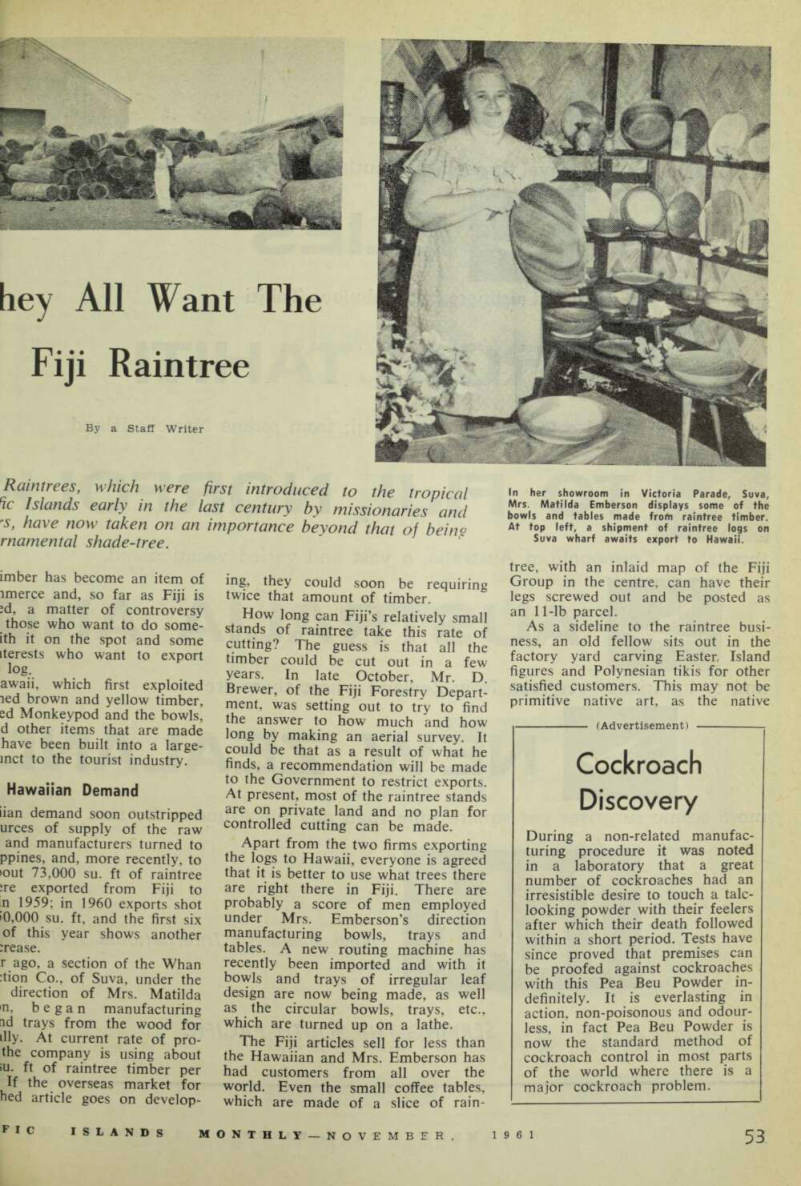
In her showroom in Victoria Parade, Suva, Mrs. Matilda Emberson displays some of the bowls and tables made from raintree timber.
At top left, a shipment of raintree logs on Suva wharf awaits export to Hawaii.
rs of New Guinea’s Sepik River it, but American tourists, who assionate about these things, are s happy with the carvings that from Suva. : raintree (Sa mane a saman ) is ed to be a native of tropical America and was probably lit to Fiji with the early mis ies before 1840. It will grow • everywhere in Fiji but the is much better when produced s dry side of Viti Levu. iropagates quite readily from ind in the right conditions pro a millable tree in 25 years. :a’s famous avenue of rain which was partly cut down a ars ago to make way for road ements, was 50 years old at ne. Being able to fix the exact these trees enabled forestry to make valuable calculations the local growth-rate of the trees grow in other islands of cific. Some of the best speci from a shade-tree point of ire at Madang, New Guinea, they were planted by the Ger arly this century, e demand for raintree timber continue, the planting of the 5 a long term plantation crop 1 South Africa, farmers plant ie of their land with the Aus eucalypts—might be worth ring. There are large areas of canal, BSIP, for example, that latively the same annual rain the dry side of Viti Levu and he utilisation of land is virtu al present.