Territories TALK-TALK
pp. 49-53 · Read in the full issue

With Tolala
As was to be expected the Soviet and its henchmen launched the usual smear campaign in the United Nations Trustee Committee on Australia’s work in New Guinea when the latest report on trustee territories came up for debate. Their criticism has followed such a set formula of condemnation over the years that other members of the Committee have grown accustomed to a series of false accusations.
PRIME Minister Menzies in reply ing to a Dorothy Dix from Wentworth, MHR, in the House re cently said, “The record of this country in New Guinea and the Mandated Territory of Papua is a magnificent record.”
Russia and its satellites are not so much concerned about Papua as they are about New Guinea; nor is Papua a “Mandated Territory”. Surely a Public Servant preparing the Prime
Minister’s reply should have been aware of that, even if Mr. Menzies did not realise the difference be tween an Australian territory and one under mandate to the League of Nations.
Canberra’s annual cornucopia spills out lavish largess to Papua, while New Guinea has to come, practically, cap in hand for crumbs from the Master’s table. And despite the fact it is by far the greater producing and revenue-earning portion of the amal gamated Territory.
Remarks made in the recent Legco meeting emphasise this preference.
Education Director Roscoe quoted UN critics as saying: “We give far too much attention to Papua and not enough to New Guinea.” And MLC Downs in quoting disproportionate expenditure on engineering works and service to the Central District of Papua, remarked: “Centralisation will never develop the country, es pecially if it is the wrong place.”
Well Deserved Credit I was glad to read of Director Roscoe’s remarks in the Legco Sep tember meeting crediting the Christian missions for their great work in edu cating the natives of both Papua and New Guinea.
So often these days the Govern ment wants to grab all the kudos for the results of civilising influences which are now becoming more ap parent as the years go by. And this is anything but fair for those pioneer ing missionaries.
Speaking personally, I recall events of some 50 years ago. As a lay mis sionary with the Methodists in Ger man New Guinea, besides being the mission printer, I was a tutor in the George Brown College at Watnabara, in the Duke of York Group, where the standard of education then would be rated particularly high even in these days. (Over)
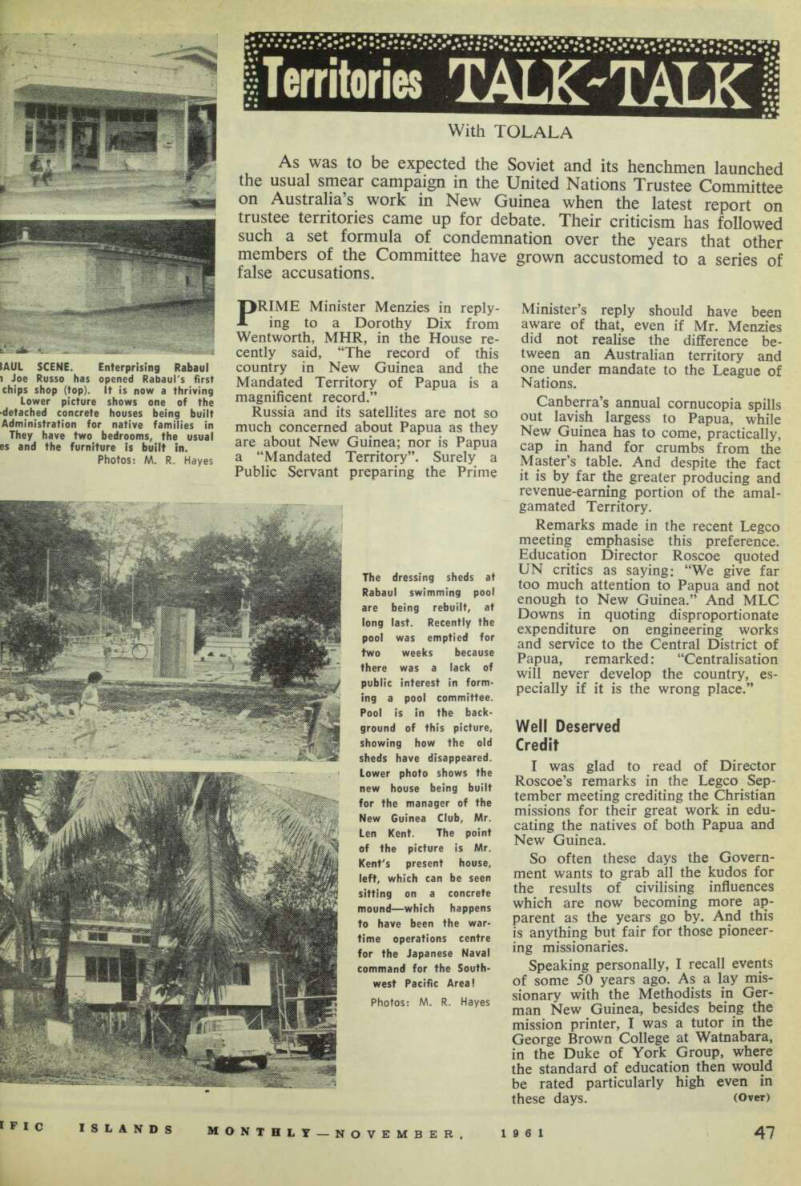
[?]AUL SCENE. Enterprising Rabaul [?] Joe Russo has opened R abaul's first chips shop (top). It is now a thriving Lower picture shows one of the detached concrete houses being built Administration for native families in They have two bedrooms, the usual es and the furniture is built in.
Photos: M. R. Hayes
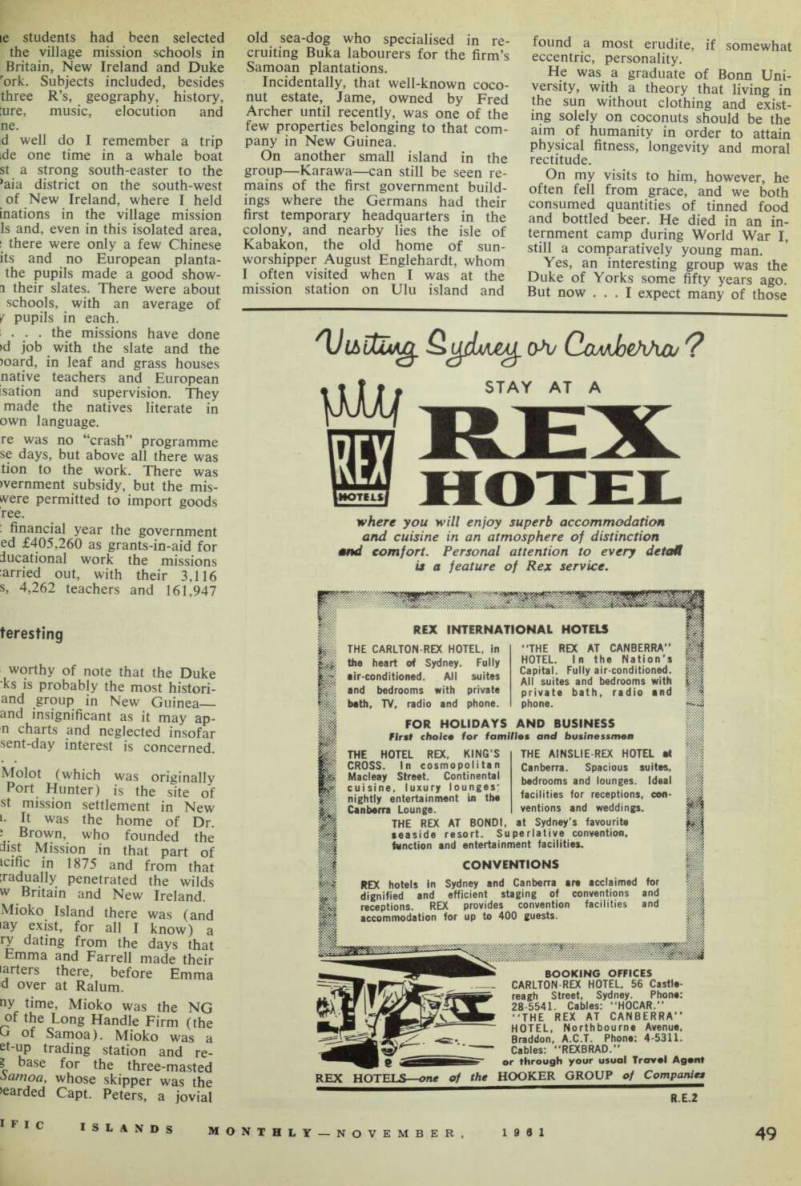
The dressing sheds at Rabaul swimming pool are being rebuilt, at long last. Recently the pool was emptied for two weeks because there was a lack of public interest in form ing a pool committee.
Pool is in the back ground of this picture, showing how the old sheds have disappeared.
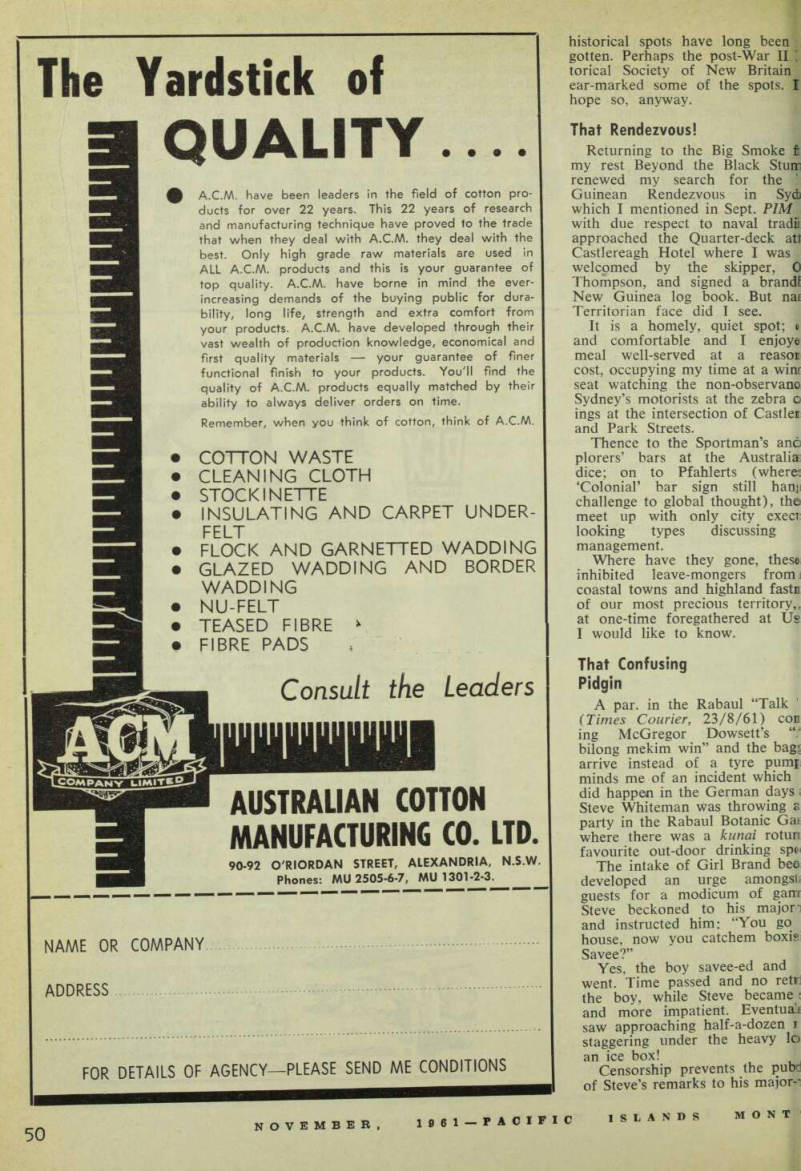
Lower photo shows the new house being built for the manager of the New Guinea Club, Mr.
Len Kent. The point of the picture is Mr.
Kent's present house, left, which can be seen sitting on a concrete mound—which happens to have been the war time operations centre for the Japanese Naval command for the South west Pacific Area!
Photos: M. R. Hayes
ie students had been selected the village mission schools in Britain, New Ireland and Duke r ork. Subjects included, besides three R’s, geography, history, ture, music, elocution and ne. d well do I remember a trip de one time in a whale boat st a strong south-easter to the *aia district on the south-west of New Ireland, where I held inations in the village mission Is and, even in this isolated area, : there were only a few Chinese its and no European planta the pupils made a good show i their slates. There were about schools, with an average of / pupils in each. ... the missions have done »d job with the slate and the )oard, in leaf and grass houses native teachers and European isation and supervision. They made the natives literate in own language. re was no “crash” programme se days, but above all there was tion to the work. There was wernment subsidy, but the mis were permitted to import goods fee, ; financial year the government ed £405,260 as grants-in-aid for ducational work the missions :arried out, with their 3,116 s, 4,262 teachers and 161,947
teresting
worthy of note that the Duke ks is probably the most histori and group in New Guinea and insignificant as it may ap n charts and neglected insofar sent-day interest is concerned.
Molot (which was originally Port Hunter) is the site of st mission settlement in New i- It was the home of Dr.
' Br own, who founded the aist Mission in that part of icific in 1875 and from that iradually penetrated the wilds w Britain and New Ireland.
Mioko Island there was (and iay exist, for all I know) a ry dating from the days that Emma and Farrell made their larters there, before Emma d over at Ralum. ny time, Mioko was the NG of the Long Handle Firm (the C of Samoa). Mioko was a et-up trading station and re ? base for the three-masted oamoa, whose skipper was the >earded Capt. Peters, a jovial
old sea-dog who specialised in recruitmg Buka labourers for the firm’s Samoan Plantations.
Incidentally, that well-known coconut estate, Jame, owned by Fred Archer until recently, was one of the few properties belonging to that company in New Guinea On another small island in the group Tarawa—can still be seen remams of the first government buildmgs where the Germans had their first temporary headquarters in the colony, and nearby lies the isle of Kabakon, the old home of sunworshipper August Englehardt, whom I often visited when I was at the mission station on Ulu island and
found a most erudite, if somewhat eccentric, personality He was a graduate of Bonn Uni versity, with a theory that living in the sun without clothing and exist ing solely on coconuts should be the aim of humanity in order to attain physical fitness, longevity and moral rectitude, On my visits to him, however, he often fell from grace, and we both consumed quantities of tinned food and bottled beer. He died in an in ternment camp during World War I still a comparatively young man.
Yes, an interesting group was the Duke of Yorks some fifty years ago But now ... I expect many of those
historical spots have long been gotten. Perhaps the post-War II ‘ torical Society of New Britain ear-marked some of the spots. I hope so, anyway.
That Rendezvous!
Returning to the Big Smoke t my rest Beyond the Black Stum renewed my search for the • Guinean Rendezvous in Sycb which I mentioned in Sept. PIM with due respect to naval tradit approached the Quarter-deck att Castlereagh Hotel where I was welcomed by the skipper, 0 Thompson, and signed a brand!
New Guinea log book. But nai Territorian face did I see.
It is a homely, quiet spot; « and comfortable and I enjoye meal well-served at a reason cost, occupying my time at a wint seat watching the non-observano Sydney’s motorists at the zebra o ings at the intersection of Castlei and Park Streets.
Thence to the Sportman’s and plorers’ bars at the dice; on to Pfahlerts (wheree ‘Colonial’ bar sign still hanji challenge to global thought), the meet up with only city_ execi; looking types discussing management.
Where have they gone, these, inhibited leave-mongers from i coastal towns and highland fastn of our most precious territory,, at one-time foregathered at Us I would like to know.
That Confusing
Pidgin
A par. in the Rabaul “Talk (Times Courier, 23/8/61) con ing McGregor Dowsett’s ‘V bilong mekim win” and the bag? arrive instead of a tyre pumii minds me of an incident which did happen in the German days < Steve Whiteman was throwing a party in the Rabaul Botanic Gat where there was a kunai rotun favourite out-door drinking spc( The intake of Girl Brand bee developed an urge amongsk guests for a modicum of gam Steve beckoned to his majon and instructed him: “You go house, now you catchem boxisi Savee?”
Yes, the boy savee-ed and went. Time passed and no retid the boy, while Steve became ; and more impatient. Eventual saw approaching half-a-dozen i staggering under the heavy lo an ice box!
Censorship prevents the pubd of Steve’s remarks to his major-i
ious Creek ably the most famous creek v Guinea is Edie Creek. And ;spite its fame, I have come two different methods of spell : name recently, oy Struben’s Coral and Colour Id (PIM, Sept., p. 84) he t Edi; explaining that it is not after some girl-friend but was )y Bill Royal after a certain of bicycle he rode when a on cyclist. ; recently I have been brows ough Errol Flynn’s Wicked, Ways and he spells it Edey. wed Hero" apropos of Errol Flynn, a Sunday paper’s book reviewer ing of Flynn’s book, in the aver edition, refers to him as d, self-accused show-off, the ho hated himself for earning dollars a year posturing in ictures. ... It is an extra / book irritating by its blather tamly dealing loosely with the but from it emerges an c portrait of a flawed hero of times”. : was one thing that impressed le edition of his Wicked Ways published in England by ann. Flynn’s libellous re dout DO Ted Taylor (PIM, y, 1960, p. 15) had been de itirely; the direct result, I un 1, of legal action instituted by inst the New York publishers, ffiat I hear recently it seems 1 if there will be any finality
in the case. But Ted Taylor needn’t worry about his reputation. That is sans reproche, and I think Keith McCarthy made that clear at a Legco meeting last year.
Playing With Fire Orchids to Magistrate F. J. Winkle for his remarks made last month in the Rabaul District Court anent Aus tralian women wearing scanty cloth ing in front of natives. The case was one of a house-boy assaulting a young married woman who was wearing “very short trousers” around the house.
The native was sentenced to two months’ gaol, but was released on a 12 months’ bond because of “inno cent, but mitigating circumstances on the part of the woman”.
Despite the progress we are making in P-NG to eradicate racial prejudices we must not forget that the Old Adam still exists even in house-boys. And this reminds me of a remark made by S. W. Reed, the sociologist, in his The Making of Modern New Guinea (p. 250): The white women look on the boys as hardly human, and sometimes ap pear before them in stages of undress which they would consider extreme in the presence of white men. It seems somewhat strange that the sight of an unclad European female should be sexually exciting to men inured to almost complete nudity among their own women. ... A Gov ernment officer told me of his once being detailed to serve certain papers to a married woman in Rabaul. He went to the latter’s home and knocked on the porch railing. The lady of the house suddenly appeared at the door clad in the flimsiest of negli gees. Her salutation is worthy of note. “Oh, pardon me,” she said, “I thought it was a boy”
Then there was the incident in the early ’Thirties when some of the Bright Young Things of Rabaul started appearing on tennis courts in the shortest of shorts and Judge “Monte” Phillips, an official of the Tennis Club and a keen player, de spite his gamey leg, issued an edict that such costumes could not be worn on the courts. And “Monte” knew his natives.
Magistrate Winkle will, no doubt, be soundly criticised by many of the modern madames, proud of the charms with which Nature has en dowed them, and accuse him of being an old blue-nose, but he is on the right tack and realises that sex de sires know no racial discrimination.
[?]magistrate F. J. Winkle, who has [?]ething to say recently about women scanty clothing in front of natives.
"Tolala" discusses it here.