Pacific Shipping And Cruising Yachts
pp. 101-115 · Read in the full issue
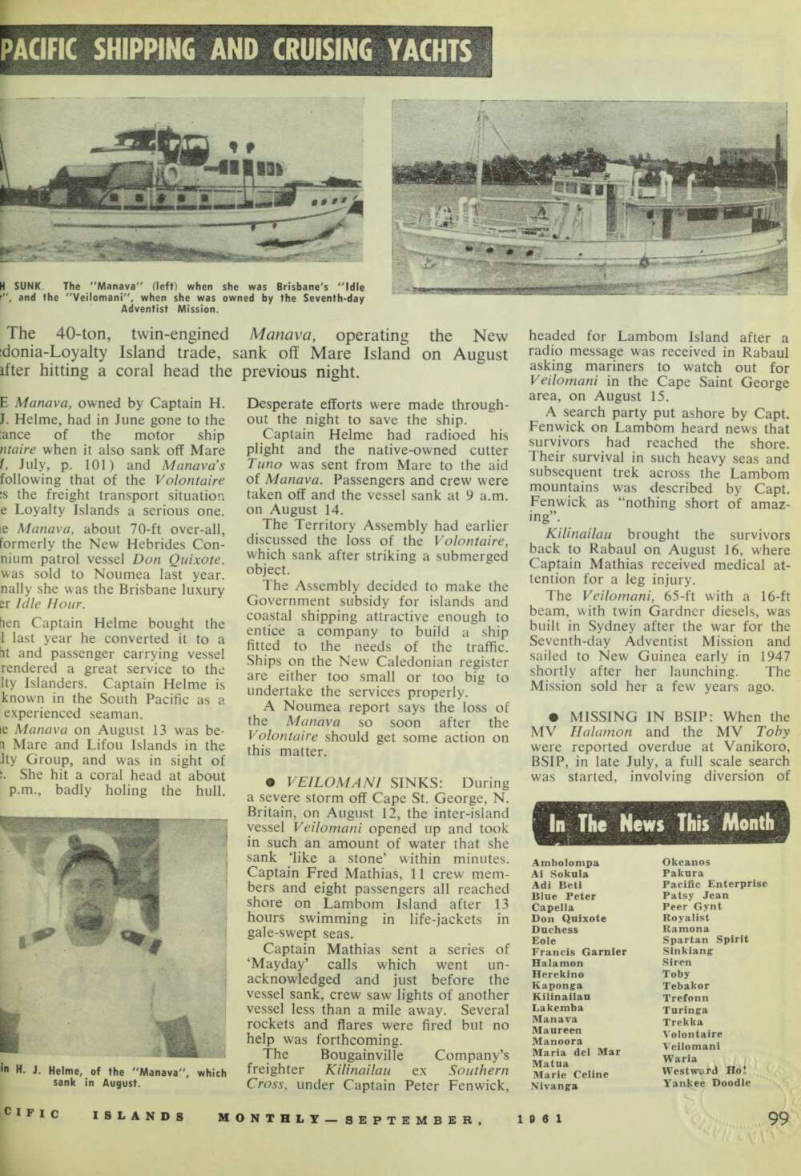
The 40-ton, twin-engined Manava, operating the New donia-Loyalty Island trade, sank off Mare Island on August liter hitting a coral head the previous night.
E Manava, owned by Captain H.
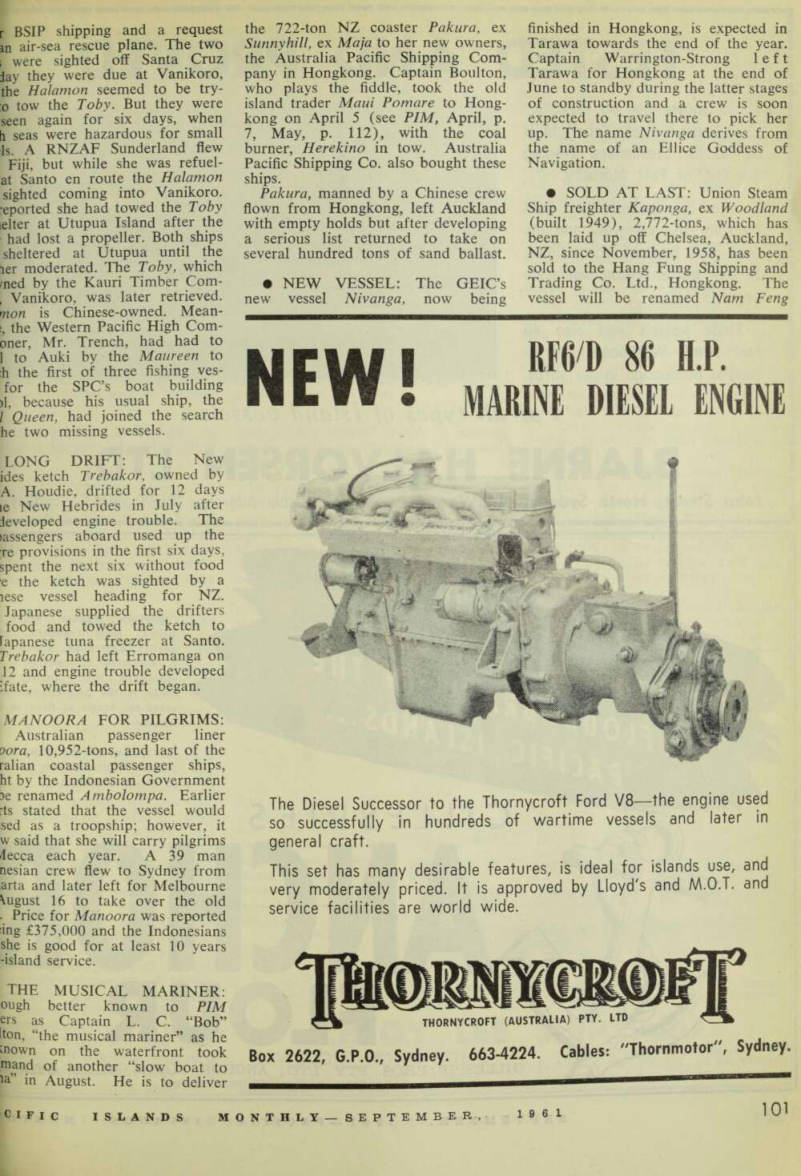
J. Helme, had in June gone to the :ance of the motor ship ntaire when it also sank off Mare t, July, p. 101) and Manava’s following that of the Volontaire ;s the freight transport situation e Loyalty Islands a serious one. ic Manava, about 70-ft over-all, formerly the New Hebrides Con nium patrol vessel Don Quixote. was sold to Noumea last year, nally she was the Brisbane luxury er Idle Hour. hen Captain Helme bought the 1 last year he converted it to a tit and passenger carrying vessel rendered a great service to the Ity Islanders. Captain Helme is known in the South Pacific as a experienced seaman, le Manava on August 13 was be lt Mare and Lifou Islands in the Ity Group, and was in sight of !. She hit a coral head at about p.m., badly holing the hull.
Desperate efforts were made through out the night to save the ship.
Captain Helme had radioed his plight and the native-owned cutter Tuno was sent from Mare to the aid of Manava. Passengers and crew were taken off and the vessel sank at 9 a.m. on August 14.
The Territory Assembly had earlier discussed the loss of the Volontaire, which sank after striking a submerged object.
The Assembly decided to make the Government subsidy for islands and coastal shipping attractive enough to entice a company to build a ship fitted to the needs of the traffic.
Ships on the New Caledonian register are either too small or too big to undertake the services properly.
A Noumea report says the loss of the Manava so soon after the Volontaire should get some action on this matter.
0 Veilomani Sinks: During
a severe storm off Cape St. George, N.
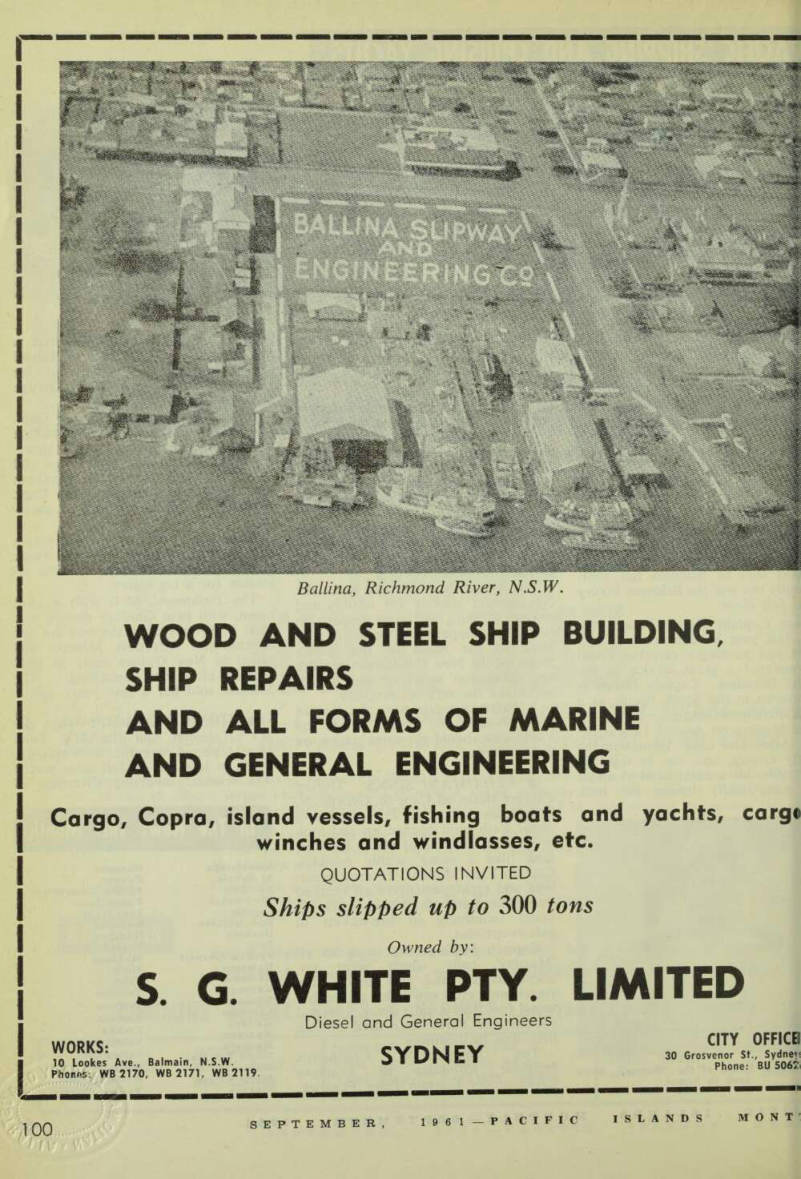
Britain, on August 12, the inter-island vessel Veilomani opened up and took in such an amount of water that she sank ‘like a stone’ within minutes.
Captain Fred Mathias, 11 crew mem bers and eight passengers all reached shore on Lambom Island after 13 hours swimming in life-jackets in gale-swept seas.
Captain Mathias sent a series of ‘Mayday’ calls which went un acknowledged and just before the vessel sank, crew saw lights of another vessel less than a mile away. Several rockets and flares were fired but no help was forthcoming.
The Bougainville Company’s freighter Kilinailau ex Southern Cross, under Captain Peter Fenwick,
headed for Lambom Island after a radio message was received in Rabaul asking mariners to watch out for Veilomani in the Cape Saint George area, on August 15.
A search party put ashore by Capt.
Fenwick on Lambom heard news that survivors had reached the shore.
Their survival in such heavy seas and subsequent trek across the Lambom mountains was described by Capt.
Fenwick as “nothing short of amaz ing”.
Kilinailau brought the survivors back to Rabaul on August 16, where Captain Mathias received medical at tention for a leg injury.
The Veilomani, 65-ft with a 16-ft beam, with twin Gardner diesels, was built in Sydney after the war for the Seventh-day Adventist Mission and sailed to New Guinea early in 1947 shortly after her launching. The Mission sold her a few years ago.
• Missing In Bsip: When The
MV Halamon and the MV Toby were reported overdue at Vanikoro, BSIP, in late July, a full scale search was started, involving diversion of
[?] SUNK. The "Manava" (left) when she was Brisbane's "Idle [?]", and the "Veilomani", when she was owned by the Seventh-day Adventist Mission.
in J. J. Helme, of the "Manava", which sank in August.
r BSIP shipping and a request in air-sea rescue plane. The two i were sighted off Santa Cruz jay they were due at Vanikoro, the Halamon seemed to be try ;o tow the Toby. But they were seen again for six days, when h seas were hazardous for small Is. A RNZAF Sunderland flew Fiji, but while she was refuel at Santo en route the Halamon sighted coming into Vanikoro. •eported she had towed the Toby teller at Utupua Island after the had lost a propeller. Both ships sheltered at Utupua until the ler moderated. The Toby, which wed by the Kauri Timber Com , Vanikoro, was later retrieved. mon is Chinese-owned. Mean the Western Pacific High Corn oner, Mr. Trench, had had to 1 to Auki by the Maureen to :h the first of three fishing ves for the SPC’s boat building >l, because his usual ship, the I Queen, had joined the search he two missing vessels.
Long Drift: The New
ides ketch Trebakor, owned by A. Houdie, drifted for 12 days le New Hebrides in July after developed engine trouble. The tassengers aboard used up the xe provisions in the first six days, spent the next six without food e the ketch was sighted by a lese vessel heading for NZ.
Japanese supplied the drifters food and towed the ketch to lapanese tuna freezer at Santo.
Trebakor had left Erromanga on 12 and engine trouble developed Tate, where the drift began.
Manoora For Pilgrims:
Australian passenger liner oora, 10,952-tons, and last of the ralian coastal passenger ships, ht by the Indonesian Government 5e renamed Ambolompa. Earlier rts stated that the vessel would sed as a troopship; however, it w said that she will carry pilgrims 4ecca each year. A 39 man nesian crew flew to Sydney from arta and later left for Melbourne August 16 to take over the old . Price for Manoora was reported Jng £375,000 and the Indonesians she is good for at least 10 years -island service.
The Musical Mariner:
ough better known to PIM ers as Captain L. C. “Bob”
Iton, “the musical mariner” as he aiown on the waterfront took mand of another “slow boat to to” in August. He is to deliver
the 722-ton NZ coaster Pakura, ex Sunny hill, ex Maja to her new owners, the Australia Pacific Shipping Company in Hongkong. Captain Boulton, who plays the fiddle, took the old island trader Maui Pomare to Hongkong on April 5 (see PIM, April, p. 7, May, p. 112), with the coal burner, Herekino in tow. Australia Pacific Shipping Co. also bought these ships.
Pakura, manned by a Chinese crew flown from Hongkong, left Auckland with empty holds but after developing a serious list returned to take on several hundred tons of sand ballast.
• New Vessel: The Geic’S
new vessel Nivanga, now being
finished in Hongkong, is expected in Tarawa towards the end of the year, Captain Warrington-Strong left Tarawa for Hongkong at the end of June to standby during the latter stages of construction and a crew is soon expected to travel there to pick her up. The name Nivanga derives from the name of an Ellice Goddess of Navigation, • SOLD AT LAST: Union Steam Ship freighter Kaponga, ex Woodland (built 1949), 2,772-tons, which has been laid up off Chelsea, Auckland, NZ, since November, 1958, has been sold to the Hang Fung Shipping and Trading Co. Ltd., Hongkong. The vessel will be renamed Nam Feng
i Wind) and will be used to timber between the Philippines pan.
IMALL FIRE: Quick action by rs using fire extinguishers pre a small fire spreading on board O-ton Ai Sokula when berthed ller’s Wharf, Suva, on August amage to the inter-island trader was undergoing refit was only
Larbour Master Moves:
Harbour Master, Captain C. has now moved into his new ice on Pilot Point, from where able to see ships approaching my direction. The house was ly occupied by Mr. C. Brew, lie Service Commissioner.
Vharf Face Lift: Suva Is
le only port to improve its ance lately, for completed in for the arrival of the NZ lor General on August 12, were rements to the wharf and ns shed. Old galvanised iron I has been replaced by iium and road sealing and tree ig has been carried out.
MAIDEN VISIT; Pacific Trans -td.’s SS Lakemba, made her ill at Apia, end of July, when rought passengers and a deck of timber consigned to Morris om Ltd. The 4,800-ton vessel 9 passengers aboard many of complained about the lack of linment there and the local system. It has been suggested all shipping companies and be supplied with a leaflet ex
plaining the “points” system in Samoa which could be distributed to pas sengers.
• Geic Improvements:
Work on improving some reef pass ages in the GElC—funds for which have now been approved to the tune of £72,500—wi1l probably begin in earnest next March and take about nine months. A team of Royal Engineers, consisting probably of two officers and six NCO’s, will undertake the work. a schedule for the work released
in Tarawa says the team, after arriv ing in March, will go to Nui in April to improve the boat passage there, while their ship lands explosives at other Gilbert islands. Nui has been chosen as the first island to start work on because it is the most suit able for experiment. In May the team will split and go to Nanumanga and Tamana to blast both passages.
They will improve boat passages in Arorae and Bern in June and July, blast new boat passages on Hull, Gardner and Sydney in September- October, improve the passages at Aranuka and Marakei in November, and return to the UK, the work com pleted, in time for Christmas.
The GEIC Administration says it knows very well that islands other than these have good claims to con sideration when it comes to improved passages. But finance is the thing, and the Colony wants to get as much work done at the minimum expense.
In the light of experience gained from next year’s improvements, a pro gramme of work on other islands may be drawn up.
Meanwhile, Betio Harbour, Tarawa, has seen the final stages of con struction work completed, and re cently a big crowd welcomed the oil tanker Pacific Enterprise when it successfully berthed alongside Betio wharf. It was the first entrance into the harbour of an overseas vessel. • SMALL SHIP: Newest addition to Fiji’s fleet of pleasure vessels is the Adi Beti, sold by the Public
IMPPOVEMENTS. Dredging has begun at the north end of Suva's wharf, in preparation for the work of rebuilding and enlarging the dock area.
Photo: Rob Wright
ks Department to Mr. Robbie >er, of the Hot Springs Hotel, isavu, who plans to run the Adi as an excursion craft to islands ly to Savusavu, which is on Vanua HARD WORDS. West Samoa’s Uy Samoa Bulletin, in its usual ue style, had some critical things ay about the behaviour of some the ratings aboard HMNZS alist, whch brought Viscount ham, NZ Governor-General, to i in August on a farewell visit.
Bulletin commented that it could no reason why the 200 ratings descended on Apia shouldn’t 5 had a good time, but it couldn’t why the men should smash a s of glasses in one club, or why nember of the Shore Patrol ild himself be “completely inated” and try to break down the r of another bar. “We welcome visitors,” said the Bulletin, “but liganism of this nature, particuf from one supposed to be in :ge of the keeping of discipline shore, is lamentable. There were vis and fights among the Shore ■ols themselves. When harassed :ials of the RSA managed to t the troublemakers, fights started i in front and behind the RSA arises . . . and in closing we canhelp compare the behaviours of softly spoken Chinese crew from Chengtu, in port at the same
time, with the barbarous behaviour of some of the crew of HMNZS Royalist” um/CDrD ccomrce.
•. Hovercraft Services.
A Liverpool, England, company has applied for licences to introduce the first hovercraft services (the British designed Hovercraft moves on a cushion of air) linking a number of towns in Britain besides services across the channel. The firm, Star ways, plans to spend £Stg.soo,ooo on the project if licences are provided The cross channel service would link Penzance and London with Dover and Calais, and Harwich with Rotter dam and Antwerp. A model of a Hovercraft ferry designed to carry 500 passengers and 200 motor cars at 100 m.p.h. across the English Channel was the focal point of pub- He interest in the British pavilion at the Sydney Trade Fair in August,
© Fisheries Course: Mr.
Ron Powell, Cooks’ Fisheries Officer, was one of the lecturers for the nine weeks’ course in commercial fishing techniques which began at Tulagi, BSIP, on August 23. About 25 islanders from the BSIP, NNG, P-NG and the New Hebrides are attending. The course is being con ducted jointly by the South Pacific Commission and the Food and Agri culture Organisation, The Fisheries Training centre is conducted along different lines from
the SPC-FAO fisheries training course held in Noumea in 1956. The emphasis is strongly on the practical aspects of fishing, and for each hour that trainees listen to lectures, they will spend days at sea or on reefs learning by actual practice, under the guidance of four instructors, how to make, use and maintain a wide variety of fishing gear. They will also study techniques for preserving fish by salting, drying and smoking.
Three fishing boats have been specially built and equipped for the Fisheries Training Centre by the twenty-four island trainees attending the SPC-FAO boatbuilding course now in progress at Auki, in the Solo mons. These boats are 25-foot cut ters, each equipped with a 12 h.p. air-cooled diesel engine and auxiliary sail. Handling and maintenance of the boats, and elementary navigation, will be part of the instruction given at the Centre. © LESSON: As a result of an accident with a police punt in rough weather off Savusavu, Vanua Levu, Fiji, in July, police punts in Fiji will in future be used only in calm waters and rivers. Assistant Superintendent Peter Harrison, 35, and Constable George Kumar, 28, were flung into the sea when their punt, driven by an outboard motor, was swamped. They were nearly two miles from the shore.
The Superintendent managed to get ashore and reach a village, where he reported that the constable, who could not swim, was still hanging on to the fuel tank of the outboard motor. Villagers went out in a launch but meantime the constable
[?] SLIPWAY. The Vacuum Oil Company's 720-ton tanker "Pacific Enterprise", and W.
Carpenter's inter-island ship "Ai Sokula", are the first large ships to use the new a slipways at the same time since the slips were opened in July. "Pacific Enterprise's" [?]e port is Lae but she moves around the South Pacific. Her master is Captain B. J. tridge. The "Ai Sokula" (Captain Robert Croaker) operates from Suva to Vanua Levu [?]ts and Taveuni. First ship to have the honour of using the slipways was Tonga's "Aoniu". slips were built at a cost of £650,000. The slipway on the left can take ships up to 1,000 tons and the one on the right up to 500 tons.
Photo: S. A. Whippy
ON THE "WARIA". The two men in a small boat who left Lae, NG, in May to sail to Perth ("PIM", July, p. 110) got no further than Port Moresby—in the boat, anyhow. The "Waria" developed engine trouble in Pori Moresby and Charles Hyland and Lee Hall flew to Australia from there. Mr. Hall, who is employed at Lae, returned to Lae aboard the "Soochow" in early August, and this photograph of him was taken aboard.
Photo: Pat Robertson
anaged to reach the shore. Both ?ere injured by coral.
NORFOLK PLANS: An officer 2 Commonwealth Department >rks spent a fortnight on Nor land in August investigating the sealing of roads and the ility of establishing a harbour, fer, he was more concerned he roads than the harbour, and lopes that the visit might mean mite move was at last being to give Norfolk a port of are likely to be unfulfilled, roblem of where to put a decent i place of the present landings igston and Cascades, on oppo ses of the island, has been 51n 8 official minds for so many
years that it is difficult to know when plans were first mooted. Recently there have been hopes that a plan involving hot air (PIM, June, p. 105) could be adopted but this is likely to be a last resort, as it is very expensive. The recent official visitor will make a report on the subject of possible sites for a harbour but there are no plans to get the subject finalised once and for all, and it may still be years yet before any firm proposals are made.
• Rabaul Visit: The Nor-
wegian bulk-ore carrier MV Trefonn arrived in Rabaul in August to put ashore for burial a seaman who died
of a heart attack. The new 13 000ton motor vessel was on a vovaee f ro m Svdnev to rhirm whpn *
"an died Ld th? SCa ‘
mans fam.ly m . ~y . , a , r f^ ues J t * l ® t he f hou d no * bun^ d at sea but should be cre P iatet i °r buried ashore at a convenient port,
. •.Geic Recruiting: The Mv
Sinkiang is this year engaged on the annual recruiting and repatriation of GEIC phosphate workers at Ocean Island and Nauru. She began work in July under charter to the British Phosphate Commission. This year 480 workers are being recruited for
yment at Ocean and Nauru, and orkers are being repatriated.
X)NG SAIL: Fiji’s newest i canoe—the 42-footer built re al Kabara in the Lau Group— ; seen in Suva for the Hibiscus il in late September. She will led the 155 miles from Kabara a, bringing a group of islanders vill perform dances. Greatest t will probably be in the canoe (PIM, August, p. 45).
"Ish Canning Project:
to start a fish canning industry uka, the former capital of Fiji, evealed in August. A company nominal capital of £250,000 is iring the project, of the directors, Suva solicitor, laurice Scott, said Levuka had hosen as the site for the cannery ie it had good wharf facilities, ccess to the fishing grounds and igs near the wharf suitable for iery. He said the fishing ships be Japanese-manned and the s would be Japanese but there be employment for local said shares would be available public and it was not expected here would be any difficulty in I capital. He added that he not say when the company I start operating but fishing s were coming from Japan to o the details of the scheme.
SAD SOUVENIR: Recently on the shores of Lifou Island * Loyalty Group was a bottle ining a message that had been n overboard by lone navigator Clabaut in May, 1960. The
message in the bottle asked the finder to send the paper to the French naval newspaper, Cols Bleues in France.
The bottle, the 86th thrown overboard by the late Guy Clabaut took a year to reach land although it was close to land at South 22 deg. 20 min, and West 174 deg. 41 min. when tossed overboard. At the time Clabaut was making his solitary way around the world in the tiny yacht Eole and suffered great privations on the last stage of the voyage to New Caledonia.
He arrived at Mare island in the Loyalties in an exhausted condition and was flown to hospital in Noumea.
He failed to rally and died in Noumea in August, 1960. His body has since
been returned to his homeland, Morocco. His yacht still lies at anchor in Noumea’s Bai de Moselle. • LAUTOKA WHARF; Letters of protest have been sent to the Fiji Government over the fact that the £H million Lautoka Wharf can still only accommodate one overseas ship at a time. The Government shelved a plan that the north face of the wharf be dredged to 24-feet, although the contractors were still on the job at the time. Lautoka Chamber of Commerce has been asked by the Government to make a “case” for the extra dredging, which would allow ships like Matua to berth at the north face instead of having to lay off in the stream and be discharged by lighters.
The Chamber is reported to be annoyed by the Government’s answer, and also by a strong rumour that shipping interests are not particularly interested in bringing cruise ships to Lautoka, because of the alleged danger in passing a ship tied up at the CSR wharf.
Captain J. Mullins, doyen of Fiji pilots, told PlM’s Lautoka corres pondent, that except in very bad weather, there was plenty of room for any ship, cruise or otherwise, to come to the new wharf.
• French Are Coming: The
Commander in Chief of French Forces in the Pacific, Rear Admiral Martinez, will visit Suva in the French warship Francis Gamier for four days of the Hibiscus Festival on September 19 to 22, Some 170 matelots make up the complement of
KING UP. This is how the "Maria del Mar" looked in August on the reef at Santo, [?] she went aground in March. Captain Frank Sadler, master of BP's "Tulagi”, told [?]" that her back appeared to be broken. The evidence of it seems to show in the photograph.
FAREWELL. Goodbye Sydney! said these Papua-New Guinea nayal ratings when they took the RAN Lighter MRL253 from Sydney to Manus Island, NG in July. Sixteen of them had arrived in Sydney a few weeks previously with a lighter from Manus. ("PIM", August, p. 99). Photo: Sydney "Daily Telegraph"
the French warship which launched in 1936, and has s of 36 knots.
News of Cruising Ya<
© TURING A, 40-ft ketch, by Messrs. J. Crooks, P. Baxt J. Hargreaves, all of Southlan was due to sail from the B 1 Auckland during August on t leg of a world tour. The kes been built during seven years time project for the voyage wh take three years.
• Blue Peter: 63-Ton
can yacht with owner Bill ] his wife and a two-man Phi crew, last reported as being a : sight in Hollandia {PIM, July, was reported in Wewak at t of July. She later went on to ; and then headed for Rabaul, some trouble and was towed Madang. Blue Peter was I Hongkong, entirely of teak, ai Rabaul she intends to sail fon
• Ex Moon Fleet: A
note from Wewak, NG, tells Joe Pachernegg is thinking a on a tour again. Joe am Madang at the end of 1959, a out from Suva in the staysail si Moonfleet, formerly the Ko Hawaii, and began work as fessional seaman. He is ms the MV Rouna Falls, Wewak, renamed the Moonfleet, Q Says Joe: “It’s a name which right out of Homer’s Odyss means the old ocean himself, put a fair amount of work i and she is now almost comple constructed—re-fitted and re
is plenty of room in the 39-ft islander. Now I am making to depart in March next year pan, Hawaii, Tahiti, and perhaps ith America, the Galapagos and )ly Europe. But . . . sail a Df that size alone? Certainly I am looking for a crew now. ne or two red-blooded fellows, ;llows with the right sort of iasm with a few quid in their who are prepared for dis rt, but are willing to do things o places”.
CAPELLA, 43-ft ketch, sailed Roslyn, Long Island, USA, on •0 on a 12,000-mile voyage to Marshall Islands, where she will id to transport Roman Catho ests, medicine and food among ed mission stations. Her pre owners, Mr. and Mrs, Jack will remain aboard to operate lip for the Jesuits. They will erve as lay apostles in the Mar 'ella (meaning chapel) has un ie a four-year refit to make her to operate for a number of without repairs. She is diesel ed, with Neoprene sheeting the entire hull, with fibre glass the cast iron keel of the boat, to will have its own radio
station, built by Binns to receive and transmit commercial traffic. Call sign is WKBG. Route to the Mar shalls will be through the Panama Canal, via Galapagos Islands, Mar quesas, north of Tuamotu Archi pelago to Tahiti, on to Rarotonga, thence to Tonga, Suva, through the Ellice Islands to Tarawa and on to the destination at Majuro Atoll, in the Marshalls. • PATSY JEAN, 28-ft ketch, from Opononi, NZ, cleared Raro tonga for Hawaii on June 10 and after stops at Aitutaki and Penrhyn arrived at Christmas Island on July 9. Patsy Jean is under charter to
Allan McQueen and Brian White of Rarotonga and with them is Amosa Marsters, a Cook Islander. Brian White is believed to be looking for a new boat and is keen to see the catamaran type popular in Hawaii, suitable for ocean cruising. • SIREN, rebuilt trading ketch is being operated around the Cooks by Patsy Jean’s owner Don Silk, and former crew mate Bob Boyd, in an effort to accumulate funds for fur ther cruising. • DUCHESS, a schooner owned and skippered by Mr. Ferris, arrived in Honolulu early in August, 31 days out of Bora Bora. (Over)
[?]hernegg, in Wewak, aboard his staysail [?] "Okeanos" (formerly "Moonfleet") [?]he hopes to take on another cruise far. See page 110. Joe is master MV "Rouna Falls", seen at left, with the "Okeanos" on the right.
RAMONA, sailed by owner m McDougall, also arrived in ilu, in August, 22 days out of iva.
REKKA, a yawl skippered by Cuzwell, accompanied by his daureen, arrived for a short Honolulu before returning to linland in August where Guz lans to sell Trekka and build ing larger.
VESTWARD HO!, 53-ft yacht cruised the South Seas a few igo has been sold in Honolulu (oung preacher who plans to is large family to the remote )f the Pacific to spend his time ting the natives. He has never »t on a boat before. Westward a highly developed racing le, will make an unusual sight the copra schooners.
MARIE CELINE, a schooner y in Tahiti, has been sold to Barkhorn of Honolulu.
Prans Pacific Race, The
yacht classic from Honolulu, ed outside entries from the Navy, Japanese Government rom Canada. Australian-built Peer Gynt, owned and skip
pered by Gordon M. Morrison of San Francisco YC finished 10th in her Class and 40th in the fleet of 41. Winner of Class A, was the 66-ft cutter, Nam Sang of Newport, while Class B was won by Ichiban, 50-ft sloop; Class C, by Nalu 11, 46-ft sloop; and Class D, by Vamonos, 36-ft sloop.
• Yankee Doodle, 40-Ft
American yacht on a two year pleasure cruise, hit Belcher’s Rocks, off Makuluva, about 10 miles from Laucala Bay, early on the morning of August 22. The steel-hulled yacht, sent out a distress signal to VRO Suva, and an RNZAF launch left
Laucala Bay to take the yacht in tow.
Later, the Pilot launch Seniceva took over.
Skipper, Mr. Jack Marston, his wife Diana, 11 year old daughter Dale, and a New Zealand couple, John and Marilyn Smith who joined Yankee Doodle in Honolulu, were aboard the yacht when she struck the reef and was carried over.
When the yacht hit, a steel cleet pierced Mr. Smith’s foot causing a deep wound. Later in Suva, the Yankee Doodle was to be put on the slipway to assess damage. She did not take in any water after she hit.
Next call after Suva for the yacht will be Auckland.