Whales Of
pp. 87-99 · Read in the full issue
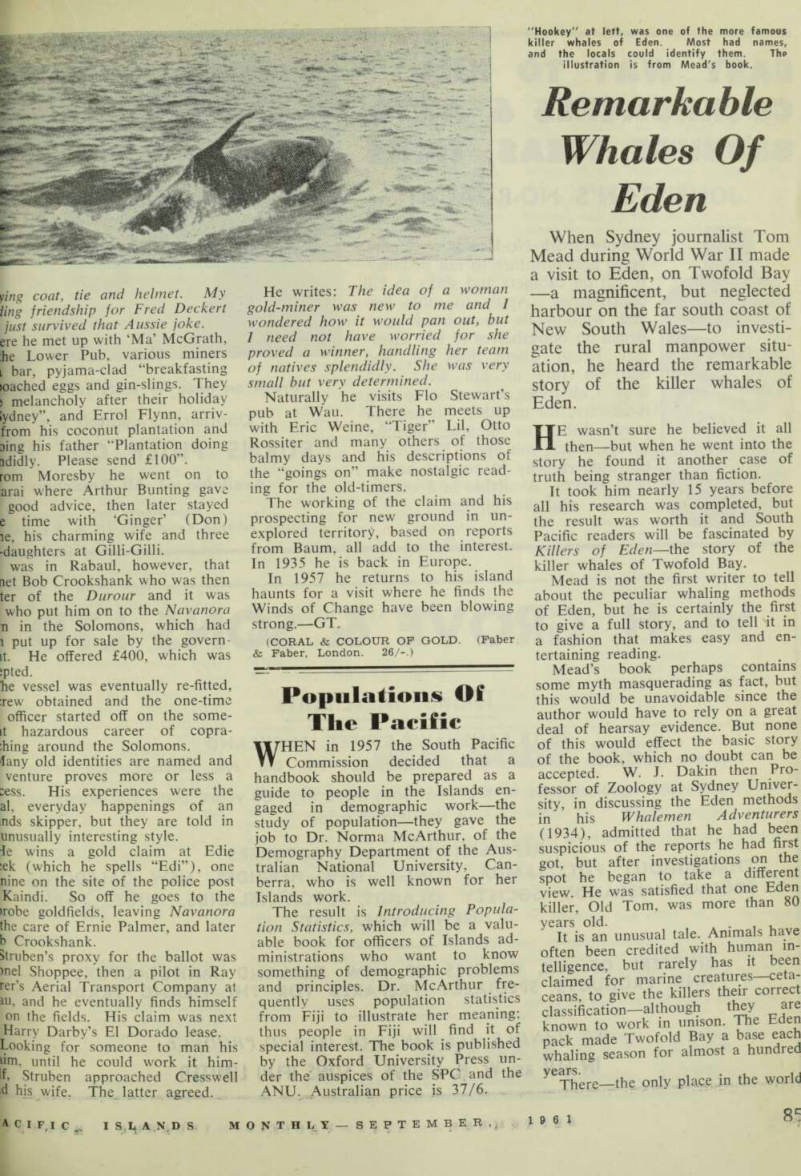

Remarkable Whales Of Eden
When Sydney journalist Tom
Mead during World War II made a visit to Eden, on Twofold Bay
—a magnificent, but neglected
harbour on the far south coast of New South Wales —to investi gate the rural manpower situ ation, he heard the remarkable story of the killer whales of Eden.
HE wasn’t sure he believed it all then —but when he went into the story he found it another case of truth being stranger than fiction.
It took him nearly 15 years before all his research was completed, but the result was worth it and South Pacific readers will be fascinated by Killers of Eden— the story of the killer whales of Twofold Bay.
Mead is not the first writer to tell about the peculiar whaling methods of Eden, but he is certainly the first to give a full story, and to tell it in a fashion that makes easy and en tertaining reading.
Mead’s book perhaps contains some myth masquerading as fact, but this would be unavoidable since the author would have to rely on a great deal of hearsay evidence. But none of this would effect the basic story of the book, which no doubt can be accepted. W. I. Dakin then Pro fessor of Zoology at Sydney Univer sity, in discussing the Eden methods in his Whalemen Adventurers (1934), admitted that he had been suspicious of the reports he had first got, but after investigations on the spot he began to take a different view. He was satisfied that one Eden killer, Old Tom, was more than 80 years old. 4 , It is an unusual tale. Animals have often been credited with human in telligence, but rarely has it been claimed for marine creatures—ceta ceans, to give the killers their correct classification —although they are known to work in unison. The Eden pack made Twofold Bay a base each whaling season for almost a hundred —the only place in the world
e it —men used them to hunt s. wadays men hunt whales m big, •ful chaser ships and kill them explosive harpoons fired from The time is past when men put a in oared boats, when they ed to the whales with hand n harpoons and killed them by with lances, and never again he world see men using whales ch whales as George Davidson thers did at Twofold Bay. ! first whaling from the Austra nainland was begun at Twofold in 1828. Benjamin Boyd, who to build a great city on the wes hores of Twofold Bay, at Boyd , considered whaling from the i good enough proposition to e in it extensively later, s story of Benjamin Boyd, and essel, the Wanderer, occasion breaks the surface in Mead’s but the main tale is of the ig Davidson family. >rge Davidson died in 1952, 1 man. He gave up active whal i 1932. Davidson’s father had the killer whales before him. winter, year in year out, they d in the bay and remained un e summer. The killers would ly round up a whale like sheep herd it into the bay, where the f “Rusho” would go up from halemen on Boyd’s Tower, who [ take to their boats and give The whalemen knew the killers ime, and the killers knew the iques of the whalemen. ; killers would head the whales throw themselves over their loles, forcing them up. The i would have their reward when 'hales were lanced and buoyed; would be allowed to feast un ited—ripping out the whale’s es —until the natural gasses i the whale to the surface once i and the whalemen towed it in. £ book is illustrated with photo s, including some of the
5.-
SI.
[iLERS OP EDEN. Published by and Robertson. 28/6.) e Soldiers 9
onen Of
rberl
ERE are two schools of thought about Xavier Herbert’s first r novel since Capricornia —those say it is absolutely brilliant, those who say it is absolutely nprehensible. I am one of those find Soldiers’ Women incompre ble. is incomprehensible to me as to Herbert should have taken 500
pages to write this mixed-up story of Australian women’s reactions to the war and to the absence of their men folk.
Herbert doesn’t identify the city where the action takes place, but it appears to be Sydney, There are few men in the book, and those that are are mostly American servicemen brought in by the Yank Invasion.
There are brothel keepers, soldiers’ molls, straying wives, lesbians, all talking, all taking up page after page of endless dreary detail Those who insist that Soldiers’
Women is a brilliant novel appear to be able to take in their stride Herbert’s peculiar, almost gushing, flowery style. But 500 pages from the beginning I still found it irritating.
West Australian-born Herbert, a one-time Protector of Aborigines in the Northern Territory, won fame with Capricornia before the war.
Seven Emus was a very short short novel published in 1959 and not well received. He was talking about the plot of Soldiers’ Women during the war, and had been working on his masterpiece qver since.
Obviously this is a book readers must make up their own minds about. Those who found Capricornia to their liking, as I did, probably owe it to themselves to read Herbert’s
controversial follow-up.
SI.
(SOLDIERS’ WOMEN. Published by Angus and Robertson. 30/-.)
Pacific Airline
11 ram a THERE was once a vogue for novels about airlines. Ernest K.
Gann, a one time pilot, achieved great success with his novel The High
and The Mighty, which revolved around a possible forced landing in the Pacific. Now in A Cry to Heaven, Scotsman James MacGregor has tried to imitate his success.
A chartered airliner leaves Hono lulu ostensibly on a flight via Can ton, and Noumea for Sydney with 10 passengers aboard, Brunewald, the owner of the American airline, Air safe, is aboard with his girl friends; an actor who played Tarzan on screen; and as rich an assortment of mankind as you would find in a psychiatrist’s waiting room.
Author MacGregor, having isolated his characters in time once the air craft is aloft, then sets about turn ing on the tension, with the discovery
ime cheesecake photographs in ;wald’s briefcase. >n the passengers discover to dismay, that Brunewald has no ion of taking them to Sydney, as virtually hand picked them— pped them—in an effort to stop -bomb test in the Pacific near iokimoko Atoll. inewald, disclaiming a political ion, merely maintains that he rdered the crew to fly the plane * Test Zone, as a token protest 5t further H-bomb explosions. the plane circles the area, r McGregor, using a literary de ls old as time, probes into the of his characters, and reveals to be a murderess, another a homaniac, a member of the to be homosexual, like Ernest Gann, MacGregor to create any tension on board irliner, and the average reader’s st will be lost well before the
)f his book.-
AF.
CRY TO HEAVEN. Published by nann. 20/-.)
0 Novels Of
i. Australia
lOUGH the eyes of five-year )ld Elizabeth Ingefell, author :es Margaret McGuire attempts create the Australia of 1901 in irst novel September Comes In. •ugh she has done research in ffort to make the background ntic, the novel fails because it action of any kind. It has no interest than a faded photo -1 in an old family album. ic could almost make this novel ;t book for a course in “What’s g with the contemporary Aus n novel?” r it is no more than a genteel oot of English Romance Fiction, its Aunt Emma Woodstocks, Drdshire tea sets, and Captain -Bossinghams. le story opens in Adelaide, at the of the century, when Elizabeth’s ly moves from the Outback to seaside. ielaide, perhaps once the most capital city in Australia, con is of the fact that convicts were r transported there in Colonial , is revealed as having a class cious Edwardian society apeing inglish betters. trough Elizabeth, we are taken ummer garden parties, on a ride stage coach, see the Royal Visit the occasion of Federation and on an Australian picnic, ut author McGuire has failed to her characters “reality”. Adelaide r have been Edwardian, but some
of its population no matter how refined still possessed ambition and greed or a sense of humour and a sex life.
If Miss McGuire meant to write a satirical novel I feel she has failed through being too close to the object of her satire.
Another novel this month set in South Australia is The Living Come First by “Jack Danvers”. Dealing lightly with the assimilation problems of half-caste aborigines, the novel concerns the murder of the daughter of a station owner in the Outback. As the prose style is obviously feminine, we suspect “Jack Danvers” to be Camille Caseleyr, who holds the copyright of the book.
Two half-castes, Jack Austral and Cherry, are brought to Kurdnatta cattle station as children and grow up as one of the family. The station owner’s daughter, Thelma Craig, treats them as brother and sister until she goes south to Adelaide and mixes with “white society”.
She returns to the station, prior to going to the University, and shows her distaste for their old relationship by carefully avoiding contact with Jack and Cherry, Jack, a sensitive and intelligent young man, resents this slight and goes to Thelma’s room to talk to her. An argument flares into a scuffle, a mat slides from under Thelma’s foot and they both land on her bed,
he with his hand on her H Thelma accuses him of tryiii rape her, and says she will tes father.
Knowing that this would cos? his job, Jack cannot believe th;j could be so cruel. Thelma tell;! she will wait until her return to < aide before writing to her fatH tell him of the assault.
She never reaches Adelaide.
Police black trackers are bn to her parked car, to see if the; pick up the tracks of the killer.. it appears that three people visited the scene since the killiJ However, the ending is marrr probably the most improbable
tion imaginable.-
AF.
(September Comes In, 21/-. :
Living Come First, 17/6. Botm
lished by Heinemann.)
Arc Teenagers
People ?
npO future historians charting A downfall of Western man.j of the most interesting phenoc of our time, may well be the evoli of that unseen nonentity, once « a “child” into the vociferous ager . . . the big spender in our bag free enterprise system w by clothing manufacturers, n companies and the makers of : ointment.
Between You, Me and Gatepost, a handbook for teensi by US recording star Pat Boone, i shed some dismal light on the cu nightmare.
Twenty-six year old Boone, w contribution to literature sists of Twixt Twelve and Twet slangy, Salinger type treatises tweenagers, now offers a book v includes chapters entitled “Gettii Touch With Parents”, “Can Thr Love”, “Dating Daze”, “O Steady” and “Are We Old Em To Marry?”
Boone suggests that teenage 11 should ponder on the question “W marriage interfere with my gn before looking for a minister, himself was married at 19.) He produces some eyebrow rr statistics for this side of the PI when he says that recommended ! for homecomings in the US2 childen are: Ages 12 to 14, 11 ages 14 to 16, midnight; ages 18, 1 p.m.
Presumably, by the time the; are 21, they don’t come home as But Pat’s is a message of hop<c he tells the enthralling story off Mickey Mantle, a teenage basr star with the New York Yankees, , came His Problem.
seems that when playing this ive form of cricket in Boston, y “struck out five times in a and cried like a baby. Mickey sred so much that he was ted to the minor league. But iddy told him straight “If that’s e guts you’ve got, you don’t ; in baseball”. ;r that Mickey didn’t blubber ire. He worked until he was again and Boone says “that is American horse sense made f Mantle a champion”, thinks the challenge to youth ’sixties is, not sex, but how id a nuclear war. His advice ive faith in God and our lagers, he says, should laugh as icet the challenge of peaceful tition with the Russians . . . ie all American way for meet ings head-on. And it’s the ous way”.
es, eh.
AF.
(Veen You. Me And The
3ST. Published by the World’s 18/9.)
> Stories Of
rate Lives
SCORE, by Miss Storm meson, and A Private View, 5s Joyce Howard, have some n common—they both tell the if the private life of a man.
Score is set, as the authoress nywhere in the world, but as her characters states, “I don’t it once whether I’m in Greece, , North Africa”. Most readers ump for Cyprus, chief characters in the story • Richard Ormston, Governor colony, his wife Sophie, his Caroline, and his son v. The last named has a girl Sarah Leng, and Sir Richard nistress, Anne Boyd, story tells of revolt against spying power, of ruthless mur d sudden death.
Richard Ormston, the unhappy t of his mother’s upbringing, an who has never put a foot in his whole career and always s right word for the right man ; tly the right moment until he :ed with the dilemma of iy Boyd, Anne’s husband, be tested as the leader of the He allows Boyd to be tortured. 1 Jameson has written so many te novels that her admirers are Suffice it to say that this novel her skill at its best—ingenious, J n .g and beautifully written. nvate View is the story of a kfe, told in a series of cleverly
constructed flashbacks. Alden Moore is old and lives in an Old People’s Home. He is content and at peace despite the occasional clamour and unease Of his fellow-inmates.
As he reflects on his life, through one bright spring day, he relives his failures and successes while working at an orphanage, his compromises with love and his unexpected fulfil ment.
This is Miss Howard’s second novel—the first was Two Persons Singular —and in it she allows free play to her warm compassion without becoming sentimental. It is quite a small novel (224 pages) written in
an easily read style and the sort of book you hate to leave once you
have started to read it.
EN.
(Last Score And A Private View
are both published by Macmillan. Each 20/-.)
Writer With
A Gift
THERE seems no limit to the manifestations of Miss Muriel Spark’s arresting talent as a writer who has the extraordinary gift of being both extremely funny and ex tremely serious at the same time.
Her novels and short stories have
a striking reception both in the *d Kingdom and the United s, and she has recently attracted b with some radio plays specially ;n for the BBC. They are best ibed as dramatic narratives and of them are given in Voices at and interleaved here with six stories. e four plays are very clever— :ularly The Dry River Bed. Miss : uses all the tricks of the trade it her effects, but no one can ; her for that when the resul production is so finished and led. ? Danger Zone was difficult to but would be delightful to listen a radio play. ; six short stories are gems of ity. The character drawing is tating and Miss Spark’s ear for
;ue is superb.-
EN.
ICES AT PLAY. Published by illan. 20/-.)
Good New
riller
fH The Dead Past Miss Jean Scholey makes her debut as a ir-writer. The book is exciting ery readable.
District Commissioner in Tan ka is faced with the murder of landering adventurer from Dar daam—a case of murder for y, or for diamonds? pects are plentiful, in fact all lain characters come under sus i at one time or another. And e clues are there to detect the murder if the reader is wide 5 and not content to have the ry solved for him at the end j book. j climax on the wharves of the East African port, in which the is set, is cleverly executed, ether a colourful, swift-moving use story with characters and round to match an ingenious
EN.
E DEAD PAST. Published by nann. 20/-.)
e Junior
okshelf
ONG the books for the young md the younger available at your shop now are Let It Rain, Every - Is Somewhere, The Roan e r, The Andalusian Guitar, and Valeriane Series. instated from the French, The lusian Guitar by Saint-Marcoux, d make delightful reading for ntelligent 14 year old, curious t the customs of foreign lands, nio, whose father had been killed
in a Corrida des Torros, and whose grandfather had been crippled by a bull, has a burning ambition to be a bull fighter. In Spain, this usually occurs in Andalusian boys who see such a profession as the only means of escape from abject poverty. He succeeds in killing 100 brave bulls.
Let It Rain is by Dorothy Koch, with simple colourful drawings by Helen Stone. It tells the story of a rainy day at home in an imaginative mood for the benefit of kindergarten aged children. Everything is Some where is a companion piece, written and illustrated by Vasiliu, which
draws the distinction between toys and animals and flowers and things that one can touch, and the things that one cannot, such as rainbows.
Everything is somewhere but only God is everywhere is the theme of this attractive work for the same age group.
The Roan Runner is an adventure story for older children. Written by Jane and Paul Annixter it tells about the boy Clem, the Roan Runner, a young stallion, and Poojer the dog —all of them a devoted trio.
And there is a bright new set of small books about Valeriane. There
is a set of six just issued, eac;c a letter of the alphabet promr displayed in their spine (lett; to F in this release) and we pi( the set will eventually incluoj alphabet. Valeriane meets s engine, goes to a carnival, gg sea, etc. The pages are small, < ful and thick, and the type They would make a nice set 1 four-to-six-year-olds.
(The Roan Runner, 15/6. I
Rain, 13/3. Everything Is
Where, 13/3. Valeriane Seri,
Each. The Andalusian Guitaii
All published by Heinemann.)
What’s New in Paper H
There is a first class select' mysteries and thrillers in the> batch of paper-backs, including by Agatha Christie, Ngaio Peter Cheyney, Erie Stanley C and Alistair Mac Lean. Thev one book in the following tith isn’t recommended.
The Sittaford Mysted
Agatha Christie, was first puj in 1931, but this tale of the; seance which rapped out a murder is still fascinating. (For
The Thirteen Problh
another of the earlier models* Queen of Crime, but Miss ♦ gives value for money by pre 13 short mysteries in the on© Miss Marple does the dea (Great Pan).
Poirot Investigated
Agatha Christie again (of cou in the same nature as the n one—ll cases of myster: detection between the same Hercule Poirot does his usus job. (Great Pan).
The Labours Of Hero
by Agatha Christie, is anoti Poirot —and this time we hr tales of detection. They different, and some are ai You’ll pick some of the sod (Fontana).
Surfeit Of Lampreys
detective contribution of Zealander Ngaio Marsh, mist, the macabre, and Lord LampK his family get mixed up murderous doings. The story\ beginnings in NZ and mo London. (Fontana).
Ladies Wont Wait, Bd
Cheyney, is the Cheyney bl< desperate men and dangerous 1 Michael Kells, secret agent, is a chase across Europe. The by the way, are all “lookers”.
Pan).
Ie Case Of The Moth
EN MINK, by Erie Stanley ner, is another classic in the ner tradition of hard-hitting, talking, woman-shy Perry Mason jrs. Fans won’t be disappointed, at Pan). [E SECRET WAYS, by Alistair .ean, was first published a couple ars back as The Last Frontier. ael Reynolds has to kidnap a ist from a Russian scientific rence, but in Hungary he gets gled with the beautiful, dis ig Julia, which makes the job . (Fontana).
E Education Of
M*A*N K*A*P*L*A*N is one onard Q. Ross’ hilarious stories man’s battles with the English ige at the American Night ratory School for Adults. Even determined not to be amused Ive in after the first few pages yman’s incredible murder of . (Great Pan).
Jc Medicine, By D. C.
MD, must hardly be out of overs—yet here it is. The is based on the American ’$ study of the healthy ain folk of Vermont. He comes th cure-all medicines in the of apple-cider, vinegar and but who wants to be like the nt mountain folk, anyhow?
Pan).
I Sins Of Rachel Cade,
harles Mercer, tells of an :an nurse’s missionary medical in East Africa. But she gets sd, at different times, with the and one of the missionaries, )es some sinning on that ac )efore she sees the light. There ippy ending. They also made a film. (Fontana).
SN’T ALL MINK is Ginette ’’s story of how she graduated shop-girl to director of the house of Balmain. She admits 11s very expensive things to ch people, and there is noth 'll about her account of it. oentions that Balmain has »g lists of customers—the hetic and the “not so nice”, na).
Kingdom Of The
T, by Lucy Walker, is a novel he Australian outback. Judith n’s uncle leaves her a share ►attic station, and the other ’ a man > doesn’t want her out the nearest neighbour is es off. But Judith comes, ■ • (Fontana).
AGAIN SANDERS, is Edgar Wallace’s Sanders of the river.
Commissioner Sanders is all things to all men, and even the Africans love him. Well, they did in 1928 when the late Edgar wrote this adventure story, but what they would do to him now we would hate to guess. (Great Pan), THE DUPE, by Robert S. Close, tells of the barque Laconda and what happens aboard when it is bound for the Horn with a tyrannical mate aboard. Australian Robert Close now lives in Europe after the Australian censors made it unreasonably hot for him a few years ago because he pub lished Love Me, Sailor —a book which by today’s standards is kindergarten stuff. (Great Pan).
The Greatest Raid Of All.
by C. E. Lucas Phillips. This is the story of the British raid on St.
Nazaire when the Normandie Dock was destroyed. No less than five VC’s were gained in that remarkable action, which is here told with the full flavour of its impudence and daring. (Pan Giant Illustrated).
Stain Of Suspicion, By
Charles Williams. Murder in a Florida town. More violence threatened, A fast-talking knight in shining armour goes in batting for the girl in the middle of it all. (Great Pan).
My Friends The Miss
BOYDS, by Jane Duncan. An eight year-old of the Scottish Highlands tells of a vanished world of the time of World War I. Into that atmosphere come the six Miss Boyds, townbred sisters. (Great Pan).
DUNKERLEYS, by Howard Spring, is a novel with magazine publishing as a background. Publisher, editor and contributors are all involved, and Spring is in good story telling form. (Fontana).
THE LOSERS, by Clifford Irving, was made into a film. It’s a thriller of sorts, with one woman’s sexual interests the main prop. (Great Pan).
FIESTA, by Ernest Hemingway, was the novel that made his name, but it was called The Sun Also Rises.
The setting is one of frustrated love in Spain. (Great Pan).
An Infamous Army, By
Georgette Heyer, is a Heyer historical, with the Battle of Waterloo adding some stupendous, super-colossal,
reen colour. And, as a matter ct, as history it’s not bad. 3iant).
Denary At Jalna, By
de la Roche, is one of the >aks family sagas. They ly have a family tree—when is first published in hard covers 8 it was the fifteenth book.
Giant).
SELIQUE, by Sergeanne It has taken two paper-back to tell the life of Angelique angle, half devil, wholly !” Book one tells of her child md of her marriage to the Comte de Peyrac, who arouses iy and her mind, but who is way from her to keep an ment at the stake. Book two, the nameless and penniless [ue’s climb back to the court King through a world of ; and lust. (Pan Giant). iopies are all from William Collins s) Ltd. Each 4/-, except ue Book I”, 7/6; “Angelique Book “The Greatest Raid of All”, “It Mink”, “Sins of Rachel Cade”, iry at Jalna” and “An Infamous all 5/-.)