Islands Reefs Those You Like
pp. 86-87 · Read in the full issue
And Those You Don't
It is not often that, after reading a book on the Solomons New Guinea, one is left with a nice clean mental taste, wi thoughts of cannibal orgies, sex or ivory-towered solutions ton on the need for assimilation or future native welfare.
SUCH, however, was my experience on finishing Coral and Colour of Gold by Roy Struben, a South African and an ex-RN officer who, with characteristic British under statement, tells a simple tale of his experiences in avoiding coral reefs in the BSIP and seeking gold reefs in TNG.
In 1929 he was invalided from the RN and three years later itchy feet and economic conditions found him searching for an auxiliary schooner in Sydney, Brisbane and Port
Moresby. On arriving at the place he wrote: “Here I was pi into a strange new world”. Co ing he says:— My arrival embarrassed me, took the advice of my cabin m young Australian miner, as to was being worn in those parts went ashore in a white tropica and my old uniform sun-helmet, hearing a citizen hoarsely in ‘Who’s the fireman?’ I crep a store and emerged wearing a and sixpenny straw hat, fur
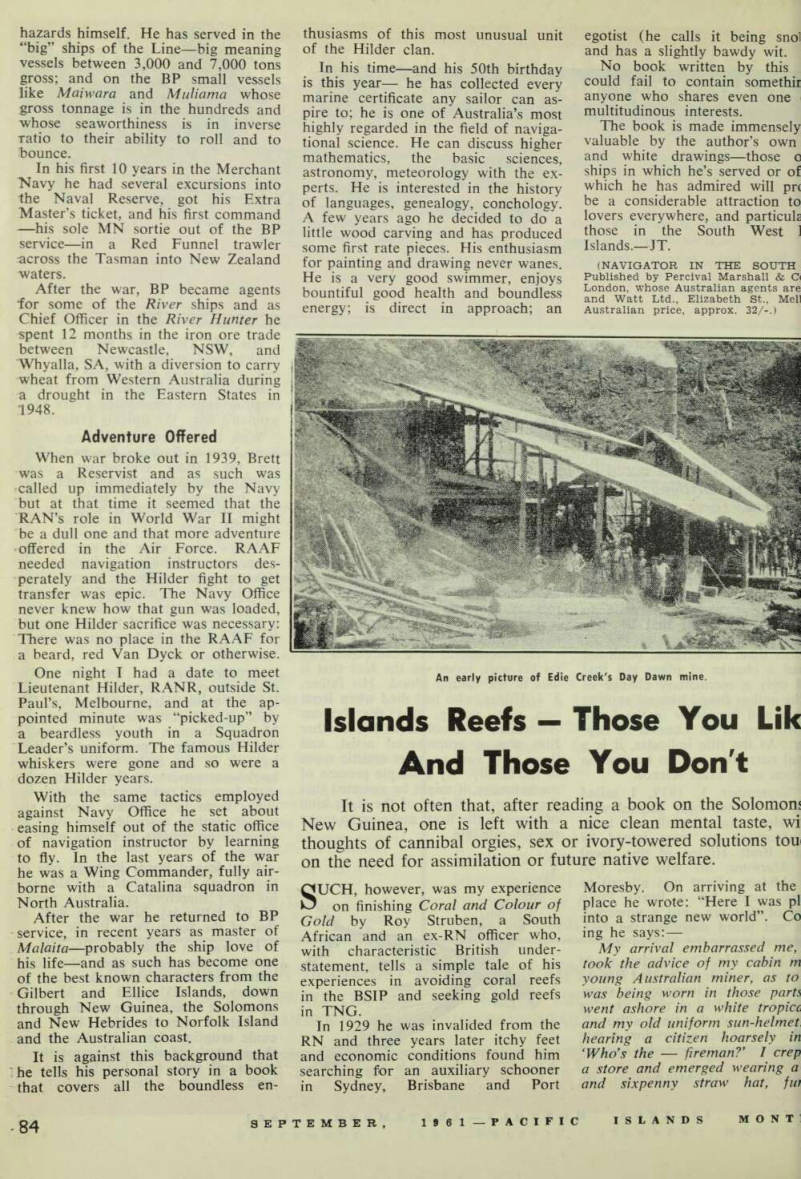
An early picture of Edie Creek's Day Dawn mine.
ying coat, tie and helmet. My ling friendship for Fred Deckert just survived that Aussie joke. ere he met up with ‘Ma’ McGrath, he Lower Pub, various miners \ bar, pyjama-clad “breakfasting »oached eggs and gin-slings. They ) melancholy after their holiday Ldney”, and Errol Flynn, arriv from his coconut plantation and Ding his father “Plantation doing tididly. Please send £100”. rom Moresby he went on to arai where Arthur Bunting gave good advice, then later stayed e time with ‘Ginger’ (Don) le, his charming wife and three -daughters at Gilli-Gilli. [ was in Rabaul, however, that net Bob Crookshank who was then ter of the Durour and it was who put him on to the Navanora n in the Solomons, which had i put up for sale by the govern it. He offered £4OO, which was jpted. he vessel was eventually re-fitted, :rew obtained and the one-time officer started off on the some it hazardous career of copra hing around the Solomons, lany old identities are named and venture proves more or less a cess. His experiences were the al, everyday happenings of an mds skipper, but they are told in unusually interesting style, ie wins a gold claim at Edie :ek (which he spells “Edi”), one nine on the site of the police post Kaindi. So off he goes to the (robe goldfields, leaving Navanora the care of Ernie Palmer, and later b Crookshank.
Struben’s proxy for the ballot was )nel Shoppee, then a pilot in Ray rer’s Aerial Transport Company at iu, and he eventually finds himself on the fields. His claim was next Harry Darby’s El Dorado lease.
Looking for someone to man his lim, until he could work it him- L Struben approached Gresswell d his wife. The latter agreed.
He writes; The idea of a woman gold-miner was new to me and 1 wondered how it would pan out, but I need not have worried for she proved a winner, handling her team of natives splendidly. She was very small but very determined.
Naturally he visits Flo Stewart’s pub at Wau. There he meets up with Eric Weine, “Tiger” Lil, Otto Rossiter and many others of those balmy days and his descriptions of the “goings on” make nostalgic read ing for the old-timers.
The working of the claim and his prospecting for new ground in un explored territory, based on reports from Baum, all add to the interest.
In 1935 he is back in Europe.
In 1957 he returns to his island haunts for a visit where he finds the Winds of Change have been blowing
strong.-
GT.
(Coral & Colour Op Gold. (Faber
& Faber, London. 26/-.)
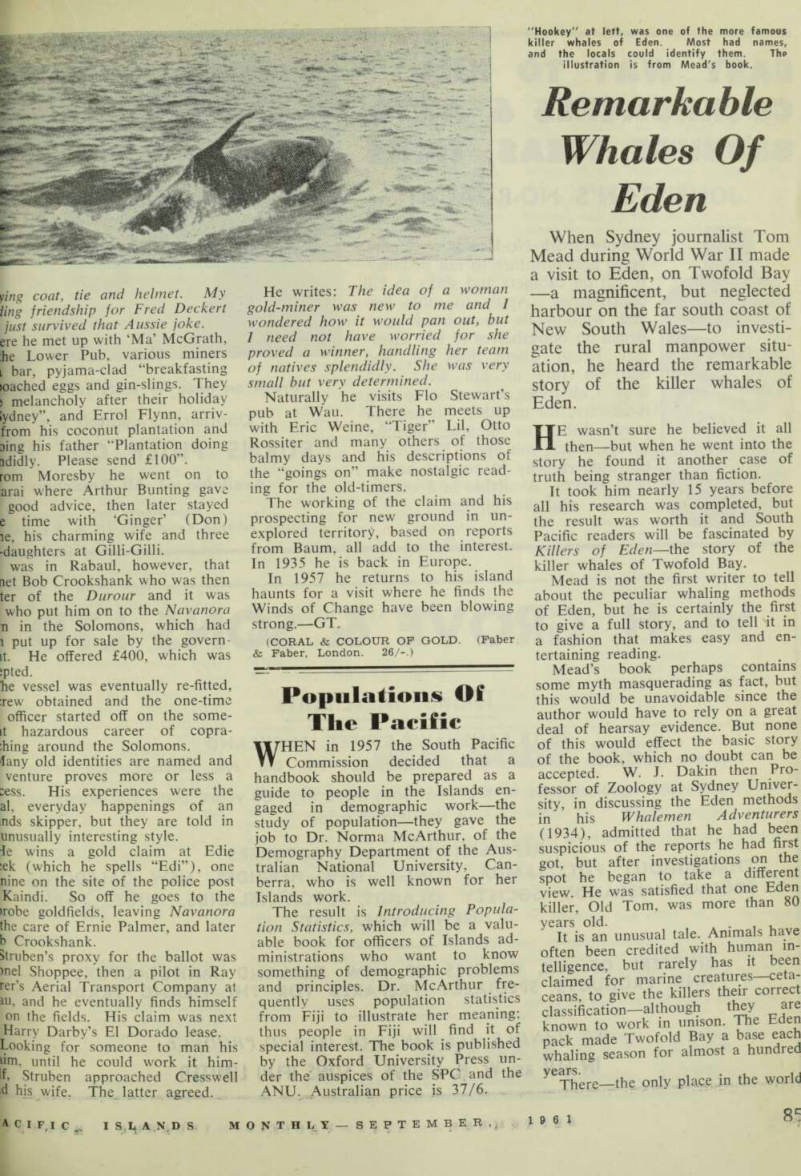
"Hookey" at lett, was one of the more famous killer whales of Eden. Most had names, and the locals could identify them. The illustration is from Mead's book.