Young Ancient Mariner Celebrates
pp. 85-86 · Read in the full issue
The Month's New Reading
Young Ancient Mariner Celebrates 50th Year With A Book
Brett Hilder has based his life on the proposition that any e can do anything at least once: Gain an Extra Master's rtificate; carve a wood figure; paint a picture—each was a oblem to be attacked, overcome and beaten.
OUPLE of years ago, an English lublisher suggested that he write k about navigation in the South c, and it was no surprise to who knew Brett that he duly iced a manuscript, this time, the original publisher lad a change of plans but that d only a momentary change of the author found himself another iher and Navigator in the South will appear in London in Sep ;r. As the title indicates, it is a nal narrative, and no treatise on ation as an exact science.
September 3, 1939, I sailed id to Nordup near Rabaul with it Henry in a small sail boat, afternoon we were joined by tin Brett Hilder of the local I Maiwara, his wife and two children. Brett was alleged to ery young for a Burns Philp er of that era—but a powerful, t, red beard disguised the fact, ably that was the idea of it. lat night, Mr. Chamberlain made istoric announcement that Britain at war with Germany—a state- I that seemed to us more exciting ominous at the time although, the rest of our generation, it was oment that changed the tack of lives.
'nest went to the Middle East with
the 6th Battalion and was killed in the evacuation of Crete. The rest of us found ourselves in Melbourne, Vic toria, in the early part of the war and it was at this stage that Brett decided to draw and to paint.
This seemed to be a calculated risk on his part, based on the fact that it was in the family blood. His father, J. J. Hilder, who had died when Brett was very young, was the famous Australian watercolourist. His brother Bim was a commercial artist, and there were various other artistic types in the family. By a simple process of mathematics, it might be assumed that there were sufficient of the right kind of genes in the Brett make-up to make the job possible.
His wife, Tilly, and I were his early models and then, as now, he had less success with his female portraits than with male—or at any event, a singular talent for adding years to a woman’s life. We quickly resigned.
With many people, painting might have been a flash in the pan affair but the Hilder enthusiasms aren’t waning ones. His painting technique has improved out of sight as the Hilder Profiles in PIM have shown over the years.
A few years after the war he had a one-man exhibition in Sydney and although some of the local arty critics were less than pleased with the result, it was pretty typical of the man that a large proportion of the paintings— mostly heads of Melanesian natives— was sold.
Anyone looking for the arty craftiness or the gimmick in his writ ing will be similarly disappointed. His style is characteristic of dozens of Master Mariners who have recorded their adventures permanently. Per haps it is the early writing of log books —or reports to the owners who want facts and not rhetoric —which in clines them to the plain literary ap proach, but in a world given over to gimmicking writers it makes quite a change.
Brett joined Burns Philp as one of that Line’s first cadets in 1928 and his story therefore covers the period of BP latter-day history as well as that of the South West Pacific.
He was on Malabar —although on leave at the time—when she com mitted suicide on the rocks south of Sydney in 1931; and on Montoro when that vessel evacuated the people of Rabaul after the May, 1937, vol canic eruption there. He has helped the master’s of sister ships get them selves off reefs and has had brushes with the same Pacific navigational
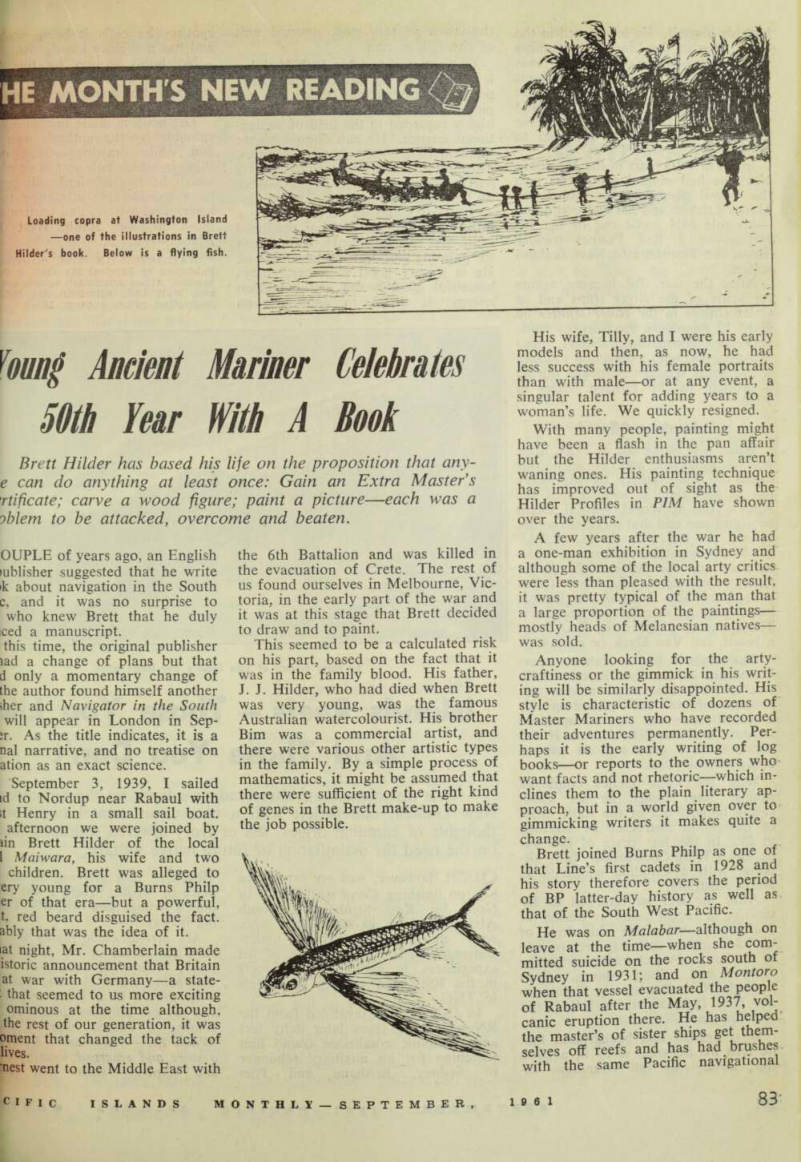
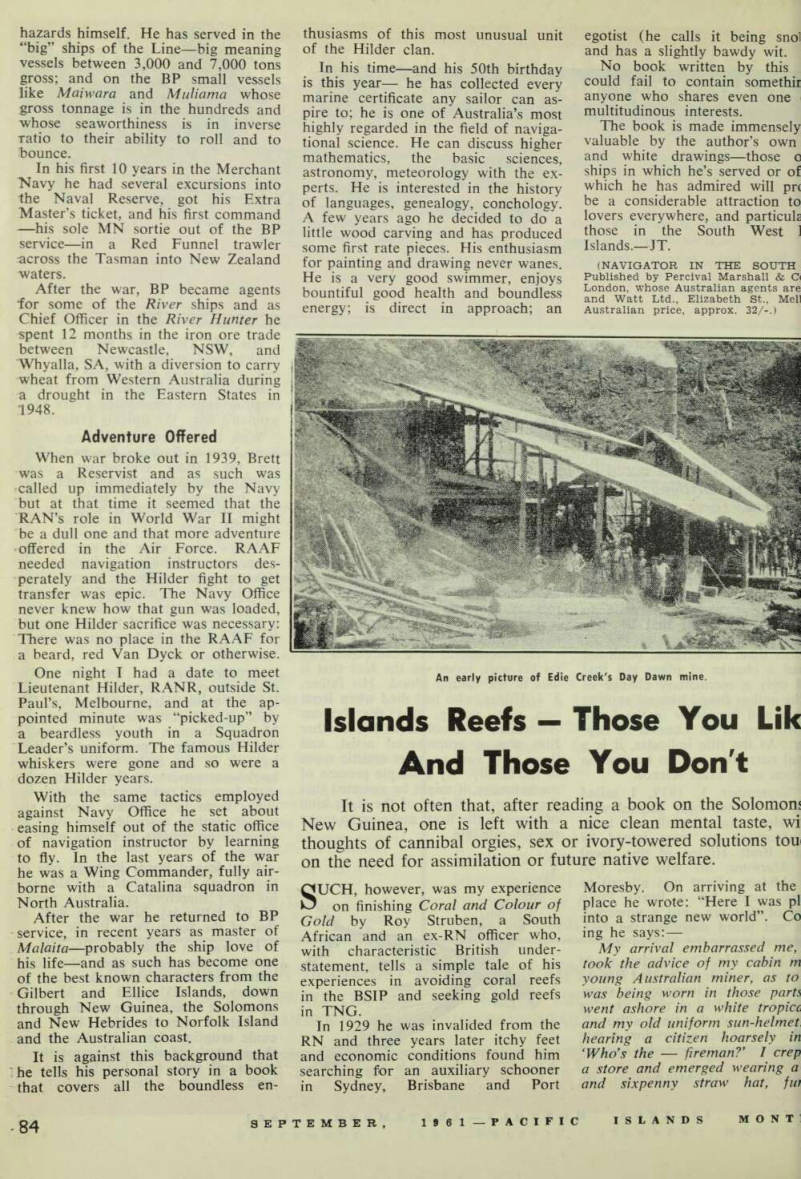
Loading copra at Washington Island —one of the illustrations in Brett Hilder's book. Below is a flying fish.
hazards himself. He has served in the “big” ships of the Line—big meaning vessels between 3,000 and 7,000 tons gross; and on the BP small vessels like Maiwara and Muliama whose gross tonnage is in the hundreds and whose seaworthiness is in inverse ratio to their ability to roll and to bounce.
In his first 10 years in the Merchant Navy he had several excursions into the Naval Reserve, got his Extra Master’s ticket, and his first command —his sole MN sortie out of the BP service—in a Red Funnel trawler across the Tasman into New Zealand waters.
After the war, BP became agents "for some of the River ships and as Chief Officer in the River Hunter he spent 12 months in the iron ore trade between Newcastle, NSW, and Whyalla, SA, with a diversion to carry wheat from Western Australia during a drought in the Eastern States in 1948.
Adventure Offered When war broke out in 1939, Brett was a Reservist and as such was called up immediately by the Navy but at that time it seemed that the RAN’s role in World War II might be a dull one and that more adventure offered in the Air Force. RAAF needed navigation instructors des perately and the Hilder fight to get transfer was epic. The Navy Office never knew how that gun was loaded, but one Hilder sacrifice was necessary: There was no place in the RAAF for a beard, red Van Dyck or otherwise.
One night I had a date to meet Lieutenant Hilder, RANR, outside St.
Paul’s, Melbourne, and at the ap pointed minute was “picked-up” by a beardless youth in a Squadron Leader’s uniform. The famous Hilder whiskers were gone and so were a dozen Hilder years.
With the same tactics employed against Navy Office he set about easing himself out of the static office of navigation instructor by learning to fly. In the last years of the war he was a Wing Commander, fully air borne with a Catalina squadron in North Australia.
After the war he returned to BP service, in recent years as master of Malaita —probably the ship love of his life—and as such has become one of the best known characters from the Gilbert and Ellice Islands, down through New Guinea, the Solomons and New Hebrides to Norfolk Island and the Australian coast.
It is against this background that he tells his personal story in a book that covers all the boundless en
thusiasms of this most unusual unit of the Hilder clan.
In his time—and his 50th birthday is this year— he has collected every marine certificate any sailor can as pire to; he is one of Australia’s most highly regarded in the field of naviga tional science. He can discuss higher mathematics, the basic sciences, astronomy, meteorology with the ex perts. He is interested in the history of languages, genealogy, conchology.
A few years ago he decided to do a little wood carving and has produced some first rate pieces. His enthusiasm for painting and drawing never wanes.
He is a very good swimmer, enjoys bountiful good health and boundless energy; is direct in approach; an
egotist (he calls it being snol and has a slightly bawdy wit.
No book written by this could fail to contain somethir anyone who shares even one multitudinous interests.
The book is made immensely valuable by the author’s own and white drawings—those o ships in which he’s served or of which he has admired will prc be a considerable attraction to lovers everywhere, and particula those in the South West 1
Islands.
JT.
(Navigator In The South
Published by Percival Marshall & C< London, whose Australian agents are and Watt Ltd., Elizabeth St., Mell Australian price, approx. 32/-.)