Pacific Report
pp. 115-135 · Read in the full issue

The month’s round-up of news and pictures of people and events, from PIM correspondents in the South Pacific.
jssibly a New Plane
ir New Hebrides Airways
Although it is being constructed make the transport of copra sier, a new road now being built South Tanna, in the New Hebrides, 11 provide a drive through some the most beautiful scenery on the and. The road is being built from itukwey to Kwamera Point. It is ficult terrain and the road builders the Yenenefe Local Council—are moving large quantities of rock d stones by hand. New Hebrides es not get many tourists—although th new hotel plans, and the service ortly to be established by Fiji Air tys between Fiji and the Solomons is should be fixed. Tanna can be ached by New Hebrides Airways ipide aircraft from Vila.
Some of the people of Tanna have :ently celebrated, in their own way, e first anniversary of the arrival of ;w Hebrides Airways to their area, ore than 1,000 people put on a nee and sports meeting at Willie m’s airstrip near Lenakel. The lebrations began the previous night id many people danced until dawn.
The airstrip, which was built by e local people after a great deal of rly difficulties (for the full story e PIM, March, p. 49) provided an eal site for cycle, car and horse cing and athletic events.
Meanwhile New Hebrides Airways July arranged to lease for three onths a Drover from Fiji Airways, tie agreement allows New Hebrides irways to buy the aircraft during ie period of lease, if it decides to.
The reason for the lease was that was found when the New Hebrides a pide was flown to Fiji Airways at ausori in June for repair, overhaul id renewal of its certificate of air orthiness, it required a number of la jor replacement parts which were °t available in Fiji. The delay leant New Hebrides Airways would e without any aircraft.
The Rapide was flown to Fiji by
Paul Burton, one of the co-owners (with Bob Paul) of New Hebrides Airways, who also expected .to fly the Drover back to Tanna in late July. It is a 520-mile over-the-water hop from Nadi to Tanna.
W6St Samoan Station
Gots Aaotg Rowgt
new transmitter, costing more than £jo,ooo, brought into service at the Afiamalu transmitting station should substantially improve recep tion j n \y es t ern Samoa and possibly exten d Station 2AP’s overseas range.
A ceremony attended by the Hon.
Tamasese (a j oint Head of State), , he High Commissioner; M r. J. B.
Wright, the Hon. Faalava’ au Galu, Minister of Broadcasting, and mem bers of the Cabinet> marked the in . auguration of the 10 kW transmitter a( Apja ™» development will help 2AP
to make itself heard in the Southwest Pacific, where the Fiji Broadcasting Commission and the recently estab lished Tongan Broadcasting service are already providing a fair amount of competition. Radio Noumea in July also had plans for expansion.
Beetles Go To
War Against Flies
The Pyrophorus beetle, although black, is much smaller than the Rhinoceros beetle and has much nicer habits, which may raise its popularity in the Pacific area.
It is useful because it destroys the young of flies. The Pyrophorus burrows into the soil and can also fly considerable distances in search of its prey.
A colony of 100 Pyrophorus beetles was recently released in the Avarua and Titikaveka districts of Rarotonga and officials hope that when they become established they will help to reduce the number of flies. Other islands will get them later on.
Results So Far
Of Cooks" Scholarships
Since the New Zealand Govern* ment began sending Cook Islanders overseas in 1946 for higher educa tion or specialised trade training, many have qualified or trained ifi medicine, nursing, teaching, dentistry, plumbing, motor mechanics, survey:
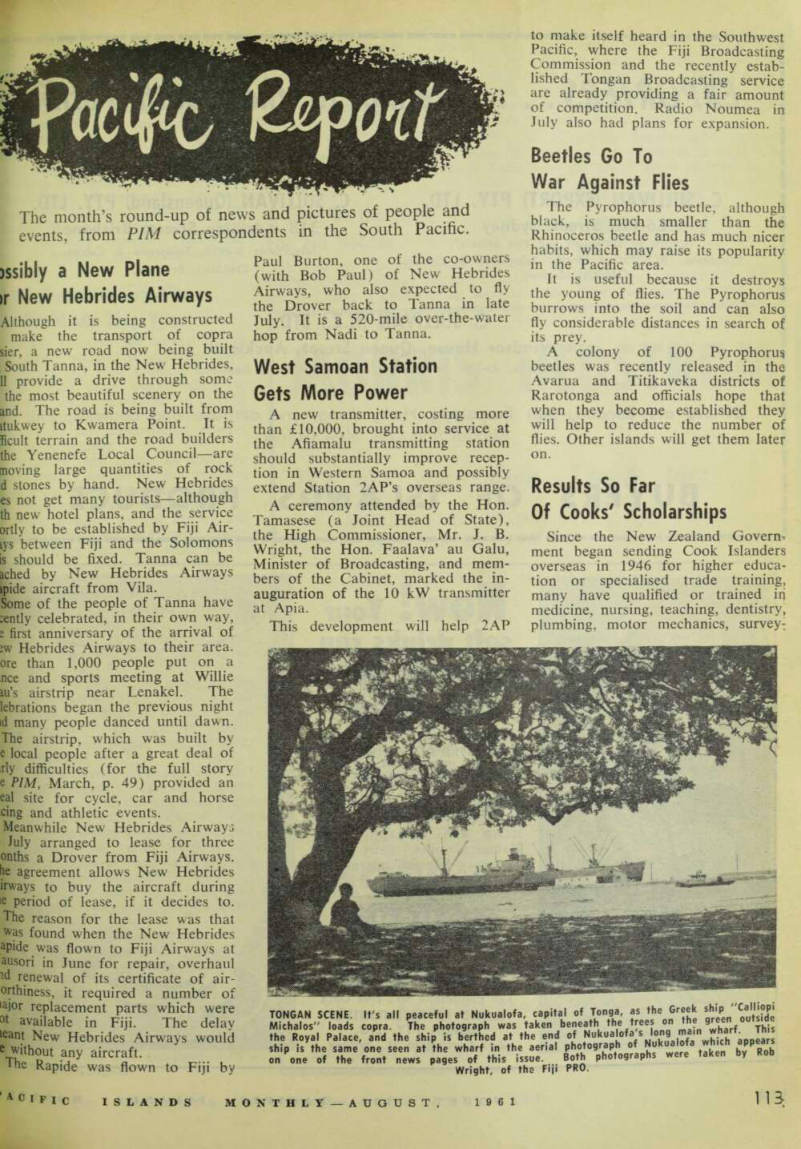
TONGAN SCENE. It's all peaceful at Nukualofa, capital of Tonga, as the Greek ship Calhoun Michalos" loads copra. The photograph was taken beneath the trees on the green outside the Royal Palace, and the ship is berthed at the end of Nukualofa's long main wharf. This ship is the same one seen at the wharf in the aerial photograph of Nukualofa which appears on one of the front news pages of this issue. Both photographs were taken by Rob Wright, of the Fiji PRO.
ng police work, carpentry, fitting md turning, dental mechanics, steno graphy, agriculture and radio.
Over the years, 84 students have ■eceived secondary or university edu ction; 14 have had technical train ng; and 25 have attended Avele Agricultural College in Western Samoa.
In 1960, 28 Cook Islanders were ittending secondary schools in New Zealand on Government Scholar ships, 24 at Avele College; five at Central Medical School, Suva; three were attending university full time and 17 training for trades or pro fessions.
P NG Documentary Film
To Be Made This Year
I A film showing the normal life of the native peoples in different parts of Papua and New Guinea, and the work being done among them to improve their standards of living, will be made by the Commonwealth Film Unit for international release, before November.
I In colour, and lasting an hour, the documentary will be the last of a five year programme, depicting all aspects of Territory life and development.
Main locations for the filming will be along the coast of Eastern Papua, New Britain, the back areas of the Sepik and parts of the Highlands.
Members of the Commonwealth Film Unit were expected to arrive in the Territory in August to commence work although Mr. Maslyn Williams, senior producer of the unit, was there in June to organise the shooting of the film.
The most recent film made by the Commonwealth Film Unit, called “Political Development in Papua and New Guinea” was made for screen ing to members of the UNO Trustee ship Council.
A New York correspondent said that “the honesty and quiet drama of this film held the audience spell bound for its full 30 minutes. You could have heard a pin drop during the sequence of casting the first vote in the election of native members to the Legislative Council”.
There have been some very good documentaries coming out of P-NG lately.
Solar Heat For New
Hebrides Hospital
A solar-heated water supply is a feature of the Seventh-day Adventist Mission’s new 16-bed hospital at Acre in the New Hebrides. The hospital has been built and equipped with a grant of £A 14,000.
Several hundred people saw the opening ceremony. Among the visitors were Pastor C. D. F.
McCutcheon, president of the Central Pacific Union Mission of Seventh-day Adventists, and Pastor R. R. Frame, assistant secretary of the Australian Division of Seventh-day Adventists.
In charge of the new hospital is Assistant Medical Officer Joeli Taoi, of Fiji.
A Shot in the Arm
For Fiji Soccer
A visit to Fiji of British (Leeds United) soccer player Freddie Good win has done a lot to create schools’
interest in soccer. Goodwin’s tour has been made at the request of the British Council. He has instructed and coached many school players in many districts—and his advice generally has been, “Early coaching means better football”.
Goodwin hasn’t been impressed with soccer standards in Fiji. There are players of great promise, he said, but many lack a sense of the principles of the game.
Work Going Ahead
On NH College
Work is in progress in Vila, in the New Hebrides, on the British
*ntral Teacher Training College *IM, May, p. 138). The buildings e prefabricated and are being ected by the Brisbane firm of ay-Book Homes Pty. Ltd., which scted prefabricated homes in Vila "replace some of those lost by the rricane of 1959. Two assembly ims are on the job, but the founta ins were prepared by the British sidency Works Section.
The establishment of the Training >llege is a vital step in the New jbrides and will speed up British ucation efforts. The first intake of ; students is expected early next ar. The money is coming from grant of £A133,590 from British D&W funds.
H Police Trained
i New Caledonia
New Hebridean recruits of the •ench division of the New Hebrides mstabulary have lately been receiv g training in New Caledonia, ghteen recruits returned from New iledonia to Vila in May after three onth’s basic training and a further mtingent of 20 is currently in oumea for their training.
xpert Looking at
oisoned NH Fish
Information about species of New Hebrides fish known to cause food wsoning when eaten has been Elected by Professor A, H, Banner, ead of the Marine Biology aboratory of the University of lawaii. He visited Vila recently on is way back to Hawaii from angkok. Professor Banner inter iewed many local residents about oisoned fishes. The University of lawaii has been investigating fish oisoning over several years, and a fila report says that New Caledonia light be selected as headquarters for urther studies. A few months ago m officer of the BP vessel Nikau lied after eating poisonous fish.
)pen Finding On
Native Death Inquiry
After six weeks of intermittent Jut prolonged hearings a Rabaul in quest in July returned an open find ing in the death of a native who, ac cording to some evidence, was assaulted by Mr. Charles Blake, of Lolobau Plantation, New Britain.
The Coroner, Mr. F. J. Winkle, SM, declined to give his reasons for arriving at the finding, on the ground that the matter was still open to other proceedings.
He found that the native had died from a ruptured spleen on May 4 this year while working for Mr.
Blake at Lolobau plantation. ( PIM, June, p. 132.) There were three possible causes for the injuiry, he said. The first possibility was an unlawful assault by Mr. Blake on the native, the second was the manner in which the native had exerted his body in handling a bag of copra, and the third was a combination of the first two.
Mr. Winkle said that the evidence did not establish beyond reasonable doubt, which of the possibilities was the actual one causing death. Accordingly the finding would be an open one.
The native who died was Sebe
Gobow, a Finschhafen man, whom Blake had signed on at Rabaul to work as a labourer at Lolobau.
Medical evidence disclosed that Sebe had been suffering from an un realised condition of a malarially en larged spleen. The condition had been unrealised because of the ex pansion of the spleen backwards rather than forwards, Sebe’s companions told the inquiry that they had seen Mr. Blake strike Sebe and order him to carry a bag of copra to a waiting surf boat, After complying with the order Sebe had collapsed on the beach and had died soon afterwards, Witnesses were unable to agree on the exact nature of Blake’s alleged assault on Sebe although there was
iome agreement that a blow had been lelivered in the centre of the body it a height ranging from the nipples o six inches lower. Some evidence vas also given of a kick on the side >f the body. .
The first surprise turn in the evi lence came when Mr. Dudley F. [ones of Rabaul (for Blake) was ible, through cross-examination, to :ast doubt on whether or not two of he witnesses had even been present luring the alleged assault.
Later in the hearing Mr. Jones submitted in his address that the two witnesses had organised a campaign to distort and exaggerate the evi dence of the assault. They blamed Blake for the death of their com panion, he said, and had accordingly “invented their evidence in a desire for retribution”.
“They wanted to see the man they regarded as Sebe’s killer get punish ment in a high degree,” Mr. Jones added.
Mr. Jones said that another native witness had apparently been a vic tim of their pressure or a victim of imagination. This witness’s story had been so out of keeping with the others that it was ludicrous, he added.
Another vital link in the evidence was revealed in the closing stages when Mr. Jones called on Dr.
Marion Radcliffe Taylor of Rabaul as an expert witness.
Dr. Taylor had visited Lolobau only a few weeks before the fatality and had watched the manner in which the natives there loaded bags of copra from their backs into surf boats.
She said that in a case where a man had a spleen enlarged towards the back of the body, the internal pressure caused by the action of unloading the bags was “positively dangerous to life”.
Inspector R. Park of Rabaul as sisted the Coroner at the inquiry.
Big Projects Soon
For NNG
In a note to the Netherlands Parlia ment, the Minister for New Guinea Affairs has said that the European Economic Community Development Fund will finance six big projects in NNG in the near future.
These projects are: Study of the population structure at a cost of £A800,000; Geological research (£A2i million); Building and equipping of an Agricultural Re search Station (£AI million); Build ing and equipping a health centre at Hollandia (£A500,000); Central Agricultural Training Centre at
Manokwari (£A500,000); and aerial mapping of New Guinea (£AU million).
More Dead From
The NG Jungle
A chance meeting with a tribe of friendly natives enabled a combined Australian-United States Air Force search party to discover two wartime bomber wrecks in New Guinea’s Owen Stanley Ranges in July.
Leader of the party, Wing Com mander Bundle, of the RAAF, Townsville, said this on their return to Port Moresby on July 23.
He and two United States Air
Force members brought back with them from Kokoda, the remains of eight Australian servicemen found the previous week in one of the crashed aircraft.
The remains were buried at Bomana War Cemetery, Port Moresby.
Natives carried the remains in tin boxes to Kokoda through heavily jungled mountain country from the site of the crash on a mountain slope 8,500 feet up in the Owen Stanley Range.
The aircraft, a Beaufort, crashed in January, 1945, en route to Aitape from Port Moresby.
Wing Commander Bundle said that
ut for a chance meeting with •iendly natives at Cargi Village on ie Kokoda track, his party would ot have found the crashed Beau dr t.
Natives also told him where to ad a missing wartime United States 25 Mitchell bomber.
Wing Commander Bundle said the irty did not see the Beaufort until icy were ten feet away from it. ‘The wreckage was as green as ie jungle around it and covered ith bamboo.
“It was scattered over sixty feet om the point of impact and must we hit the mountainside with tre icndous force.
“We scraped away jungle growth om the tailplane and identified it om the serial number.”
From the wreckage the party col cted three cameras, three watches, iree cigarette cases, 10/8 in silver id copper and a Bible to return ► next-of-kin of the dead service icn.
The search party found the [itchell bomber in a water-filled imb crater.
“The water was about ten feet ;ep and the wreckage would have ;en extremely difficult to find,” fag Commander Bundle said.
“The Mitchell was unknown to us id it is possible the crew parachuted it before the crash.
“We have radioed the United ates Air Force in Hawaii for de lls about it and if the missing air icn were aboard we will go back ► extricate their remains.”
Wing Commander Bundle and his am of Lieutenant W. Wheeler and Jrgeant H. Pailillo, of the USAF, onolulu, earlier this year recovered ie bodies of nine American airmen om a Mitchell and a C-47 lost on fount Menevi in 1944.
They know the approximate where 3outs of three more wartime aircraft recks which were spotted during an srial survey.
Two of the wrecks are believed to 2 missing BAAF aircraft.
Wing Commander Bundle said >ey would probably return later in le year to try to reach the wrecks.
Continuous bad weather in the |wen Stanleys at this time of the “ ar had made the three aircraft in -cessible to the search party, (PIM.
J ly, P. 115.)
lanuabadans Change
0 Surname System
The Papua-New Guinea Adminis a\Or, Sir Donald Cleland, in July raised a native village group for oandoning its traditional “first
names only” and adopting the Western system of permanent family surnames.
A mass meeting of natives of Port Moresby’s sophisticated Hanuabada Village, earlier in the week decided to change to the Western system.
Other Papua and New Guinea trades people know each other only by Christian or given names. Their fathers’ names are used as stop gap surnames in census surveys, court hearings and for other Administra tive purposes.
The Hanuabadans’ changeover from the old system was “a welcome step forward in their progress,” Sir Donald said. “It shows the natives
are giving serious thought to such things.” (See PIM, July, p. 75.)
Battle of the Tasman
Joined in October
The battle of the Tasman will be joined in October when Qantas in augurates its first trans-Tasman air services. TEAL will step up its flights to meet the new competition.
Qantas will cross the Tasman for the first time as a result of the new air agreement made between NZ and Australia earlier in the year, in which NZ bought from Australia its half share of TEAL and became sole
owner. It was agreed that TEAL Qantas could be competitors ac: the Tasman, although competii: will be “controlled”, so that TH still ends up with more than a share of the lucrative Tasman tn The new Qantas service will gin on October 3.
Services will be Sydney-Auckll Sydney-Wellington, Sydney-Ck church, Melbourne-Auckland, I bourne-Christchurch, using Lock!
Electra Mark II aircraft.
Initial frequency will be six a v/ each way, building up to ten a \i in the January peak periods.
TEAL in July released new tl tables which will provide for' flights a week across the Tass through the December-Febr peak season. TEAL says they provide for an expected 20 per • increase in traffic this summer o pared with last.
Said TEAL’s general manager,, F. A. Reeves: “It is not wi' realised just how many flights, how many passengers now fly a«. the Tasman. Nor is it gene; realised how fast this traffic is g ing.
“The introduction of economy fares, the development of pac tours, and the 70-seat jet- Electras have all been impot factors in reaching a new market for air travel in both Zealand and Australia,” he said..
The present winter timetables tween Auckland and Austn cities provide for 10 return sen weekly—seven to Sydney, two Melbourne, and one to Brisbas with a total of 700 seats availaE TEAL’s trans - Tasman sun services will be approached in ses steps. Return services between A land and Sydney will jump seven a week to 10 a week in (> ber and to 13 a week in Decernt Auckland-Melbourne will rise two a week to three a week inr cember.
Return services linking Wellin and Sydney will rise from five a to seven a week in October, to at the beginning of December ■ to nine from mid-December.
Return services from Christcll to Australia will be daily in Do ber—five to Sydney and twt' Melbourne.
Both TEAL and Qantas will J vide all-Electra services on Tar routes. TEAL withdrew its last on these routes in March. QC changed from Super Constells to Electras in May.
Both airlines will fly into the New Zealand international airt and will, between them, pn
140 passenger seats each way each ek across the Tasman during the mmer peak.
alaria Eradication
ans in Guadalcanal
A pilot malaria eradication project to be begun on Guadalcanal, BSIP, [ the end of the year. The WHO s begun to recruit personnel and der supplies. Guadalcanal has been osen as a pilot area because it con ins some of the most difficult 'untry in the BSIP, and if malaria n be eradicated there it will be latively simple in other parts of e Protectorate. New Georgia will so be another pilot project area.
How Many Wives
ave You?"
The P-NG administration in late ny took a census with a difference 1 urban Port Moresby. The census js of natives, and it was planned to “P the Administration gauge the rut of native villagers to Port
loresby.
Some of the natives are un oubtedly polygamists, with perhaps r ives in Port Moresby and back 0me > too,” said an officer. “But we
are fairly satisfied that most natives have one wife.”
Sample of questions include: For men, “How many wives have you?”, and for women; “Have you more than one husband?”. Many of the questions are those of age, sex, religion as asked in the Commonwealth-wide European census held in June.
The native census was taken of natives in settlements roughly in a six miles radius of Port Moresby.
a finn nn ft/UUita *+,UUU OR maiaiTd
for a Blq Event
The blessing of a new church at the Buma Catholic Mission, on Malaita, BSIP, and the accompany ing festivities, attracted a crowd of more than 4,000 people. The impres sive new church, built of local tim ber in the style of a basilica, is 126 ft long and 52 ft wide. About 1,000 people were in the church itself dur-
I the solemn High Mass celebrated Bishop Stuyvenberg. The Buma ission station was begun almost years ago.
There were 14 ships at anchor at ima for the great day and more in 264 pigs and four head of ttle were slaughtered for the tradi mal feast and old time dances. The urch was blessed on a Sunday, but i accompanying festivities ex ided through to Tuesday.
ork Goes Ahead
n Moresby's New Dam
One of Papua-New Guinea’s big st engineering projects—the dam ross the Sirinumu Gorge in the othills of the Owen Stanley Ranges, tside of Port Moresby, can now go ead, because agreement was ached at the last minute in July on e purchase of 3,012 acres of native i'ned land required for the work.
The dam, on the Laloki River, is e first stage in a long-range plan develop the river’s full hydro metric potential to meet Port oresby’s power requirements.
The contract was let to Horni ook-Kaiser Joint Venture for 49,052 in June. Most of the 3,000 res of land purchased will be in itiated and arrangements are now ; ing made to resettle the people on :w land especially bought west of e dam site.
About 1,200 acres of the 3,000 at are now being bought was gently required to enable construc -3n work to begin. The contractors ive already established work camps id they started work on stripping of ie ov er-burden at the end of July,
It’s hoped the dam will be completed by the end of next year, but a new power station will have to be built if Port Moresby’s power requirements are to be met after 1965.
The first stage of construction of the dam will give it a height of 80 ft, but eventually a second building stage—not yet tendered for—will increase it to 100 ft.
Mpu. faipHnma Plane New caieaoma nans
Fishinq Industry
“ ' New Caledonia is to make an effort to develop a fishing industry, and the Japanese are to be asked to
help. A scheme is now being drawn up in Noumea, which will enable an approach to be made. No details were available in July, The scheme follows discussions in Paris recently on economic measures in the South Pacific French Terri tories.
Another of the subjects discussed at the economic conference was New Caledonia’s agricultural position. It was decided to organise a “system of guidance” to help New Caledonia produce and to market its products.
Primary producers in New Gale donia at the moment are in serious trouble because of imports of food from overseas, mostly from Europe.
Large quantities of frozen poultry and eggs come in each year, and there has been criticism that New Caledonia relies to too great an extent on imported food. Most of the huge sums spent on poultry imports would remain in the country if the local industry could be properly developed. , ..
Foreign Exchange Still
New Caledonia S Trouble The question of the distribution of foreign exchange will have a direct bearing on the success of the Australian Trade Mission which will visit New Caledonia in August, a
Noumea correspondent reported in late July.
The Mission, of 20 businessmen representing a large range of Aus tralian products, will be in New Caledonia from August 18 to 23 and then will fly to Fiji. Some members of the mission will individually visit Tonga, Western Samoa, New Heb rides and the Solomons.
The Noumea correspondent said the matter of foreign exchange was a subject of recent publicity, and it was one of the subjects discussed in Paris recently at an ecomonic con ference of South Pacific French Ter ritories.
New Caledonian importers were
bitter about being made to goods in France which are unfii for the purpose. Earth-moving eqy ment and flour for bread making v two sore points.
New Caledonian business! claimed that, as the exports of I Caledonian goods brought in h sums of foreign exchange, the cou should be allowed to control s» of this exchange instead of it all ing swallowed up by France.
The correspondent said tl seemed to be little the Austra Trade Mission could gain in I Caledonia if New Caledonia did have the foreign exchange to chase the goods needed.
The correspondent added: “T: with Australia could, of course, increased a hundred-fold if the 1c could dispose of their foreign change as they think fit. Then actually a shortage of rice in country. Small stocks from Austi have arrived and are being ur dally rationed. Yet Australia c supply all of New Caledonia’s n in rice, Australian rice is tops —judged the best in the world. I ever, they have to import inferior from France and Saigon. And i is through the whole list of f stuffs.
“The position hinges on the ri< lous when it is known that sugi shipped across the world from ' land and Belgium. Cans of soup jam also come from England not to mention Xmas puddings! outcome of the foreign exch question is awaited with the gre of interest.”
The New Caledonian Chambe Commerce in July issued a < munique announcing the visit oJ Australian Trade Mission and it would put its building at the posal of the visitors to help show samples. It was a friendly ture that will be appreciated b} Australians.
However, business is business, the Chamber also called on its r bers, and all shopkeepers in Nou to freely display New Caledc and French products at the tirr the Mission’s visit so the vi. will not fail to notice them!
They Want Their
Fish Protected
A French professor must be ing he had left some things ui since one of Noumea’s pro publico’s, choosing the nom plume of a fish, wrote to the protesting about the dynamitin local fish.
The writer alleged that the 5’
lundation coral reef expedition inned to dynamite selected sites to tain one specimen of every type fish living about the reefs.
He pointed out the expedition ider. a professor, had once de ired that dynamiting of fish was s most terrible and wasteful means fishing.
Elsewhere, concern has been ex essed about the use of small mesh r lon nets which haul up great entities of small fish and crabs.
A member of the Legislative As mbly wants a law passed forbid ng the use of the nets. His motion ill be discussed.
ev. & Mrs. S. G. Cowled
0 Retire Soon
A quarter of a century of mission y service in Fiji will come to an id on September 30 when the Rev.
G. C. Cowled, chairman of the [ethodist Mission in Fiji, and Mrs. owled, leave the Colony on pre firement leave.
Mr. Cowled arrived in Fiji in 1937 :ter 12 years on Methodist circuits 1 New South Wales. He had first itered the church in 1917 and went * to World War las a trooper with le Australian Light Horse Ambu ince Brigade. After the war he spent iree years on Goodenough Island, apua, with the Methodist Mission.
Equally active in mission work has een Mrs. Cowled, who has won 'arm approval from the Fiji com lumty for her efforts in many fields. n recent years she has been particu
larly active with the Girl Guides and in the Fiji branch of the Pan- Pacific and South East Asia Women’s
latest photograph of Rev. and Mrs. S. G.
Cowled, who will leave Fiji on retirement ve in September. They have been in Fiji lost 25 years, where Mr. Cowled is chairman of the Fiji Methodist Mission.
Association, of which she was e president.
Mr. Cowled said in Suva ini he had confidence in Fiji’s futit with some reservations.
He said that people had to b©< pared to work harder, and there to be greater emphasis on intea There were anxious days ae but they could be overcome the races learned to live tog»j Christianity was the answer to “The Christian churches cam a big part in this,” he said, “s' think there is evidence now of co-operation among them than has been among the different generally.
“We have to foster, I can thii no better word, friendship. We e to become more friendly with j other and develop goodwill. . churches can get together more' Mr. Cowled, a great beliew the union of the churches, says\ while there may not be ok union among them for very years, they can work togethen; Two recent examples of co-o tion were the conference of miij in Western Samoa and the thea cal conference held at Suvas after, when a recommendation' passed about the need for a tIJ gical training college.
Talking about the progress church had made in his 25 yea Fiji Mr. Cowled said that the had become very much more more particularly since the eie World War 11.
In the last 10 years or so ( had been a drop in the numUi missionaries from overseas, butti had been more than a correse ing increase in the number off clergy. The Fijian clergy now* greater responsibility and wouu more responsibility in the chun the future.
Mr. Cowled, in his long 5 labours in Fiji, has been headif of the Davuilevu Technical S chaplain to the Fiji Military I (he was senior Chaplain whei Fiji First Battalion went to thea mons during the war, andb awarded the OBE, Military Dii< for his work there), a merntfr many boards responsible for 1 munity work, and a member Fiji Legislative Council.
He and Mrs. Cowled estaKi the mission station at Savusavu u Mr. Cowled helped with his;i hammer and paint brush to coo the residence at Naqelekulsl helped to establish a post schor continuation school for youtL the district who could not qualh schools in Suva, and who couji
iord to go to Suva because copra is then not at a satisfactory price. 1952, after an overseas trip, saw r. Cowled in the top position in e Methodist Mission in Fiji, and e following year he became a Iminated member of Legco.
As a Legco member much of his Drk was behind the scenes. When ! spoke in debate he was always wth listening to—sound common nse, presented in logical and force -1 fashion. (Incidentally while Mr. owled was away on leave during a mncil session, a fellow member of k mission, the Rev. D. I. Telfer, ok his place for a few months. As debater Mr. Telfer was in the same ould as Mr. Cowled—calm, logical id forceful. The vocation of the fission may have had something to a with this.) Mr. Cowled’s term of chairman f the mission has seen the comple on at Suva of Epworth House, a ne building bound by Marks, tewart and Nina Streets, which is wned by the Fijian (Methodist) Ihurch in Fiji, and which is the eadquarters of the mission.
Mr. and Mrs. Cowled will leave ? iji in the Arcadia on September 30 or the United States, where they fill spend three weeks. They will hen join the Oronsay for a voyage ‘cross the North Pacific to the Far -ast, and will arrive at Sydney on December 3. In Sydney they will ettle at North Narrabeen.
Sir Donald Cleland
Sees It All
Hie rapidly increasing interest of natives in education and Local Gov ernment Councils and a strong sense of loyalty by them to the Australian
Government were among the out standing impressions gained during a recent extensive tour by P-NG Ad ministrator, Sir Donald Cleland.
With Lady Cleland, Sir Donald toured from June 21 to July 10, visiting New Britain, New Ireland, the Morobe District (including Huon Peninsula, Markham Valley, and parts of the Highlands areas), and Siassi Islands (between southern New Britain and the NG mainland).
Some highlights of the crowded tour: • In Rabaul, Loyal Service Medals were presented to Tolongoma and Tomanage, both long recognised as outstanding men of their areas. Uri Tupoli, having served with the Public Health Department since 1932 (he took charge of Anelaua Hansenide Colony during the war, after the evacuation of the nuns), also received an LS Medal at a ceremony on New Ireland. • A precarious canoe trip ashore from Laurabada II to the small island of Nonowaul, when the 158 native population sent a plaintive message that their dot of land, 12 miles west of Kavieng, had never been visited by an Administrator. • An old era ended at Taskul, on New Hanover Island, when Sir Donald inaugurated the new Local Government Council: as the old luluais and tultuls handed in their caps of office, he presented the new councillors with their badges. • A drive down almost the entire length of New Ireland, with floral arches over the road and hundreds of floral decorations on each side, as group after group enthusiastically greeted the Administrator. New Ire land these days has a lively optimistic atmosphere compared with the un
certain outlook during the immediate postwar years. • Inspection of a saw-mill at Cape Hoskins established by two Aus tralians, Messrs. Allan Thompson and Max Wright, where £lOO,OOO has been invested and a quarter of a million super feet of first-class hard wood is produced monthly. • Examination of the site where a £90,000 bridge (520 ft.) is being built across the wide Leron River.
It is the second last bridge along the important road between Lae and the rich Highlands; when the road is completed it should enable rural pro ducers, especially coffee-growers, to market produce more economically. • An unscheduled trek in teeming rain down the mountain road from Kakalo patrol post to Wasu (Huon Peninsula) when their four-wheeled vehicle, on loan, broke down. They completed the final part down the greasy trail on wiry mountain ponies. • At Menyamya, only recently gazetted as unrestricted, 2,000 natives rose out of the grass soon after the official aircraft landed on the grass strip. Roaring war-cries and waving spears and bows and arrows, they swept in a war-charge at the official party. It was a demonstration of how the natives originally attacked enemies. On this occasion they ended their performance with their tra ditional “chin-chucking” form of greeting, alternated with vigorous hand-shaking.
SPAL May Extend
Tahiti Service to Fiji
“Just having a look around what we hope will be a future field of
The Administrator, Sir Donald Cleland, on his tour presented the Loyal Service Medal to Uri Tupoli, of New Ireland, shown here with his wife and family. Tupoli has been with the Department of Public Health since 1932. In 1936, after being ad mitted as a patient to the Anelaua Hansenide Colony, he continued to carry out his work as a medical orderly, and during the Japanese occupation took charge of the colony and supervised it. He is a conscientous and highly regarded man. Behind Sir Donald is Levi Sanmun, of Kavieng Hospital, who was awarded the Loyal Service Medal in 1955.
See report below.
activity” was the way Mr. J. H.
Dollar, president of South Pacific Air Lines, San Francisco, described a brief visit to Nadi, Korolevu, and Suva in July.
SPAL already operates a twice weekly service with Super-Constella tion aircraft between Hawaii and Tahiti, and it recently received US Government approval to extend the service to American Samoa and to Fiji. However, the airline had asked also for other routes and for per mission to extend to the US main land, but had been knocked back by the US Civil Aeronautics Board.
It has reapplied and, until a final decision is reached, SPAL did not intend to extend its Honolulu-Papeete service westwards, Mr. Dollar said.
Fiji turned on a bout of bad weather the weekend Mr. Dollar was in the Colony, but it did not put him off—“ I’ll be back again soon for a longer visit,” he promised.
SPAL’s eventual extension to Fiji would provide more competition for TEAL’s Tahiti flights from Nadi, but TEAL are not worried, according to unofficial reports. North-west Fiji in terests are quite happy about it: It would mean more visitors to the dis trict and more dollar currency to change.
Interest in Port
Moresby Marriage
A white woman doesn’t marry a native in Papua-New Guinea every day of the week. When attractive Christine Parkinson, 24, married John Kaputin, 22, in Port Moresby on July 17, it was the first instance ever of such a marriage, so one way or another you could expect it to get a fair share of publicity, which it did, in the Territory and in all the Aus tralian newspapers.
A Port Moresby correspondent re ported : The happy couple didn’t want any of the publicity. Mrs. Kaputin’s only comment to the Press was that the marriage was her business, which it was. At the moment both are living happily in the small flat attached to a European-owned trade store which Kaputin manages near Ela Beach, Port Moresby. They have been enter taining their mutual friends at dinner, as any normal couple would, and are being left alone by the stickybeaks, as is their due.
The only really stupid piece of re porting that came out of the publicity was the statement that Kaputin had been “banished” by his “tribe”—the New Britain Tolais—who were “humiliated” because of his marriage to a white woman. This statement,
whose source apparently was some Tolai inmates of the local Port Moresby gaol (who presumably had their own telephone line direct to
the “tribe” over there on New Britt was given wide publicity in 1 tralia.
The truth was the opposite.
Tolais in Rabaul are pretty pies with young John for being gannr try such a bold experiment in relations, and if he pays a visii; Rabaul soon he is likely to be g§ something in the nature of a IT ticker-tape reception.
Kaputin’s planter father, who present at the marriage ceremonvj not terribly happy about the marrir (He first opposed it.) But misgiw are the perfectly normal ones of ; father who wonders whether his ; is doing the right thing, who hti that everything will turn out all n for both of them, and that his S 3 wife won’t be banished from her titl Kaputin and his bride met when: was a pupil at Ward’s Strip (II Moresby) Teachers’ Training Colltl She—and her husband, John LaWi were teachers there. The Lakes H come from West Australia and been in the Territory two years. (I PIM, December, page 131.) The Lakes went back to Perth i year, where the husband got a divw from Christine. She returned to I Moresby early this year to teach, , she and Kaputin have been sees lot together in public. (00
John Kaputin and his bride, Christine Parkin son, arrive at the District Office, Port Moresby, on July 17, for their marriage. The ceremony was performed by the Central District Commissioner, Mr. P.
Kaad.
Photo: Malik
He is a fine athlete and in June js team-mates chaired him off the eld when he scored the winning ry for Papua in a Rugby League latch against New Guinea. He was ducated in Queensland.
He is a popular young fellow, very resentable. His European team lates presented him with the practical redding gift of an electric fry pan.
Most local Europeans have already ist interest in the event, and the pneral view is that if the bride is ware of the problems associated with nixed manages—as she no doubt is— ben she deserves congratulations for icr marriage decision.
fwo Bristol Freighters
torn Pakistan for P-NG
.. Trans-Australia Airlines has pur hased two almost new Bristol Mark (1 freighters from Pakistan Air Force or use in Papua and New Guinea.
The first Bristol will operate in August to augment the air freighting wsiness TAA took over from Qantas o all parts of the Territory and to he BSI.
These newer type twin-engined Bristols with their nose-loading facilities will help back the DC3 “Sunbird” fleet, which recently had loading restrictions placed on them by the Department of Civil Aviation.
Mr. J. P. Ryland, general manager, said TAA will now be able to lift larger items of cargo with the big loading entrance —cars, trucks, earth moving equipment, tractors etc., for the Highlands will be part of future cargo lifts. The new planes have an average pay load of five tons and will be based at Port Moresby and Lae.
Another innovation by TAA has been the equipping of some DC3 freighters with Jet-Assisted-Take-Off units to give greater payload capacity from short airstrips in the Territory.
In normal flying operations, the rockets (worth about £3OO each and carried as a pair under the fuselage) will be used only in case of an engine failure during take-off from restricted airfields.
"Pard" Mustar Makes a
Quicker Trip to NG
The pilot who flew the first aircraft from Australia to New Guinea in 1928 did the 3,000 mile flight again on August 5. Instead of a six day flight from Melbourne to Lae in a single-engined float plane, Mr. E. A. (“Pard”) Mustar took only 14 hours in a TAA DC6B plane.
Mustar went as a guest of TAA to
Lae to christen the first of the new Bristol freighters (item above) which had just arrived in P-NG. The plane was named “Leahy Brothers” after the two Leahy brothers who have been famous for helping to open up and develop New Guinea during the past 40 years.
Now 68, Mustar spent more than 15 years in the Territory before be ing forced to leave by illness in 1935. During World War II he re turned for a short period as a Group Captain in the RAAF.
“Pard” Mustar’s career has been packed with adventure. First at Gallipoli in World War I, then with the Australian Flying Corps as a gunner with Ross (later Sir Ross) Smith. Returning to Australia, he became a pilot. Then, in the late 1920’5, with gold finds in New Guinea and the need to carry in mining equip ment to inaccessible areas, in pre ference to native bearers, Mustar showed how, backed by the wisdom of Mr. C. J. Levien, of Guinea Gold NL. The first aircraft to fly in the Territory, a small wood and fabric
DH37 was shipped to Rabaul, as sembled and flown by Mustar to the new airstrip at Lae in 1927.
Mustar conceived the idea of using all-metal aircraft to beat the rigours of the Territory’s climate. Guinea Airways, Ltd., sent him to Germany and he bought a single-engined Junkers W 34, an all-metal monoplane which could lift one ton of cargo and passengers.
A second Junkers W 34 was de livered by sea to Melbourne several months later. Mustar then made the inaugural Australia-New Guinea flight in this float plane, landing at Eden, then Sydney’s Rose Bay where he had to land at night, with the lights of a tennis court on the waterfront his only guide. He then flew on via Bowen, Cooktown, Thursday Island and Samarai.
Even the increased pay loads of these two aircraft could not match the demand so Mustar persuaded Guinea Airways to introduce a new, three-engined all-metal Junkers G3l which could carry three tons of cargo.
Three of these planes helped establish the Bulolo goldfield, and the town ship, and flew in dredges, in pieces, that took a fortune in gold from the river flats.
Now an officer with a Melbourne insurance company, Mustar recently had a DC3 plane on TAA’s “Sun bird” service named after him.
Prof. Davidson On
Fiji's Problems
Fiji’s problems in light of West Samoan experience were discussed in Suva in late July by Professor J.
W. Davidson, Professor of Pacific History at the Australian National University, Canberra.
As constitutional adviser to the West Samoa Government, Professor Davidson has had a big share in the task of helping West Samoa towards a smooth changeover to self government. (Over)
Mr. E. A. ("Pard”) Mustar —today.
FROM TONGA. This smiling group of guests from Tonga visited Po lynes Asso ci a tion of Sydney at a function in July. They are S. Tufui, David Salter and W. Kolomatangi.
Professor Davidson stopped off at Suva for a few days en route to West Samoa and Honolulu (where he was to attend the Pacific Science Congress and a meeting of the SPC’s urbanisa tion advisory committee.) In Suva Professor Davidson re ferred to the proposals made recently by Mr. R. W. Robson for a con vention to discuss the constitutional problems of Fiji and to come to light with a workable scheme for the future.
Professor Davidson said: “I am aware of the complexity of Fiji’s political problems. 1 am convinced there is no satisfactory alternative to giving the people an opportunity of thrashing these out for themselves.”
He went on to make some con structive comment on Mr. Robson’s proposals. For example, a great deal of preparatory work would be neces sary and discussion was essential be fore a constitutional convention could achieve any worthwhile results.
In Western Samoa there had been discussion on the issues involved for more than 18 months before the con vention met. Fiji, which had more complicated problems, might take even longer in the preparatory pro cess.
He was convinced that Western Samoa took the right line in deciding that the constitution should be adopted by a widely representative constitutional convention instead of
allowing it to be worked out official circles.
“Where the people of a count have thrashed out problems and ff ally endorsed the conclusions reache the constitution is likely to posse the standing necessary to bring stab government to that country when tl constitution comes into operation,” I said.
“On the other hand, if the constit tion is in any sense imposed on tl people, it will be far easier to ove throw.”
Professor Davidson quoted thi classic case of Ghana where the fir constitution was agreed to after di cussions between the Secretary « State and the leading Ghanian pol ticians in London, This constitutic was superseded within three years t its birth.
The moves of India and some oth« countries towards a stable constitutic were made through conventions, an what followed was that a large an representative group of Indian leade:; felt they had really thrashed out tH problems themselves, and they too the responsibility for the results.
Although he cautioned that pn paratory work would take a gres deal of time, there was still an air o urgency about Professor Davidsoni remarks. He said: “There is no doutl in my mind that there is no time to b: lost in any colony in considering it: political future. Changes are almo:certain to come about more quickll than most of us are ready to admit.
m Memorial to
Jimmy" Joyes
More than 35 Europeans gathered ; Iwi plantation, Bougainville, on ily 28 for a memorial service to imes Murray Joyes, who had owned vi plantation for 34 years and who as killed in an accident in Queens ,nd in May.
The gathering, which included ;ven visitors from Rabaul, and Mr. )hn Joyes, the late Mr. Joyes’ eldest >n, who had come from Warwick, ueensland, to be present, saw Mr. )yes ashes sealed into a cairn of ver stones erected at a spot not far om where he had landed to take yer the plantation in September, m.
Members of the Royal Papuan tmstabulary stood guard with arms jversed, and a bugler sounded the ast Post.
Among those present were the ougainville District Commissioner, Ir. Allan Gow; Mr. Robin McKay of Aropa), as president of the ougainville sub-branch of the RSL; Ir. Roy Ewer, of the Rabaul branch f the RSL; Mr. Dick Paul, for the few Guinea Planters’ Association; Ir. Bruce Strange, for the Bougain ille Company; Mr. John Chipper, ILC; and Mr. Paul Mason, MLC.
Mr. Robin McKay, a close friend f the late Mr. Joyes, arranged de lils of the ceremony, and Mr. Fred urcher, another old friend, gave a hort account of Mr. Joyes’ career in lew Guinea.
The ceremony was an impressive nd dignified one, and a fitting send ff to an old timer who had played is part in developing the area, who lad fought in Bougainville during the var. and who spent a great part of is life on Iwi.
: iji Anxious to Hear
/ital Sugar Report
The sugar interests of Fiji—the nills and the growers—were anxiously waiting in early August the report )f the Eve Commission into the sugar ndustry, which was completed earlier n the year.
The release of the report was not expected to be far off.
Meanwhile, the 1962 sugar season in Fiji should be the best yet, pro dded troublesome elements can be Jeterred from interfering with the cane planting plans of hard-working farmers. The mills will buy sufficient cane in 1962 to crush 250,000 tons of sugar.
Another “if” is that the offer is conditional on there being an agree
ment for the sale and purchase of cane, and this should follow the report.
Originally the mills aimed to pro duce 235,000 tons of sugar next season.
In aiming at such a big target it can fairly be assumed that the mills see an outlet for 250,000 tons of sugar in 1962-63. And there will also be some attempt to build up stocks, which were sadly depleted during the 1960 troubles when a carryover of more than 50,000 tons from previous seasons was used to help to fill Fiji’s quota of 199,000 tons under various agreements, such as the International Sugar Agreement and Commonwealth Sugar Agreement, and sales locally and to New Zealand.
Fiji's Phone System
To Be Expanded
Fiji in the next five years will have a super-efficient telephone system, ac cording to plans disclosed by Acting Financial Secretary H. P. Ritchie.
The Colonial Mutual Life Assur ance Society has agreed to advance £40,000 this year as part of an overall plan to spend £500,000 in expanding the automatic telephone system both in the larger centres and in rural areas. By enlarging the present V.H.F. repeater stations, it is proposed to serve both the large islands with much greater facilities.