Lost Footsteps
pp. 83-84 · Read in the full issue
The Month's New Reading
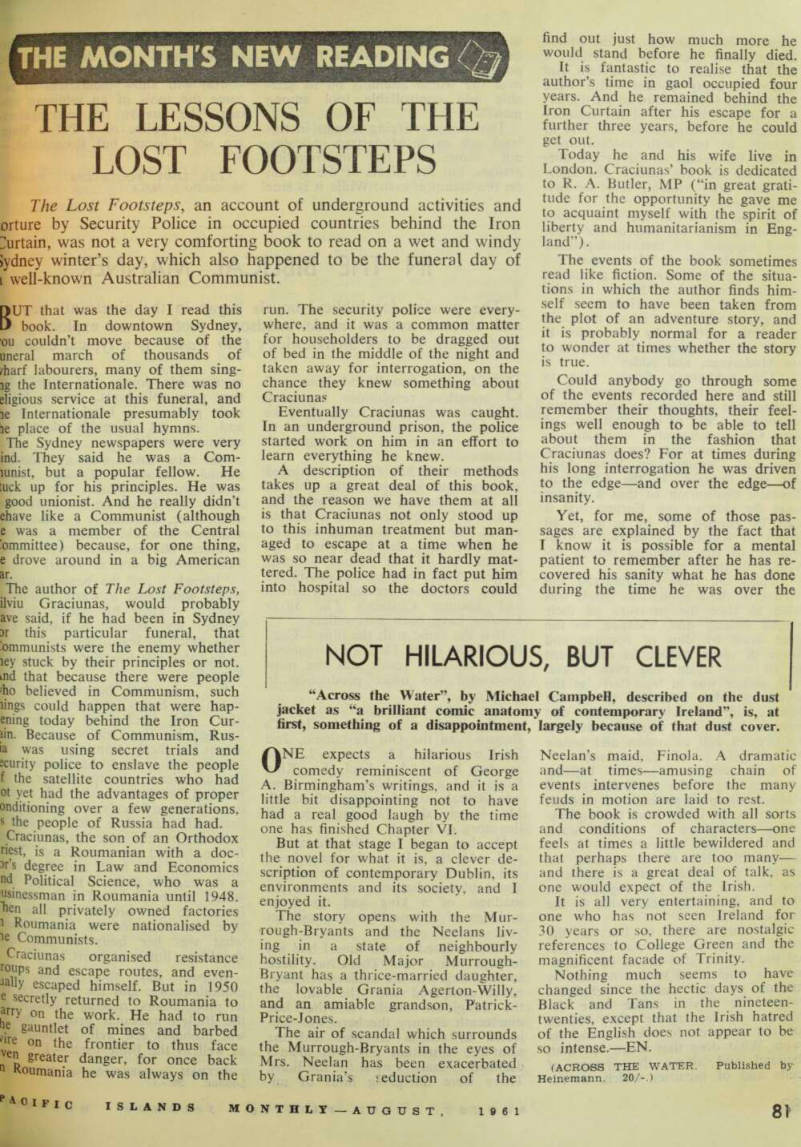
The Lessons Of The
The Lost Footsteps , an account of underground activities and orture by Security Police in occupied countries behind the Iron Curtain, was not a very comforting book to read on a wet and windy tydney winter’s day, which also happened to be the funeral day of i well-known Australian Communist.
BUT that was the day I read this book. In downtown Sydney, ou couldn’t move because of the uneral march of thousands of (harf labourers, many of them sing ig the Internationale. There was no eligious service at this funeral, and le Internationale presumably took le place of the usual hymns.
The Sydney newspapers were very ind. They said he was a Com mnist, but a popular fellow. He tuck up for his principles. He was good unionist. And he really didn’t ehave like a Communist (although e was a member of the Central tommittee) because, for one thing, c drove around in a big American ar.
The author of The Lost Footsteps, ilviu Craciunas, would probably ave said, if he had been in Sydney 3r this particular funeral, that Communists were the enemy whether ley stuck by their principles or not. uid that because there were people 'ho believed in Communism, such lings could happen that were hap ening today behind the Iron Cur fin. Because of Communism, Rus ia was using secret trials and scurity police to enslave the people f the satellite countries who had ot yet had the advantages of proper onditioning over a few generations, s the people of Russia had had.
Craciunas, the son of an Orthodox riest, is a Roumanian with a doc k’s degree in Law and Economics nd Political Science, who was a tfsinessman in Roumania until 1948. nen all privately owned factories 1 Roumania were nationalised by le Communists.
Craciunas organised resistance roups and escape routes, and even ly escaped himself. But in 1950 e secretly returned to Roumania to jrry on the work. He had to run . gauntlet of mines and barbed /ire on the frontier to thus face e n greater danger, for once back Roumania he was always on the
run. The security police were every where, and it was a common matter for householders to be dragged out of bed in the middle of the night and taken away for interrogation, on the chance they knew something about Craciunas Eventually Craciunas was caught.
In an underground prison, the police started work on him in an effort to learn everything he knew.
A description of their methods takes up a great deal of this book, and the reason we have them at all is that Craciunas not only stood up to this inhuman treatment but man aged to escape at a time when he was so near dead that it hardly mat tered, The police had in fact put him into hospital so the doctors could
find out just how much more he would stand before he finally died.
It is fantastic to realise that the author’s time in gaol occupied four years. And he remained behind the Iron Curtain after his escape for a further three years, before he could get out.
Today he and his wife live in London. Craciunas’ book is dedicated to R. A. Butler, MP (“in great grati tude for the opportunity he gave me to acquaint myself with the spirit of liberty and humanitarianism in Eng land”).
The events of the book sometimes read like fiction. Some of the situa tions in which the author finds him self seem to have been taken from the plot of an adventure story, and it is probably normal for a reader to wonder at times whether the story is true.
Could anybody go through some of the events recorded here and still remember their thoughts, their feel ings well enough to be able to tell about them in the fashion that Craciunas does? For at times during his long interrogation he was driven to the edge—and over the edge—of insanity.
Yet, for me, some of those pas sages are explained by the fact that I know it is possible for a mental patient to remember after he has re covered his sanity what he has done during the time he was over the
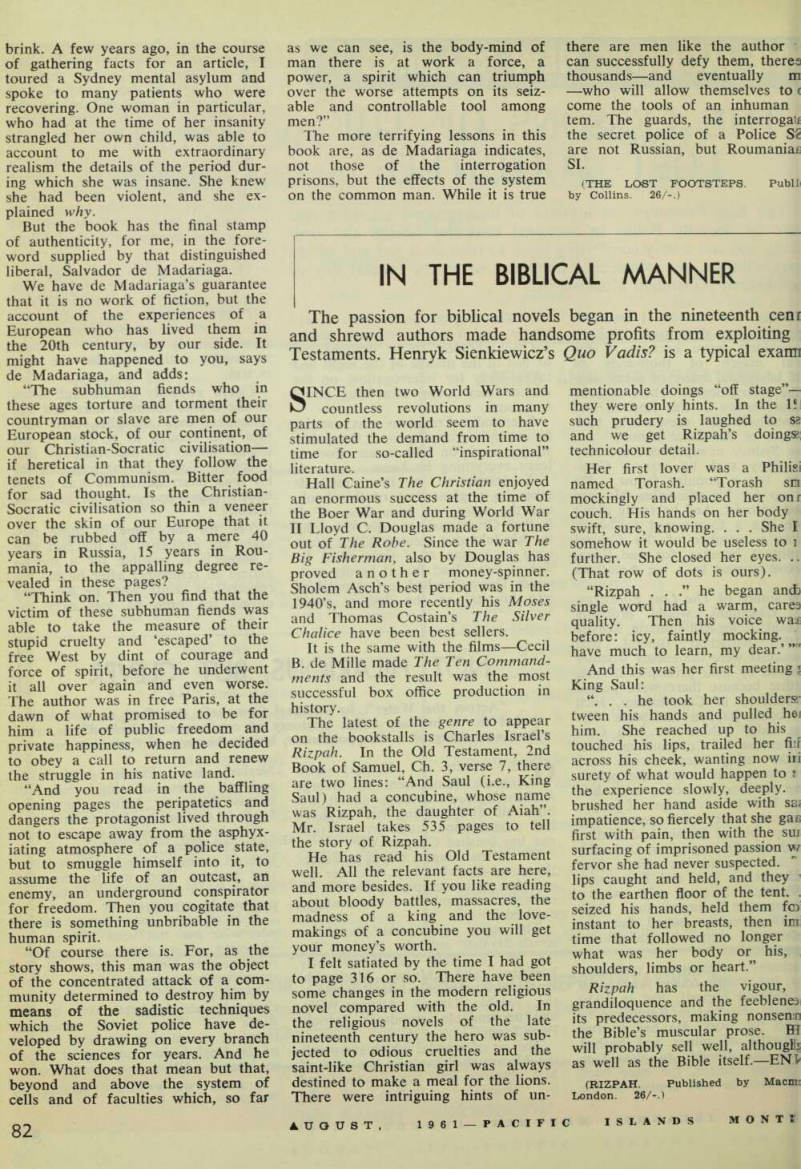
brink. A few years ago, in the course of gathering facts for an article, I toured a Sydney mental asylum and spoke to many patients who were recovering. One woman in particular, who had at the time of her insanity strangled her own child, was able to account to me with extraordinary realism the details of the period dur ing which she was insane. She knew she had been violent, and she ex plained why.
But the book has the final stamp of authenticity, for me, in the fore word supplied by that distinguished liberal, Salvador de Madariaga.
We have de Madariaga’s guarantee that it is no work of fiction, but the account of the experiences of a European who has lived them in the 20th century, by our side. It might have happened to you, says de Madariaga, and adds; “The subhuman fiends who in these ages torture and torment their countryman or slave are men of our European stock, of our continent, of our Christian-Socratic civilisation— if heretical in that they follow the tenets of Communism. Bitter food for sad thought. Is the Christian- Socratic civilisation so thin a veneer over the skin of our Europe that it can be rubbed off by a mere 40 years in Russia, 15 years in Rou mania, to the appalling degree re vealed in these pages?
“Think on. Then you find that the victim of these subhuman fiends was able to take the measure of their stupid cruelty and ‘escaped’ to the free West by dint of courage and force of spirit, before he underwent it all over again and even worse.
The author was in free Paris, at the dawn of what promised to be for him a life of public freedom and private happiness, when he decided to obey a call to return and renew the struggle in his native land.
“And you read in the baffling opening pages the peripatetics and dangers the protagonist lived through not to escape away from the asphyx iating atmosphere of a police state, but to smuggle himself into it, to assume the life of an outcast, an enemy, an underground conspirator for freedom. Then you cogitate that there is something unbribable in the human spirit.
“Of course there is. For, as the story shows, this man was the object of the concentrated attack of a com munity determined to destroy him by means of the sadistic techniques which the Soviet police have de veloped by drawing on every branch of the sciences for years. And he won. What does that mean but that, beyond and above the system of cells and of faculties which, so far
as we can see, is the body-mind of man there is at work a force, a power, a spirit which can triumph over the worse attempts on its seiz able and controllable tool among men?”
The more terrifying lessons in this book are, as de Madariaga indicates, not those of the interrogation prisons, but the effects of the system on the common man. While it is true
there are men like the author can successfully defy them, theres thousands—and eventually m —who will allow themselves to ( come the tools of an inhuman tern. The guards, the interrogate the secret police of a Police S<c are not Russian, but Roumanias SI.
(The Lost Footsteps. Publii
by Collins. 26/-.)