Of Trading
pp. 76-77 · Read in the full issue
One Pound Bought A Chat Of Trading
By R. W. Robson
In the Central Pacific of 50 to 60 years ago, the Hitch fields were notable people.
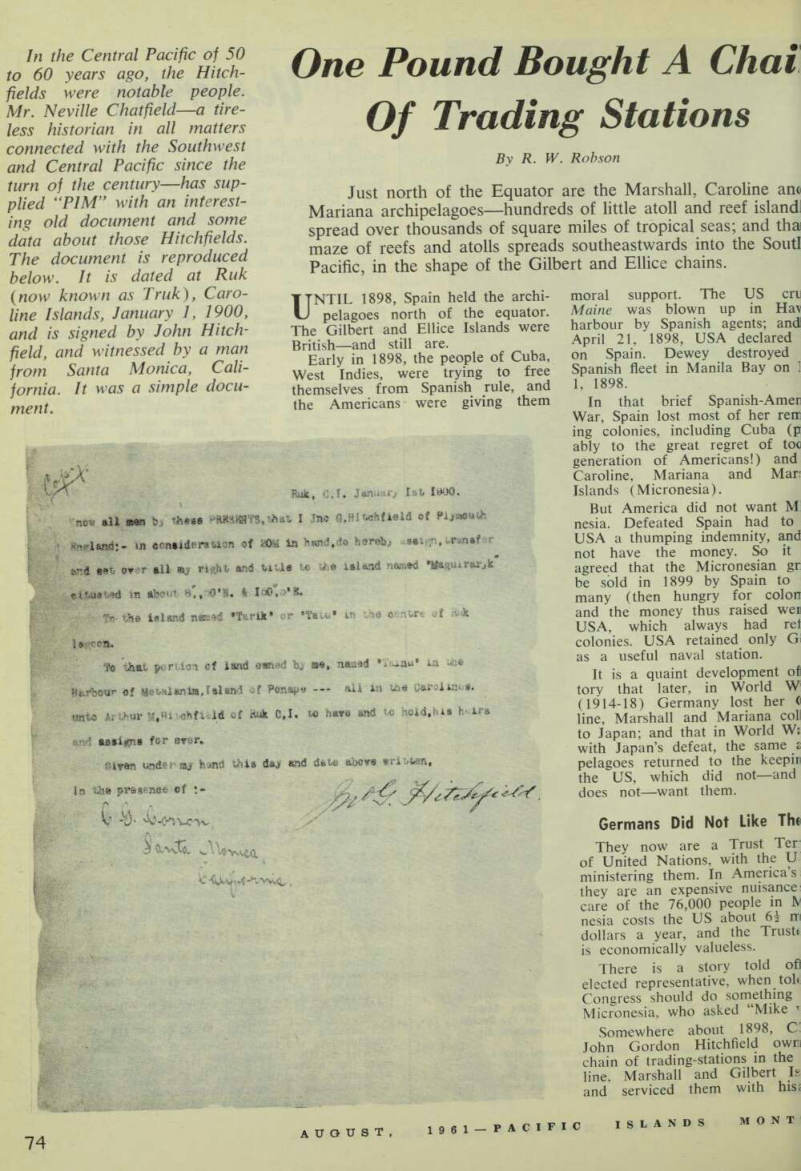
Mr. Neville Chatfield —a tire less historian in all matters connected with the Southwest and Central Pacific since the turn of the century—has sup plied “PIM” with an interest ing old document and some data about those Hitchfields.
The document is reproduced below. It is dated at Ruk (now known as Truk), Caro line Islands, January 1, 1900, and is signed by John Hitch field, and witnessed by a man from Santa Monica, Cali fornia. It was a simple docu ment.
Just north of the Equator are the Marshall, Caroline ano Mariana archipelagoes—hundreds of little atoll and reef island! spread over thousands of square miles of tropical seas; and that maze of reefs and atolls spreads southeastwards into the Soutl Pacific, in the shape of the Gilbert and Ellice chains.
UNTIL 1898, Spain held the archi pelagoes north of the equator.
The Gilbert and Ellice Islands were British—and still are.
Early in 1898, the people of Cuba, West Indies, were trying to free themselves from Spanish rule, and the Americans were giving them
moral support. The US cru Maine was blown up in Ha\ harbour by Spanish agents; and!
April 21, 1898, USA declared on Spain. Dewey destroyed Spanish fleet in Manila Bay on ] 1, 1898.
In that brief Spanish-Amen War, Spain lost most of her rem ing colonies, including Cuba (p ably to the great regret of toe generation of Americans!) and Caroline, Mariana and Man Islands (Micronesia).
But America did not want M nesia. Defeated Spain had to USA a thumping indemnity, and not have the money. So it agreed that the Micronesian gr be sold in 1899 by Spain to many (then hungry for colon and the money thus raised wen USA, which always had ret colonies. USA retained only Gl as a useful naval station.
It is a quaint development ofi tory that later, in World W (1914-18) Germany lost her C line, Marshall and Mariana coll to Japan; and that in World Wi with Japan’s defeat, the same s pelagoes returned to the keepin the US, which did not —and does not—want them.
Germans Did Not Like Thf They now are a Trust Ter of United Nations, with the U ministering them. In America s they are an expensive nuisance: care of the 76,000 people in JV nesia costs the US about 6i m dollars a year, and the Trust* is economically valueless.
There is a story told ofl elected representative, when tok Congress should do something Micronesia, who asked Mike 1 Somewhere about 1898, C, John Gordon Hitchfield own chain of trading-stations in the line, Marshall and Gilbert Is and serviced them with his;
chooner, which he usually navi ;ated himself.
Changes in Islands proprietorship lust have worried him. He could et along well with the Spaniards, nd he had no quarrel with the Americans; but the trading climate hanged appreciably with the advent f the Germans.
The up-and-coming Australian rm of Burns Philp & Co. had been •ying to extend shipping and trad ig operations into Micronesia, laptain Hitchfield evidently decided e could do more good for himself s a navigator and trader for Burns hilp rather than as a lone fighter, o he persuaded his brother Arthur fcDonald Hitchfield—who was icely established as a trader at ’oinawa, Abaian, in the Gilbert ilands—to move up into Ruk (now died Truk—no one knows why) ad take over the Hitchfield property tere.
Enter BP's Captain Hitchfield sold his estab shments in the Carolines to his rother for 20 German marks (ap roximately £1 Sterling), and the Id document in Mr. Chatfield’s pos ssion (reproduced herewith) shows aw the sale was arranged.
Burns Philp & Co. entered the ilbert and Ellice service under a ail contract with the Australian overnment in 1902, and Captain itchfield commanded the Ysabel hen she made her first run to the ilberts in March, 1902. But he made ily one run—he left the BP ser ce late in 1902 and was succeeded f Captain Voy—and Captain Hitch ed disappears from this history.
But we have a record of brother rthur Hitchfield until 1936.
At first, taking up where his rother left off, he fought the Ger man traders in the Carolines; but, as generally known, the Germans in ieir Pacific Islands colonies used rery trick and device to drive out on-German traders and shippers; id in 1902 Arthur Hitchfield had it, and sold the properties he *d acquired from brother John.
Arthur Hitchfield then visited u rope; returned in 1903 to his ading post in Abaian, Gilbert u/u’ and sett l e d down.
When World War I came, Arthur 11 the Gilberts and travelled to °gland. He wanted to enlist, and * Ve at least one shot at the people no had driven him out of the Caro -2' But he was too old for en em 1 ’ and returned t 0 the Gil- I ,u f. 1933, Arthur Hitchfield from the Gilberts to Fiji, > with his younger daughter, Ger
trude, went to live in Suva. There, he was a popular figure—once he carried off the singles championship at the Suva Bowling Club. In 1936 he went on to Sydney for medical treatment, and died there a few months later.
“Arthur Hitchfield was the finest character and most loyal English man I met in all my South Seas experience,” says Mr Chatfield “The two brothers, John Gordon and Arthur, were sons of Commander John Hitchfield, of the Royal Navy.”