Portuguese Timor
pp. 73-97 · Read in the full issue
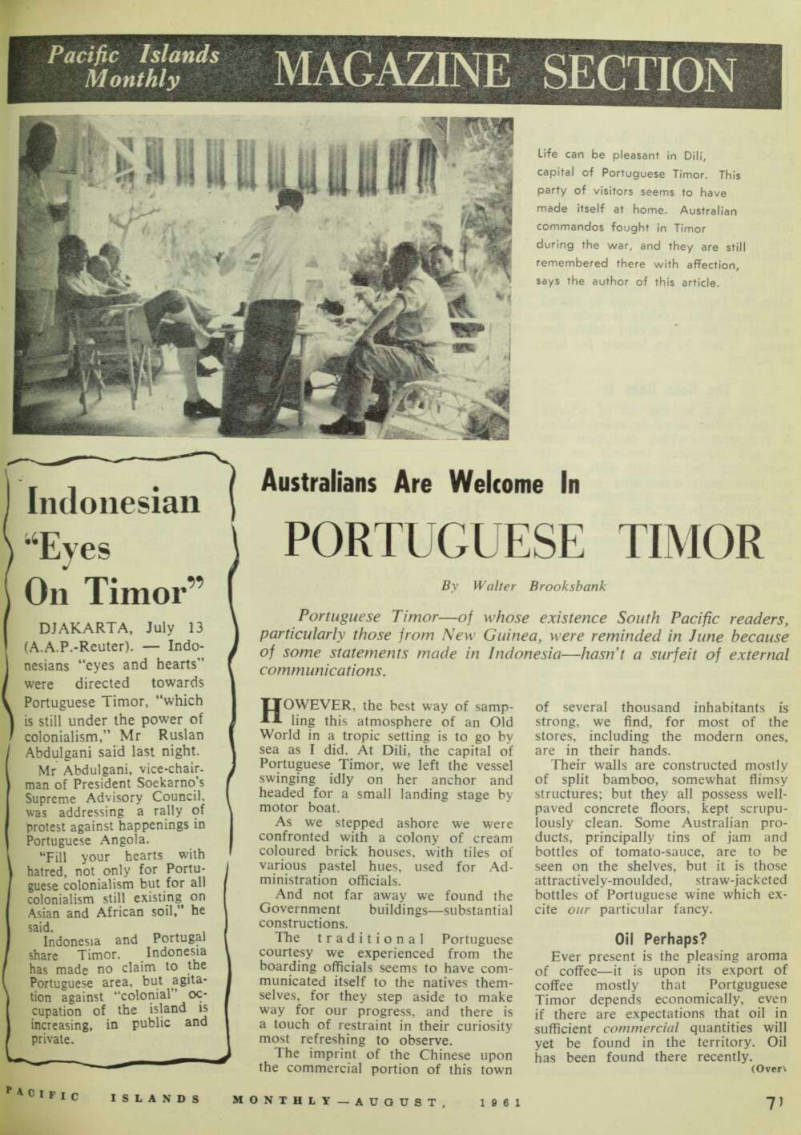
Australians Are Welcome In
By Walter Brooksbank
Portuguese Timor—of whose existence South Pacific readers, particularly those from New Guinea, were reminded in June because of some statements made in Indonesia — hasn't a surfeit of external communications.
HOWEVER, the best way of samp ling this atmosphere of an Old World in a tropic setting is to go by sea as I did. At Dili, the capital of Portuguese Timor, we left the vessel swinging idly on her anchor and headed for a small landing stage by motor boat.
As we stepped ashore we were confronted with a colony of cream coloured brick houses, with tiles of various pastel hues, used for Ad ministration officials.
And not far away we found the Government buildings—substantial constructions.
The traditional Portuguese courtesy we experienced from the boarding officials seems to have com municated itself to the natives them selves, for they step aside to make way for our progress, and there is a touch of restraint in their curiosity most refreshing to observe.
The imprint of the Chinese upon the commercial portion of this town
of several thousand inhabitants is strong, we find, for most of the stores, including the modern ones, are in their hands.
Their walls are constructed mostly of split bamboo, somewhat flimsy structures; but they all possess well paved concrete floors, kept scrupu lously clean. Some Australian pro ducts, principally tins of jam and bottles of tomato-sauce, are to be seen on the shelves, but it is those attractively-moulded, straw-jacketed bottles of Portuguese wine which ex cite our particular fancy.
Oil Perhaps?
Ever present is the pleasing aroma of coffee—it is upon its export of coffee mostly that Portguguese Timor depends economically, even if there are expectations that oil in sufficient commercial quantities will yet be found in the territory. Oil has been found there recently. (Oven
The sun is striking down on us rather fiercely and before long we seek relief from its heat in an at tractive beer-garden close by the waterfront. Surrounding us are some obviously long established residences distinctively Portuguese in design and fitted with their characteristically
brightly-painted shutters.
At length a musical-comedy type of waiter leisurely unfolds himself from the loggia and comes to attend our wants. Our anxiety is soon dis pelled: si, he will accept Australian money, it will be an honour for him to do so!
The Beer Does It There is a sudden stir of activity at one of the other occupied tables.
A prosperous-looking merchant gets up and advances towards us. It seems that the rapidity with which we have been consuming our beer has stamped us as Australians! Our newly-found friend also once visited Australia. His somewhat faulty English is more than compensated for by the warmth of his handshakes, and we have the feeling that hospi tality is about to be lavished on us!
And so it proves! . . . Fortified now by a delectable Chinese meal, washed down by the choicest of Portuguese wines, at last we recom mence, now in the tender care of our mentor, our sightseeing tour of Dili. . . • The Cathedral, the jewel which was once the pride and joy of Dili: built largely from donations subscribed from Portugal, Macao, Singapore and Goa, and noted for the gorgeous richness of its furnish ings, it is, now only a rubble-heap.
The irony of it all is that it was bombed by Allied aircraft during the time that Dili was in Japanese hands.
We soon meet and pass the market, an unusual-looking, quite imposing building, with its ornate facade, as we climb in our hosts car on our way up to the loftily situated original site of the town. We narrowly miss extinction at the hands of a truck driven by a native. Sundry age-old houses, composed of palapa palm and stone, come into view.
Now a real surprise awaits us— th" De Carvalho Hospital. Superbly situated, the hospital, with its new concrete wing, is extensive and very well equipped. As we are conducted
around the spacious wards by an obliging young Portuguese surgeon, perfectly at home with his English, we note that, in the allocation of patients there is no racial discrimina tion. Portuguese nationals, Chinese Timorese natives—all may be seen in any one ward. Somewhat unex pectedly, we are permitted entry even to the maternity ward! Here there proves to be a preponderance of young Timorese mothers; country types they appear to be mostly, and a never-ceasing wonderment is writ ten in their large attractive eyes.
We hear an interesting story surrounding the De Carvalho Hospi tal. It was erected partly as a memorial to a Government medical officer of that name who, some 70 years or so ago, distinguished him
self by his heroic self-sacrifice wl there broke out at Dili an epidei of bubonic-plague. At the time Carvalho had just completed his I years of service in the territory was about to go home to Portr to enjoy his retirement. When plague struck the town he cance his passage and remained on to n ister to the sufferers. Several w( later he himself was stricken by disease and died.
The Army barracks at nearby 1 bisse are next on our visiting Here, the sentry offering no ot tion to our entry and appare welcoming the diversion, we fin collection of particularly solid bi ings set at all sorts of hapha; angles. We had been under the
(Continued on p. 93>
pectation of seeing some ebony skinned Angolese troops drawn from Portuguese West Africa, but no longer we find do they form part of the garrison.
Our attention concentrates upon a platoon of khaki-clad Timorese native troops undergoing instruction in squad-drill by a Portuguese army n.c.0., uniformed in slate-blue and who at the moment, unjustifiably it
;ems to us, is dispensing that par ilar brand of hell reserved for :ercise by n.c.o.’s.
Striding across the parade-ground a manner which indicates that he on some duty bent, a Portuguese rmy officer suddenly checks his ride on observing our little party id, with a wave of recognition to irds our mentor, now advances to eet us.
The Good Things of Life The house, one of the married larters, in which, after a short con icted tour, he begins to entertain , is small, but its walls are thick and the place is delightfully cool, ic glass face of a spacious cabinet obvious antiquity permits of the ;ht within of a wide assortment wines and liqueurs.
From within now comes the sound footsteps; the beaded curtains rt with a musical tinkle, and a lishly dressed young woman ps daintily across the mat-strewn or.
Olive-skinned, her features classi lly moulded, a tinge of blue in r glossy raven hair, she is quite beauty, this young woman. Pre nably she is the wife of our tem rary host; and, as we stumble ough the introductions, she ex >its a vivaciousness which ren rs her even more attractive.
Presently several more Fortu ne Army officers and their wives ive, and soon conversation is tak [ place on terms at least partly lerstandable by all.
Buffalo Shoot Do we intend to visit the interior? 1 we wish to engage in deer-hunt- I and go on a buffalo shoot? )uld we like to inspect a coffee rotation? We will, of course, be iflng a visit to Bacau, so beauti fy situated in the hill country, ere there is a large airfield, a rofortable hotel and a delightful imming-pool? Do we intend to 'i a visit to the area where drill- I for oil is being carried out? To of these questions, we answer to our great regret, our ship due to sail at daybreak and that *“1 not be possible. At daybreak? we de Dios, so soon as that! 1 18 n . ow our turn to ask questions. ® soc i a l life here at Dili. In this [ Post Of Portuguese colonisation, tar removed from the Mother uutry, do the womenfolk find the : too lonely for them? No, as edly n ot! The Army; the Adminis «on; the clergy; the consular rep utatives; the merchants: these ' ments constitute the pattern of
society, and life is never really dull.
At last we succeed in taking our farewells—at least so it seems. But our newly-acquired friends are among the crowd assembled at our point of departure from Dili—this pontoon-jetty, bobbing alarmingly on the waters, ruffled by this strong breeze which has sprung up unex pectedly from the west. One seeks for a fixed object upon which to focus one’s gaze—and finds it there, somewhat hazily outlined against this miracle of a saffron-tinted sky, in the form of Atauro Island, of that island, which, we have learnt, is a penal settlement, once accommo dating not only criminals but de portados expelled from Portugal dur ing troublous times in its history.
On our expression of surprise at the large number of natives who by now had gathered to see us leave it was explained to us that the word had gone around the town that we were Australians, and that the natives still cherished a strong affec tion for the Australian commandos who had fought so gallantly and with whom they shared their misfor tunes during the Japanese occupa tion. «... , ...
Adios. Actios.
Patiently the natives present have awaited the conclusion of the fare wells tendered to us, but, as our motor-boat begins to get under way, they now give full-throated vent to their own sentiments.