Insecurity Is
pp. 67-69 · Read in the full issue

Still A Ng
Talking Point
From a NG Correspondent Fear of future economic and political insecurity in the Trust Territory of New Guinea (and in the Territory of Papua, too, for that matter) continue to occupy a big part of the thoughts of people associated with the Terri
tory.
THE extent to which the fear is justified is open to doubt. There is considerable weight in the belief that it may be nothing but the out come of a gloomy outlook.
In any case, the fears received a knock on the head in two state ments here in the past few weeks, and both statements are therefore worth recording and examining.
The first came from a smooth talking native leader, Stanis Boramilat, from the Gazelle Peninsula of New Britain; and the second was delivered by the Leader of the Australian Federal Parlia mentary Labour Party, Mr. A. A.
Calwell, as he left Port Moresby after touring P-NG. The tour, incidentally, w as Mr. Calwell’s fourteenth of p-ng, so he is no starry-eyed new comer.
Stanis Boramilat has sometimes been accused of insincerity because of the glib nature of some of his speeches ln public. But he is one of the few
Tolai native leaders with fluency in English, and his method of using the language is probably the only reason for the accusations.
The fact remains that Stanis rose to his feet at a Rabaul meeting and gave an impassioned assurance that the native people of New Guinea would not turn Australians out of New Guinea when self-government came. He hinted in addition that the dream of self-government was far from being a practical reality in the foreseeable future.
With a sweep of his hands, Stanis appealed for tolerance towards “the ignorance of some of our people who might unthinkingly say silly things to the contrary”.
He said that Australians and what he termed “other friendly white races”
would always be welcome in New Guinea. The main reason motivating his statements, he said, was to issue an assurance to some Australians who « ere worried about the future of New Gumea - The mass of the native people would be genuinely surprised to learn that some Australians were worried.
“There is a mutual future for all of us here, and we will certainly not turn against the people who are help ing us”, Stanis added, Stanis sa i d his people were work ing for the day when they would be businessmen, professional men, gov ernment officers and missionaries, but not to supplant Australians in this work.
He said that his people could not easily forget the Australian blood
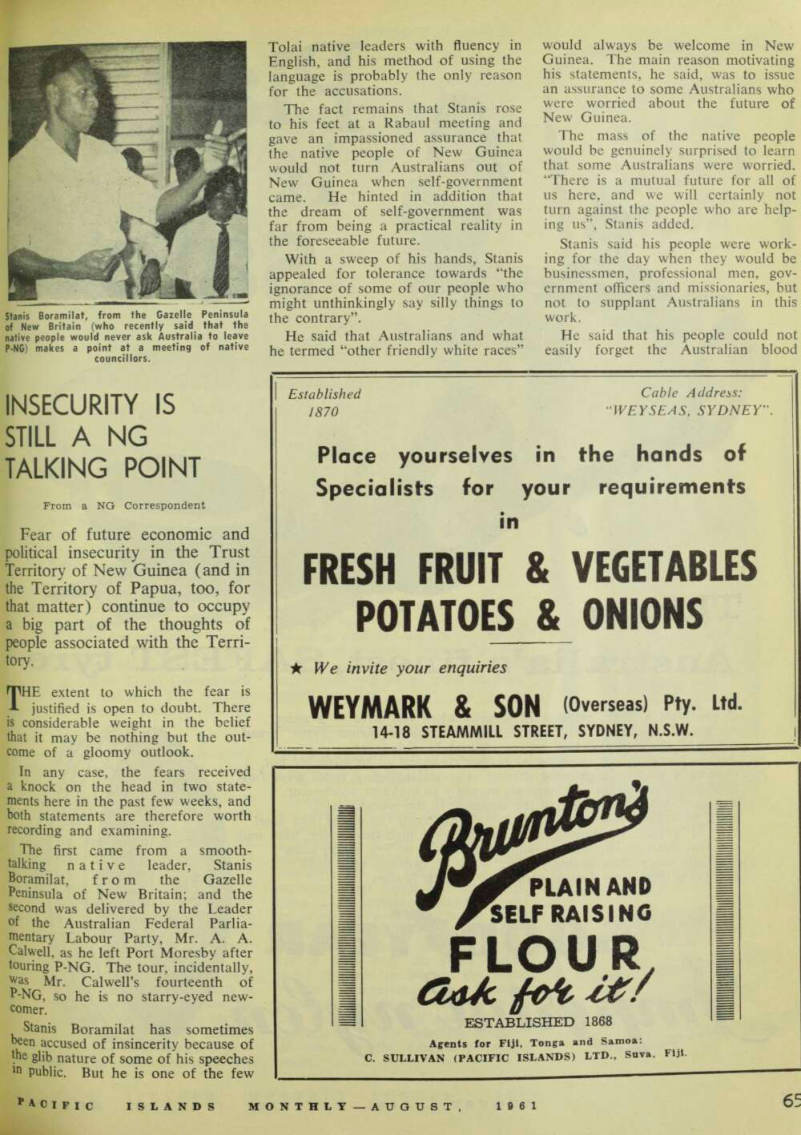
Stanis Boramilat, from the Gazelle Peninsula of New Britain (who recently said that the native people would never ask Australia to leave P-NG) makes a point at a meeting of native councillors.
which had been shed in New Guinea during the Pacific war, and this was an added cause for continued friend ship.
Stanis made his address at a meeting of native Local Government councillors in Rabaul. The Admini strator, Sir Donald Cleland, attended the meeting.
Mr. Calwell, speaking in Port Moresby, said that he had on every possible occasion discussed with native leaders their feelings towards self-government and their feelings towards continued association with Australia.
Without exception, he said, the natives had assured him that there would always be a place for Aus tralians and other friendly-disposed People in New Guinea. In addition they had indicated that the native people had many years to go before they would be ready for self government.
Even when self-government came, they believed mutual development of the territory would still continue be tween Australia and the native people.
Mr. Calwell added: “It is morally obvious that the final choice regard ,n 8 the future must rest with the
native people rather than with Aus tralia or any other nation. But at the same time the natives are firmly of the opinion that when the time for the choice comes, the practical impact will not be as great as some people may feel”.
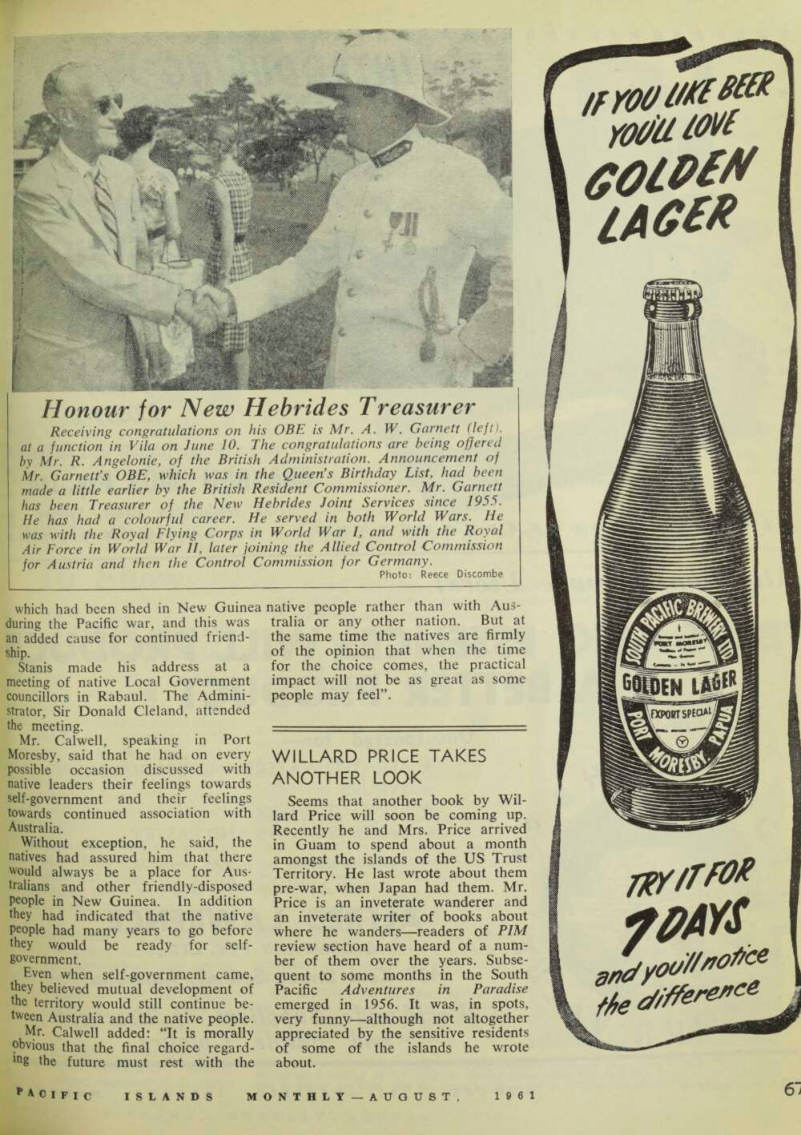
Honour for New Hebrides Treasurer
Receiving congratulations on his OBE is Mr. A. W. Garnett (left), at a function in Vila on June 10. The congratulations are being offered by Mr. R. Angelonie, of the British Administration. Announcement of Mr. Garnett’s OBE, which was in the Queen’s Birthday List, had been made a little earlier by the British Resident Commissioner. Mr. Garnett has been Treasurer of the New Hebrides Joint Services since 1955.
He has had a colourful career. He served in both World Wars. He was with the Royal Flying Corps in World War I, and with the Royal Air Force in World War II, later joining the Allied Control Commission for Austria and then the Control Commission for Germany.
Photo: Reece Discombe