Double Canoe Revives
pp. 47-51 · Read in the full issue
An Old Art
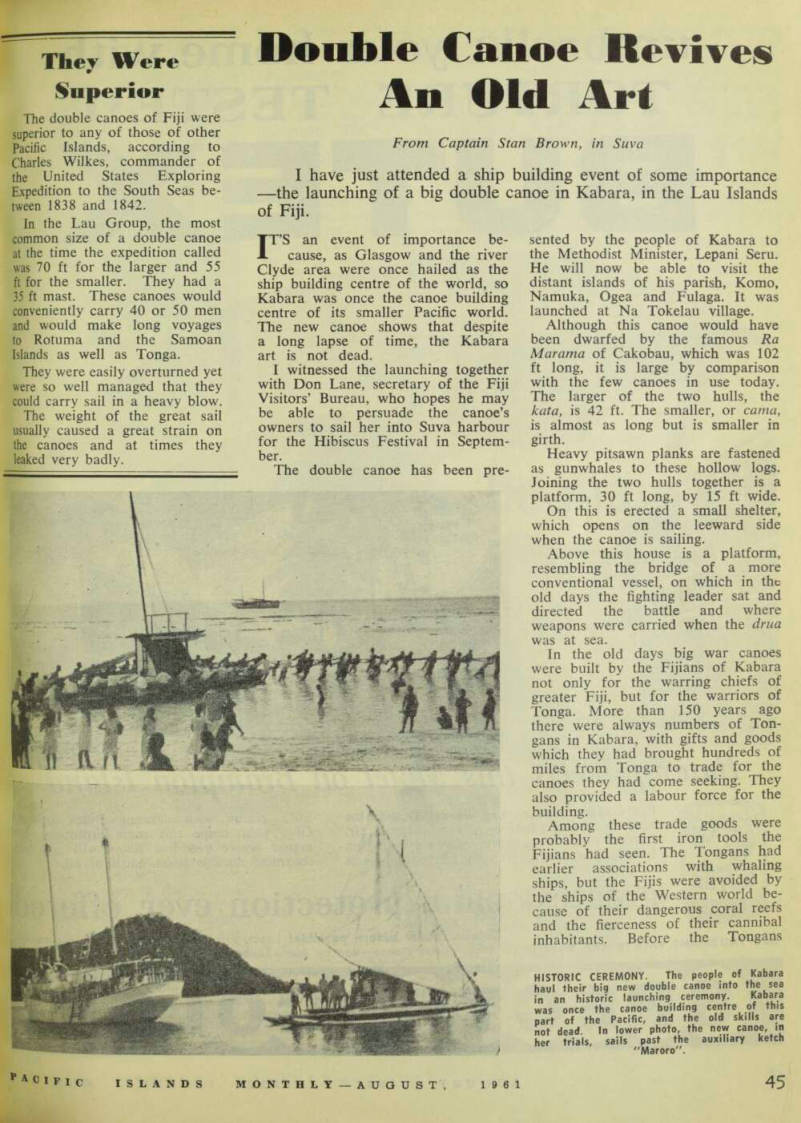
From Captain Stan Brown, in Suva I have just attended a ship building event of some importance —the launching of a big double canoe in Kabara, in the Lau Islands of Fiji.
IT’S an event of importance be cause, as Glasgow and the river Clyde area were once hailed as the ship building centre of the world, so Kabara was once the canoe building centre of its smaller Pacific world.
The new canoe shows that despite a long lapse of time, the Kabara art is not dead.
I witnessed the launching together with Don Lane, secretary of the Fiji Visitors’ Bureau, who hopes he may be able to persuade the canoe’s owners to sail her into Suva harbour for the Hibiscus Festival in Septem ber.
The double canoe has been pre
sented by the people of Kabara to the Methodist Minister, Lepani Seru.
He will now be able to visit the distant islands of his parish, Komo, Namuka, Ogea and Fulaga. It was launched at Na Tokelau village.
Although this canoe would have been dwarfed by the famous Ra Marama of Cakobau, which was 102 ft long, it is large by comparison with the few canoes in use today.
The larger of the two hulls, the kata, is 42 ft. The smaller, or cama, is almost as long but is smaller in girth.
Heavy pitsawn planks are fastened as gunwhales to these hollow logs.
Joining the two hulls together is a platform, 30 ft long, by 15 ft wide.
On this is erected a small shelter, which opens on the leeward side when the canoe is sailing.
Above this house is a platform, resembling the bridge of a more conventional vessel, on which in the old days the fighting leader sat and directed the battle and where weapons were carried when the drua was at sea.
In the old days big war canoes were built by the Fijians of Kabara not only for the warring chiefs of greater Fiji, but for the warriors of Tonga. More than 150 years ago there were always numbers of Ton gans in Kabara, with gifts and goods which they had brought hundreds of miles from Tonga to trade for the canoes they had come seeking. They also provided a labour force for the building.
Among these trade goods were probably the first iron tools the Fijians had seen. The Tongans had earlier associations with whaling ships, but the Fijis were avoided by the ships of the Western world be cause of their dangerous coral reefs and the fierceness of their cannibal inhabitants. Before the Tongans
HISTORIC CEREMONY. The people of Kabara haul their big new double canoe into the sea in an historic launching ceremony. Kabara was once the canoe building centre of this part of the Pacific, and the old skills are not dead. In lower photo, the new canoe, in her trials, sails past the auxiliary ketch "Maroro".
brought the iron tools, the Fijians built their canoes from logs that had been hollowed out by fire and smoothed with stone adzes.
Outrigger canoes are still sailed in the southern Lau group, but the days of these big double canoes ceased after the death of Cakobau, and the end of tribal warfare. The larger canoes were mainly for war fare.
Since 1910 A double canoe was built in Kabara in 1910, and presented to the church. A small one was sailing in Lau before the Pacific war, and it was found recently by David At tenborough and featured in his TV series for the BBC, People of Para dise.
It is five years since the two trees were selected and felled for the hulls of the double canoe just launched.
After several years of seasoning, they were hollowed and shaped by a xe and adze.
It was not until September, 1960, that the two hulls were carried out of the bush two miles from the vil lage and taken down to the building site.
This was an operation that needed the combined efforts of the entire male population of Kabara.
Ahead and astern of the platform the hulls are decked over, each with a single carved piece of timber that Provides a watertight cover for the oeck, and which carries a consider able amount of carving.
Some of it is merely decorative
but the major portion provides fair leads for the rigging, a butt for the forward end of the yard, and drain age scuppers.
The sail is of the traditional mat ting type of pandanus fibre attached to a boom and a yard, each 30 ft in length. The two steering oars are huge affairs, each carved from a single log.
Almost all of the timber used is vesi.
The sailing principle is similar to that in use in smaller canoes, where the outrigger is kept to windward. In this case the small hull, which bears the same name as an outrigger, is always the windward hull.
When it is necessary to go about, wind is spilled from the sail and the foot of the yard is transferred to the other end of the canoe and butted against a duplicate carved projection.
The steering oar is shipped, and the oar which has been carried forward is used on the new tack.
While the launching ceremony may have lacked the drama of earlier launchings (when the canoes were rolled over the bodies of prisoners taken in battle!) the ceremonies con nected with it were traditional and colourful.
After a speech of welcome to the visitors, the canoe was presented by the carpenters to the people of
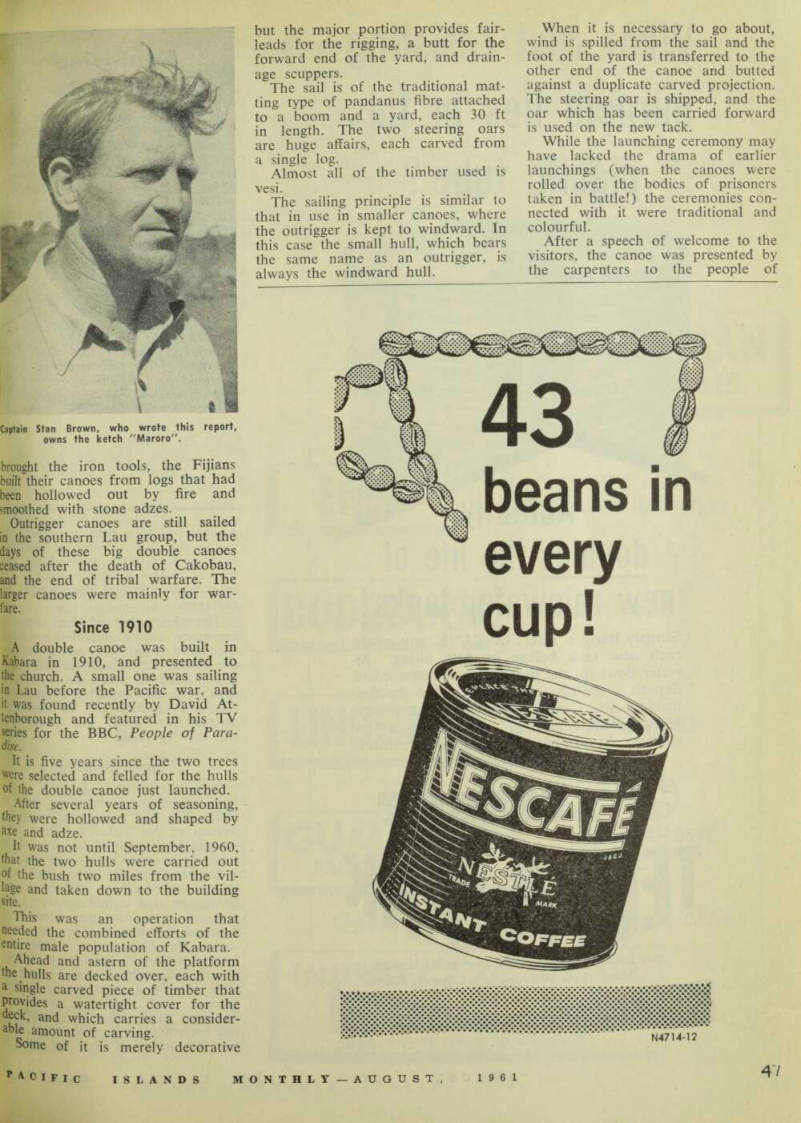
Captain Stan Brown, who wrote this report, owns the ketch "Maroro".
Kabara, who in turn present* canoe to the Methodist Mi Both presentations involved th ing of tabua (whale’s tooth in each case received ceremon ceptance.
The christening of the car ceremony once involving bloodshed, was now perform the wife of Lepani, Kasanita 1 She poured oil over the bow deckhouse and named the can Gaunavou (which can be trai as the New Era). The cano still on dry land.
Tongan Memories
After the christening, each four villages of Kabara presei meke. The first performers we women of Na Tokelau villag< presented a vakamalolo, dres; green and red costumes and w a headdress made of coconu spines and feathers. These ments are used in mekes only part of Lau, on the islan Kabara and Komo. The mei women of Naikeleaga villag* formed a Tongan lakalaka reo a time when the Tongans ca these islands in great number; coconut leaf ( tekiteki ) hea was seen again when a vakar was presented by Lomati villag the last meke of the day 1
spirited club dance by the men of Udu village.
After two hours of ceremonies, we then had lunch in the form of the traditional feast. The launching was to take place after this, and at two o’clock the call went out for all men and women to assemble.
As the canoe was more than a mile from the beach, the road made of sand, and the canoe extremely heavy, the task appeared to be one that would take the rest of the day!
But coconut fronds were cut and placed upside down on the road, and with the whole village pulling on ropes, or pushing from behind, the journey was made in about 30 minutes. The canoe skidded easily over the centre stems of the fronds.
In the water, the sail was raised for sailing trials.
The man most responsible for the canoe’s construction was Laitia Ledua (who won the Military Medal in the Solomons when serving with the Ist Battalion FIR). Yet he had never previously built such a canoe, nor had he assisted in the building of one. His knowledge was handed down, as is the case with many of the old Islands crafts. It came from his father, Tadu a famous builder.
Besides many canoes, Tadu had be fore the war built a 50-ton cutter in Kabara.
Many Hands
Laitia was helped, of course. Due to the great amount of carving that is done in Kabara in the production of kava bowls, there are many men who are extremely handy with tools.
Most of the men of the island were thus able to assist in her building.
For those less skilled there were still jobs to do, such as the trans porting of the heavy hulls from the bush to the building site.
Although it was decided that the wind was too light on the day of her launching to properly assess the sailing qualities of the canoe, we enthusiastically accepted the invita tion to go for a sail.
She sailed cleanly and comfortably with 20 men on board. She will not carry that number when sailing in the open sea.
After we left, she made her maiden voyage—to Lakeba—and Lepani reported that he was well satisfied with her performance.
Kabara thus has proved that she an s tUl do it—and that the island °uld still be a canoe building centre.
Yet double canoes of the Na aunavou type are really no longer «;Aii e^ ono , mic proposition. She may w «« be the last of her kind.