In Fiji History?
pp. 31-35 · Read in the full issue

" Lost” Manuscript May Tell...
Have These Men A Place In Fiji History?
By Robert Langdon
A valuable manuscript which fills in a gap in early Pacific history and adds yet another chapter to the famous mutiny on the Bounty story has recently been acquired by the Mitchell Library, Sydney. The manuscript also raises a lot of interesting questions.
THE manuscript is the narrative of *• Midshipman David Thomas Renouard describing an epic voyage in a small ship from Samoa to Java in 1791. Only barest details of the voyage were previously known.
Renouard was a midshipman in HMS Pandora when it sailed to the Pacific in 1790 to find and arrest the
Bounty mutineers.
The Pandora, under Captain Edward Edwards, arrived in Tahiti on March 23, 1791.
Fourteen mutineers who were on the island were arrested, and a hand some 3 3-ft schooner that they had built under the guidance of James Morrison, the Bounty’s boatswain’s mate, was confiscated.
Captain Edwards had the schooner refitted to accompany the Pandora on its voyage across the Pacific in search of Fletcher Christian and t . °. t^ler mutineers who had left Tahiti in the Bounty.
Nine of the Pandora’s crew were assigned to man the schooner, which Captain Edwards named the Matavai,
after the bay in Tahiti where the Pandora anchored.
The nine men were a 20-year-old master’s mate called Oliver (com mander), 16-year-old Midshipman Renouard, Francis Dobbs, quarter master, and six seamen.
The Pandora and Matavai left Tahiti on May 19, 1791, and sailed westward, visiting various islands in search of the missing mutineers. On June 21, they reached Tutuila, Eastern Samoa.
Scene of Massacre This island, unknown to Edwards, was where Count de Langle and 11 other members of La Perouse’s ex pedition had been massacred in 1787.
The Matavai went in close to reconnoitre the coast while the Pandora stood four or five leagues off. The schooner was soon sur rounded by dozens of canoes filled with hostile natives, who tried to board it.
One native was killed and several
were wounded when Oliver ordered his men to fire. The rest jumped into the water and swam to the shore, dragging their canoes behind them.
Oliver and his men then noticed with alarm that the Pandora was standing out to sea with a brisk, late afternoon wind. The schooner could not follow it as it was becalmed under Tutuila’s lofty mountains.
It was nearly sunset before a breeze sprang up, enabling it to set off in pursuit. The crew lost sight of the Pandora when night fell but continued to stand on the same course as when it was last seen.
At daylight they were horrified to find that the Pandora was not in sight. Because the schooner had only six pints of water and a gallon of rum on board, Oliver had to make a quick decision. (Over)
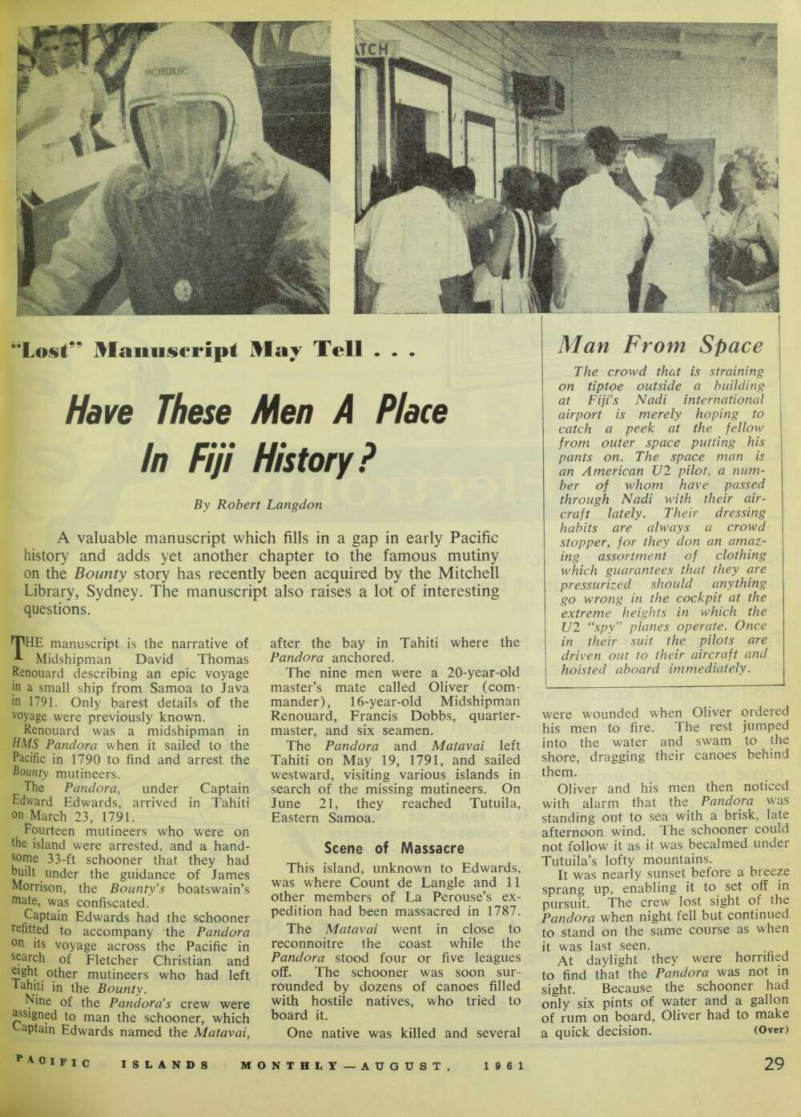
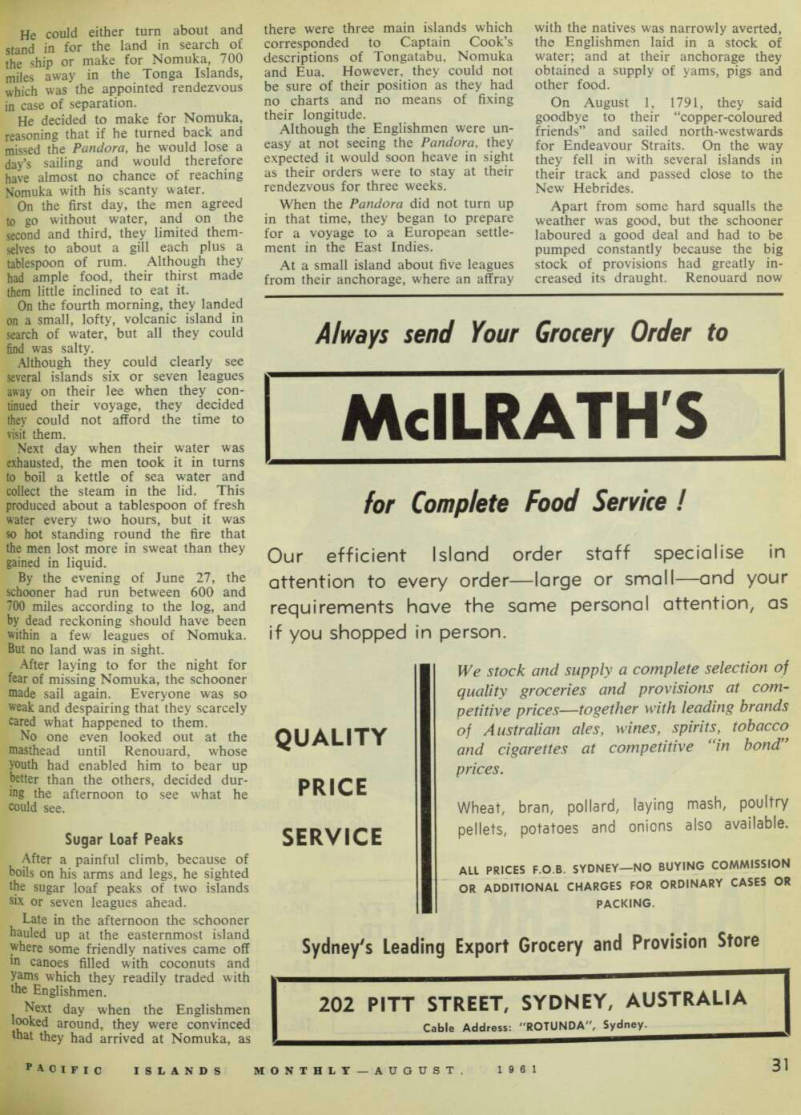
Man From Space
The crowd that is straining on tiptoe outside a building at Fiji’s Nadi international airport is merely hoping to catch a peek at the fellow from outer space putting his pants on. The space man is an American U 2 pilot, a num ber of whom have passed through Nadi with their air craft lately. Their dressing habits are always a crowd stopper, for they don an amaz ing assortment of clothing which guarantees that they are pressurized should anything go wrong in the cockpit at the extreme heights in which the
U 2 “spy” planes operate. Once
in their suit the pilots are driven out to their aircraft and hoisted aboard immediately.
He could either turn about and stand in for the land in search of the ship or make for Nomuka, 700 miles away in the Tonga Islands, which was the appointed rendezvous in case of separation.
He decided to make for Nomuka, reasoning that if he turned back and missed the Pandora, he would lose a day’s sailing and would therefore have almost no chance of reaching Nomuka with his scanty water.
On the first day, the men agreed to go without water, and on the second and third, they limited them selves to about a gill each plus a tablespoon of rum. Although they had ample food, their thirst made them little inclined to eat it.
On the fourth morning, they landed on a small, lofty, volcanic island in search of water, but all they could find was salty.
Although they could clearly see several islands six or seven leagues away on their lee when they con tinued their voyage, they decided they could not afford the time to visit them.
Next day when their water was exhausted, the men took it in turns to boil a kettle of sea water and collect the steam in the lid. This produced about a tablespoon of fresh water every two hours, but it was so hot standing round the fire that the men lost more in sweat than they gained in liquid.
By the evening of June 27, the schooner had run between 600 and 700 miles according to the log, and by dead reckoning should have been within a few leagues of Nomuka.
But no land was in sight.
After laying to for the night for fear of missing Nomuka, the schooner made sail again. Everyone was so weak and despairing that they scarcely cared what happened to them.
No one even looked out at the masthead until Renouard, whose youth had enabled him to bear up better than the others, decided dur ing the afternoon to see what he could see.
Sugar Loaf Peaks After a painful climb, because of boils on his arms and legs, he sighted the sugar loaf peaks of two islands six or seven leagues ahead.
Late in the afternoon the schooner hauled up at the easternmost island where some friendly natives came off in canoes filled with coconuts and yams which they readily traded with
the Englishmen.
Next day when the Englishmen looked around, they were convinced that they had arrived at Nomuka, as
there were three main islands which
corresponded to Captain Cook’s
descriptions of Tongatabu, Nomuka and Eua. However, they could not be sure of their position as they had no charts and no means of fixing their longitude.
Although the Englishmen were un easy at not seeing the Pandora, they expected it would soon heave in sight as their orders were to stay at their rendezvous for three weeks.
When the Pandora did not turn up in that time, they began to prepare for a voyage to a European settle ment in the East Indies.
At a small island about five leagues from their anchorage, where an affray
with the natives was narrowly averted, the Englishmen laid in a stock of water; and at their anchorage they obtained a supply of yams, pigs and other food.
On August 1, 1791, they said goodbye to their “copper-coloured friends” and sailed north-westwards for Endeavour Straits. On the way they fell in with several islands in their track and passed close to the New Hebrides.
Apart from some hard squalls the weather was good, but the schooner laboured a good deal and had to be pumped constantly because the big stock of provisions had greatly in creased its draught. Renouard now
began to suffer a reaction from his earlier privations and for much of the time was delirious.
On reaching the northernmost part of the Great Barrier Reef towards the end of August, the schooner was almost shipwrecked. (This was at the very time that the Pandora was wrecked a couple of hundred miles further south).
A week passed before the schooner cleared the numerous shoals, sandy keys and islands that lay in its path.
The Englishmen did not see the coast of Australia in their passage, but they did have “a very extensive view of the southern part of New Guinea”.
Beyond the reef, the schooner sailed at the rate of 100 miles a day until reaching the southern coast of Timor, There the crew met a Dutch merchant vessel whose captain supplied them with things they needed and showed them charts of the neighbouring islands.
The schooner reached Surabaya on the northern coast of Java on Sep tember 22, 1791. When Oliver sought the aid and protection of the Dutch Governor, the Governor, who had been given descriptions of the Bounty mutineers, would not believe that he and his shipmates were crew mem bers of the Pandora.
Under Suspicion
The Governor suspected, in fact, that Oliver & Co. were really the mutineers themselves—a suspicion that was reinforced by the facts that the schooner was built entirely of foreign timber and that Oliver, a non-commissioned officer, had no warrant to command it.
The Englishmen were therefore detained in Surabaya until the
Governor sent them, with their schooner, to Sarambang. They reached Sarambang on October 29, On the very next day, the Rembang, a Dutch East Indiaman, put into port with none other than Captain Edwards and the survivors of the Pandora wreck—these men having transferred to the Rembang in Timor after a nightmare voyage in four boats from the Great Barrier Reef.
After Edwards had informed the Dutch authorities that Oliver & Co. were members of his crew, the schooner was handed over to him.
Edwards promptly sold it again to cover his expenses.
All the Englishmen then pushed on to Batavia where they got passages in four East Indiamen to Europe.
Oliver, however, developed a fever in Batavia, was left behind in hospital, and died a few days after his shipmates sailed.
Report Written Later After Renouard got back to England, he served in the Navy for three more years and then got a job in the Navy Victualling Office. His narrative of the Matavai’s voyage was apparently written up from a diary after he had been at the Victualling Office for some years.
The manuscript in the Mitchell Library (which turned up in an English second-hand book dealer’s) is a copy of the original made by
Alfred Purshouse Driver on Septem ber 7, 1864. The whereabouts of the original—if it still exists—is un known.
Because the Matavai had no charts and no means of ascertaining longi tude, Renouard’s narrative is naturally vague about the various islands seen and visited. But it should be possible, from the hints given in the manu script, for historians to plot the schooner’s approximate course.
Probably the most important question for historians to solve is whether or not the Matavai was among the islands of Fiji when its crew thought they were at Nomuka.
Renouard says that he and his shipmates learned afterwards (ap parently from Captain Edwards) that the island where they had waited for the Pandora was actually the Tongan island of Tofua and not Nomuka as they had thought.
However, all the evidence seems to indicate that they were really among the Southern Lau Group of Fiji. If this was the case, Oliver and his men were the first Europeans to live in close contact with the Fijians, and they probably sighted several islands whose discovery has been ascribed to other navigators.
• Twenty Years. The New
Guinea Women’s Club of Sydney had a most successful year last year, the Club’s president, Mrs. M. L. Foxcroft, said in July, in presenting the Club’s 20th annual report.
Bligh of the 'Bounty'.
COINCIDENCE. By an amazing coincidence, as is shown in the manuscript described in this story, the schooner "Matavai" was almost wrecked off Queensland at the very time the "Pandora" was in fact wrecked to the south. This sketch of the wreck of the "Pandora" was made by Midshipman Peter Heywood, of the "Bounty", who was one of the last prisoners to escape from the sinking vessel. The "Pandora's" four boats can be seen to the right of the ship. Heywood's original sketch is now in the Mitchell Library, Sydney.