Territories TALK-TALK
pp. 29-30 · Read in the full issue
With Tolala
Opposition leader Calwell’s visit to P-NG at the beginning of last month triggered off a bit of enthusiasm in Labour Party circles up there for the formation of a local branch of the Party.
FROM some of the remarks pub lished the impression might be gained that this is the first time an ALP branch has been formed in New Guinea. This is far from being the case, as numerous B 4 residents can testify; some of the prime movers are still much in evidence there now.
In an old copy of The Rabaul Times, dated October 10, 1941 (that’s nearly 20 years ago) there is a report of the preliminary meeting held in Rabaul on October 6, for the purpose of forming the Rabaul ALP branch.
It was held in the Cosmopolitan Hotel and chaired by Vic. Florance, a well-known local barrister, who in troduced T. W. McLaren, secretary of the ALP (New Guinea Branch) who had worked for the Party in NG “since its inception on the gold fields almost four years ago”.
Tom McLaren addressed the meet ing and spoke of the membership on the goldfields which was over 500 and “today those who had at first jeered at the prospect were now en thusiastic supporters”. He also re ferred to matters relating to the strike on the fields.
It was decided to hold a public meeting for the formation of a Rabaul Branch on October 20 and the following organising officers were appointed for making preliminary arrangements: Chairman, T. W. Mc ren; Secretary, V. Florance; Treasurer, A. J. Gaskin; Commit tee, R. L. Clark and T. Walsh.
The branch was duly formed and lhe Rabaul Times eventually re ported that the “executive of the „ ALP branch is having a busy , and was keeping in touch an the Minister for External Terri ries (Senator Fraser) who regretted e could not make a visit to the mtory “owing to the gravity of j^ ar situation”. He also referred non? pro P° s . ed legislation concern wnk S of a mortgage Tom McLaren, who was a baker vac when the Japs came in. thl together with all members ne r. formation committee, except -6 a skin, in Montevideo Maru.
In a Country Town It’s not easy to get away from P NG associations, even in a small NSW country town.
I was toying with a drink the other day in one of Campbelltown’s popu lar hostelries and, as my eye roamed along the shelves of bottles before me I espied the well-known rounded “Sabrina” glass of South Pacific Breweries.
Later I discovered they were souvenirs, and my informant was the wife of Mine Host, one-time Nurse Phillips of Lae, who also pointed out some good samples of Hagen axes displayed, the presentation of Ken Jarvis, of the P-NG Public Works, whose home is here.
Prior to my arrival that day naval ratings from HMAS Tarangau, re cently arrived from Manus and on a sight-seeing tour, had visited the pub.
They religiously ordered soft drinks.
Following them came a pair of TAA pilots, off duty for a spell from their Islands flights, but nonetheless happy to exchange comments on NG.
A few days later I met up with a casual visitor—a student from the Holy Cross College at Ryde, armed with camera and transistor radio, named Harry Kamachu who, he told me, had been three years at college and was hoping eventually to become a patrol officer. His father, Joseph of Manus, so he told me, had been killed by the Japanese.
Then I happened to meet up with Grafton Nott, of Qantas, who was for some years at Madang. He recently came back from the Philippines and is now staying here with his charm ing wife, Mary (well-known in the Territory). His brother, Owen, is on a plantation in the Kokopo area.
Add to these associations the fact I live in the Bonito Flats, named after the schooner which took W. W.
Froggatt (the entomologist) on an exploration trip to Papua in the 1880’s and now owned by his son, J. L. (well-known in Rabaul and PM), so I have P-NG folk all about me.
And not forgetting Don Kennedy, well-known in P-NG as an airlines
officer; Mrs. Miller, wife of the Sur veyor-General of NT and in TNG in pre-war years, and several other Be hinds whom I do not know so well.
The Gentle Art
Of Integration
I suppose we all realise these days that editors are playing up integra tion and assimilation between the white and black races. But surely there is at times a tendency to over reach ourselves in this respect to an extent bordering on the ludicrous on the one hand, and very questionable good taste on the other.
We had the over-publicised mixed wedding in Rabaul last year, then there was the Swedish film star who married the coloured gent., to whom she has since had a baby and now comes the Kaputin-Parkinson match.
Mention is made, in several re ports of the romance, of the raised eye-brows of residents. It could be that the eye-brows were raised not so much for the disregard for past conventions as on account of the publicity it received.
Granted, all this publicity is ex cellent material for the consumption of the Afro-Asian members of UNO and the Administration’s success in combating racial segregation, never
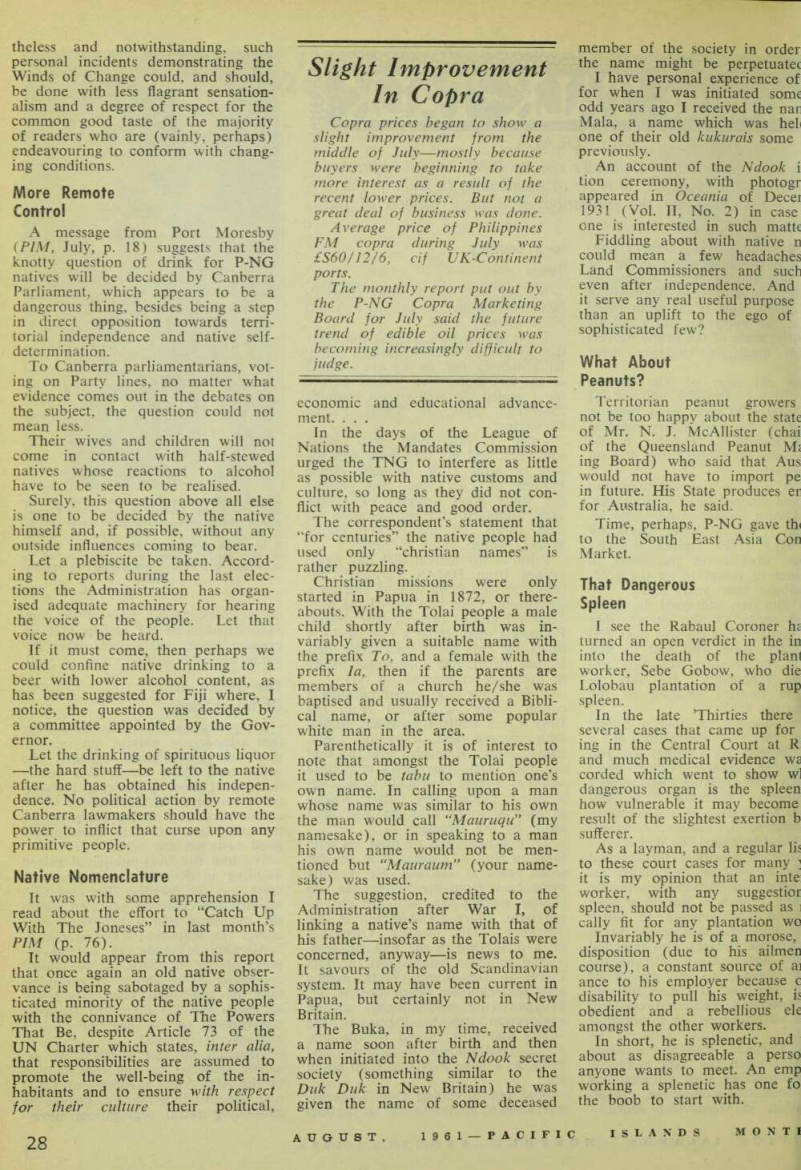
AWARD. During a New Guinea tour by Sir Donald and Lady Cleland in July, Lady Cleland, pinned the Meritorious Service Medal on Dr.
F. X. M. Willis, at Nonga Hospital, Rabaul.
It has been awarded to Dr. Willis for services in the Belgian Congo as a member of an Australian Red Cross team during the troubles there.
Photo: C. H. Meen
theless and notwithstanding, such personal incidents demonstrating the Winds of Change could, and should, be done with less flagrant sensation alism and a degree of respect for the common good taste of the majority of readers who are (vainly, perhaps) endeavouring to conform with chang ing conditions.
More Remote Control A message from Port Moresby ( PIM, July, p. 18) suggests that the knotty question of drink for P-NG natives will be decided by Canberra Parliament, which appears to be a dangerous thing, besides being a step in direct opposition towards terri torial independence and native self determination.
To Canberra parliamentarians, vot ing on Party lines, no matter what evidence comes out in the debates on the subject, the question could not mean less.
Their wives and children will not come in contact with half-stewed natives whose reactions to alcohol have to be seen to be realised.
Surely, this question above all else is one to be decided by the native himself and, if possible, without any outside influences coming to bear.
Let a plebiscite be taken. Accord ing to reports during the last elec tions the Administration has organ ised adequate machinery for hearing the voice of the people. Let that voice now be heard.
If it must come, then perhaps we could confine native drinking to a beer with lower alcohol content, as has been suggested for Fiji where, I notice, the question was decided by a committee appointed by the Gov ernor.
Let the drinking of spirituous liquor —the hard stuff—be left to the native after he has obtained his indepen dence. No political action by remote Canberra lawmakers should have the power to inflict that curse upon any primitive people.
Native Nomenclature It was with some apprehension I read about the effort to “Catch Up With The Joneses” in last month’s
Pim (P. 76).
It would appear from this report that once again an old native obser vance is being sabotaged by a sophis ticated minority of the native people with the connivance of The Powers That Be, despite Article 73 of the UN Charter which states, inter alia, that responsibilities are assumed to promote the well-being of the in habitants and to ensure with respect for their culture their political,
economic and educational advance ment. . . .
In the days of the League of Nations the Mandates Commission urged the TNG to interfere as little as possible with native customs and culture, so long as they did not con flict with peace and good order.
The correspondent’s statement that “for centuries” the native people had used only “Christian names” is rather puzzling.
Christian missions were only started in Papua in 1872, or there abouts. With the Tolai people a male child shortly after birth was in variably given a suitable name with the prefix To, and a female with the prefix la, then if the parents are members of a church he/she was baptised and usually received a Bibli cal name, or after some popular white man in the area.
Parenthetically it is of interest to note that amongst the Tolai people it used to be tabu to mention one’s own name. In calling upon a man whose name was similar to his own the man would call “Mauruqu” (my namesake), or in speaking to a man his own name would not be men tioned but “Mauraum” (your name sake) was used.
The suggestion, credited to the Administration after War I, of linking a native’s name with that of his father—insofar as the Tolais were concerned, anyway—is news to me.
It savours of the old Scandinavian system. It may have been current in Papua, but certainly not in New Britain.
The Buka, in my time, received a name soon after birth and then when initiated into the Ndook secret society (something similar to the Dak Duk in New Britain) he was given the name of some deceased
member of the society in order the name might be perpetuatec I have personal experience of for when I was initiated some odd years ago I received the nan Mala, a name which was hel( one of their old kukurais some previously.
An account of the Ndook i tion ceremony, with photogr appeared in Oceania of Decei 1931 (Vol. 11, No. 2) in case one is interested in such matte Fiddling about with native n could mean a few headaches Land Commissioners and such even after independence. And it serve any real useful purpose than an uplift to the ego of sophisticated few?
What About Peanuts?
Territorian peanut growers not be too happy about the state of Mr. N. J. McAllister (chai of the Queensland Peanut Mj ing Board) who said that Aus would not have to import pe in future. His State produces er for Australia, he said.
Time, perhaps, P-NG gave th< to the South East Asia Con Market.
That Dangerous
Spleen
I see the Rabaul Coroner hz turned an open verdict in the in into the death of the plant worker, Sebe Gobow, who die Lolobau plantation of a rup spleen.
In the late ’Thirties there several cases that came up for ing in the Central Court at R and much medical evidence wa corded which went to show w] dangerous organ is the spleen how vulnerable it may become result of the slightest exertion b sufferer.
As a layman, and a regular lis to these court cases for many : it is my opinion that an inte worker, with any suggestior spleen, should not be passed as ] cally fit for any plantation wo Invariably he is of a morose, disposition (due to his ailmen course), a constant source of ai ance to his employer because c disability to pull his weight, is obedient and a rebellious ele amongst the other workers.
In short, he is splenetic, and about as disagreeable a perso anyone wants to meet. An emp working a splenetic has one fo the boob to start with.