They’re Catching Up
pp. 78-79 · Read in the full issue
With The Joneses
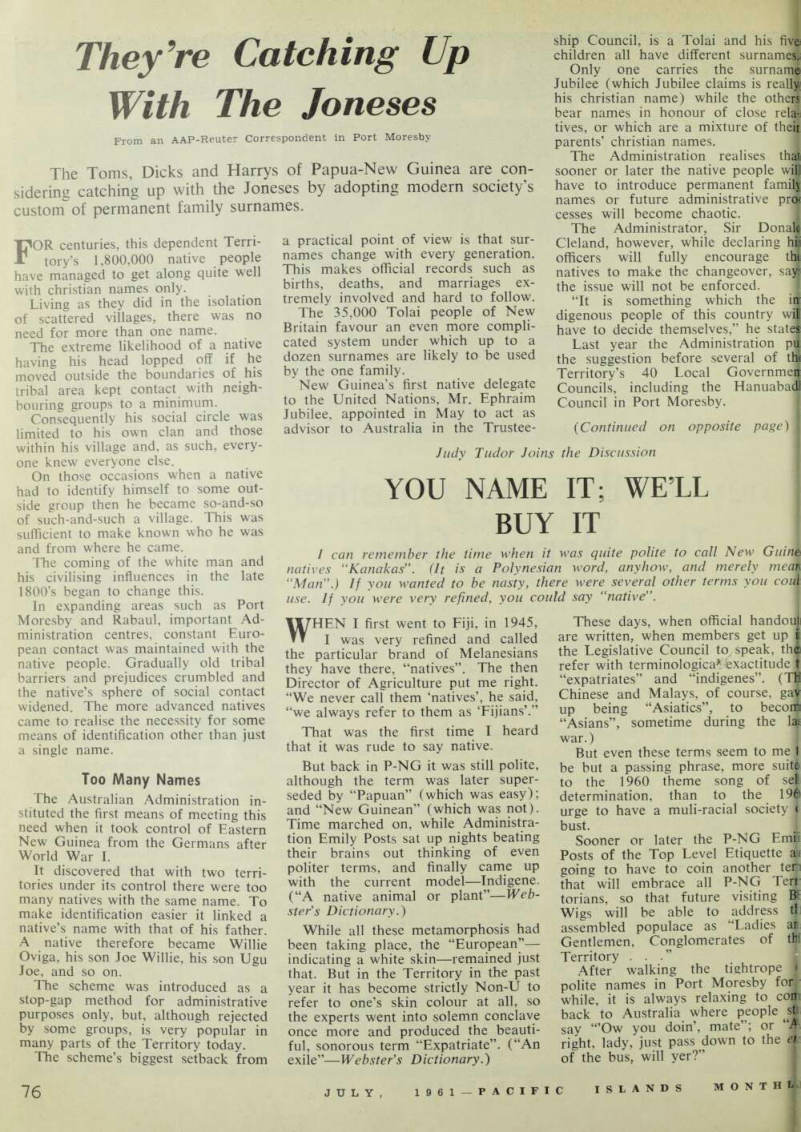
From an AAP-Reuter Correspondent in Port Moresby The Toms, Dicks and Harrys of Papua-New Guinea are con sidering catching up with the Joneses by adopting modern society’s custom of permanent family surnames.
FOR centuries, this dependent Terri tory’s 1,800,000 native people have managed to get along quite well with Christian names only.
Living as they did in the isolation of scattered villages, there was no need for more than one name.
The extreme likelihood of a native having his head lopped off if he moved outside the boundaries of his tribal area kept contact with neigh bouring groups to a minimum.
Consequently his social circle was limited to his own clan and those within his village and, as such, every one knew everyone else.
On those occasions when a native had to identify himself to some out side group then he became so-and-so of such-and-such a village. This was sufficient to make known who he was and from where he came.
The coming of the white man and his civilising influences in the late 1800’s began to change this.
In expanding areas such as Port Moresby and Rabaul, important Ad ministration centres, constant Euro pean contact was maintained with the native people. Gradually old tribal barriers and prejudices crumbled and the native’s sphere of social contact widened. The more advanced natives came to realise the necessity for some means of identification other than just a single name.
Too Many Names The Australian Administration in stituted the first means of meeting this need when it took control of Eastern New Guinea from the Germans after World War I.
It discovered that with two terri tories under its control there were too many natives with the same name. To make identification easier it linked a native’s name with that of his father.
A native therefore became Willie Oviga, his son Joe Willie, his son Ugu Joe, and so on.
TTie scheme was introduced as a stop-gap method for administrative purposes only, but, although rejected by some groups, is very popular in many parts of the Territory today.
The scheme’s biggest setback from
a practical point of view is that sur names change with every generation.
This makes official records such as births, deaths, and marriages ex tremely involved and hard to follow.
The 35,000 Tolai people of New Britain favour an even more compli cated system under which up to a dozen surnames are likely to be used by the one family.
New Guinea’s first native delegate to the United Nations, Mr. Ephraim Jubilee, appointed in May to act as advisor to Australia in the Trustee
ship Council, is a Tolai and his five children all have different surnames; Only one carries the surname Jubilee (which Jubilee claims is really his Christian name) while the others bear names in honour of close rela-j tives, or which are a mixture of theit parents’ Christian names.
The Administration realises thali sooner or later the native people will have to introduce permanent family names or future administrative pro* cesses will become chaotic.
The Administrator, Sir Donalo Cleland, however, while declaring hiii officers will fully encourage th«j natives to make the changeover, saw the issue will not be enforced.
“It is something which the inr digenous people of this country wi| have to decide themselves,” he states Last year the Administration p 4 the suggestion before several of thk Territory’s 40 Local Governmen Councils, including the Hanuabadf Council in Port Moresby.
(Continued on opposite page)u
Judy Tudor Joins the Discussion
tie councils were asked to inquire ng the people within the council s to see what they thought of the II except the Hanuabada Council still considering the matter, while Hanuabada people have accepted i principle but are disputing its ementation. senior Administration officer, Mr. lant, of the Department of Native irs, explained: “Apparently they decide what names are to be . The younger people want to their present names while the ■ people want to go back several rations and take the names of forefathers.”
Census r. Plant said that as soon as this t had been argued and a final ion reached the Administration d take a census and record the ;s chosen for each family. will be a first step in a most rtant aspect of Papua - New ea’s social development,” he e issue, meanwhile, was raised recent meeting of the Port :sby District Advisory Council, wernment-appointed body which des two native members, e council agreed that many areas ic Territory were not yet ready any changeover to permanent ■s, and that any changeover ig even the more sophisticated is would take time, t, said the council in a recom lation to the Administration, a d country must have united ms and every available source d be utilised to foster the ae.