[?]hey're Becoming Rather Crowded In
pp. 77-101 · Read in the full issue
Pacific Islands Monthly
Magazine Section
The Happy Isles
Atafu, Nukunono and Fakaofo are three atolls which Drm the Tokelau Islands—the furthest north and most distant f all New Zealand territories. It is doubtful if any Pacific islands ave he., less contact with European influence.
From a Special Correspondent
IE islands were in the news in June with the visit by NZ’s ister of Island Territories, Mr. F. i. Gotz. fe on the Tokelaus is simple, and are happy people, as PIM corres lent J. P. Shortall pointed out in irticle in August last year, after ng them. ie islanders have no public debt no prisons, they give their labour for public projects, and may not their land to outsiders. Nor do need social security, unemploy ; benefits, or old age pensions, lere are no motor vehicles—not a bicycle, no newspapers or ) stations, and one telephone The only Europeans on the P are a Roman Catholic priest a mission sister. it that doesn’t mean that life in Pokelaus is idyllic.
Now that the population of the group is about 2 ’ ooo ' the spec're of eventual overcrowding leading to P? vert y is looming. Emigration to New Zealand is one solution al 'ilollBll only Emilies able to adapt themselves are encouraged to emi grate, An atoll can be as uncompromising an environment as a desert or an Arctic waste. In the Tokelaus, each atoll comprises several tiny islets from 10 to 15 feet in height set in a coral reef surrounding a lagoon 6 Small Islets The largest islet is only four miles long and 300 yards wide. The lengths of the atolls vary between three and seven miles, and the widths between and 6 i miles, but they contain very little land.
Fakaofo, which has the largest
population (about 850), has an area of 650 acres, just over one square mile. Atafu (about 600) is 500 acres in extent. Nukunono, the largest atoll, has an area of 1,350 acres and a population of about 550.
The only serious overcrowding problem is on Fakaofo where it has been necessary to persuade 40 families to set up a “suburb” to relieve the pressure on the very tiny islet where the original village stands. Elsewhere the people still live on one islet.
Naturally the Tokelau Islanders’ diet is restricted, with fish and coco nuts the main item.
Agriculture in the Tokelaus entails more than simply tilling the soil. It is also necessary to create it. The tiny islets are covered with coarse coral sand or rubble, which is suf ficient to sustain certain vegetation (especially the coconut palm) but re quires constant mixing with vegetable compost to support root crops.
Plenty of Fish Fortunately the lagoons are well stocked with fish, and the timbers of the indigenous tauanave and the pandanus palm are suitable and sufficient for building houses, furniture and canoes.
The islanders earn sufficient income from the sale of copra, carved wood
(Continued on p. 99)
and plaited mats and fans to flour, sugar, rice, kerosene and co, to supplement the products ie land and sea. The amount
realised from the sale of copra each year is usually about £B,OOO, approximately double the value of the goods imported.
Unfortunately the islands do not have enough revenue to support essential Government services. Export and import duties, charges for radio messages, and proceeds from the sale of the group s own set of three postage stamps, which are popular collectors’ hems, earn a little over £l,OOO a year.
The cost of essential services is many times that amount, and an annual subsidy from New Zealand of approximately £20,000 is needed to make up the deficit.
But while the islands are not financially self-sufficient they are almost so in administration. The dayto-day control of local affairs is carned out by Tokelau officials.
Village councils comprising one representative of each family periodically assemble to deliberate upon communal affairs. They also present their views and offer their advice to the Administrative Officer for the Tokelau Islands.
Also known as the District Officer, he is stationed in Apia and is responsible to the New Zealand High Commissioner for Western Samoa, who is himself responsible to the New Zealand Government as Admimstrator of the Tokelau Islands.
The Administrative Officer visits the islands whenever transport is available and supervises local tradmg and administrative activities.
As in most Pacific territories transport is a problem. It is also the bottle-
neck preventing full development of the Tokelaus’ limited resources, RNZAF flying-boats, which oc casionally call to check the emergency landing facilities on each atoll, bring Government officials and other visitors. Three or four times a year a ship chartered by the Administration brings supplies and takes away copra a nd other products. Passengers are a iso carried. Warships of the Royal New Zealand Navy occasionally create considerable interest when they call during Pacific cruises, The vagaries of the weather some times foil even these intermittent attempts to break the isolation of the islands. Sudden rain squalls, un favourable winds or rough seas may ma ke it dangerous to work whale boats through the reef passages. If this happens loading or unloading of the ship becomes impossible, and if these conditions persist, it may be necessary to postpone or cancel the ship’s call at that island, In some respect the iso i at ion of the Tokelau Islands is a blessing. It means that the islanders are left alone to live more or less in their traditional manner, and more or less as they prefer—which is why they are happy, no doubt.
The distance of the islands from other land makes it probable that they will hold the honour of being among the few remaining Pacific paradises for some years yet . It is in fact dou btful whether the people will ever be required to adapt their traditional way of life as much as the inhabitants of larger and less isolated territories.
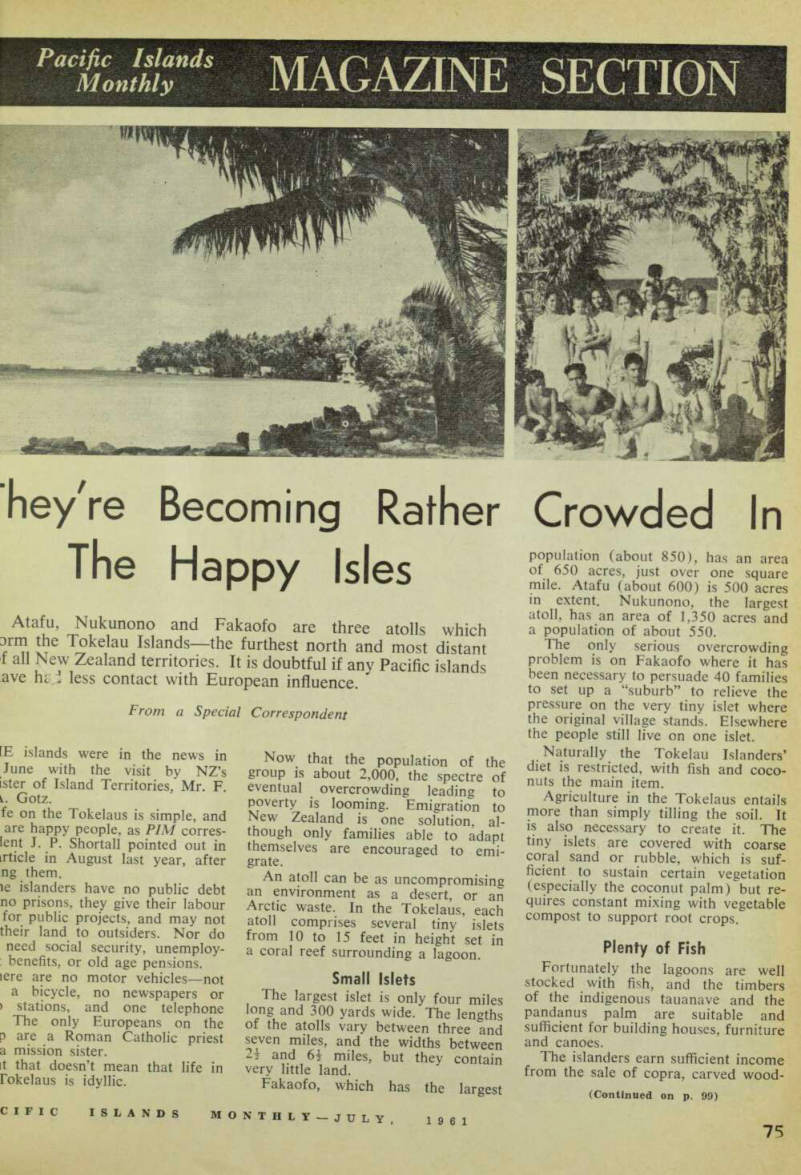
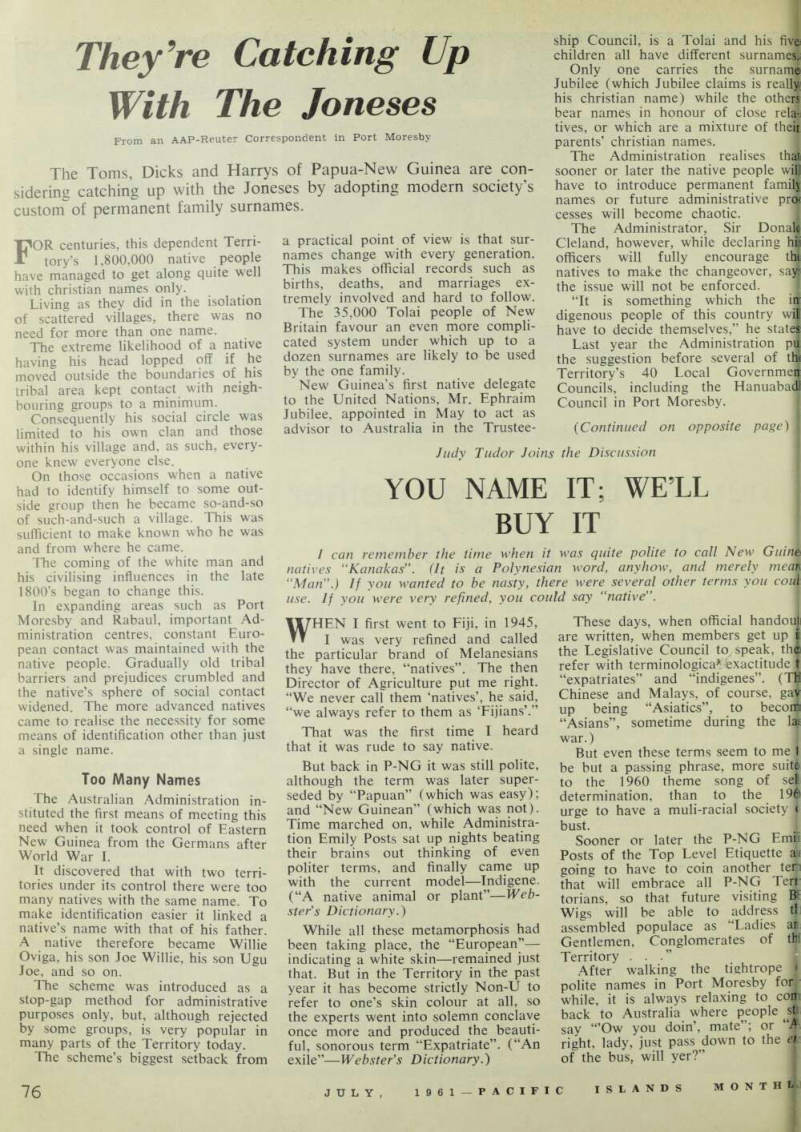
[?]e beautiful Toke us, and some of [?]e 61 islets that ake up the atoll [?] Fakaofo. The goon is on the [?]ght. This atoll as the largest [?]pulation and the [?]ost serious over [?]owding problem.