Travel
pp. 140-141 · Read in the full issue
Talk
Details of a new tour being arranged in Sydney for those who want to have a quick look at New Caledonia; a discussion on New Guinea’s tourist policy; and some down-to-earth hints for those who want to travel Europe cheaply; are the highlights of this month’s travel section.
Package Tours
To New Caledonia Coral Tours Pty. Ltd., which is run by Mr. Joe Mulders from an office in Botany Rd., Mascot, NSW, will get going with organised tours to New Caledonia in September.
These tours will be run in conjunc tion with the French airline, TAI.
The tours will be of 12 days dura tion and, from Sydney, will cost ap proximately £AI67. This includes tourist class, Sydney-Noumea, air travel, about 700 miles by car in New Caledonia and, of course, all hotel accommodation.
Because of the hotel accommoda tion problem in New Caledonia’s country centres, each tour party will be limited to four persons.
Coral T ours Pty Ltd. is in terested in the proposed tourist hotel and casino on a site a few miles out of Vila, New
Hebrides. The promoters are still getting together the capital necessary to finance such an ambitious project.
Until they do'—or until there is more hotel accommodation than at present in Vila and Santo—the New Hebrides is right off the regular tourist beat.
Australian Policy
And P-NG Tourism A statement attributed to Mr. S.
Fox, of Port Moresby, who is a member of the recently formed P-NG Tourist and Travel Assn., brought down the wrath of Territories Minister Hasluck in May. Mr. Fox said that Mr. Hasluck had made it clear that he wanted only Australian tourists in P-NG; and that others—particu larly Americans— would “spoil” the natives. Mr. Fox said his Assn.
would ask Australia to relax the restrictions.
In reply Mr. Hasluck said: “There is no restriction on the entry of ‘foreign tourists’ into P-NG, other than the conditions which apply to all persons travelling to the Territory, whether from Australia or from overseas.* “At present facilities for tourists in the Territory are limited and, in view of the many other urgent priorities, it is extremely unlikely that Administration funds will be spent in the short-term on promoting the tourist trade ... in the longer term the tourist trade will be one of the important means of helping to support the economy of the Terri tory.
“In the short term it is prob able that tourists from overseas going direct to Papua or New Guinea will be mostly those who
join organised cruises. The overseas tourists who go to the Territorv from Australia would be well advised to make their arrangements through one or other of the airline or ship ping companies. Anyone travelling individually would have to go to some trouble to make advance arrange ments about accommodation and in ternal travel. . . .
“The Government will facilitate any measures which commercial enterprise may wish to take for the handling of visitors to the Territory even although, at this stage of development, it has no immediate intention of spending public money on providing such facilities. So far as promotion is concerned, we have to recognise a commonsense fact that it is no use persuading the sight
seeing tourist to visit the Territon if we are unable to handle his traw and accommodation when he ge= there. . . . Within five years tH
situation might be radically changed!
What Mr. Hasluck says is realist! enough; and in the matter ( immediate development of tourisil puts the ball right back into the coit of private enterprise. And so fas of course, P-NG private enterprii hasn’t done much more than induljj in some wishful-thinking. * Even if in possession of a vaL passport, it is necessary to obtain al. a Permit to Enter P-NG from the Aur tralian Department of Territories. F 3 this you fill in a form giving most of tt particulars already on your passport' colour of hair, “height in boots”, e?
You also have to produce a return ticM and documentary evidence that you has accommodation in the Territory. I members of “PIM” staff who have bea going to P-NG several times a year 1 the past 30 years, have to go through I this rigmarole every time they go to tt Territory.
You Can Travel Europe
Cheaply—Part II
(Compiled by a young staff member vw has done it) Don’t fall for the line about hito hiking being easy in Europe. A fe: years ago it was, but so many tensl thousands of hitch-hikers, many * them from Australia, have swarrar across Europe, a reaction hi developed among motorists.
France, they would sooner run yc, down.
Besides, have a care for yen European host. Unless you spejs his language, you make him a prete dull companion on a long journei These days many young peoji share the expense of hiring a o in England to tour the Confines Even allowing for the higher raif for taking a car abroad from the Ul this is still fairly reasonable wild shared by three or four. But pleair pick your companions with ca£ otherwise you will add to the numfcfi of parties that have broken-k through violent arguments. If are interested in cathedrals, castif and bull-fights, don’t go with * anti-Christ member of the RSPCA If you are going to England fro* Australasia, it’s not a bad idea • get off ship or plane in Greece I
and travel by train across e to London. in travel is very cheap when uy a ticket for a long distance, le the country of origin, you >uy kilometric tourist tickets, means that you can travel so thousands of kilometres, in, pain or France, at a low rate lometre. ich main-line railways are very and second class travel better \ustralian Ist class. In Italy, iave about five types of trains, ou’ll soon find that Express, the train stops everywhere, or the payment of a supple ry charge, you can travel by which will rush you through untryside at about 90 miles an European trains (with the e exception of Spanish railways) much faster than English or lian trains on main lines, ou are going to do a lot of ravel, buy a Cooks Continental vy Guide, you’ll find it invalu big European cities you can mes get a concession ticket ams, underground trains and which makes urban transport :heap.
London Tube and Under -1 are rightly famous, along le London system’s big red city and the Green Line country In Paris the Metro is equally cient as the London Under and a lot easier for the novice lage than that city’s buses. It tactically no French at all to out your Metro route from ection boards or to follow the
correspondence at junction lines.
Metro travel comes in premier or deuxieme class, and fares in either are at a flat rate all over the network —i.e., it costs as much to travel be tween two adjacent stations as it does to go to the end of the line.
Taxis in Paris and London are round about the same equivalent cost as in Sydney—and are just as scarce in wet, peak hours. Taxis in Spain, by comparison, are dirt cheap.
But getting back to trains—if you like to do these things in a big way, you can get a 2nd class rail ticket from London to Basra, on the Persian Gulf, for £Stg.42/10/- and stop off at Paris, Rome, Athens, Istanbul, Ankara, Aleppo and Bagh dad on the way.
Russia is
Now Easy
If you have ever thought of visit ing Russia you are in good company.
It’s one of the popular things to do in Europe these days, and for ob vious reasons conducted tours are favoured more than going under your own steam.
Because of weather, the tourist season runs between mid-May and mid-September, although there are usually special excursions arranged so that devotees may be in Moscow for the May Day festival.
The cost of such tours varies ac cording to how long you are going to be there and what sort of accommo dation you require. The 15-days “Eastern Express” coach tour is typi cal of what you can get ex-London, in the lower-priced tours. This costs £Stg.66/3/- (approx. £AB2/10/-)
plus a loading of from £3-£4 if the tour is taken between mid-July and early August.
This amount covers air transport between London and Ostend, sight seeing at certain cities, hotels and meals. The coach has reclining seats, a bar, toilet, two drivers and a courier —all very necessary, as two nights during the 15, as well as most of the days, are spent on the road. The cost of the whole tour can never theless be considered very cheap.
The route is from Ostend via Helmstedt to Berlin, where one after noon and a night are spent; then via Frankfurt-on-Oder, across the Polish frontier and via Poznan to Warsaw.
The following day you travel from Warsaw, cross into the USSR, lunch at Brest and spend the night at Minsk. A half day further on, you are at Smolensk, and the following night in Moscow.
Three days are spent here and the return is direct through Minsk, Brest, Warsaw, Frankfurt, Potsdam and Ostend.
People who travel on an Australian passport will find that USSR, Poland and East Germany are three of the 12 countries for which it is not valid.
However, getting an endorsement for these places presents no great diffi culty. You should apply to your nearest branch of the Department of Immigration or Passport Office, or if abroad, to the Australian Consul or High Commissioner. You will have to fill in a form and also pre sent a letter in which you set out why you want to go to these countries, when you will go in and when you will come out. The en dorsement will cost you 2/-.
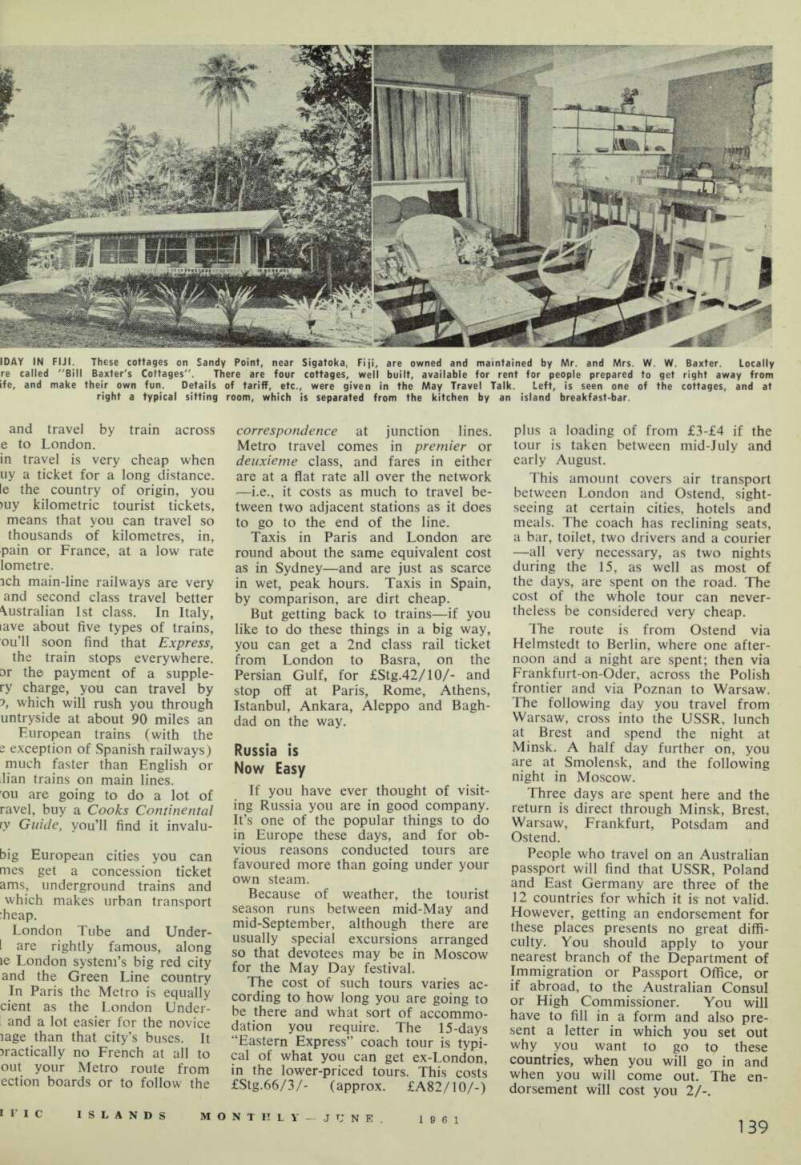
IDAY IN FIJI. These cottages on Sandy Point, near Sigatoka, Fiji, are owned and maintained by Mr. and Mrs. W. W. Baxter. Locally re called "Bill Baxter's Cottages". There are four cottages, well built, available for rent for people prepared to get right away from ife, and make their own fun. Details of tariff, etc., were given in the May Travel Talk. Left, is seen one of the cottages, and at right a typical sitting room, which is separated from the kitchen by an island breakfast-bar.