Pacific Report
pp. 113-136 · Read in the full issue

The month’s round-up of news and pictures of people and events, from PIM correspondents in the South Pacific.
on Organisations to be
>n to Inspection iere are in Fiji increasing num of unskilled and semi-skilled men are being organised as trade is. They are mostly Indians, de lised Fijians, and part-Europeans under irresponsible leadership, could be socially dangerous, e majority of trade unions in Colony are in charge of re -ible people. But an increasing >er of irresponsible trouble rs are appearing as union ils; and the Government has 1 difficulty in keeping in touch their activities. new law, to give anyone the on payment of a fee, to in the constitution, rules and list embers of trade unions was 1 by Fiji Legco in April. The ussioner for Labour, Mr. John tch, explained the need for the he said it was desirable that ir Department officials should the right at any time to inspect ade union organisation.
Derienced Young
ers in Fiji
iing itself With too many s, Fiji has adopted a new law, which newly qualified men undergo a period of tutelage, stablished practitioners, before mcing practice on their own ipean and Fijian lawyers do sm to be in over-supply, but ibarrassing number of young ; h ay e been hanging out their s in the last two or three years, is some undesirable competi r available business. Overseas have made unfavourable com pon the number of inexperi young lawyers who have d before them.
A. I. N. Deoki, himself an lawyer, said in Legco that e had qualified he had dif
ficulty in getting a position with legal firms in New Zealand—“l suppose they didn’t like the colour of my skin,” he remarked.
He asked that Fiji use its influ ence to help Fijian and Indian students to get suitable positions in New Zealand during this period of practical training, now stipulated as necessary before they could practise in Fiji.
Tahiti at the
Hour of Jets
May 4 marked the official opening of the Papeete-Faaa airport with the arrival of TAPs DCS jet from Paris, via Montreal, Los Angeles and Hono lulu.
Aboard the inaugural flight was guest of honour, French State Minister Robert Lecourt, James K.
Kealoha, Lieut.-Governor of Hawaii and Bengt Danielsson of Kon Tiki fame, together with representatives
of the French government and French aviation.
In the past dozen years, French aviation authorities have slowly closed their aviation gap in around the-world service. It was in 1948 that the French airline company Trapas brought French Polynesia out of its isolation by establishing the first airline from Noumea to Papeete.
It was the Papeete based airline company Air Tahiti which established the first inter-island air service be tween Papeete-Raiatea-Bora Bora in 1950. This same company bought out Trapas in May, 1951, and estab lished the Papeete-Aitutaki airline which remained in service for one year. (New Zealand’s Tasman Empire Airways, Ltd., in 1951 came into the picture, too, using sea-planes which continued to land right in Papeete harbour until the end of last year, when land planes took over.) Air Tahiti equipment and materials became in their turn Regie Aerien Interinsulaire, which was re named Reseau Aeriens Interinsulaire (RAI), and it was this latter com pany which undertook an aerial re connaissance of all the archipelagoes and the exploitation of the Bora Bora to Papeete service.
For a long time passengers from Pans en route to the South Pacific travelled by way of India to Bora Bora where the RAI Bermuda flying boat brought them on the last phase of their journey to Papeete. It was
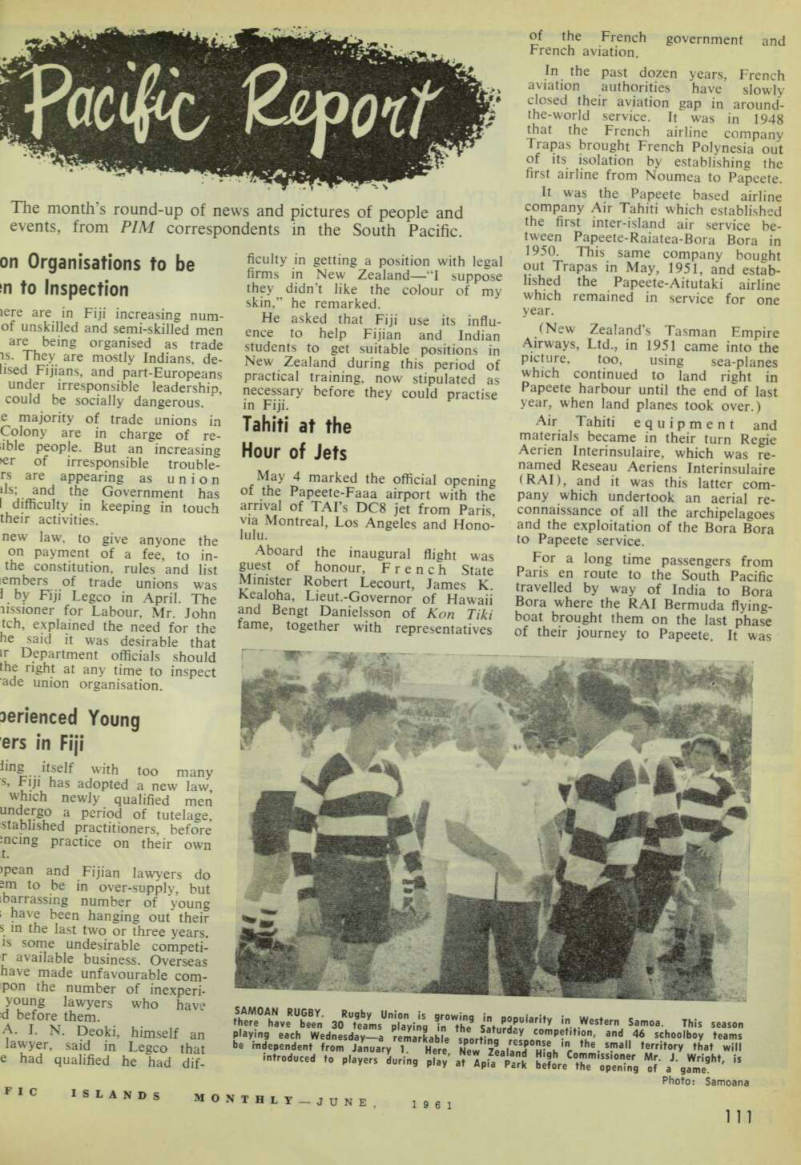
SAMOAN RUGBY.Rugby Union is grouwing in popularity in Western Samoa. This season there have been 30 teams playing in the Saturday competition, and 46 schoolboy teams Playing each Wednesday—a remarkable Sporting response in the small territory that will be independent from January 1. Here New Zealand High Commissioner Mr. J. Wright, is introduced to players during play at Apia Park bafore the opening of a game.
Photo: Samoana
g felt that an airstrip at Papeete
; indispensable.
vote was taken by the Tahiti ritorial Assembly on June 18, 5, and it was agreed that an aero me at Papeete was of utmost im tance in order to avoid a break air communications between nch Oceania and the exterior. But 'as to be many years before this ect could become a reality.
'uring May-June, 1957, TAI in aboration with the Civil Aviation r ices made their first reconnais ;e and study trips for a proposed imea-Nadi-Bora Bora air service. s a result, a weekly service was gurated by TAI from Orly to i Bora with DC6B planes from ber, 1958, and the service was nded in May, 1960, to Los eles with the co-operation of Air ice, thus closing the gaps in the id-the-world service.
October, 1960, Papeete-Faaa air was opened for service for regu ?assenger flights, and in March, , the first test flight TAI jet -d safely and the airstrip pro iced ‘okay!’ ,e great stretches of the new Irome extend in the direction ie prevailing winds on the west of Tahiti opposite the island of rea. It is bounded on the east towards Papeete by Point area between Hotel Les iques and the Route des lichers, and to the west by Point i and the Paifau River, e construction of the airstrip and Uing in of the lagoon has isolated n sections of water, but narrow ids have been retained to per iccess to the ocean by native ue canoes. The general direction
of the airstrip is north-east south-west and most planes will land, winds per mitting, m a west-east direction. The airstrip which is 3,416 metres long is created on an artificial fill-in. The northern section of the airstrip is presently used by commercial aircraft The fill-in consists of two kinds of materials—river boulders excavated from below sea level, and coral. The fill-in was placed on a base of coral slabs.
Work was begun on the artificial fill-in in May, 1959, by the Societe de Dragages et Travaux Publiques (French Society of Dredgers and Public Works). This company has had to its credit numerous world-wide projects—the aerodrome at Pnom penh, the construction of the ports of Cambogia and Sianoukville, canals m Cochin-China, the port of Djakarta and important construction work for the aerodrome at Hongkong.
Work on the airstrip was mech anised, and in spite of its rapid pro gress, employed only some 400 work men. pie fill-in was completed in February, 1961, and work was con tinued on installations. The new air port buildings will be modelled on those at existing international airports with all the usual tourist amenities, shops, bars, restaurant, banking facilities, post office, etc. The main passenger building and new technical buildings should be ready by the end of 1962. Until that time, the old buildings, spruced up with a coat of pale green paint, will remain in use.
These originate from the days of the first flying-boat service to the outer islands.
Three airline companies are at pre sent using the airport—the French
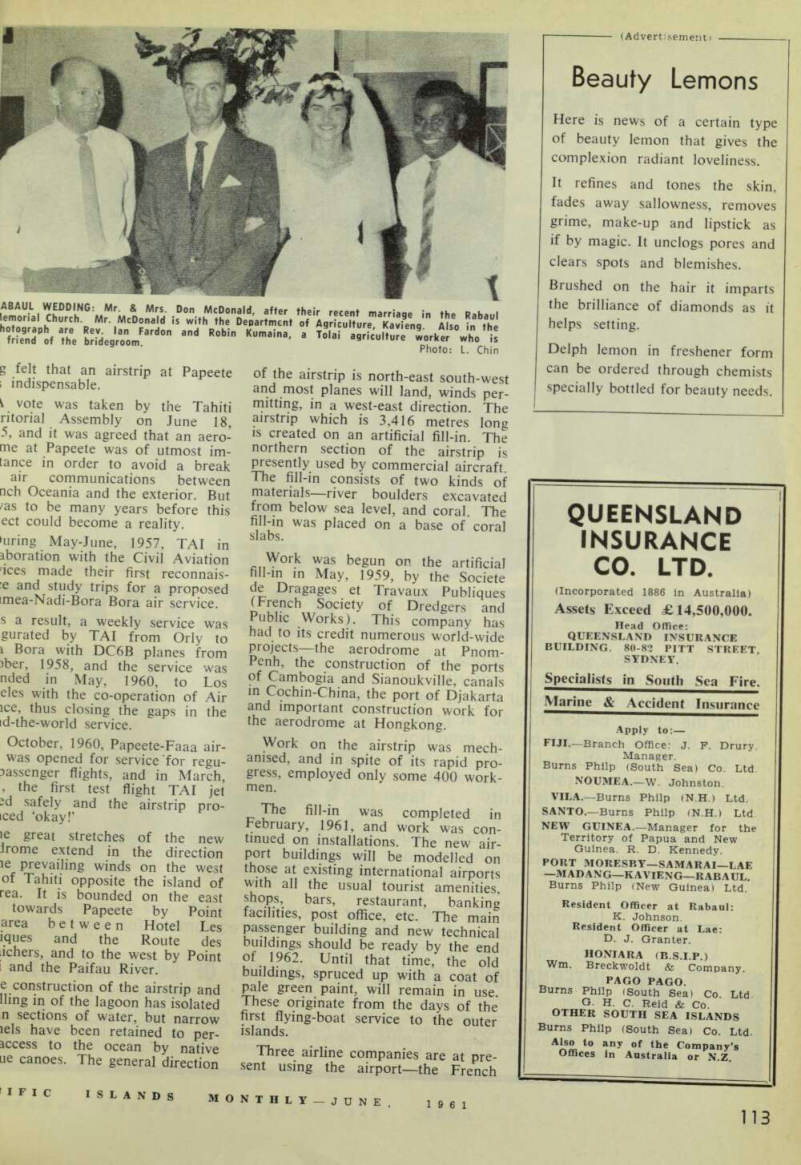
[?]ABAUL WEDDING: Mr. & Mrs. Don McDonald, after their recent marriage in the Rebaul [?]emorial Church. Mr. McDonald is with the Department of Agriculture, Kaving. Also in the [?]hotograph are Rev. Ian Fardon and Rebin Kumaina, a Tolai agriculture worker who is [?] friend of the bridegroom. Photo: L. Chin
Transports Aeriens Inter nentaux (TAI), the American •any South Pacific Air Lines X) which has a direct Honolulu 'apeete service, and the New nd ‘Coral Route’ TEAL com which uses Electra jet-props in ?ular weekly service to Tahiti ladi.
July, 1961, there will be seven ift arrivals in Papeete each week, it is estimated that by 1965 will be five planes per day arriv n Tahiti. Together with Nadi t, Papeete-Faaa is the second Pacific aerodrome capable of imodating jets. >eete-Faaa aerodrome and its ations are the property of the h government and were built estimated cost of 2,000 million politan francs, with 500 million used for construction and in ions and the remainder for sur and fill-in.
Improvements For
Airctrin D 7° * AirSTn P . Kabaul s Lakunai airstrip, sited right at the foot of the town’s steam lng atupi volcano, is to be re-sited a . lengthened—thanks to the de cision of local Tolai natives to grant more land. But the re-siting won’t mea n the strip will go elsewhere— it will probably be swung around a blt to ot> viate the present hazard of aircraft having to let down either over the crater or over a high range of hills. DCA is at the moment making a survey of the proposed work The Tolais had until recently con sistently refused to grant the small area land needed, despite many tern P tin g propositions, Jhp Ham anH Itc
™ . Its
Cost Are Going Up
Tenders closed on May 2 for con struction of one of Papua-New
THE POLYNESIAN ASSOCIATION: these happy groups were all photographed at a recent gathering of the Polynesian Association in [?]ney. TOP LEFT: All from either Suva or Lautoka, are: Sam McCaig, Lawrence Little, Ali Khan Richic Robinson, Jim Bentley, Everett [?]ey and Arthur Harmon. TOP RIGHT: Mr. N. Wills, of NSW, fiancee of Miss Orbell Chambers,of Lautoka, who is next to him, Mr. & Mrs. John Raddock, of Tavua, Fiji. Miss Chambers is Mrs. Raddock's cousin. LOWER LEFT: A gay group from Tahiti and New [?]edonia-Pierre Fagu, Email Estall, Madame Lorna Canninng, Etienne Hamblin (all of Tahiti), Madame G. Studwell, of Noumea, Madame [?] roro, of Thiti, with her small daughter and-in front-stanley Brodin and G, Studwell, LOWER RIGHT: Represeting Norfolk Iland are Alma Young, Ivens Buffett and Frances Kleiner, of Los Angeles (she is the daughter of Cora Young, formery of Norfolk).
Photos: A. E. Ray
Guinea’s biggest engineering projects! yet—the dam across the Sirinumui Gorge in the foothills of the Owen!
Stanley Ranges, 30 miles from Port Moresby.
In early June it was announced the! contract had been let to Hornibrook-I Kaiser Joint Venture for £549,052. 1 Plans for the dam go back a long way, complications have been many,! and are not completely ironed outl yet. Administration does not yet| officially own any of the 13,000 acres! that the project will require. The! involved clan system of native land! tenure is holding this up andl although the authorities have been! working on this aspect of it for about eight months, only about 800 people! of the 3,000 involved have signed! on the dotted line—or the equivalent.
The dam will flood about twice as! much land as originally intended— requiring the removal of about 300 villages. The “regrettable error” of about 40 feet in determining high water mark, which was due to an incorrect aerial survey, was announced last November and was said, at the] time, to have set the project back four months.
The tenders that recently closed were for the first portion of a project; for fully developing the hydro-electricity potential of the Lalokii River. The whole project, which; will be undertaken over a period of; years, will run into millions of : pounds.
Norfolk Wants Liquor
Laws Altered
The Norfolk Island council took) a look at Norfolk’s liquor laws inr May and agreed to a draft ordinance? to amend some of the present re strictions.
Liquor sales on Norfolk are con trolled by the Administration, whichr issues, at 14 days’ notice, permits fon the supply of liquor for functions? open to members of the public. Las® October the Bowling Club com plained that this provision was too: restrictive, because it prevented pert mits being given to functions where) only club members were present.
The new draft ordinance seeks to: alter these restrictions.
Sairusi Says He's
Sorry for the Trouble
Fiji’s most famous gaol Sairusi Nabogibogi, has never earned) for himself the nickname of Houdmi,i
■ some of his more famous fellow apers. But he was “out” for 307 s and led police a merry chase on [umber of occasions they thought y were about to catch up with him. ■Y set up many road blocks and e they fired shots at a car which ; off into the darkness, ut the Fiji police got their man y on Good Friday morning when ’ raided a Suva house and found usi, with his father and a number others, calmly drinking yaqona. fs of the arrest spread quickly, the next court day saw masses eople headed for the court house.
Sairusi never appeared. The 'd continued to be disappointed :ourt days after that. le fact was that the police were under obligation to bring him be a court as soon as possible after t, for Sairusi was already serving light year sentence for offences ng from theft to violence. And didn’t want to encourage the of hero worship for Sairusi. irusi finally turned up in court lay. Proceedings lasted a bare linutes, but news that he was at m public display spread quickly, the court room was soon filled verflowing and others sought ge points at the windows, sy gave him another two years s gaol break. Said Sairusi, “I very regret I have forced the police ;nd sleepless nights searching for
ia Levu Road
Seems Closer
party of top Fiji Government Is, including Mr. A. C. Reid, ary for Fijian Affairs, and Mr.
Common, Director of Public •» May made a 17-mile walk :h the heart of the big island of Levu, prospecting for a route road which will finally link orth and south sides of the The present road stops at > in the north, and begins again oaloa in the south, but a road would link the important of Labasa and Savusavu has een a dream. verdict of the walkers: Their eems a possible one for a road.
re Getting Some
jhtened Government"
P-NG Public Service in May led a 12-day “orientation” for advanced natives of the ry Public Service. Its signifi
cance was that it is the first of a series directed towards making the New Guinea natives better fitted to take over self-government.
The Public Service Commissioner, Mr. N. Thomson, put it more colour fully (according to an official Press release) when he said that it was hoped the 13 members of the first course—and others later—“would be able to go among their peoples and explain many of the problems facing them as they marched at an ac celerated pace towards enlightened democratic self-government”. It all sounded pretty good.
The members of the first course included four Suva trained medical graduates. They and their colleagues received lectures, films and took part in discussion groups on various as pects of P-NG Government, the structure of the Australian Govern ment, and such things as the possible future developments of the P-NG Ad ministration.
Mr. Thomson said it was hoped the course would show the advance native public servants the kind of organisation in which they were work ing, their duties and responsibilities, and “the Australian way of life”.
)per Deported
m New Guinea
rian Leonard Cooper, BA, aged the P-NG co-operatives officer was convicted in January for tious utterances to New Guinea yes, was back in Sydney in May " having completed his two ths’ gaol sentence in Port esby. He was out of New Guinea “keeps”. lid Cooper to the Press at Sydney 3rt, “I have been deported. If d the money I would fight it in High Court.
Jew Guinea is an Australian pos on and I am pretty sure I can’t deported from one Australian tory to another.” s later went on to Melbourne, to a job.
mea Cracks
m on Motorists the first three months of 1961, nea’s motorists between them 42 driving licences because of : offences. This is an increase iarly 50 per cent, on the figures he same period of 1960. Sus ons ranged from eight days to years, although one motorist didn’t stop after an accident had licence cancelled indefinitely, r accidents are still on the in
s Weavers Are
ing Money
Niue Weavers’ Association, ;d last year at the suggestion
of Mr. Angus Mcßean, headmaster of the Niue school, and now run by the women of the island, is making good profits. More than £5,000 worth of woven goods have been sold— more than 80 per cent, of the money being received directly by the weavers, and a portion going into reserves.
The Niue weavers make some of the best woven products in the Pacific —and their hats especially are much sought after. While Mr. Mcßean was in New Zealand last year he went more thoroughly into the question of marketing the Niuean ware there, and one large department store im mediately ordered more than £3OO
worth of goods. It shows what can be done with initiative—and the right goods.
New Houses for
Rabaul at Last
Rabaul residents, many of whom nearly 20 years after the war's end are still living in Kraft paper houses, are watching enviously as the first stage of the Administration’s Native Housing Project nears completion.
The £85,000 project consists of 28 double-unit concrete brick cottages, each of which will house two native families. A second stage, which will
[?]an Leonard Cooper—now out of gaol.
nence construction shortly after
s, is planned to accommodate jmgle natives and will cost th married and single quarters be furnished and will be let to es at cheap rentals.
5 Adds and
racts Departments
creation of two new Depart of the Papua-New Guinea Ad ration was announced in April; e absorption of two others was need in May.
Department of Customs and e will be absorbed into the new tment of Trade and Industry, le Department of Civil Affairs ease to exist from July 1, its s functions being distributed ;st other existing departments, other new department is that ?our.) imminent death of the Depart
of Civil Affairs—formerly the
ment of the Government iry—has been forecast for a r of years. ;reat deal of the importance ttached to the Government Sec -5 Department was curtailed
some years ago—some say because of Ministerial direction—and in recent years Civil Affairs inherited a lot of the jobs that none of the other de partments wanted.
A distribution of these functions back to their more appropriate de partments will be made after July 1.
The Treasury will take over re sponsibility for Stores and Supply, Motor Transport and the Govern ment Printing Office. A Civic Service Branch will be formed in the Treasury Department and will take over re sponsibility for public libraries, fire brigades, public utilities and certain other functions.
Control of Public Reserves will
pass to the Department of Lands, which will be responsible for the acquisition of property on behalf of the Administration.
The Department of Law will take over responsibility for Corrective In stitutions (which is what P-NG calls its gaols).
It is expected that the Police Force, which also is now part of the Civil Affairs Department, will shortly be created as a statutory authority out side the Public Service.
Mr. Claude Champion, who for the last couple of years as Director, has been ably coping with the mixed bag of duties that the control of Civil Affairs Department entailed, retires
in June. Opportunity was therefore taken, according to an official state ment, to make an alteration as “the changing scene of Territory develop ment made a redistribution of functions desirable in the interests of efficiency, consolidation and con venience to the general public as well as to the Administration”.
Looking Into
Earthquakes
In New Guinea in May to have z look at what goes on in the Terrii tory’s earthquake region, was Russiai scientist, Professor V. V. Beloussoy He was accompanied by a New Zeai land seismologist, Dr. G. A. Eiby.j The Russian expert left for tin Philippines on May 31, but befon he departed from Port Moresby hi said that his short visit was only i preliminary to 12 months study c* the world’s earthquake areas beim undertaken by UNESCO. The wors areas were South America, Mediten ranean, parts of the Pacific and fron Japan down through SE Asia.
UNESCO will try to find a mean of minimising damage to life am property in those areas badly affecte< by earthquakes.
When he is at home, Professa Beloussov is attached to Moscow Un; versity. He is also president of th International Union of Geology am Geophysics.
Native Advisers to
Trusteeship Council
Australia, for the first time, sei two native advisers to the Unite Nations Trusteeship Council which meeting in New York in June. j They are Ephraim Jubilee, MLC, schoolteacher of New Britain; an Raymond Gadabu, of the Naur Local Government Council.
They accompanied Mr. DudlG McCarthy, an assistant secretary < the Department of Territories, Cai berra, and Australia’s special repi sentative at the Trusteeship Couno meeting. Mr. John Hudd, Australis Minister to UN, leads the Australis delegation. (New Guinea is held as Trusteeship Territory by Austral!
Nauru is held jointly by Austral!
United Kingdom and New Zealair but is administered on behalf of s three by Australia). I Some time ago, the Trusteeshr Council asked that native delegati should attend Council meetings. J Raymond Gadabu, 40, is a Naurusi Affairs Officer and Magistrate; 11 has attended the four South Pacili Conferences that have been held sinr 1951.
fter primary schooling in Nauru, was educated at the Geelong or Technical School, the Gordon tute of Technology, Geelong, a business college in Melbourne, uring the war he worked as a c and salesman in Geelong, and 945 he returned to Nauru to join Administration. 3hraim Jubilee, 35, was born near iul and is a supervisory teacher, e is a nominated member of the nstituted Legislative Council of la-New Guinea which was in irated in April, 1961, and is the native member from the New lea side who speaks in English ouncil. In Press and radio inter s during his brief stay in Aus i on his way to New York, he that it was unlikely that either r the Nauruan adviser would be 1 to address the Council but they be there to answer any questions 1 about New Guinea. He said he would say that in New Guinea, ralia was building a very firm Jation for self-government the people were ready for it. s opinion, that wouldn’t be ready it least another 20 years, s a Tolai, Ephraim belongs to a archial society in which there io surnames. He was given the i Jubilee by his father, who was ive Methodist preacher, because as born on the 50th anniversary ie founding of the Methodist on in the area by Dr. George n).
stralia Explains
India
he capacity for some nations to in their own metaphorical glass ses and throw propaganda stones :es the business of administering Trusteeship Territory just that h more interesting. 1 May, the Australian represen e to the United Nations, had to up to solemnly deny that Aus a administered floggings to her /e New Guineans as a matter of ry fe allegations was made by Mr.
A. Vellodi, of India, who said /as “shocking”. The Australian tentative said that in a few cases in the last three years, ules had received a mild form orporal punishment as an alter e to sending them to gaol. In /ay could it be called flogging, ith the membership of the Nations constructed as it is y, it is the question that remains rtant for publicity purposes; ex itions are not news and usually lowhere.
J Has a Bigger
Better Slipway
e new slipway built in Suva •ur by Messrs. Christiani-Nielsen Gammon Ltd. for ships of rate size is now receiving its ing touches, and will be avail for “restricted use” on June 16. 2 first ship to go on the new iy (on July 3) will be the -vessel Aoniu, owned by the nment of Tonga.
Home for
fobacco Co.
iew home for one of Fiji’s two tte companies will be completed ear at Nabua, about four miles Suva. It is being built by the
Fiji Tobacco Co., a subsidiary of British Tobacco Ltd., which at present operates from a factory at Walu Bay, Suva’s industrial suburb.
The new factory will be of modern design and incorporate staff amenities —including a sports field which will be one of the first things laid out when preliminary work begins on the site.
The Fiji Tobacco Co., was estab lished in Suva in 1955. The follow ing year Carreras Ltd. also opened a factory. Both companies manufacture cigarettes using mostly imported leaf but both are encouraging the growing
In Suva
Among those attending a recent function in Suva to mark the first operation of two big new generators for the Suva City Council electricity undertaking was Mr. K. J. Hicks (centre), commercial manager of Ruston and Hornsby Aust. Pty. Ltd., Melbourne, seen here talking with Cr. Livai Vola Vola (left) and Cr.
Arjun Jiva.
Photo: C. L. Cheng
of local tobaccos and are spending considerable sums on experimenting with this for blending.
(Vlaybe, Someday, a
Suva Pt. Airport
Two Australian experts—Dr. K. N E. Bradfield, of the Department o: Civil Aviation, and A. S. Reiher, o the Department of Works —who were called in by Fiji to settle the questioi of where Suva should have its air port, ended by having a little ead way.
Shorn of all its wordage, their re port, released in May, seems to b that there should be a bit of mend and-made-do at Suva’s present air port at Nausori, while land i reclaimed at Suva Point for “possible’ airport development there in th future.
For years, leading Suva citizen have been pressing for an airport a Suva Point, about two miles fron the centre of the city, in place of th old strip 15 miles out on the bank of the Rewa River.
They have had their opponents who said that an airstrip at Suva Poin (which in recent years has develope as a residential area) would b dangerous, noisy and expensive.
The experts don’t appear to hav done anything to help either side an most people presume that the report will find its way into tha catacomb of pigeon-holes that Fii keeps for just such purposes.
Fiji’s real trouble, of course, i that Nadi, the international airpor is 100 miles away from the capita Suva. Short-term visitors to Fii would be encouraged to break the journeys there if they didn’t have 1 be decanted away out in the sticl in the middle of the sugar-cane be]
3 b.r. with
All AAod. Cons.
The number of houses in tl Hohola housing development, out the scrub of Port Moresby’s hinte land, will be 105 this month. Th includes 35 newly completed tw bedroom houses, with built-in cui boards, lined ceilings, septic-tanks, et The new houses will rent at £l/19, as against the £l/14/- per week f the older unlined variety (which ha been let up to now at £l/16/- p week).
In addition to these, 16 three be room houses, to rent at £2/6/5, a also being built at Hohola and w be available when the AdministratK
got over the difficulty of getting er pipes which are in short ply.
Native people now living in the old ises will have “first go” at the :er types if they can show that / can pay the full rent and if / can supply a suitable family to ; the old house they are vacating, a the case of its own employees, Administration has been subsidis the rent of the houses in certain umstances, using a formula based income and family responsibility, till continues to do so—although in the event of a tenant who ts to transfer from an old house in improved model, he Hohola housing scheme is an lirable one, although the area in :h the houses are built is in the , dust-bowl about half way irds what is usually referred to Ward’s Strip, an old war-time Kirome. It is out there that Port esby’s and the Territory’s first e-in theatre is being built.
ricultural Development
Fiji
ever Fiji gets development ed on a co-ordinated plan, the island of Vanua Levu will see J changes. here has been considerable /th and development around the Co.’s sugar-mill at Labasa, and r plantations extend for miles in area. But there are other very ' areas in Vanua Levu—small is and wide fertile valleys capable reducing great agricultural wealth lich now are in their virgin state, much is practically uninhabited.
May, a large, new power- Dn was formally opened at isa, the joint enterprise of Mr, Gibson, Mr. Gurabachan Singh bas a) and Mr. Hussein Ali itoka). Hitherto, Labasa town district have relied for an electric and power supply on the gen
erators at the CSR Co.’s sugar-mill.
This is typical. The CSR has done much in the past, in an unostentati ous way, to assist in the development of Fiji, apart from the sugar industry.
Only recently, in a public state ment the CSR said that its organisa tion and its staff of agricultural ex perts were prepared to advise all cane farmers on the best way of growing food (sustenance) crops. It pointed out, for example, that maize may not be grown close to sugar-cane, because of risk of the downy mildew disease.
But many other food crops could be grown on cane-farms in rotation with cane, and data about such crops was readily available to all interested.
Food for Japanese
Harvesters of the Sea
The degree to which the Japanese, bereft in World War II of their colonial empire, have turned to the sea for food supplies was illustrated
Portion of Port Moresby's Hohola housing scheme. See below.
on May 24, when the Tenyo Maru tied up in Suva, Fiji.
She is the mother-ship for 43 Jap anese fishing vessels which, at that time, were operating in the waters northwest of Fiji. With the deep fishing techniques developed by Japan since the war, these little ships catch large quantities of tuna and similar fish, load them into the Tenyo Maru, and thence they are conveyed either to Japan, for consumption, or elsewhere, for canning.
When the Tenyo Maru was in Suva, loading fuel, foodstuffs and water for her charges, she was carry ing 124 tons of newly-caught tuna in her refrigerated chambers.
Tertiary Education
Will Be a Problem
The growth of education in the South Pacific since the end of World War 11, although it still falls short of what is desirable, has been so accelerated that it is creating more problems of itself.
One is a greater demand for tertiary education—a demand that is going to increase 10-fold in the next decade. The retiring president of the Fiji Education Workers’ Society, Mr.
A, N. Jayant, is only one of several who have recently proposed that a South Pacific University be estab lished. Suva is the logical place for this, but at the moment we can’t see it happening unless the United Kingdom weighs in with a large grant from Development Funds that will establish such a seat of learning and endow it for the forseeable future.
The Pacific territory which could make the best use of such an or ganisation at present is Fiji itself.
Most other territories, such as Samoa, Tonga, BSIP, etc., have sent their
students to Universities in Australia and New Zealand and probably would prefer to do so as long as they can.
Papua-New Guinea has its first student at University this year, and by the time that territory is pro ducing large numbers of students it will probably want a University of its own. The Central Medical School, Suva, is a fine conception but Papua-New Guinea has now got a medical school of its own with, this year, students from BSIP and Netherlands New Guinea.
As Australia and New Zealand must continue to provide a guiding hand for the Pacific Island terri tories, probably the best solution for
the moment is that Universitie: there should continue to providi tertiary education where required. I If some of the money spen currently on trying to win friendl and influence Asian people througl the Colombo Plan were devoted ti providing University and secondar education and boarding facilities, fo people from the South Pacifii Islands, it might pay better divi dends in the end.
One of the people who recentll has been advocating this is Aus tralian MP, Mr. A. E. Luchetti, wh has had a lot to say on the subjec of charity beginning at home.
'Smithy 7 Plaque Now
Can Be Seen in Suva
All of the older generation whi remember the extraordinary feats a Australian airman Charles Kingsfor Smith will be glad to know that “th Fiji plaque” now is in its right posj; tion —at the corner of Victorf Parade and Albert Park Road.
There, every pedestrian now ma read, in letters inscribed on a stou column, the fact that, on June £ 1928, “Smithy”, in his famou pioneer flight across the Pacific landed the Southern Cross in tha very small green park. With hiit were co-pilot C. P. T. Ulm, engine© J. Lyon, and radio man H. Warner The commemorative plaque, fa some reason, was placed on the wa* of the park’s tiny grandstand, when
The old photograph shows Smithy's "Southern Cross" in Albert Park shortly after putting down there in 1928. The plaque has now been erected on the street in the left hand corner of the photograph.
TONGAN MEMORIES. Mr. and Mrs. J. D. Whitcombe, photographed in Auckland in late May, 50 years after their marriage in Tonga, where they were well known residents for many years. They were married at Tubou College by the Rev. R. C. G. Page, on June 26, 1911. Mr. Whitcombe was then an inspector with the Tonga Agricultural Department, and his bride had arrived in Tonga for the wedding by the "Tofua" from NZ only the day before. Among those who had farewelled her at the wharf in NZ was her brother, who afterwards immigrated to Australia and later to England, and who is now living in Ireland.
In July, Mrs. Whitcombe will fly to Ireland to visit her brother for their first reunion since that wharf farewell of 50 years ago.
remained hidden for years, fhe grandstand was rebuilt re itly; and the two men who were :rumental in shifting the plaque a public spot were the FBC mana in Suva, J. S. W. Stannage, who ompanied “Smithy” on some of famous pioneer flights, and for r radio-man R. C. Farquhar, who ced up in Suva the signals hidi ng that the Southern Cross pro ed to land in Suva, and who r eupon hurriedly organised a tree ing party, which made it possible “Smithy” to bring the machine over the lagoon and drop it aculously into the park.
vau Food Position
a Little Better
amiliar Tongan sounds of tapa kava making have given away Vavau to the noise of hammer saw as reconstruction after the rch 16-17 hurricane is now well anced, says a correspondent.
Ir. Sim of Fiji Public Works >t. and his group of expert car ters, who were sent by the Fiji 'erment to help Tonga out, have rned to Suva. While in Vavau, r completed repairs on the hospi which had lost its roof, built a fling house to replace that of 0 Mumui which had been com ely destroyed, and did other neces repair jobs in the hospital com nd (about £B,OOO was spent for erials for the work), ow, under the direction of Mr. 1 Jennings, the local PWD is con ing to work on Government dings, tackling first the schools vhich 25 out of 27 were either >usly damaged or totally de yed. fliat is to be done to replace the ifu wharf shed—all of which was /n into the sea, is not yet known, jugh it is certain that some re ement will be essential if there lot to be continuing confusion y time a ship brings in cargo, present, the undamaged but ly inadequate Customs bonding is being used.
Ithough it is difficult to place a ey value on damage to private sing which ranged from flimsily tructed Tongan “fales” to Euro i style cement and timber build , the extent of the damage is y seen from figures recently re td by the Vavau medical depart t. Of a total of 2,173 private ;es standing before the hurricane, 6 (71 per cent.) were totally olished, 89 (4 per cent.) were aged and uninhabitable, 188 (8
per cent.) were damaged, but in habitable, 350 (16 per cent.) were only slightly damaged.
Unfortunately much of the timber, iron, etc., from destroyed and damaged houses was swept out to sea so there are comparatively few pieces for the people to pick up— nor can they fall back on traditional housing; for the palms have been so badly damaged that what fronds remain are useless for weaving into roofs or walls. In the circumstances, it is no wonder that most of the shelters the people have been able to make for themselves are both in adequate and unsightly.
Local stores have a good supply
of building materials which are sell ing briskly and will continue to do as long as any of the Vavau people have money to spend.
However, few Tongans have sub stantial cash reserves and once the money from the last of the copra (which is now being sold) is gone, it will be a long time before there is more to replace it. How long is a much debated question locally. It is certain that there will be no cash crop in less than 18 months which is the earliest time the storm-hit trees can be expected to bear again.
Estimates of the percentage of trees which are down or will die as a result of the hurricane range
from 15 to 85 per cent, of the total.
Local planters who believe the larger figure more nearly accurate, point out that replacements planted now will not come into economic bearing for ten years. In a predominantly one crop country such as Tonga, the loss of so many nuts means a serious reduction both in private fortunes and in government income.
To offset the generally grim pic ture of housing and copra is the fact that the food situation is bettei than was at first expected. Although bananas were all destroyed and most breadfruit trees were down, root crops such as yams, talo, kumala. and manioc have not entirely perished. Favourable weather condi tions following the storm have helped damaged crops re-establish themselves and have given newly planted ones a good start.
In some villages where pre hurricane planting had been lighl and in others where the storm was particularly violent, people are re lying heavily on relief food anc throughout Vavau special groups such as babies and young children nursing mothers, the aged and the sick will continue for some time tc need help with food, but the overall picture is nowhere near so grim as it might be.
49 Years With
The Old Firm
When he retired on April 30 a; manager of Burns Philp (South Sea] Co. at Apia, Western Samoa, Mr Harold Gow had completed 49 years in the BP service in the something of a record even for 2 company that specialises in the lengtl of service of its top executives.
Mr. Harold Gow.
Harold Gow began with BP’s in ; traditional manner of those pre orld War I days—as a supercargo, 1912. A little over two years later, was at Gallipoli, followed by ser :e in Sinai, France and Belgium, ck to Sydney in 1919, he was soon again—this time to the Gilbert d Ellice Islands, and again as a jercargo, with a spell as manager the company’s branch at Tarawa, One of Mr. Gow’s special jobs s in 1935 when he took over for 1 the Washington and Fanning ands plantations which had once med the coconut empire of ther Rougier.
Three years later he was trans red to the Suva branch of the npany and he remained there un -1945, first as shipping manager 1 later as merchandise manager, ning valuable experience for the t 15 years of his career as manager Apia.
During the Pacific war, while at fa, Mr. Gow met his future wife 0 was then one of the senior ses attached to the United States !nd General Hospital, Suva.
The Gows have become part of the of Apia during their years there, 1 although Mr. Gow is now re d, they will continue to make ir home in Western Samoa.
cks and Drakes
th a Hydrant
’ortly Sigatoka chemist, and for ■ Mayor of Lautoka, C. A. ierry”) Adams, is a Fiji identity
of rare wit and repartee, who might have made the perfect model for The Man Who Came to Dinner, had not the late Alexander Woollcott usurped that honour.
Every so often Adams breaks into the public prints over one venture or another and one of his more recent, and longer, campaigns has had to do with a fight against the Public Works Department for a better road through Sigatoka township.
The road is the main one connect ing Suva with the great North-West, and it also happens to pass right by the front door of Gerry’s chemist shop. In dry weather dust from the unsealed road chokes the shop, and in wet weather the road is a morass of mud, which Gerry has insisted is more suited for ducks than vehicles.
From time-to-time Gerry has brought this point home to passersby with large signs outside his shop ad vertising that the “Dust is by Cour tesy of the Public Works Depart ment”, and in January this year he inserted a paid advertisement in the Fiji Times in which he pointedly wished the PWD “an indifferent New Year”.
In April, when rain turned part of his road into a lake, Gerry set about proving that it was better fitted for ducks by arranging to photograph a number of youngsters paddling there alongside several toy ducks of the inflatable type, thoughtfully provided
by Gerry. But because of the weather, the photographs weren’t successful.
So he tried again—this time in bright sunshine, when there could be no mistakes.
The difficulty was that without rain there was no flooding, and Gerry solved this problem by turning on the nearest fire hydrant. This did the job so successfully that the District Officer was upset, although Gerry got a fine photograph of the ducks, plus some of the local youngsters fishing in the deluge.
The end result was that in May, Gerry appeared before Senior Magis trate M. J. C. Saunders to answer charges of having interfered with the water hydrant.
The case didn’t last long. Mr.
Malcolm Beddoes, of the PWD, said he had been instructed to withdraw the charge and say nothing.
Gerry commented that the charge was childish, in fact “infantile”.
Mr, Saunders said it was evident that Mr. Beddoes had not initiated the prosecution. The summons shouldn’t have been issued anyhow, said Mr. Saunders, and he awarded Gerry three guineas costs.
Said Gerry; “The bird brain . .
Mr. Saunders; “No, no, no!”
Gerry said there was also the matter of damages—“for frivolous vexatious prosecution, occasioning mental anguish.”
Mr. Saunders said that Gerry might
TEACHERS. "Steel, Education, Mendi" [?] the luggage as the first of 55 [?]ates of P-NG's "crash" teacher train programme set off from the Malaguna [?]ers College, Rabaul, in May, for their jobs at village schools. The men were [?]ited from Australia, without previous [?]ing experience, and given a six months' [?]e. In mid-May the second group, of trainees, arrived at Malaguna to begin their programme.
Photo: K. Vellacott-Jones
have the right to seek damages, but not in that court.
The Sigatoka road in late May was still unsealed, and it still got very muddy—on the occasions that it rained.
Australian Land in New
Hebrides Condominium
The official check-up on the titles to the New Hebrides land, presented to the Australian Commonwealth Government over 50 years ago by the late Sir James Burns, is still in progress.
At one time, it was thought that
the land totalled 100,000 acres, scattered over the archipelago; but it is unlikely that Australia will establish title to half that quantity.
Nonetheless, it still is a very valuable estate.
A leading official of the Australian Department of External Affairs, Dr.
John Cumpston (formerly Australian Consul in New Caledonia) recently visited the Condominium in connec tion with the Australian land claims; and in the accompanying photograph he is seen talking with Chief Nam bus, head of the village at Sulphur Bay, Tanna. Members of the village council also are sitting around.
They are discussing a small piec of former Burns Philp (now Au: tralian) land, situated on the beac immediately eastward of the village It is now being used as a feeding place for pigs and a ground for kavs
drinking.
Sulphur Bay, incidentally, is th Tanna headquarters of the Jon Frui movement. Chief Nambus claims t have personally seen Jon Frum, wit; whom (he says) he maintains a soi of telepathic communication.
Suva Has An
Earthquake
People rushed into Suva’s street) on June 5 when a sharp earthquak jolted the city, making building sway. The shock lasted five or si: seconds.
Several cracks appeared in Suvr buildings, although many others tha were reported turned out to be oh cracks which had gone previously un noticed.
The Acting Chief Geologist, Me R. E. Houtz, reported that the epii centre was not more than 10 mile' west of Suva, and that the intensity was force four or five of the modified Mercalli scale. The jolt was felt an far away as Levuka and Nausori. I Suva had its last previous earthi quake in 1953. It was force Severn and damage was done by seismic waves.
Rabaul Inquest Into
Labourer's Death
The inquest into the death of a native plantation labourer, held all the Coroner’s Court, Rabaul, New Guinea, before Mr. F. J, Winkle,;
Dr. John Cumpston, in the New Hebride[?] See story.
caused great interest in the ritory, Ir. Dudley Jones watched the in sts of Mr. Charles W. Blake, who accused by some native witnesses :he inquiry of having struck the ve, Sebe prior to Sebe’s death of uptured spleen on May 4, at :e’s Lolobau plantation. he inquiry was adjourned in litely, without evidence having g completed, after the Coroner ime ill. ative witnesses, also employed on >bau, said that they were carry sacks of copra from the copra I to a surf boat on May 4. Sebe, usually was employed cutting s, was also supposed to be load copra. But he was sitting down ving betel nut when Blake is ;ed to have approached him. Ac ting to native witnesses (some of m, on cross-examination, contra jd themselves), Blake spoke with ;, then punched him and Sebe down. Sebe then got up and made trips to the surf boat carrying *a, then collapsed on the beach, was carried to Blake’s house re he was examined by a Euro i medical assistant who tried to ve him—without success. is body was taken to Rabaul for -mortem. Surgeon-Specialist J.
L Clezy said that the post-mortem ved Sebe’s spleen was four times nal size and had ruptured. The external sign of injury was a II puncture wound on the fore l near the hairline. It could have i caused after death.
Ir. Charles W. Blake is a well wn Territorian of many years’ ience. Before the war he lived re Morobe District. After the war his marriage to Mrs. Margery >, who had been widowed during Rabaul invasion, he bought Lolo- Plantation, 120 miles from aul, which had formerly been ed by the Miles Thomson Estate. a March, 1959, Mr. R. J. Sear, he Markham Valley, near Lae, inistered a punch to the body of of his native labourers. The re died of a ruptured spleen. Mr, was charged with unlawful kill and was subsequently found by Justice Kelly to have adminis l the punch that was a factor in native’s death. Judge Kelly took dew that as the virtually endemic se of enlarged spleen amongst natives makes them vulnerable le lightest of blows or knocks, a of £l5O fitted the case. This ig caused a great deal of criti in Australia.]
Fire Was Not
Airline's Fault
A Port Moresby Coroner, Mr. G.
F. Hall, in May, absolved Papuan Air Transport from any responsibility for the fire which caused the crash and loss of its DC3 freighter at Bereina on April 8. He found that the fire was a chemical fire which com menced in the cargo, through no fault of PAT or its employees. He congratulated the DC3 pilot, Captain Miles Lewis, for his handling of the aircraft before the crash.
The fire started in the cargo in mid-air, and Captain Lewis was able to land the aircraft with no loss of life.
Mr. Hall found that the aircraft was carrying cargo for the P-NG Health Department, and that some of the crates had not been labelled as required by law.
In evidence an Administration sup ply officer had told the Coroner that acids, ether and alcohol carried on the plane had not been manifested.
Former Islands Man
To Face Trial
Alfred Vercoe, 43, a photographer well-known in Western and Ameri can Samoa where he formerly carried on busines, was committed for trial in Sydney on June 7 on a charge of having attempted to obtain £25,000 by falsely pretending to the father of a kidnapped Sydney school boy, Graeme Thorne, that he had taken part in the kidnapping and was able to return the boy. Another man, Stephen Bradley, has since been sen tenced to life imprisonment for the kidnap and murder of the boy—a crime he carried out on his own.