Pacific Shipping And Cruising Yachts
pp. 99-107 · Read in the full issue
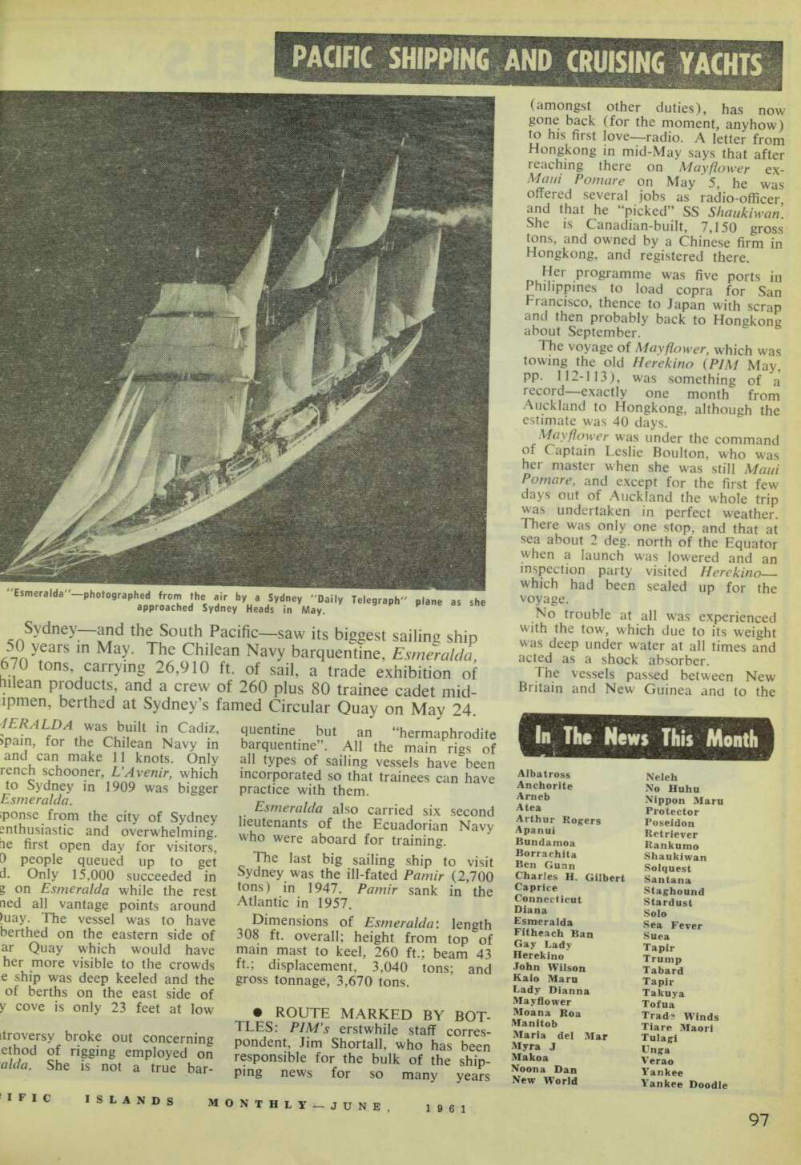
Sydney—and the South Pacific—saw its biggest sailing ship 50 years m May. The Chilean Navy barquentine, Esmeralda 670 tons carrying 26,910 ft. of sail, a trade exhibition of hilean products, and a crew of 260 plus 80 trainee cadet mid ipmen, berthed at Sydney’s famed Circular Quay on May 24
4ERALDA was built in Cadiz, Spain, for the Chilean Navy in and can make 11 knots. Only rench schooner, L’Avenir, which to Sydney in 1909 was bigger Esmeralda. ;ponse from the city of Sydney enthusiastic and overwhelming, lie first open day for visitors, 0 people queued up to get d. Only 15,000 succeeded in S on Esmeralda while the rest ned all vantage points around >uay. The vessel was to have berthed on the eastern side of ar Quay which would have her more visible to the crowds e ship was deep keeled and the of berths on the east side of y cove is only 23 feet at low itroversy broke out concerning ethod of rigging employed on alda. She is not a true bar
quentine but an “hermaphrodite barquentine”. All the main rigs of all types of sailing vessels have been incorporated so that trainees can have practice with them.
Esmeralda also carried six second lieutenants of the Ecuadorian Navy who were aboard for training.
The last big sailing ship to visit Sydney was the ill-fated Pamir (2,700 tons) in 1947. Pamir sank in the Atlantic in 1957.
Dimensions of Esmeralda : length 308 ft. overall; height from top of mam mast to keel, 260 ft.; beam 43 ft.; displacement, 3,040 tons; and gross tonnage, 3,670 tons.
• Route Marked By Bot
TLES: PI M’s erstwhile staff corres pondent, Jim Shortall, who has been responsible for the bulk of the ship ping news for so many years
(amongst other duties), has now gone back (for the moment, anyhow) to his first love—radio. A letter from Hongkong in mid-May says that after reaching there on Mayflower ex- Maui Pomare on May 5, he was offered several jobs as radio-officer and that he “picked” SS Shaukiwan.
She is Canadian-built, 7,150 gross tons, and owned by a Chinese firm in Hongkong, and registered there.
Her programme was five ports in Philippines to load copra for San Francisco, thence to Japan with scrap and then probably back to Hongkong about September.
The voyage of Mayflower, which was towing the old Herekino (PIM May, pp. 112-113), was something of a record—exactly one month from Auckland to Hongkong, although the estimate was 40 days.
Mayflower was under the command of Captain Leslie Boulton, who was her master when she was still Maui Pomare, and except for the first few days out of Auckland the whole trip was undertaken in perfect weather.
There was only one stop, and that at sea about 2 deg. north of the Equator when a launch was lowered and an inspection party visited Herekino which had been sealed up for the voyage.
No trouble at all was experienced with the tow, which due to its weight was deep under water at all times and acted as a shock absorber.
The vessels passed between New Britain and New Guinea and to the
"Esmeralda”—photographed from the air by a Sydney "Daily Telegraph" plane as she approached Sydney Heads in May.
ward of all the islands that extend the tip of New Guinea. They sed close to the Philippines and the few days they were in those ers were regularly inspected by fighters. im Shortall’s interest in anything aining to the sea is well-known he ends his account of the sucvoyage on a characteristic “All the way from about Nor- Island (which we passed about miles to the west), I dropped ed bottles with messages giving s position and my Auckland -ess—so maybe one of the 24 be picked up on some beach some v I dropped the last one just ide Hongkong.”
First Of Its Kind: Cable
Wireless, Ltd.’s., newest cable ir ship Retriever, the first of its to handle repeatered coaxial es, has been launched in Britain, tie vessel will be based on Suva i the time the Sydney-Auckland on of the Pacific Cable Project mpac) is opened, irminal building construction is :rway in Sydney, and in New and, while building sites and s have been finalised in Suva, irther along the track of the J, final negotiations for a landing ce in Hawaii have been nearly aleted. This will mean bypassing
Fanning Island, thus saving consider able expense, and elimination of the need for an additional land station. • SOME OF OUR SUBS: For a change, any periscopes sighted off the eastern coast of Australia up till the middle of June belong not to Them but to Us! Anti-submarine exercises involving the RAN, mari time aircraft of the RAAF (i.e.
Neptunes) and HMS Tapir will go on for nearly three weeks, from May 22. Area for the exercises is north from Sydney to Brisbane and Hervey Bay.
There are how four Royal Navy
submarines based in Sydney ( Pravda please copy) HMS Trump, Tabard, Anchorite and Tapir. • NEW MASTER: Moana Roa, on the NZ-Cooks run, has had Cap tain Alex Fraser, previously first officer of Maui Pomare and Moana Roa, confirmed as the new master in succession to the late Captain Hare, under whom Captain Fraser served on both ships.
• Private Life Of A Tuna:
With the object of learning more about the private life and habits of the aku (skipjack tuna), US Bureau
Commercial Fisheries vessel ” les H. Gilbert, completed a five : cruise south and west of Hawaii lay 8. formation was sought as to the n and migration routes of schools na which support summer fishing cal waters. m schools were found to be ; abundant near Johnston Island in an area about 150 miles south ahu than they were to the west , between Kauai and French te Shoals. In both areas most ic first were small. Near John- Island, a number of skipjack marked with plastic tags and sed. Recapture of any of the ed fish would give important to the origin of the migratory •Is. Scientists aboard the Gilbert ted samples of skipjack blood i will be classified and com with other samples taken from to the south such as the Line Is and the Marquesas.
The Man That Got
Y: PIM hears some unusual lories from time to time and the Gilbert and Ellice Islands y comes news of a fisherman t by a fish. ently, an empty canoe was by fishermen on the outer of Onotoa. A search for the g fisherman was fruitless. Local ities believe the man became d up with his fishing line while g up a fish and was pulled >ard. This was suggested by >sence of a fishing line in the )0 IT YOURSELF: After two work with a home made rod with a reel and 130 lb nylon mateur fisherman Cyril Curry ?i. Western Samoa, landed a yellow fin tuna, fish, claimed to be the largest fin tuna caught with a rod ;ht line by an Apia fisherman, •oked about 10 miles off shore, ears ago, Mr. Curry caught a tuna in the same place.
® Underwater Peaks: More
than 40 uncharted mountains were discovered in the Pacific Ocean bed between Guam and Japan by a Japanese survey vessel.
The Maritime Safety Agency, re ported that they were discovered by the survey ship Takuyo while making soundings of the Pacific Ocean floor for the laying of a joint Japanese-US cable. Some of the mountain peaks were 6,500 feet high, but they are not likely to be a menace to navi gation! • ICE COLD IN ARNEB : Un usual visitor to tropical Papeete in April was the US Navy supply ship Arneb, a specially converted mer chant ship for Antarctic service. Once a year since 1955, Arneb, named after a southern constellation, has made a trip to US bases in McMurdo Sound and Cape Hallett areas of the Ant arctic continent with heavy equipment and stores. Arneb’s crew were de lighted to de-frost in Tahiti but two
rnascot Eskimo dogs found the heat just a little oppressive.
Meanwhile, HMS Protector, was expected back in Portsmouth last month after penetrating further south into the Antarctic than ever before Unexpectedly favourable ice con ditions enabled the ship to reach Marguerite Bay in latitude 69 degrees, 15 minutes South, and her helicopters flew to the British base on Stonning ton Island.
HMS Protector, oldest seagoing ship of the Royal Navy in com mission, on her last voyage rounded both Cape Horn and Cape of Good Hope passed through the Panama Canal, crossed the Equator and Antarctic Circle as well as visiting lonely Tristan da Cunha. So popular has been the commission that many of the 240 officers and men have volun teered for a further season in the area.
• Danish Expedition; It Is
expected that a Danish scientific sur- Xfy i* l NNG, to be undertaken by the University of Copenhagen from July 1, 1961, will last until October 1, 1962. The 100 ton Danish motor schooner Noona Dan used by the scientists, has been granted permission to enter the island areas of Biak Nois-Noem, Mois-Waar in Geelvink Bay and the surrounding territorial waters during the period December l?xT^ pn )’ 1962 ’ As well as NNG, the Noona Dan will pay calls to coastal areas in Australia and the Solomons. • FIJI BEACONS: Improvement of navigational aids in Fijian waters ri'7 e . X Jvf cte , cl . f°H. ow ing a grant of ±.17,150 which will be spent between 1961 and 1964 to provide more radar beacons, lighthouses, marker and mooring buoys and the blasting of certain reefs.
• Wharf Scheme Started:
Other good news for shipping, is that at last a start has been made on the reconstruction of Suva wharf. This entails preliminary work on reclama tion of a small area of land and on the preparation of pile casting areas.
Chnstiani Nielsen and Gammon will carry out the work.
First phase of the building of the
The "Maria del Mar", as she looks on the reef at Santo, where she was wrecked in March. She is now for sale, as is where is.
Photo: Reece Discombe
New Cable Ship
This drawing is made from the design plans of the new 8,000 ton cable ship which was ordered by Cable and Wireless Ltd. in January - the first British cable-laying ship designed
to lay modern deep sea communications
cable. She will handle the kind to be used in the 28,000 mile Commonwealth round-the world telephone cable.
v 600 foot Walu Bay berth will ready for shipping by June, 1962, the whole job, including the re struction of Prince’s wharf, will finished by the end of 1963.
► Tonga’S Pilot Launch;
Fairway echo sounder has been sd to the equipment aboard the :ualofa Pilot Launch Unga. This portable unit and can be operated either 5 standard flashlamp eries or from a 6, 12, or 24 volt )ly. It provides readings on an ■parallax dial on two ranges, i.e. 1 50 feet or 0 to 50 fathoms. It been found to be valuable in ob ng quick and accurate soundings le harbour area, especially at en :es to boat harbours where silt s to build-up during bad weather.
REEF PASSAGES: The Gilbert Ellice scheme for improvement eef passages has got Colonial e and War Office approval. It )ped the work will be done by a ’ of Royal Engineers. Details t available yet but a £5tg52,500 t will enable 10 channels to be oved.
High But Not Dry: Maria
Mar, wrecked on Pallicolo Reef March, has been put up for sale is and where is” reports PlM’s ) correspondent.
Bulk Cement Carrier:
2 screw motor ship John Wilson, in Leith, UK, for the Wilson Portland Cement Company, land. On completion of trials e cement handling plant the ship I for NZ via Panama Canal, so rill be seen in the South Pacific.
Three Day Boat Day:
ing and unloading ships at Niue ;ver easy because it involves ring from the ship lying off to the wharf. However, the h Tofua took 55 hours to com ber business. Normally she I arrive and depart on the same Rough seas were running, when ' came to Alofi, 9.30 a.m,, i 28, and she moved round to )u, southeast of the island, until calmed down next morning, began at 10.30 a.m. but not 4.30 p.m. March 30, did she way.
Mew Mission Boat: Young
■ of the Bundamba Methodist h, Queensland, are building a diesel powered boat Bunda :or use in the Papuan mission t a cost of £2,000.
• Trocus Fisheries: Mr.
Louis Devambez has completed a mission in the New Hebrides dealing with the trocus fisheries for the South Pacific Commission. Mr. Devambez spent four weeks on the NH coasts studying the situation. He had earlier spent some time in 1959 on the same subject at the invitation of the New Hebrides Administration.
Trocus fishing has been banned since 1958, because of excessive exploita tion. Mr. Devambez reported that the trocus is recovering slowly but surely.
• Trade Winds Price: Trade
Winds, sold by Athol Rusden to the
French Administration at Vila re cently, fetched him £19,000, accord ing to a New Hebrides report. • MISSING. Reported missing in Netherlands New Guinea at the end of May was the 10-ton wooden schooner Manitob, which had set out from Sorong on a trading voyage through the most westerly islands of Netherlands New Guinea, adjoining Indonesian territory. She was due back at Sorong on May 15.
• For New Guinea. Burns
Philp (New Guinea), Ltd., in May took delivery in Hongkong of three
coastal vessels for the New ea service. Two are each of 100 and the third is of 43 tons. ’s NG shipping director, Mr. G e, said in Port Moresby that hips would arrive in Rabaul on 17 and go into service fin itely.
Hope For Harbour. Nor-
Island is going ahead with in ations, recently approved by ahan Territories Minister Paul ck, into the possibility of creat n artificial harbour. The Ad oration has already looked at the 'ihty of using compressed air to one. s works on the breakwater 3le. Compressed air is fed to ated pipes or plates laid on ;a bed. The air rises in the of small bubbles, the effect be mduce horizontal currents, plus Idy, near the surface. The ts and the eddy act together to the energy of the waves, □rtunately, for the most favour esults there must be a com ►n of certain factors which limit the use of the scheme irfolk. Also the method is ex and could only be seriously :red . . Norfolk if the eco possibilities really justified it. the investigations are going in other ways.
Erth For Honiara. The
Ports Authority has recently
msidering a report, made by a firm, on the construction of
a deep water berth for Honiara.
Honiara at the moment has a stub jetty, which is big enough only for the Tulagi to unload one hatch at a time directly onto the wharf. The proposed new deep water berth would commence at the seaward end of the stub jetty and run north-easterly, roughly parallel to the present cause way to the mooring dolphin.
The new construction would be
210 ft., giving a total length of 235 ft. when added to the stub jetty. Depth of water alongside would be 26 ft.
The report has also proposed that the depth of water over near by Pelope Shoal be increased to 27 ft. by removing the top of the shoal—although this idea won’t be greeted with enthusiasm by every body, as some think the shoal acts as a natural dredge in that part of the harbour.
The Ports Authority has con -11 suited overseas shipping companies m ar, d replies so far received from H three say that the wharf proposal H would certainly enable their vessels to berth alongside Port Cruz. The BSIP thinks the new arrangements would enable all but the very largest vessels to come alongside, with the aid of a pilot vessel. • GOOD. Captain Hugh Williams’
Apanui, which started in the Cook’s service in May, is a good steady sea boat. This was proved during the 10i day trip from Auckland to Rarotonga against headwinds.
Last of The
"Tiare Maori"
The "Tiare Maori", sunk and badly damaged by a mysterious fire in Papeete Harbour earlier this year, has finally ended her days. She has been moved because she was in danger of becoming a menace to navigation. See p. 107.