Henderson - Isle Of
pp. 77-95 · Read in the full issue

Near Disaster
From M. D. Howse, on Pitcairn Island To the outsider, Henderson Island is a tiny speck on the Pacific map about 110 miles north-east of Pitcairn. But to the Pitcairn Islander, Henderson is almost his other world—a world rich in historical events, valuable as a source of timber for his carving trade, and as a subject for pleasant conversation.
jV/fANY are the stories I have heard . here on Pitcairn of uninhabited, fascinating Henderson Island, only five miles long and two and a half miles wide—stories of adventure, of courage, seamanship, companionship, disaster and near-disaster.
Here, they kept telling me, is an island where fish and colourful birds abound in thousands; where many caves still conceal the secrets of the early Polynesian voyagers. It was here, during the war, they said, that Pitcairners sweated for six weeks, under NZ sponsorship, to build an airstnp over jagged coral and subtropical growth, without any mechamcal assistance, and when the backbreaking job was almost accomplished, for some unknown reason it was abandoned.
I have heard, time and again, the story of the young American Bob Tamarchm and his chimpanzee, Moko, who were put ashore at Henderson a few years ago seeking adventure and world recognition. Often at school the children have related to me how Moko, brought back to Pitcairn with his master, attended school almost every day, and of the
antics he used to get up to.
I have heard how the Henderson voyage can be dangerous. One party never reached there because of a terrific storm which came up suddenly during the night. For seven days the men drifted, and when the sun came out on the eighth day they found their position to be 120 miles south of Pitcairn, instead of 110 miles north.
Tragedy
On another occasion, many of the men in an expedition went down with Asian flu, caught possibly from pas sengers on the big ship which took them and their boats up. After four days on the island, many of the men seriously ill, the position was so bad that they decided to return to Pit cairn immediately, but how the two boats managed to reach home with the wind and rain upon them, and only a mere handful of the men fit enough even to sit up, was surely an act of God.
One member of the voyage died shortly after their return. That many more did not follow him was due only to the untiring medical atten tion given them by the medical
Scenes On
Henderson
The author of this article, Mr. M. D.
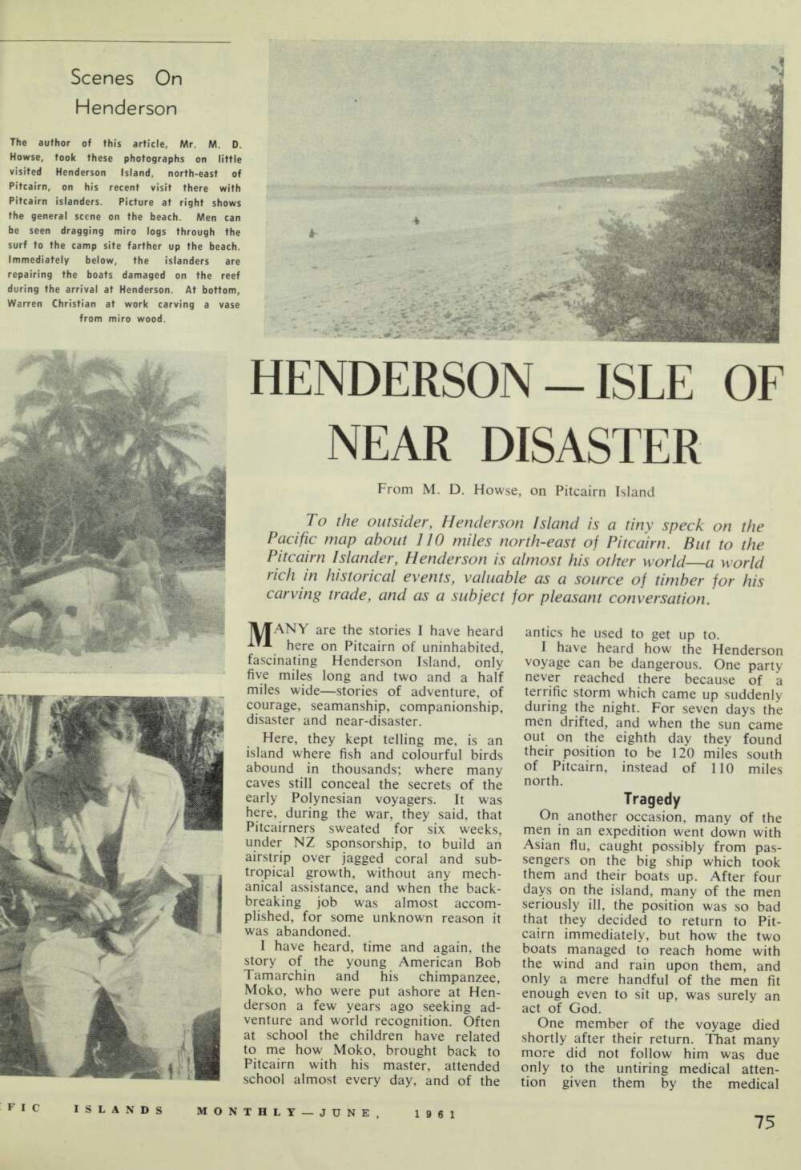
Howse, took these photographs on little visited Henderson Island, north-east of Pitcairn, on his recent visit there with Pitcairn islanders. Picture at right shows the general scene on the beach. Men can be seen dragging miro logs through the surf to the camp site farther up the beach.
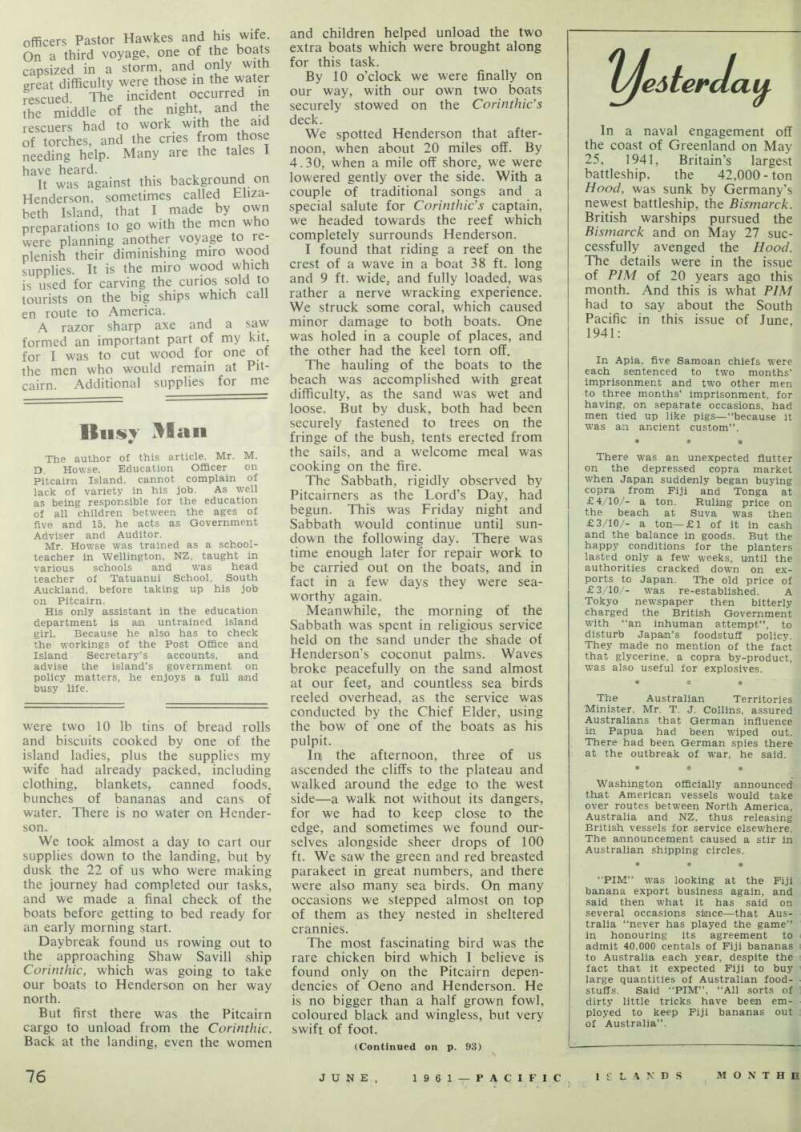
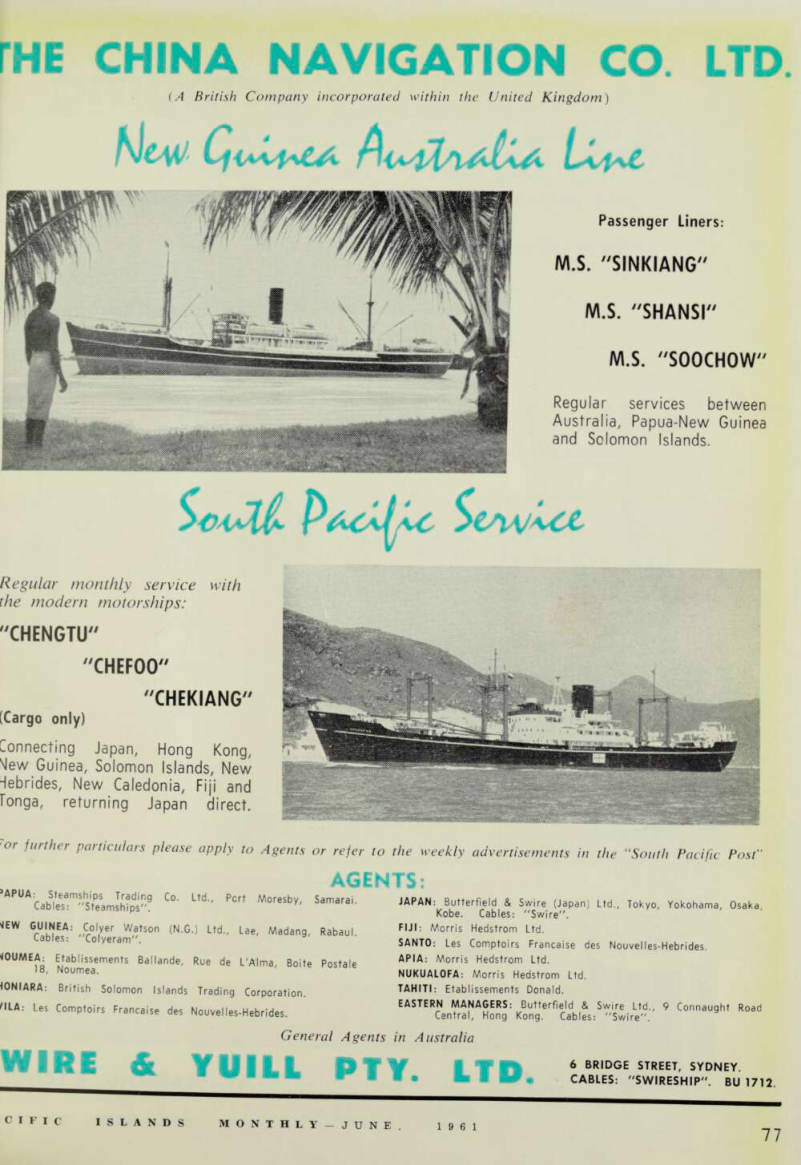
Immediately below, the islanders are repairing the boats damaged on the reef during the arrival at Henderson. At bottom, Warren Christian at work carving a vase from miro wood.
officers Pastor Hawkes and his wife.
On a third voyage, one of the boats capsized in a storm, and only with great difficulty were those m the water fescued. The incident occurred m the middle of the night, and the rescuers had to work with the aid of torches, and the cries from those needing help. Many are the tales 1 have heard. . , , , „ It was against this background on Henderson, sometimes called Eliza beth Island, that I made by own preparations to go with the men who were planning another voyage to re plenish their diminishing miro wood supplies. It is the miro wood which is used for carving the curios sold to tourists on the big ships which call en route to America.
A razor sharp axe and a saw formed an important part of my kit, for I was to cut wood for one of the men who would remain at Pit cairn. Additional supplies for me
were two 10 lb tins of bread rolls and biscuits cooked by one of the island ladies, plus the supplies my wife had already packed, including clothing, blankets, canned foods, bunches of bananas and cans of water. There is no water on Hender son.
We took almost a day to cart our supplies down to the landing, but by dusk the 22 of us who were making the journey had completed our tasks, and we made a final check of the boats before getting to bed ready for an early morning start.
Daybreak found us rowing out to the approaching Shaw Savill ship Corinthic, which was going to take our boats to Henderson on her way north.
But first there was the Pitcairn cargo to unload from the Corinthic.
Back at the landing, even the women
and children helped unload the two extra boats which were brought along for this task.
By 10 o’clock we were finally on our way, with our own two boats securely stowed on the Corinthic’s deck.
We spotted Henderson that after noon, when about 20 miles off. By 4.30, when a mile off shore, we were lowered gently over the side. With a couple of traditional songs and a special salute for Corinthic’s captain, we headed towards the reef which completely surrounds Henderson.
I found that riding a reef on the crest of a wave in a boat 38 ft. long and 9 ft. wide, and fully loaded, was rather a nerve wracking experience.
We struck some coral, which caused minor damage to both boats. One was holed in a couple of places, and the other had the keel torn off.
The hauling of the boats to the beach was accomplished with great difficulty, as the sand was wet and loose. But by dusk, both had been securely fastened to trees on the fringe of the bush, tents erected from the sails, and a welcome meal was cooking on the fire.
The Sabbath, rigidly observed by Pitcairners as the Lord’s Day, had begun. This was Friday night and Sabbath would continue until sun down the following day. There was time enough later for repair work to be carried out on the boats, and in fact in a few days they were sea worthy again.
Meanwhile, the morning of the Sabbath was spent in religious service held on the sand under the shade of Henderson’s coconut palms. Waves broke peacefully on the sand almost at our feet, and countless sea birds reeled overhead, as the service was conducted by the Chief Elder, using the bow of one of the boats as his pulpit.
Inj the afternoon, three of us ascended the cliffs to the plateau and walked around the edge to the west side—a walk not without its dangers, for we had to keep close to the edge, and sometimes we found our selves alongside sheer drops of 100 ft. We saw the green and red breasted parakeet in great numbers, and there were also many sea birds. On many occasions we stepped almost on top of them as they nested in sheltered crannies.
The most fascinating bird was the rare chicken bird which I believe is found only on the Pitcairn depen dencies of Oeno and Henderson. He is no bigger than a half grown fowl, coloured black and wingless, but very swift of foot.
(Continued on p. 93)
\nother point of interest we saw mg our Sabbath walk was the lly corroded and now unused light (se on the west side, which was :ted during the war by NZ service i. along the beach towards camp we saw a large signpost "mg the inscription: “This Island Dependency of Pitcairn and the Derty of the British Government” here was another land mark, too’ ; w^s . th e flagpole erected by Bob larchm, and upon which he had [ed his shirt for the benefit of a ing vessel. But now the Islanders hoisted the British flag given i by Captain Jones of the Corin lere were other things to see on ierson —the caves for instance ■hese were to wait until the final The next four days followed a autmc of work. ch day was begun with the read nd the discussion of a text from Bible. It was followed by a :r or thanksgiving, before the Jers disappeared into the bush their axes to cut down selected trees.
Companionship
ring ihe days could be heard the of many axes biting into the md beautifully grained timber, nen would go up to a mile from imp to obtain the oldest, better :d trees. When the logs had cut they would be hauled down ! surf, and then dragged by sea camp site. ing the evening, and often into irly hours of the morning, the ould be sawn up and the timber y shaped. The pieces would ie form of perhaps a flying fish, e ’ » a This was called ng , and it was done by the )f many kerosene lamps, men spoke little, yet the feel companionship was ever pre evening, too, was always closed vorship. Then we would lie to snatch a few hours sleep the new day began, sharing the ith numerous land crabs which to delight in crawling over us east expected. ;ing arrangements were or by the boat captains and the was changed daily except i good or willing cook was J would be occasional time off
during the day to fish. The fishing was so good that one group of five men caught 120 in less than an hour.
Parrot fish and a species known to the islanders as White fish were the most common. They could be seen in thousands swimming inside the reef in water no deeper than 2 ft. When cooked in coconut milk they were a welcome change to canned food.
We cut timber to a quota. Because there was limited space in the boats, each man was permitted to take back 150 pieces of dubbed timber.
I reached three-quarters of my quota on the fourth day, and then went cave exploring.
Old Relics In many caves I found the remains of humans—relics of early Polynesian occupation of the island. One in teresting cave was 60 ft. above the sea, and was 12 ft. high, 20 ft. wide on the floor of the entrance. After entering for 20 ft., the cave divided into three recesses. In one of these recesses I saw what appeared to be a man-made trough, filled with a trickle of water from the rock face.
In another recess I found a fan shaped shell, which could possibly have been used as a scraper, and near it was a polished adze. Near the cave entrance were remains of ovens.
Two large heating stones lay on top of a great deal of charcoal, mixed with soil and sand that had been blown in over the years. There were crushing stones underneath the dirt in the cave.
I would liked to have searched other caves, for it would be interest ing to see what some of those on the east side might reveal. But there was no time.
The islanders told me how on a previous trip they had found the re mains of a comparatively recent disaster in one of the southern caves Tour skeietons, three adults and one child, were lying near the cave entrance, with their hands by their sides. The skeleton of the child was so placed that it could have been P re^!?. a ,* ak Samples of hair were sent to Fiji for analysis but the findings were not conclusive. Pitcairners think “isnuiy have been a wartime tragedy.
The day selected for departure de pended on the weather, including a wind from the north, which would Sffc » back towards Pitcairn. On tne fifth day the committee of five men appointed by the Pitcairn Coun cil to make decisions of this kind met for a discussion. It was decided to pack in the hope of being able to cast off by nightfall, T . That da V was a hive of activity Ihe boats were dragged into the sea
and loaded—a task which took a great deal of time because the stack ing of the boats was meticulous. The captains insisted on it.
We waded waist deep into the water to reach the boats, which were being continually buffeted by the breaking surf.
By nightfall we had hoisted sail, and were headed towards Pitcairn.
Clear of the land a canvas shelter was erected along the windward side of each boat. We settled down to snatches of badly needed rest—all, that is, except the coxswains, who sat faithfully all through that night, hand on the tiller and eyes on the compass.
This was a good trip home.
There was a calm sea, and a wind of approximately five knots, and Pit cairn was spotted from the mast shortly after dawn. Soon after, we downed sails, and after 17 hours at sea we rowed to that famous landing at Bounty Bay for a rousing reception by all the loved ones waiting there.
Now that I, too, have had the ex perience of a voyage to Henderson, I, too, can take part in the topic which has since been the centre of conversa tion at many a communal gathering.