[?]ong The Dinner-Plate Daisies,
pp. 75-76 · Read in the full issue
Monkeys And Moolahs Of Papua
Who was the Captain Lawson who wrote the imaginary account called Wanderings in New Guinea"? "PIM" asked the question in an article in the lay magazine section. Was it, "PIM" asked, a man called Armit who later, in 883, went to Papua to lead an expedition financed by the Melbourne "Argus"? ircumstantial evidence seemed to suggest that it was, we said. Here is some lore on the mystery —together with a description of some of the things that Captain Lawson" wrote in the book which caused a mild sensation in the London F that day.
By a Staff Writer
If Captain J. A. Lawson’s Wanderings in New Guinea had een published after World War I, when book dust-jackets egan to come into general use, instead of back in 1875, the lystery that surrounds the old book would have been solved mg ago.
IAUST-JACKETS, and more particu lady their flaps, on which pub lishers extend themselves in the how, when and why of a book, are a valu able reader’s aid. But in 1875 when London publishers, Chapman and Hall, produced Wanderings, the fashion was “fully bound in cloth”— if not in good Morocco—and other than adorning the cover with em bossed whirligigs, scrolls and fancy lettering, no explanations were given.
So, 86 years later, the sober get-up of the original edition; its folding map of the Captain’s journey; the sepia frontispiece, are all calculated to per suade the reader that the publishers were not fooling when they published it—even if the author were.
And yet, even in 1875; even when publishing from an office in Picca dilly; and even when Papua was as un known as the wrong side of the moon —could anyone really believe any of the whoppers Captain Lawson wrote?
Literary Prank
But if they did not, why would a reputable firm of publishers indulge in this kind of literary prank? And why would anyone of the eminence of Captain Moresby, RN, bother to go into print (in the London Times) to deny what Lawson claimed?
"Hiese mysteries will likely now re main unsolved.
Although the circumstantial evi dence does seem to point to Armit, an old-time Papuan explorer, as “Lawson” the author (PIM May, p. 75), here again there are still large gaps in the story. It is difficult to fit the little we know of Armit, the real explorer of 1883 and onwards, into
[?]Mprisoned
Prison
Hidden by this great [?]ass of roots from a great [?]nyan tree at the Bay of [?]ony, New Caledonia, is stone prison cell which [?]ce held human prisoners, [?]he tree now imprisons the [?]ll. There are no prisoners the Bay of Prony these [?]ys—but ships take iron [?]e to Australia from [?]ere.
Photo: Fred Dunn
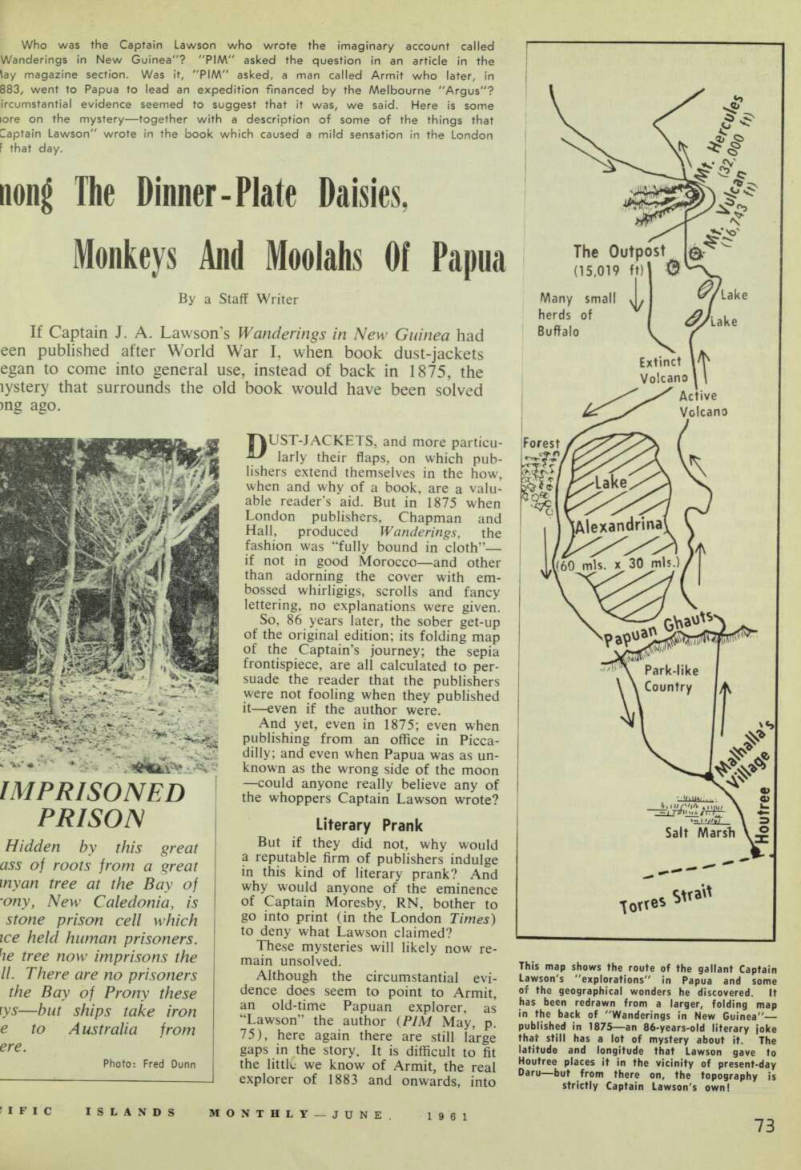
This map shows the route of the gallant Captain Lawson's "explorations" in Papua and some of the geographical wonders he discovered. It has been redrawn from a larger, folding map in the back of "Wanderings in New Guinea"— published in 1875—an 86-years-old literary joke that still has a lot of mystery about it. The latitude and longitude that Lawson gave to Houtree places it in the vicinity of present-day Daru but from there on, the topography is strictly Captain Lawson's own!
the part of Captain Lawson who, 11 years before that wrote of imaginary wanderings in the same country.
Let’s look at the book: Captain Lawson began his fabulous adventures in Sydney where he hired three aborigines (“brought up in Sydney”), as servants and arranged passage on a 120 ton brig. The party was landed on the Papuan coast at Houtree in June, 1872 —Houtree be ing in longitude 143 deg. 17 minutes E., and latitude 9 deg. 8 minutes S., which puts it slightly offshore from Daru, in the present Western District of Papua.
From this point, they headed directly inland, but not before hiring two Papuan servants, one of whom was Aboo, who although only 4 ft. 3 in. tall was capable of lifting four or five hundredweights at a time. He had lived most of his life in an in land village, but as well as speaking English he had a “smattering of French, Dutch and Portuguese, as well as several dialects of Malay”.
One feels, instinctively, that had such a mental and physical giant been alive today, he would have been nominated immediately as a member of the Papua-New Guinea Legislative Council.
If you look at the real map of Papua it can be seen that the ex pedition wouldn’t have proceeded far inland from “Houtree” before having to negotiate the Fly River. This didn’t happen in the book, although the obstacles that were encountered made getting across the Fly look about as insignificant as crossing a gutter in Pitt Street, Sydney.
Everything they encountered was the biggest or most extraordinary ever seen before (or since). A few days out they dined on roast monkey, with yams and boiled rice, the monkey being “delicious, the flesh white and tender and of excellent flavour”.
But this was junior league stuff.
Later on they met old-men apes and herds of buffalo; ostriches, no less, rushed around the grassy plains; there were herds of deer and goats; snakes with horns; hares; and the dreaded moolah, or Papuan tiger, which closely resembled its Indian cousin.
In the horticultural department they encountered, in the Papuan Ghauts (which Lawson named after a range in the Indies), English-type daisies as big as dinner-plates, which grew on 18 inch stems; and narcissi, nine inches across, with leaves seven feet long, “which gave forth a de lightful odour”.
One hundred miles inland the party came across the beautiful Lake Alexandria, 60-70 miles long and 30 miles across, studded with fertile islands and all very startling; but the real prize of the expedition was Mt.
Hercules, 100 miles further on, and 32,783 ft. high. This was the “highest mountain in the world,” said Lawson—and certainly no one has found one higher since—but it was unique in more ways than this.
Most of the world’s lofty peaks cheat a bit by rising out of surround ing mountain ranges that are them selves thousands of feet high. But Hercules went it alone. Its base was a mere 1,000 ft. above sea level and from it rose symmetrically the other 31,000 ft., the last 17,000 being mantled in snow. Stretching out from it but separate, like a conical pudding flanked by cup-cakes, were a series of minor peaks.
It must have been quite a sight, even if imaginary, and having looked, Lawson determined to try. With the faithful, multi-lingual Aboo, he be gan the ascent one day at 4 a.m.; by 9 a.m. they had reached 14,000 ft.; and-by Ip.m., 25,314 ft. (And the Queen knighted Hillary for climbing Everest with oxygen!) At this point, however, their noses began to bleed and their feet hurt, so the pair descended to the base of the mountain, which they did easily by nightfall.
With Mt. Hercules, Lawson ap pears to have exhausted even his imagination and soon he is retracing his steps to the coast which he reached about seven months after setting out. ❖ * * Captain Lawson, whoever he was, produced what must be the longest lived literary joke in history; and Cooktown’s ex-policeman Armit, who wrote those dull despatches to the Melbourne Argus , must still be laughing about it in his grave irre spective of whether he was, or was not, the culprit.