Kinjibi's Chairman Takes The Lid Off
pp. 63-69 · Read in the full issue
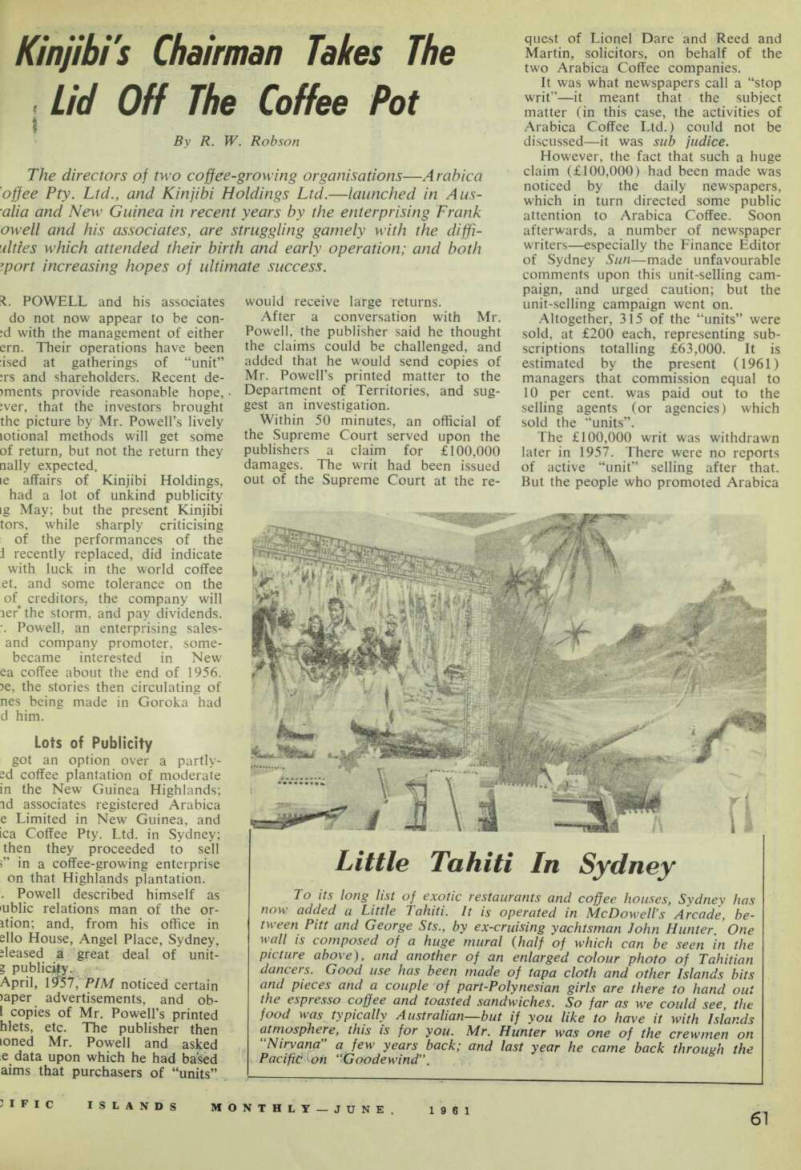
Lid Off The Coffee Pot
By R. W. Robson
The directors of two coffee-growing organisations—Arabica offee Pty. Ltd., and Kinjibi Holdings Ltd.—launched in Aus ■alia and New Guinea in recent years by the enterprising Frank owell and his associates, are struggling gamely with the diffi ulties which attended their birth and early operation; and both ?port increasing hopes of ultimate success.
L POWELL and his associates do not now appear to be con id with the management of either ern. Their operations have been :ised at gatherings of “unit” ;rs and shareholders. Recent de ments provide reasonable hope, ;ver, that the investors brought the picture by Mr. Powell’s lively lotional methods will get some of return, but not the return they □ally expected. ic affairs of Kinjibi Holdings, had a lot of unkind publicity ig May; but the present Kinjibi tors, while sharply criticising of the performances of the 1 recently replaced, did indicate with luck in the world coffee et, and some tolerance on the creditors, the company will ier the storm, and pay dividends.
'. Powell, an enterprising sales and company promoter, some became interested in New ea coffee about the end of 1956. )e, the stories then circulating of nes being made in Goroka had d him.
Lots of Publicity got an option over a partly sd coffee plantation of moderate in the New Guinea Highlands; id associates registered Arabica e Limited in New Guinea, and ica Coffee Pty, Ltd. in Sydney; then they proceeded to sell >” in a coffee-growing enterprise on that Highlands plantation. . Powell described himself as 'ublic relations man of the or ation; and, from his office in ello House, Angel Place, Sydney, leased a great deal of unit l publicity.
April, 1957 noticed certain )aper advertisements, and ob- I copies of Mr. Powell’s printed hlets, etc. The publisher then loned Mr. Powell and e data upon which he had based aims that purchasers of “units”
would receive large returns.
After a conversation with Mr.
Powell, the publisher said he thought the claims could be challenged, and added that he would send copies of Mr. Powell’s printed matter to the Department of Territories, and sug gest an investigation.
Within 50 minutes, an official of the Supreme Court served upon the publishers a claim for £lOO,OOO damages. The writ had been issued out of the Supreme Court at the re
quest of Lionel Dare and Reed and Martin, solicitors, on behalf of the two Arabica Coffee companies.
It was what newspapers call a “stop writ”—it meant that the subject matter (in this case, the activities of Arabica Coffee Ltd.) could not be discussed—it was sub judice.
However, the fact that such a huge claim (£100,000) had been made was noticed by the daily newspapers, which in turn directed some public attention to Arabica Coffee. Soon afterwards, a number of newspaper writers—especially the Finance Editor of Sydney Sun —made unfavourable comments upon this unit-selling cam paign, and urged caution; but the unit-selling campaign went on.
Altogether, 315 of the “units” were sold, at £2OO each, representing sub scriptions totalling £63,000. It is estimated by the present (1961) managers that commission equal to 10 per cent, was paid out to the selling agents (or agencies) which sold the “units”.
The £lOO,OOO writ was withdrawn later in 1957. There were no reports of active “unit” selling after that.
But the people who promoted Arabica
re by no means finished with New linea.
Late in 1957, Mr. Powell arrived the NG Highlands and, according correspondence which he issued in cember, 1957, and January, 1958, roka Coffee Holdings Limited was istered in New Guinea; proposals e made to acquire Kinjibi, Nori i and Clarens coffee plantations; ither bond or unit selling cam »n was being organised; Frank veil was general manager, field erintendent and public relations :er; the directors were A. T. Mar solicitor; J. L. Cameron, retired k manager; P. Portroni, coffee ert and investor; and (said Mr. veil) “two New Guinea planters agronomists will be added to the rd when I get to New Guinea”, reported that the solicitors were riel Dare, Reed and Martin; the itors were a well-known Sydney i; Mr. D. M. Clark was secretary.
Money Pours In luring 1958, this Goroka Coffee :ern was registered also in Sydney, jibi plantation was taken over, a really full-blooded campaign mit-selling was in progress, under energetic and ingenious direction Vlr. Powell. He bought time on tralian radio broadcasts. As re ed in PIM of October, 1958, there i entertaining radio sessions, re the merits of coffee-bonds were jrtised, and the theme-song was— he money-tree of Kinjibi s treasures bring to you and me omething like that. [oney seems to have poured in i the Australian public. Alan *uson and Bill Matthews, two -known ex-servicemen who had ted up Kinjibi from virgin bush, : happy to receive a substantial payment, and return to Aus a with their families, was reported about this time that )ica Coffee Pty. Ltd. would be e in some way a trustee company he Goroka Coffee concern’s unit rs—but that did not happen, s a matter of fact, by 1959 there some sort of revolt in the ranks Coffee, and in 1960 the d of Directors (which originally been similar in personnel to the le who promoted Goroka Coffee ) was replaced by new directors, le latter called a meeting of »ica unit-holders and took some drastic action in certain direc- The financial situation was led and difficult; but two iers, J. L. Cameron and A. M. eron, one a resident of Sydney the other of Melbourne, earned
the gratitude of the unit-holders by providing the company with enough money to save it from trouble, and get it around the financial corner.
It was about this time that connections between Arabica Coffee Ltd. and Goroka Coffee Limited—if any— were severed.
Meanwhile, Goroka Coffee Limited was “going great guns”—it entered into formal occupation of Kinjibi, bought a lot of plant, purchased a substantial share in Norikori Plantation, and purchased Cheggs’ general store at Madang.
Mr. Powell reported, as general manager, late in 1957 that Kinjibi “has 100 acres under coffee and . . . will yield between £40,000 and £50,000 next year, and full maturity in the following year”. Unit-buyers were encouraged to expect large profits. Mr. Powell was a well-known figure in New Guinea, and no ex pense appeared to be spared as he moved about the Territory.
For reasons that have not been published, these promoters, some time after 1958, formed and registered (in New Guinea) Kinjibi Holdings
with a nominal capital of 0,000; and unit-holders in Goroka fee Limited were allowed to con into shares in Kinjibi Holdings —and many did so. £300,000 he effect of this is that Kinjibi dings today has an issued capital 82,042 shares of £1 each, and 17 5 of £2OO each, making (with e adjustments) a total capital of 1,557. What remains in Goroka ee Ltd. is not shown anywhere. seems clear enough, from an ysis of the published figures, that unit-selling campaign which pro ed in Australia in 1957-59 to the of “the money-tree of Kinjibi” uced, from unit-selling, some ; around £300,000. ic directors of Kinjibi paid a nt 10 per cent, in December, , and a hesitant 5 per cent, in jst, 1959; and the rest was a £. r then, of course, the whole of much-publicised Kinjibi enter was under public scrutiny; there much criticism; and the revolt e Arabica subscribers in 1958-59 repeated by the Kinjibi sub srs in 1959-60. Kinjibi’s annual •al meeting, on March 31, 1960, inted a new Board and demanded nvestigation of the company’s s, and especially of the “Estab ent Account”. e new board (Messrs. Sidney
Baume, head of an Australian ad
vertising agency, chairman; C. W. F.
Ford, J. H. Lee, H. J. Perkins, and Mrs. C. D. Rankin) aided by a new
secretary, accountants and auditors,
issued in May, 1961, for the year
ended December 31, 1960, a report
of considerable length, in which the
activities of Kinjibi Holdings Ltd.
are surveyed with a detail and a
frankness that stirred most of the
newspapers to lively headlines. Here are some of the statements made by
chairman Baume:
The previous balance-sheet was an inaccurate presentation of the company's position, which precludes a dividend for 1960.
The minute-book does not record major financial transactions (for instance, the purchase of Norikori Ltd. shares for £36,845).
“Cheques drawn on the various bank accounts in Sydney were very often bearer cheques made out to ‘Cash’ and signed by authorised signatories. It was quite common for cheques for over £l,OOO to be cashed in this manner over the bank counter.”
“The signatories to this group of cheques were two or more of Messrs. D.
M. Clarke. P. Patroni, F. Powell, J. D.
Goodsir and K. Anderson.” (Mr. Clarke is the head of a firm of accountants and secretaries in Sydney, and he was chairman of the board until early 1960. Mr. Patroni was a relation of the promoter, Mr. Frank Powell ) D. M. Clarke and Co. were paid £4,109 for secretary and accounting services prior to the meeting of March. 1960. A further claim by them for £2,030 was rejected by the present Board.
The new board has included in its balance-sheet, as an asset, an amount of £2,864, loan to Mr. Powell, “evidently authorised or permitted by the previous Board”.
It was found that there was a “£4,550 short payment to the vendors for Norikori shares—this evidently having been taken as a commission and with the agreement of the previous board”.
This was brought back into the accounts and charged to Establishment Account.
It was found that 19,100 £1 shares had been issued to certain shareholders for 10/- each, and the remaining £9.550 had been charged to Establishment Ac count. The new board is demanding that the shareholders concerned pay this £9,550, and the Establishment Account has been credited accordingly.
With some other adjustments, the amount of the Establishment Account was reduced from £91,121 to £80,308.
The new board is scrutinising many other items in this Establishment Ac count. It is shown to include such items as advertising £31,917; commission, £28,224; supervision salaries, £4,537; travelling, £5,522; secretarial and office, £2,909.
The new board expresses indignation that the old board, while claiming that a profit was made in 1959, made no pro vision for taxation, although it was well known that profits in that year were taxable. It has provided out of the 1960 figures £2,685 for taxation in respect of 1959.
Although there actually was a small trading profit in 1960, the new Board says that, owing to adjustments made in respect of 1959 figures, there actually is an over-all loss in 1960 of £16,543. (Over)
Guinea's coffee is picked by native labour [?]d here is one girl at work in a Highlands plantation.
The new board, during 1960-61, 5 taken apparently sound and orous steps to get the company’s airs into order. \part from the finance adjustments icated, it has financed the purchase another 4,000 shares in Norikori ntation, thus obtaining control of t establishment; made efforts to p the Cheggs store at Madang quately stocked; and is applying If to arranging a special loan of least £30,000, to take care of rent debts and certain operations ently necessary for the profitable ration of the two plantations and store.
'hairman Baume points out, with d reason, that the company has y substantial unmortgaged assets Kinjibi and Norikori plantations; t 80 acres of Kinjibi and 45 acres Norikori will be in production by end of 1961; and that, under d management, Kinjibi (Mr. R. R. 1 is now there in charge) and ■ikori plantation should henceforth ce increasing profits. Given a nee, the board may turn Kinjibi n an accountants’ nightmare into ot a “money tree”, but an invest it that will give a modest return, lie Arabica Co., under the new lagement, also is modestly hope- It reports that in recent months 315 unit-holders (each unit cost 0) each received a distribution of profits of £lB—which, if they ;et the events of 1957-59, means they are getting a modest 9 per :. per annum on their money. : the two boards can get through 1962 with reasonable figures they Id achieve two worthy purposes— icly, give investment in New nea industries a better flavour, and ify an application for the listing hese shares on the stock exchanges.
The Balance Sheet he following were the principal is in the published balance-sheet, >n December 31, 1960:
The annual general meeting was fixed for June 14, and it was expected, in early June, that the shareholders would support the recommendations of the present board.
The BSIP is to print an official “family type” of magazine for Mel anesians, to be named Balama (frig ate bird). The first issue will be free but later issues will be sold at a nominal charge.
The decision to print the magazine was made in April at a meeting of the Literary Development Commit tee, whose chairman is Mr. E. P.. W.
Marriott.
Liabilities
scribed Capital— £ i ordinary £1 shares 271,607 t Holders’ Contracts— aid on 17 Units uct Debit Bal., P/L A/C 2,650 16,806 d Shareholders’ Funds is and Advances le Creditors r . for Income Tax 1959 ctors’ Fees and Salaries 257,751 8,600 12,041 2,698 3,300 3tal Liabilities 284,391
Assets
r Land, Buildings, etc., t at Cost 131,991 Plant and Machines 8,631 Furniture ... ... 1,804 Motor Vehicles 1,285 Feature Film 4,000 Cash at Bank 2,581 Sundry Debtors ... 8,592 Loan (F. Powell) 2,864 Stocks ... 16,842 Shares in Norikori ... 24,421 Establishment A/C 80,308 Formation Expenses 1,068 Total Assets 284,391