Anatomy Of
pp. 55-57 · Read in the full issue
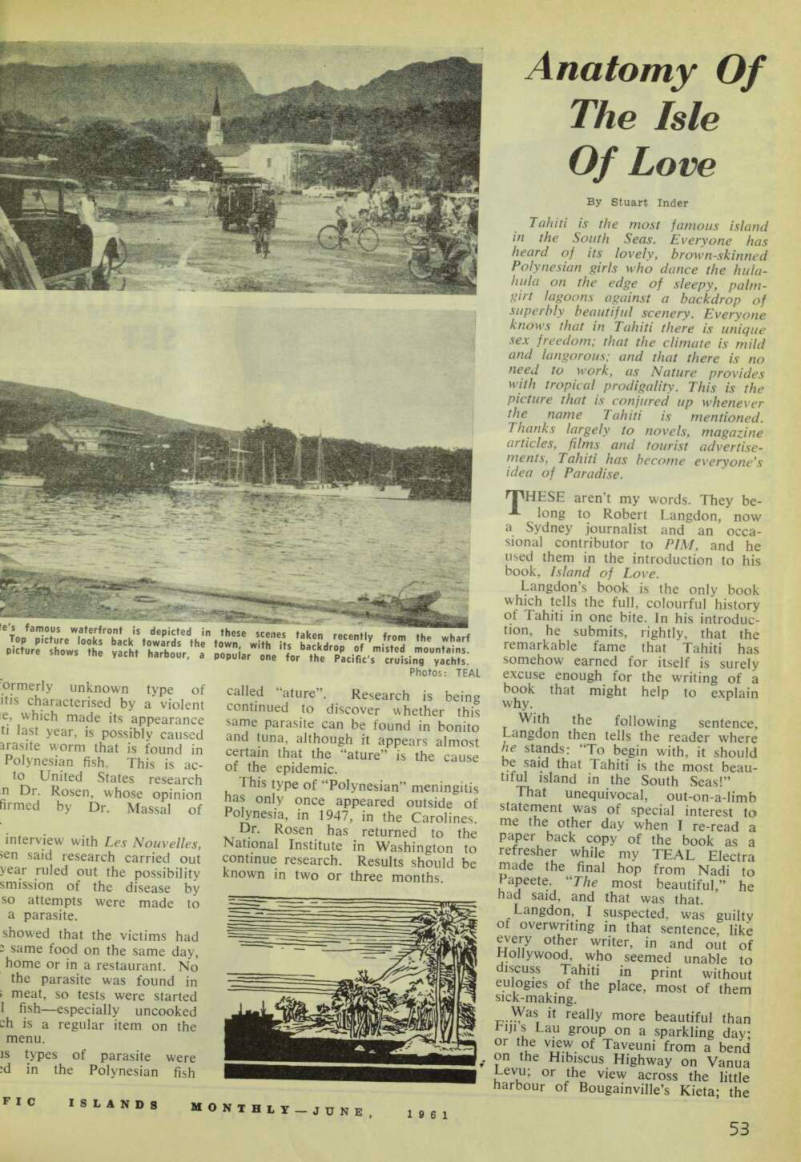

The Isle Of Love
By Stuart Inder
Tahiti is the most famous island in the South Seas. Everyone has heard of its lovely, brown-skinned Polynesian girls who dance the hula hula on the edge of sleepy, palm girt lagoons against a backdrop of superbly beautiful scenery. Everyone knows that in Tahiti there is unique sex freedom; that the climate is mild and langorous; and that there is no need to work, as Nature provides with tropical prodigality. This is the picture that is conjured up whenever the name Tahiti is mentioned.
Thanks largely to novels, magazine articles, films and tourist advertise ments, Tahiti has become everyone’s idea of Paradise.
T'HESE aren’t my words. They be- A long to Robert Langdon, now a Sydney journalist and an occa sional contributor to PIM, and he used them in the introduction to his book, Island of Love.
Langdon’s book is the only book which tells the full, colourful history of Tahiti in one bite. In his introduc tion, he submits, rightly, that the remarkable fame that Tahiti has somehow earned for itself is surely excuse enough for the writing of a book that might help to explain why.
With the following sentence, Langdon then tells the reader where he stands: “To begin with, it should be said that Tahiti is the most beau tiful island in the South Seas!”
That unequivocal, out-on-a-limb statement was of special interest to me the other day when I re-read a paper back copy of the book as a refresher while my TEAL Electra made the final hop from Nadi to Papeete. “ The most beautiful,” he had said, and that was that.
Langdon, I suspected, was guilty of overwriting in that sentence, like every other writer, in and out of Hollywood, who seemed unable to discuss Tahiti in print without eulogies of the place, most of them
sick-makmg.
Was it really more beautiful than Mjis Lau group on a sparkling day: or the view of Taveuni from a bend on the Hibiscus Highway on Vanua i-evu; or the view across the little harbour of Bougainville’s Kieta; the
age into fjord-like Vavau bour in the early morning; the rtlocks’ atoll from the lagoon; view of Norfolk’s Kingston as come upon it from the hills ye; or the view across the water Solomons’ Savo Island from the of Honiara. Could it, in fact, :h the colour seen from any t on Lord Howe Island—a scenic that most of us don’t even con ■ as part of the South Seas? s the famed, overwritten Isle of came up on the horizon, amid rain clouds, I asked seat panion Len Usher, editor and isher of the Fiji Times, whether greed that Tahiti had been over sd to blazes. “All I’ll say,” said ;r, who was not making his first to Tahiti, “is, you’ll be sur d at what you’ll find.” was raining when we landed on lew airstrip built along the coral, still raining when we piled into and headed for the “sights”, stood on Point Venus, where : had stood, before heading for ‘country”, which happened to be 0-mile drive around the bitumen d perimeter of Tahiti, with a for lunch at the isthmus. It was ng a lot of the time, and we : many stops. At each stop my ist heightened. lally, back in colourful Papeete e afternoon, I told Usher; “You right. So is Langdon, and ille, and Captain Bligh and —and a thousand or so others, place has got it."
What Has It Got? 11, what has it got? There have words for it—words that don’t I like drivel to everybody who t been there. lile I pondered the problem a glass of French wine and good food, with the fantastic of Moorea sticking up there e horizon, an answer was right nd —right at the table. :ame from Geoff Roberts, these a TEAL director, but a former d manager—the man who led the Coral Route to Tahiti 51. He and his wife had been ying in Tahiti for the past and Mrs. Roberts—not the af person to go sloppily ga-ga trifles—was unashamedly cap- I with her trip to Moorea. lave often thought about what Tahiti,” said Roberts, “and onvinced it comes down to things. start with, it’s the French ihere. It fits perfectly with the 1 easy life of the Tahitians, he mixture is pretty good.
They’re attractive, smiling people, and the French haven’t annoyed them.” (I thought about the absence of “Ladies” and “Gents” signs in that Papeete bar and the fascination of that single small room for “People”, and agreed.) “I think next it’s because there is hardly any fluctuation in tides in Tahiti. There is always water on the reef. There are no stinking mud flats to spoil the view and annoy your senses at the best time of day.” (I thought of the huge tide dis crepancy in the Lau group, and the hundreds of yards of mud, and agreed.)
“And then I think it’s the spec tacular mountain scenery. It’s so un expected. The mountains come almost down to the sea and with f he rain the y brin «- the coastal belt like^ranf^ 6 "’ 3 ” d In' 6 ,? owers are ,lke Gauguin painted them. Just '?° k ? ut ! her ® “> Moorea. Anywhere f se m . tbe ou ! b . ? eas , tßat mi ght , another coral island with some pabTls ; But r lt,s undoubtedly Moorea and f, hose fantastlC peaks make the view> I can’t do better than this. I go along with Mr. Roberts. That’s the recipe for Tahiti—the most beautiful island in the South Seas.