Quarter Century With The Mission
pp. 47-49 · Read in the full issue

Mission In The Mud
By a Staff Writer
The land that borders the Gulf of Papua is a wet world of mud, mangroves, heavy rainfall, huge river deltas—and more mud. But it is in such an environment that two of Papua-New Guinea’s most unusual missionaries have spent the past 25 years. They are Harrie and Eva Standen of the Bamu River Mission—the Mission in the Mud.
11/fOST missionaries are sent to their various stations, but the Standens simply went. Both had gone to Papua individually, to work in a bigger mission field, but in 1936 they married at the small church at Dam and thereafter branched out for themselves.
They cast their eyes to the east, to where the Bamu River empties its waters into Torres Strait, perhaps because the Bamu people had never had a missionary. No one had thought it worthwhile to contend with such ghastly living conditions to bring these primitive people enlighten ment, medical help or education— but the Standens decided to “give it a go”.
The 15 mile wide mouth of the Bamu is dotted with islands and the Standens selected Dobiri, five miles
long by two wide, as their head quarters. A survey indicated that the best place for a house was near the village of Maipani but the surrounding land was flat and low and there was plenty of evidence that high tides had flooded some of it.
In spite of assurances from the natives to the contrary, this proved a good deduction and at the next high tides, shortly after the house was complete, they sat inside and watched the flood edge inch by inch up the high piles. By luck or Providence the level stopped a foot from the floor, and even proved to be some thing of a convenience. As all travel was by canoe, it was an advantage to be able to step out the door into one and paddle off to the next house that poked itself up above the surrounding water. (Over)
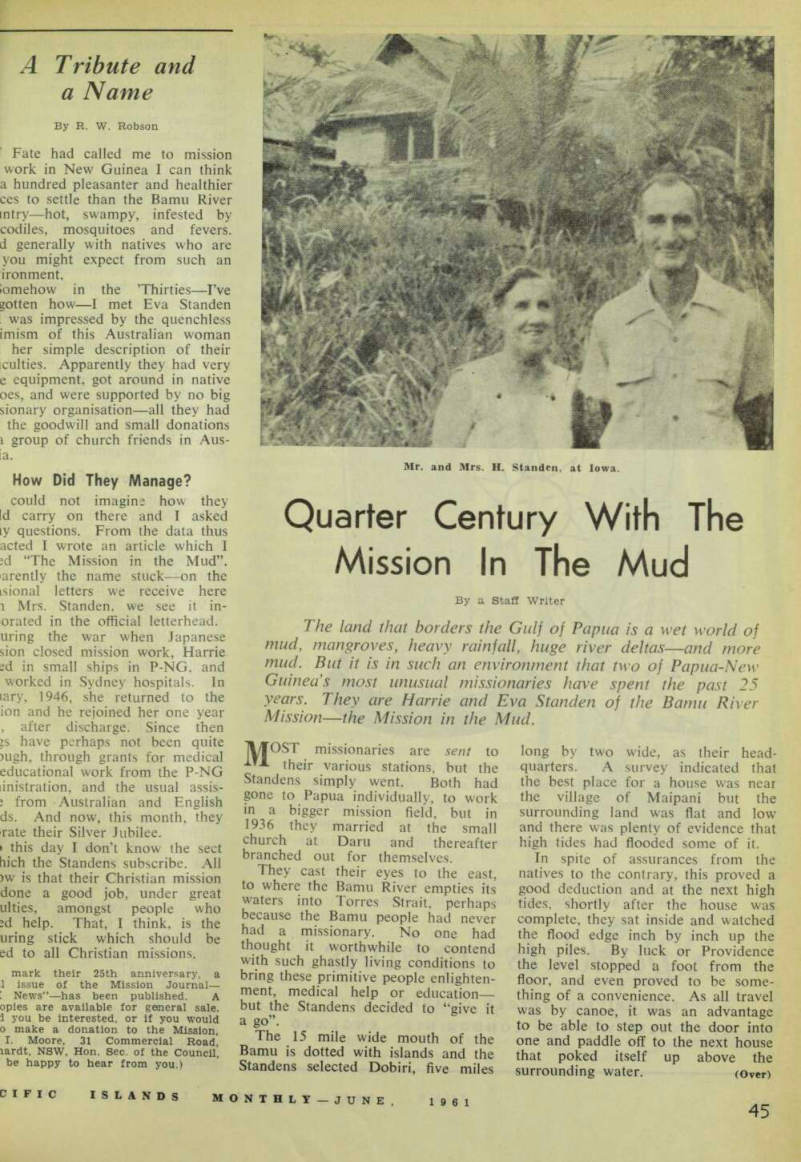
Mr, and Mrs. H. Standen, at Iowa.
When the flood subsided, howevc it left behind the revolting miu peculiar to this Gulf country at into which it was possible to sink i to the knees, hips or further. O \i this ooze it was necessary to bui walk-way platforms of sticks in ord to get about at all.
According to Mrs. Standen, thi started this enterprise on the Ban with “one bag of flour, one bag wet sugar, a case of bully-beef, few pounds of tea, a great deal hope, a rather weak faith, and notl ing else”.
They had no idea when ma money would be available for foa they had no backing from anyon no official standing. When cash needed to keep the wolf from tl mission door they bought coconui made copra and sold it.
Two years after the mission w\ founded, they managed to get Sydney and there, through dilige deputation work, established Home Council. It is this Coum which is the crux of the Mission financial arrangements today.
Mostly Faith
Explaining the economics of it PIM recently, two of the Sydno Council members, with considerate hesitation, said: “It’s mostly doi on Faith—voluntary contribution from friends, you know. It probate seems ridiculous to you”.
We thought about our own offlo with accountants and book-keeph machine-operators adding up thim on one side of the ledger and sm tracting them on the other—s operation in which Faith had no pas at all—and agreed that it did.
In 1938 the Standens acquire their first boat. It was a 25 launch, already past her first fluii of youth. They called her Pionei and she opened up larger horizon for the Bamu Mission. She w\ taken over by the Army during tl war and badly damaged.
Her first post-war replacemei was a 30 ft sailing cutter, whioi took up to two weeks to mab the short voyage to Dam and bac: if tide and wind were unfavourable She was followed by an ex-Thursdsl Island ketch, Goodwill ( Doodiw\ to the Bamu natives), that also w:\ long in the tooth. She gave up tl; ghost in 1957.
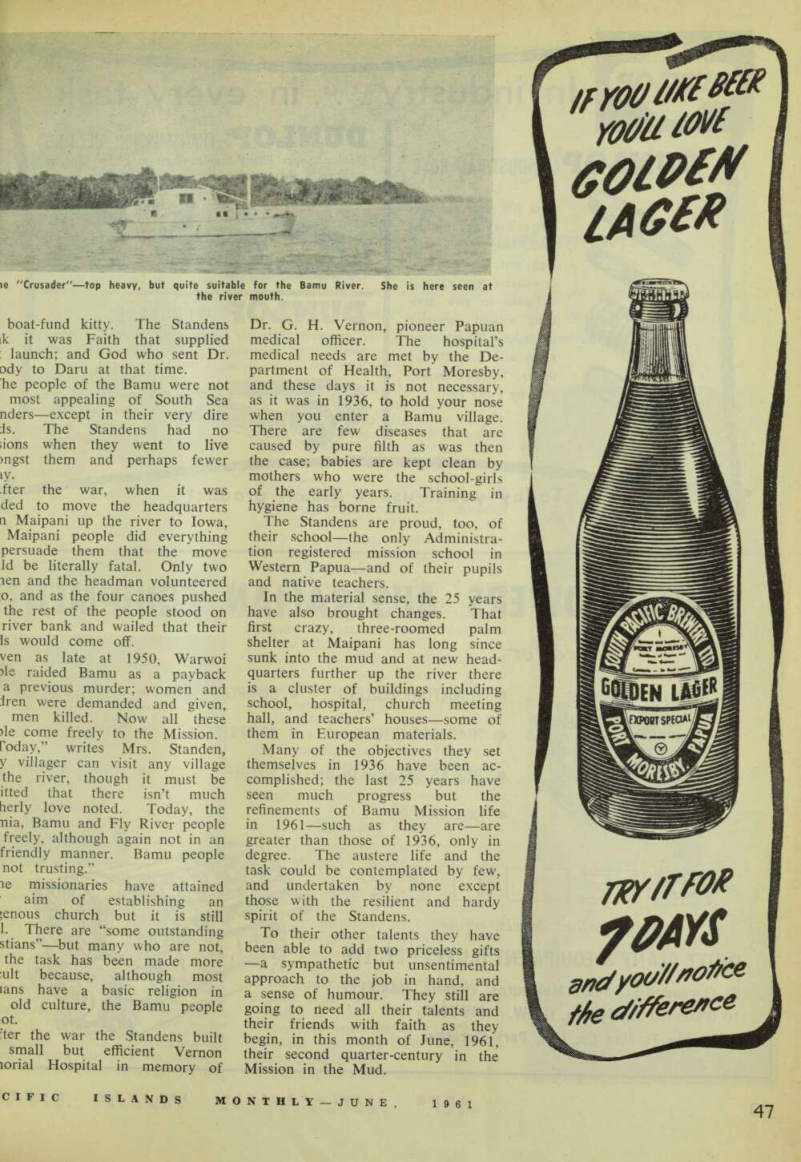
To fill the gap, Dr. C. A. Moodt Administration medical officer ; Dam, loaned them his 40 ft launoi Crusader, and later he decided sell her to the Mission for just tlf amount they happened to have j
boat-fund kitty. The Standens ik it was Faith that supplied : launch; and God who sent Dr. ody to Daru at that time, he people of the Bamu were not most appealing of South Sea nders —except in their very dire is. The Standens had no lions when they went to live mgst them and perhaps fewer iy. iter the war, when it was ded to move the headquarters a Maipani up the river to lowa, Maipani people did everything persuade them that the move Id be literally fatal. Only two len and the headman volunteered 0, and as the four canoes pushed the rest of the people stood on river bank and wailed that their Is would come off. ven as late at 1950, Warwoi fie raided Bamu as a payback a previous murder; women and Jren were demanded and given, men killed. Now all these fie come freely to the Mission, foday,” writes Mrs, Standen, y villager can visit any village the river, though it must be itted that there isn’t much tierly love noted. Today, the nia, Bamu and Fly River people freely, although again not in an friendly manner. Bamu people not trusting.” ie missionaries have attained aim of establishing an ;enous church but it is still 1. There are “some outstanding stians” —but many who are not, the task has been made more “ult because, although most lans have a basic religion in old culture, the Bamu people ot. -ter the war the Standens built small but efficient Vernon lorial Hospital in memory of
Dr. G. H. Vernon, pioneer Papuan medical officer. The hospital’s medical needs are met by the De partment of Health, Port Moresby, and these days it is not necessary, as it was in 1936, to hold your nose when you enter a Bamu village.
There are few diseases that are caused by pure filth as was then the case; babies are kept clean by mothers who were the school-girls of the early years. Training in hygiene has borne fruit.
The Standens are proud, too, of their school—the only Administra tion registered mission school in Western Papua—and of their pupils and native teachers.
In the material sense, the 25 years have also brought changes. That first crazy, three-roomed palm shelter at Maipani has long since sunk into the mud and at new head quarters further up the river there is a cluster of buildings including school, hospital, church meeting hall, and teachers’ houses—some of them in European materials.
Many of the objectives they set themselves in 1936 have been ac complished; the last 25 years have seen much progress but the refinements of Bamu Mission life in 1961—such as they are—are greater than those of 1936, only in degree. The austere life and the task could be contemplated by few, and undertaken by none except those with the resilient and hardy spirit of the Standens.
To their other talents they have been able to add two priceless gifts —a sympathetic but unsentimental approach to the job in hand, and a sense of humour. They still are going to need all their talents and their friends with faith as they begin, in this month of June, 1961, their second quarter-century in the Mission in the Mud.
[?]e "Crusader"—top heavy, but quite suitable for the Bamu River. She is here seen at the river mouth.