Old Friends Are Back In
pp. 24-25 · Read in the full issue
Latest War History
Islands readers will find the sixth volume of the official history of the Australian Army at war more than just a lucid account of the fight for New Guinea between mid-1943 and mid-1944. For them it will also be a fascinating account of the many exploits of their friends and neighbours.
NAMES that are well-known in P NG today as those of leading residents keep cropping up through the text of this latest volume, David Dexter’s The New Guinea Offensives, just as they did in the previous volumes that refer to New Guinea, Dudley McCarthy’s South - West Pacific Area—First Year, and Lionel Wigmore’s The Japanese Thrust.
It would be an interesting exercise one day to go through the three Army volumes, plus the Navy and Air Force histories and such books as Eric Feldt’s The Coast Watchers, and list what would undoubtedly be the large proportion of P-NG people who not only defended their country but who sometimes did it in a spec tacular fashion.
Those many who were engaged in private enterprise in New Guinea be fore the war risked, and frequently lost, their possessions, and on oc casions their health and their lives.
"Exploiters" Now
But of the many who survived, which fortunately is the majority, those who have again built up their homes and their capital are the ones today being labelled “white ex ploiters”, and maligned on every hand for their temerity in even living in the country, by the socialist long hairs of the mainland who are to day’s experts on what is best for New Guinea.
The fact that most of these critics never visited the Territories before the war or during it, nor have been there since, does not of course neces sarily preclude them from their right to be critics, but what it does do is prevent them making an intelligent estimate of present Islands atmos phere and Islands thinking. In this regard, these war histories can almost be read as social documents by those who know what to look for.
The atmosphere in the Islands to day is still very greatly influenced by the camaraderie of those residents who have lived and fought together over many years and who today never question each other’s basic sincerity, whether they happen to be
planting on Bougainville, or sittin in a Government office in Po* Moresby.
To read much of the out-pouring of the mainland critics, one woul believe that the P-NG Administrate and private enterprise are continuall; and personally, at war. In truth th personalities on both sides of th theoretical fence are quite ofte united in practice, and at war wit the Central Government in Canberr: a situation that Canberra certain! suspects but is never likely to adm publicly. It is practice, not theor
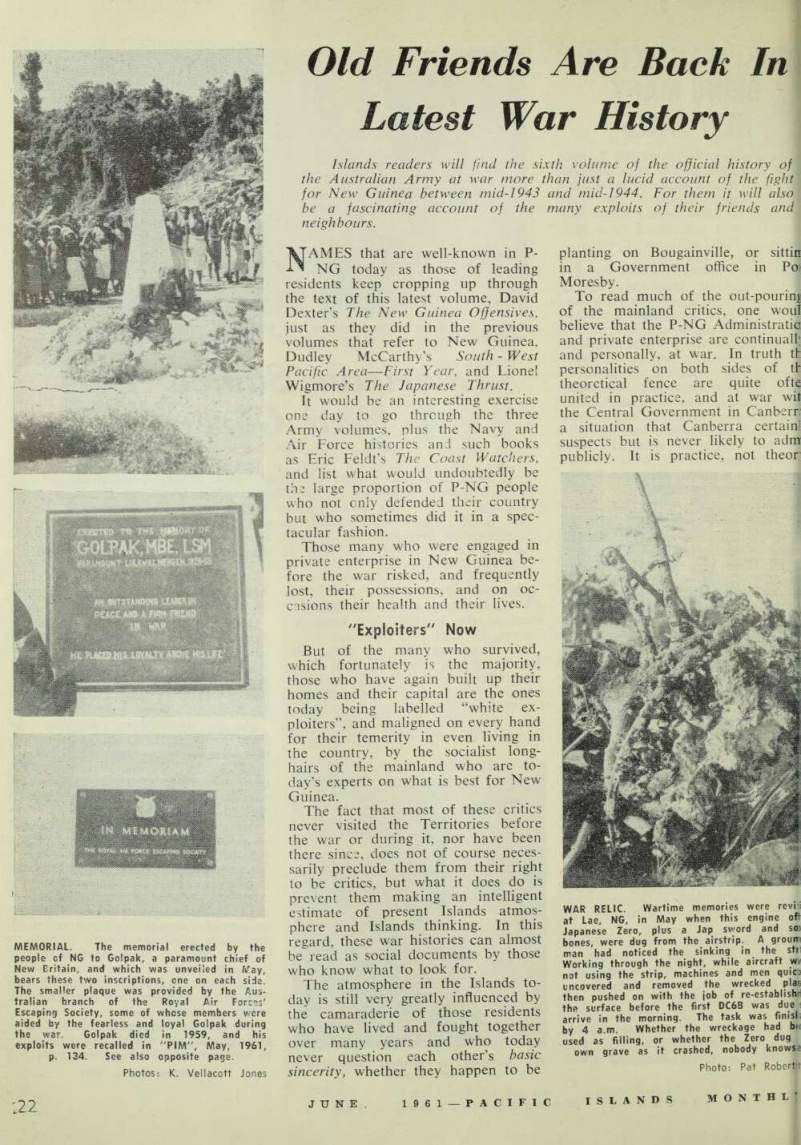
MEMORIAL. The memorial erected by the people of NG to Golpak, a paramount chief of New Britain, and which was unveiled in May, bears these two inscriptions, one on each side.
The smaller plaque was provided by the Aus tralian branch of the Royal Air Forces' Escaping Society, some of whose members were aided by the fearless and loyal Golpak during the war. Golpak died in 1959, and his exploits were recalled in "RIM", May, 1961, p. 134. See also opposite page.
Photos: K. Vellacott Jones
WAR RELIC. Wartime memories were revi[?] at Lae, NG, in May when this engine of Japanese Zero, plus a Jap sword and so[?] bones, were dug from the airstrip. A groun[?] man had noticed the sinking in the st[?] Working through the night, while aircraft w[?] not using the strip, machines and men quic[?] uncovered and removed the wrecked pla[?] then pushed on with the job of re-establish[?] the surface before the first DC6B was due [?] arrive in the morning. The task was finis[?] by 4 a.m. Whether the wreckage had b[?] used as filling, or whether the Zero dug own grave as it crashed, nobody knows Photo: Pat Robert
ch has and will count in P-NG— ct which the theorists seem unable mderstand. few Guinea’s future can be worked only in partnership with all who 2 the genuine interest of the Terri at heart, wherever they might be ig now. To leave it all to the alist experts, whose interests cally are ones of self-interest and onal conceit, is monstrous folly. he New Guinea Offensives deals, mg other things, with the Sala a campaign, the offensives against Finschhafen and Madang, in ing the events in the Markham Ramu Valleys, the war in the k and the move to Hollandia, and hes on part of the Solomons and gainville campaigns, uring some of these campaigns j were differences between senior ralian and American officers, h the author indicates were ily due to misunderstandings as be difference in the methods of two armies. The American sys was one of a highly centralised rol, the Australian system was to v commands to work out plans he spot in accordance with the ral outline. Some of the Ameri were inclined to regard the ab ; of detail in Australian planning ic to the fact that the Australians t have any plans, iticism of MacArthur appears. 1 interesting footnote tells how \rthur censored Australian news ts of the Finschhafen campaign lake them agree with his own nunique in which he had pre i, incorrectly, that the Jap s were weak and of little signi :e. In fact the Japanese had :er-attacked with very strong re giments.
2 New Guinea Offensives,
hed by the Australian War Memorial rra. 40/-.
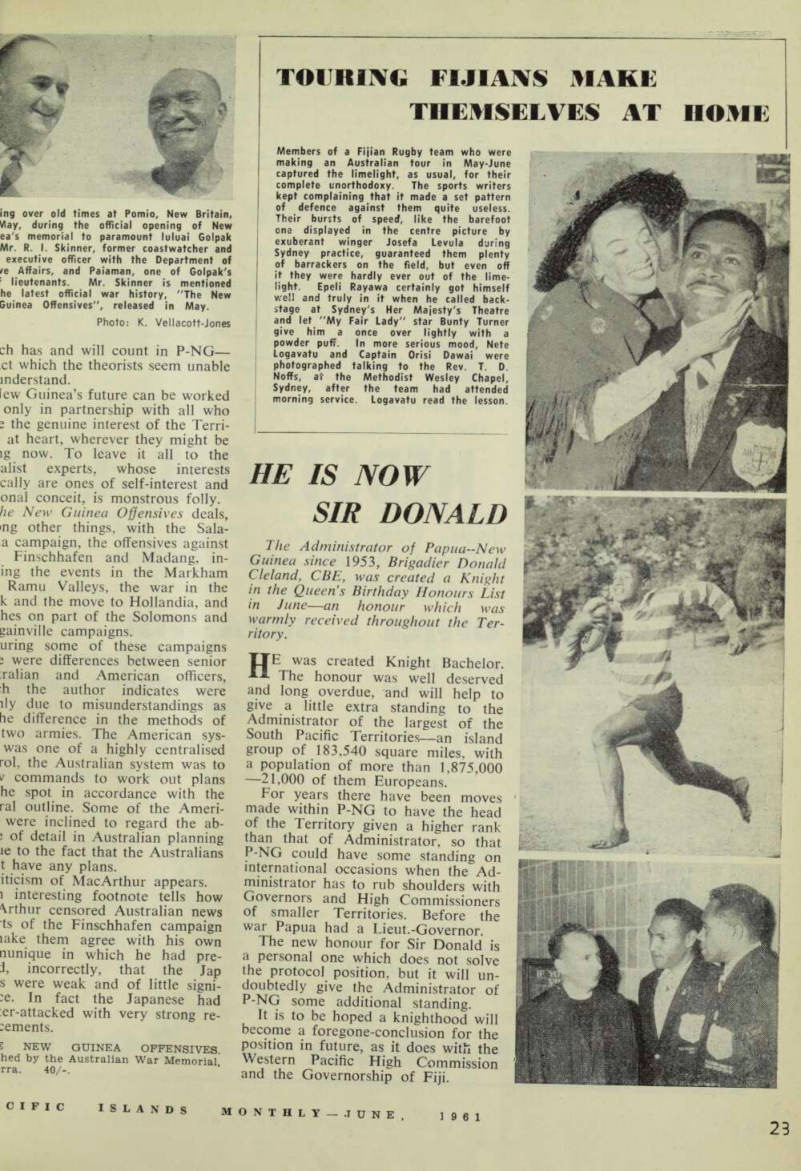
[?]ing over old times at Pomio, New Britain, May, during the official opening of New [?]ea's memorial to paramount luluai Golpak Mr. R. I. Skinner, former coastwatcher and executive officer with the Department of [?]e Affairs, and Paiaman, one of Golpak's [?] lieutenants. Mr. Skinner is mentioned [?]he latest official war history, "The New Guinea Offensives", released in May.
Photo: K. Vellacott-Jones