verybody
pp. 119-144 · Read in the full issue



Pacific Report
The month’s round-up of news and pictures of people and svents, from PIM correspondents in the South Pacific.
Jov.-General
F he Cooks
i Cobham, NZ Governor al, will make an official visit to >ok Islands in August, travelling LNZN vessel. jrary includes Rarotonga, Mam Vlauke, Mitiaro and Atiu.
Vlitiaro the vice-regal party will ) ashore, but islanders will be i aboard to meet Lord Cobham.
ong Years
Home
Cook Islanders who between have spent a total of 34 years 7 iji leper colony, arrived back unexpectedly in April, three had been at the Makogai station—Hagai Kitai for 13 Tuao Tu for 14 years, and fuiti for seven years. They all from Aitutaki. Seven Cook ;rs still remain at Makogai, one m due to return home soon. three who returned in April ;uch a long time away, all re that life at Makogai was very it, but it was nice to be home, le at the colony Hagai Kitai for the distribution Istuffs and clothing to the other Islands’ patients—all from par om home. The Cooks have a rts Fund for Makogai, the only territory which does organise i scheme for its own patients
srt With Something
verybody
celebrated Australian prima la, now living in Papua, will :op billing with a rock ’n’ roll in a Port Moresby open air concert for charity in May. ballerina is Miss Elaine Fifield, former leading dancer with s Wells in London.
r c e S^u r i S 9° e ’ Sydney, an established Australian television and stage star.
Miss Fifield has been allotted 20 minutes of the two and a half hour concert, to be held at a local football g roU nd on May 17.
She w ju dance the dying swan scene f rom Swan Lake and two scenes from the Sleeping Princess to recorded music on a wood and canvas s( , The organisers of the concert, m aid of the Red Cross, do not yet know what songs Mr. Joye will sing.
T , Three years ago Miss Fifield was considered one of the brightest stars in ballet. she surprised her friends when s he turned her back on the dancing world to marry a New Guinea copra p i anter> Mr . Les Farley, 35. The couple now live at Cape Rodney, 80 miles south-east of Port Moresby.
Miss Fifield was reported to have
refused an offer of £12,500 last year to return to London.
The chairman of the Port Moresby Red Cross Appeal Fund, Mr. George Jones, said: “We were delighted when Mrs. Farley said she would take part in the concert. She didn’t mind a bit appearing on the same show as a rock ’n’ roll singer.”
Second 'Crash' Scheme
For Samoan Officials
“There is a vast amount of good will towards Western Samoa in the New Zealand Public Service,” the Secretary of NZ Island Territories, Mr. J. M. McEwen, said in April when he opened the introductory seminar for Western Samoan public servants with administrative respon sibilities.
Mr. McEwen was deputising for the Minister of Island Territories, Mr.
F. L. A. Gotz, who had been visiting New Guinea.
Nine senior public servants from Western Samoa are in New Zealand for four months’ advanced training in administration and supervision. A similar course was held last year.
Each trainee is attached to the department corresponding to the one he works for in Western Samoa.
Under the guidance of senior officers of his “host” department, he takes part in a training programme de signed to meet the needs. From time to time trainees meet for group courses.
The provision of training of this
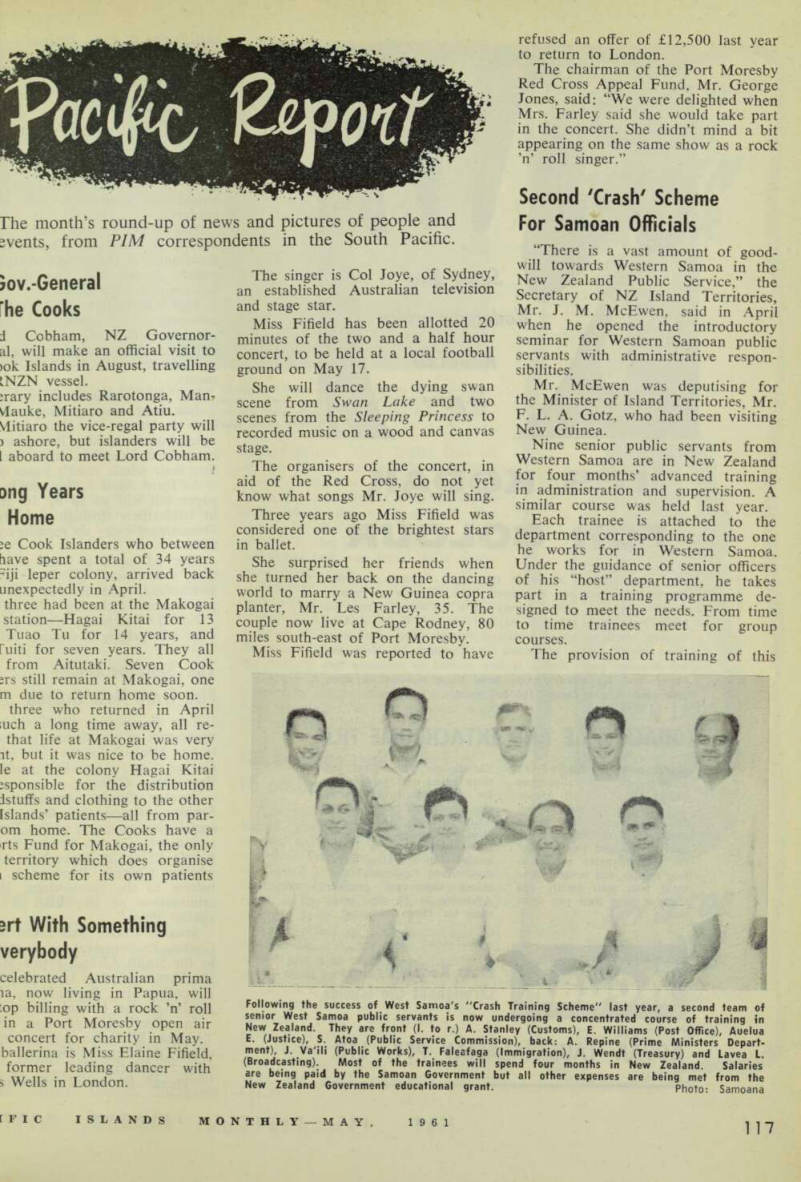
Following the success of West Samoa's "Crash Training Scheme" last year, a second team of senior West Samoa public servants is now undergoing a concentrated course of training in New Zealand. They are front (l. to r.) A. Stanley (Customs), E. Williams (Post Office), Auelua E. (Justice), S. Atoa (Public Service Commission), back: A. Repine (Prime Ministers Depart ment), J. Va'ili (Public Works), T. Faleafaga (Immigration), J. Wendt (Treasury) and Lavea L. (Broadcasting). Most of the trainees will spend four months in New Zealand. Salaries are being paid by the Samoan Government but all other expenses are being met from the New Zealand Government educational grant. Photo: Samoana
sort is one of New Zealand’s obllg tions under the Western Samo: Trusteeship Agreement.
A Financial Future
For "Cook Islands' News"
The Cook Islands’ News announc on April 1 that it was getting its on to a sounder financial basis—l would still keep faith with its 5 readers.
The News, issued daily by t Social Development Department Rarotonga, is the Cooks’ daily nev paper, despite the fact that it Government-owned.
The informative and bright lit newspaper is roneod, and contai weather information, mail notic shipping news, both local and ov seas news, and classified adverti ments.
In 1957 it was a one-page sheet, 1 it has long since grown, and thi days is rarely less than five paj roneod on both sides. But subscribe ever since inception, have been g ting their whole week’s issues for !
As from April 1, the weekly ner paper bill will go up by 3d, charg to subscribers through the Treasi Department every six months by de note.
The 3d extra a week will me that subscribers will have delivr guaranteed, and it will allow i provements including photograph For 1/- a week, Cook Island! were still getting newspaper value.
The Senator Under
Fire from New Guinea
Two Papuans in April voiced o agreement at a statement by the A tralian Minister for the Navy, Senat Gorton, on Australia’s policy Papua-New Guinea.
Senator Gorton, speaking in Senate, claimed that there was social discrimination in the Territc Senator Gorton said: “All people living in Papua-New Guiir whether Chinese, Papuans or othe belong to the same clubs. No <> crimination of any kind is sho: against them.”
Senator Cooke had asked Senas Gorton to comment on a statemr by the South African Prime Minis?
Dr. Verwoerd, that Australia practii a policy in Papua-New Guhi similar to the Union’s apartheid.
In Port Moresby, ReuT Taureka, MLC, an assistant medil officer, said Senator Gorton’s remae were “uninformed”.
“There is social discriminatt
t coloured people in P-NG,” he could name quite a few ex > to Senator Gorton.” reka is a nominated member Legislative Council and pre of the P-NG Workers’ Asso was supported by M. Maori president of the Kerema Wel tssociation. i, who a week earlier had d a colour bar kept natives out grandstand at Port Moresby’s a Football Ground, said: I discrimination does exist here > quite a large extent. Senator i should visit the football 1 and see where the native sit in relation to the white tors.” 1 said it was “silly” to say eid existed in the Territory, it is just as silly to say there ocial discrimination,” he added. ; and black will have to learn ; together here or there will be 2 in the future.”
her Look at
A Volcano
'ecent inspection of the New les’ Lopevi volcano, which d fiercely in July last year g the evacuation of the native tants of the island, has shown ?e now dormant, inspection was made by the senior geologist in the NH, , E. Williams, and the Condo n Mines Officer, Monsieur
Robert Priam. They found that all of the 12 craters which had been active during the eruption had now fallen in, including the large crater from which the nuee ardente had issued in the initial stages. Nuee ardente is the heavy cloud of fumes and ashes and lava which kills every thing in its path.
However, a three foot wide gas vent was producing a large volume of gas during the inspection and when a stone was dropped down the vent, the scientists could not hear it hit the bottom.
Lopevi is not likely to see the re turn of its inhabitants, who have now been re-settled at Drummond Bay, Epi, and on Paama.
NG Revenue and
PS on Up and Up
Australia’s slight recession has had happy results up north—or that seemed to be the burden of the song of P-NG Treasurer, Mr. H. H. Reeve, in April when he announced triumphantly that “recruitment in terest in the P-NG Public Service had recently been keen.”
As a result of this keenness, 600 new public servants have been netted in the last nine months—bringing the grand total up to 4,600.
This is a lot of public servants for a country that has £7i millions of internal revenue, and gives a lot of point to what has been said by Mr.
J. L, Chipper, MLC, about the Ter ritory floating along on Australia’s wool and wheat economy, (see p. 121.)
[?]nd people from the French Polynesian islands, or those interested in the islands—have [?]ly formed the Tahiti-Nui Club in Auckland. Here, at a recent social function, club [?]rs and visitors appreciate the dancing of this team, Pauline Martin, Joy Bone, Monica Legge and (in front) Janice Goodey.
a result of the increase in staff, dnents to native wages during period, and increased cost of is (canned meat up from £3 to >er case and the Administration 100,000 cases annually), 1.000 more than estimated will eded this financial year for PS ss. s will eat up a large slice of the onal revenue that will run into dministration coffers, ticipated revenue for the current ial year was <£14,500,000 from alian grants; £6,958,000 from internal revenue; and £550,000 the second Territory loan. ; Australian grant remains the but internal revenue will bly total £7,479,800, although »an has not yet made its target, reased internal revenue came buoyant import duty collections will probably produce about 30.000 by end of June—a record; rom income tax, . Reeve said that taxpayers, they were required to estimate income for 1959-60 (to provide >asis for provisional-tax) were ervative”. They will have to up the balance this year and it I probably amount to about
I,Ooo.
; amount of Territory loan up to early April (£387,000 out le anticipated £550,000) was jointing and it was a challenge rritorians to show faith in their ory. So said Mr. Reeve, s the opinion of some observers, that in the climate created e flat-footed; unco-operative at of the Adminstration during self-determination panic from une onwards, the Treasury was lucky to get Territorians suf ly interested in that loan to bute even £387,000.
per Petrol
ianto, Too
rk has started at Luganville, New Hebrides, on bulk fuel e installations for the Shell any which will cost more than ),000. Four tanks are being d with a total capacity of 5,000 Work is expected to be com this year, following which there :ly to be “a substantial reduc in the local prices of petroleum :ts. companies have been making r installations right throughout )uth Pacific in the last year or md petrol prices have dropped cases.
P-NG and That
Australian Bull
The promise made in Canberra in April that native members of the P-NG Legislative Council should be taken on frequent visits to Federal Parliament didn’t get much support in the Territory.
Most Territorians believe the native MLCs haven’t got much to learn from party politics in full blast; and that Parliamentary manners in the Port Moresby Legco are im peccable in comparison with the Can berra brand.
Mr. J. L. Chipper, European mem ber for New Britain, took the argu
ment a step further. He said that the native members who had visited Hollandia for the opening of the NNG Council in April had had their eyes opened to the problem there should the Dutch pull out, and they must now realise the problem they themselves would have if Australia left them with an economy they couldn’t support.
He said that it would be better to take them to India to see how the other half lives, rather than to Australia. Any visit to the outside world would give them an apprecia tion of what Australia has done for them.
In Mr. Chipper’s opinion, the Ter
ritory does not exist on a copra ar cocoa economy at all—but on tl Australian wheat and wool economi “We give no thought,” he said. “ J the effect in this Territory if whe: and wool collapsed and the Au tralian Treasurer said that, instead! the <£15,000,000 grant that was give to us last year, we had to make c with £3,000,000.”
At this stage Mr. Chipper began describe a cartoon he would draw if he were a cartoonist. It would hal an Australian cow in the middle I it, with Papuan cowboys milking it There would be this up in the lef hand corner; and that down hi tJ right—and when the thing had begi to assume the proportions of a ful scale mural, he paused dramatical and said: “And underneath, I’d ha! this caption ”
Before he could finish, across froi the Official benches on the other sic of the house came loudly the won “Bull!”
On this note the President for afternoon tea recess.
Although most Territorians woul agree that Mr. Chipper is a lous cartoonist, most conceded that in tt matter of P-NG’s razor-edge econom he spoke nothing but the truth.
Share-and-Share Alike
At Rakahanga
Mataitiko they call it, and it hasd been done in the Northern Cod Island of Rakahanga since 1942. Br after a heavy storm struck Rakahang recently the Island Council decide; it was time again for Mataitiko, am instructed the men of the island to g; and husk all the storm-scattered cocl nuts found along the beach on thi Rahui motu.
The men were organised into twf groups of 50, and in three days, the; found and husked 69,000 coconuts!
Ten open boats were used to tail the coconuts from the motu to Rakl hanga and each boat crew was give* 200 husked nuts as payment. Thu others were shared among everybody on the island, including the babies!
The result of the share-and-sharr alike scheme was that each persoji received 143 husked nuts, the heaii teacher and his family got 2,000, am the Island Council received 2,000 t( help them with funds.
New Caledonian Farmers
Protest at Imports
New Caledonia farmers have proc tested at the recent arrival of big quantities of fruit and vegetable; 1 from Australia and France.
t a meeting called to discuss the ;er they also criticised broadcasts i Radio Noumea on the qualities Tench fruit and vegetables. They this is an encouragement for im ers to seek the goods in France, roneod news-sheet has also come m the side of the farmers, by :esting that if imports are to inue on such a scale it would be od idea to do away with the local :ultural service.
Government official has replied the news the farmers wanted to •—that as soon as New Caledonia vers can fill the local demand, seas imports of fruit and vege -2s will stop. correspondent reports that this ild be easy to do with the Aus an supplies, for it would be >ssary only to stop foreign ex ige, but it would be a more dif t job to stop imports from ice. here have recently been some lages of fruit and vegetables in
New Caledonia. Shortages are usual for the time of the year, but this year it is much more severe because of rain damage to gardens, and also because of the absence of many Vietnamese who have always looked after the market gardens.
The newspapers have declared that the country can do without the Viets’ gardening efforts, but the housewives are not so sure now that they are paying prices such as 4/- a lb for Shapes, 2/6 a lb for apples, and 3/.a lb for cauliflower. , ,
Port Moresby Girl Wins
D . n • a *• Breach Ot rromise Action In an unusual case in the P-NG Supreme Court, Port Moresby, in
April, Mr. Justice Gore awarded an attractive young mixed-race woman £.500 damages for breach of promise, The woman, Miss Elizabeth English, 25, had sought £5,000 from John Read, 28, an Australian plant operator with the Commonwealth Department G f Works, Miss English, who lives with her parents in the native village of Han uabada, claimed that Read was the father of her five-months-old son. she sajd evjdence that she had kept company with Read for about two months from December 1, 1959, to February, 1960. During this time he had several times promised to marry her and buy her a home in Port Moresby.
Miss English said that because of
[?]big Yate Dam in New Caledonia last [?] was filled for the first time, because [?]rricane weather. Bottom picture shows [?]ater right to the top. The picture on [?]hows what happened to an office building garage when the water crept up towards [?]oad. The dam builders never calculated these buildings would be isolated.
Photos: Fred Dunn
3mises she had let Read seduce >he had later found she was mt, but Read then refused to her, said she had given birth to a in November, 1960. d in evidence denied he had •remised Miss English that he marry her. here had been a promise, he sen released from it by Miss i herself. had taken place in February, vhen Miss English had accused going out with other women, [• . , is judgment, Mr. Justice Gore ‘ found that there had been a e to marry.
“I cannot regard that incident as any more than a lovers’ quarrel and not as a mutual discharge of the pro mise to marry,”
Mr. Justice Gore said that in con sidering damages he had given con sideration to plaintiff’s lessened prospects of marriage, “She was a girl of good character living with her parents in an environ ment of decency,” he said, “She was of mixed-blood and educated to a standard equivalent to her station in life.
“She was a business girl working for a well-known business house in Port Moresby.
“Her prospects of marrying some one above or equal to her station in life have, in my view, been lessened by the birth of the child.”
M .r. Justice Go . re added: “One may consider the circumstances which aggravate the damages, such as the social position of defendant and his pecuniary condition. in “Defendant is a European and it can be said that Plaintiff, as a mixed blood, might have entered a society higher than her own by marrying de fendant “Defendant promised her, she said, a h° use i n town, no doubt in an en vironment on a higher plane than that which she had been used to in Han uabada.”
He also awarded costs against Read.
You Can't Dn
That Here!
mid recently^la^th” 6^ 8 bak - erS about* 50 of flour frUTust'r" 8 Ha to make some experiments in an
effort to further improve the quality of his bread.
He normally imports big quantities of flour from France every year, and he decided to import the Australian flour at his own expense, with his own foreign exchange.
But the baker ran up against a brick wall of regulations, and the iron hand of officialdom. He was forced to re-export the flour to Aus tralia.
A local paper has pointed out that where the baker made his mistake was in importing flour from Austra lia. If he had imported whisky or girls (such as from the Sydney Tivoli) all would have been well. But flour!
Good Results From
Yaws Programme
A re-survey of yaws cases among the inhabitants of three islands in the New Hebrides has revealed only one case. The survey was made by AMO Joseph Marseu and Dresser Thompson following the initial yaws campaign in the New Hebrides.
They returned to Vila in April after visiting the islands of Epi, Paama, and Emae, travelling by ship, launch, canoe, truck, and on foot during a two months’ period. In that time they saw and inspected 3,635 people.
Some Questions About
Salvation Army's Hostel
The Salvation Army is to get another grant] from the Papua-New Guinea Administration to build at Lae, New Guinea, a hostel for native
ellers and temporary guests. The t will be for £25,000 and the Lae si it will build will be after the of the Army’s hostel at Koki, Moresby, which opened for less in 1958. le Administration made money able for the Koki hostel also, at that time, Father J. Dwyer, a Catholic Mission member of Legislative Council, had some ; to say about it. the April, 1961, meeting of the j Legislative Council, the Bishop ew Gunea, the Rt. Rev. P. N. W. ig, sought information, lile giving full credit to the Sal n Army for the work they were 5 at Koki, he suggested that some le other missions would, with inistration help, also like to lish Native hostels. He said he •stood that the Lutheran Mission ilanned to build a hostel at Lae. a statement, later, the Assistant nistrator, Dr. John Gunther, said the Administraton had under , in 1958, to make a grant to alvation Army for a Lae hostel i funds became available.” They )ecome available in the 1960-61 :ial year, and the Administration 1 now honour its promise. said that other missions have t similar assistance in regard to s and these were being con d.
ottery Idea
emned
suggestion made to the Fiji nment by the Nadi Chamber mmefce that a “State Lottery” 1 be promoted, brought un able reactions from the dist Church. The plan was con d in round terms, in both radio es and sermons. re has been no answer from the ament. re is evidence that large sums Fiji each week for overseas ; s and race meetings. A figure 500 per week has been men us applying to one small town emment lotteries, under Eng iw, are frowned upon. Fiji ntly is subject to an English 1934, so that lotteries having ;ir object a benefit to charity 3 wed under police supervision. 3 British countries receive i through State lotteries—for e, Irish Hospitals and Malta ment lotteries. And, of course, ire various “consultations” in ia.
Coffee Standards
Attacked
Australian users of coffee have “abandoned their earlier attempt to improve the standard of coffee offered to the Australian public”, the official journal of the New Guinea Highlands Farmers and Settlers’ Association, Highlands Quarterly Bulletin, claims in its April issue.
The journal, which is the voice of New Guinea coffee growers, discusses the coffee conference held in Sydney in March between growers and users (the users being such people as manu facturers and distributors).
It says the rise in Australian im
ports of roasted and ground coffee, and instants which had failed to sell well in their places of origin, “and which are of a much lower standard than those being produced in Aus tralia”, was the natural consequence of the lifting of Australian import controls.
Now the users were “raising the mumbo jumbo of blending needs”, although the record showed that blending presented no problem to the users if the coffee was cheap.
The journal says that when the users at the March conference left some 800 tons of New Guinea coffee unsold out of a total of 2,800 tons they “closed an era of voluntary
agreement and made a challenge which growers had to accept”.
Adding that it exempts the two major processers in Australia from any charge of not doing their part the Bulletin concludes: “It has been customary at thes< meetings with the Australian users— to which we now say a fond farewel —for the growers to sit and listei to criticism of our coffee, our pro cessing, our marketing methods an< almost of our mere existence. Thi is the traditional role of a seller a a voluntary meeting.
“We, in the past, have not taken uj the time of such conferences with an criticism of the Australian users. W have concentrated upon positive pui suasion and the refutation of an] thing untrue. In the future, if w meet again, it will be in a differei kind of arena.” (See p. 51, thi issue.)
The Japs Start
Work at Wewak
In April, work began by a Japand salvage company in removing wzj time wrecks from Boram Bay ai| Wewak Harbour, in NG’s Sepik. 1 A Wewak correspondent report! that the work would probably tal up to six months, and obtain abo 5,000 tons of scrap metal.
The Matsekura company’s Shin Maru arrived in Wewak j April 23 from Kavieng, towing a 5 ton salvage barge, a tug boat ai three diver boats. The tow was coi pleted in three days without any dii culty, thanks to calm weather tl whole time.
The master in charge of the opei tion was Captain Iwa Moto.
Thirty-six Japanese, including fi divers, were in Wewak in early M and a further 24 Japanese were i pected to arrive there after loadil 1,200 tons of scrap at Kavieng, a cleaning up the New Ireland cal site.
Fiji Fears Loss of
Rich NZ Funds
Most serious for Fiji generally. £ for Suva in particular, is the p sibility of the closing down of Lauc Bay flying-boat base by the RNZ/ This is quite on the cards andl would mean a loss to Fiji of o: £1,000,000 per annum, from NZ Without committing himself, I Dean Eyre (NZ’s Minister of I fence) did hint at the possibility RNZAF basing land planes at Ns “New Zealand’s sphere of respt sibility”, will continue to include B
ild New Zealand take her away from Fiji, the Colony be rather exposed, under war ons. It has neither naval nor :es. withdrawal of the Sunderland >oats from service in this area oidable in the future. Mr. Eyre, questioned about the rescue nation, and the “mercy flights” quently carried out by the F with Sunderlands, replied ie Fiji Airways’ Beaver am could take over this work, what about the more remote not within range of the Are these to be abandoned? ie Search and Air-Sea rescue ation based on Nadi—is this iven up when no Sunderlands ilable? These questions are he ed in Fiji. her loss to Fiji of overseas rill come when the Fiji Gov t presently assumes respon for the operation of Nadi
ional airport.
td against the present unstable y, such losses are serious, even the same amount of money spent by Fiji Government on ort.
)e Problem
lea police in April arrested a youths, aged from 15 to 20
and accused them of smashing street lamps, breaking and entering, steal ing money and the spare wheels from cars, and generally making a nuisance of themselves. The gang has also been accused of having wantonly slaught ered a celebrated pet deer owned by a Noumea householder who used to parade it in the main street for the benefit of tourist ships.
More and Better Radio
In The Solomons
The Solomon Islands Broadcasting Service, from May 1, has extended its programme schedule to give more news and better reception to the neighbouring territories of Papua- New Guinea, New Hebrides, Gilbert and Ellice Islands and New Caledonia.
More time has been given for spot announcements and sponsored features. . But listeners in the Solomons want ing to keep up-to-date on their local news will need to curtail their social activities, according to a cor respondent, who says 8.30 p.m. and 10.10 p.m.—the new times given for the news broadcast—are “most in convenient.”
“With cocktail parties before 7 p.m., and dinner parties and movies at 8 p.m. only the stay-at-homes, who are few and far between, will benefit,”
[?]tent of the RNZAF base at Laucala Bay, Suva, is seen in this photograph. The RNZAF [?]gs are in the foreground, and in the background is Suva and Suva Harbour. See below.
Photo: Rob Wright
the correspondent says. Previously news broadcasts were at 6.55 p.m. and 9.30 p.m., but it seems that owing to technical difficulties and staff problems nothing can be done about the time change.
The Solomon Islands Broadcasting station was built at a cost of £41,000 and is fully air-conditioned with one very large studio, one small studio and a combined control room and studio.
Local people want a further ex tension of broadcast times, as even at present the broadcast hours are only 3i hours a day.
A mid-day session, incorporating more local news, has been suggested by some.
Nadi is Criticised—
And Forgiven
The move of Nadi Chamber of Commerce, in asking the Fiji Gov ernment to consider a limitation on imports of luxury goods, so as to con serve overseas funds, and which was associated with an allegation that cer tain firms in Fiji were enjoying un duly wide margins of profit, aroused severe criticism from the Suva Chamber. The latter’s delegates moved a censure against Nadi at the Federated Chamber meeting in April.
After lengthy discussion, the censure motion was dropped. Nadi Chamber explained its viewpoint and
suggested a procedure for future case This was later proposed as a motic by Suva and adopted unanimously I the Federated Chambers.
The Dutch Buy
Scottish
The local air transport company ] Netherlands New Guinea, Kroondu NV, has ordered a third Tw Pioneer aircraft from its make] Scottish Aviation, of Prestwick, Sc< land.
The aircraft will be delivered abo the middle of this year.
The new plane will have mo powerful engines that the first tw and will require a very small landi ground. It is expected that the t\ older planes will later be re-equipp with the new type engines.
These two-engined planes carry] passengers and are expected to hast the opening up of the interior. At fir they will be employed on services] the Wissel Lakes and the Balic Valley; services will later be extend to the Vogelkop Peninsula.
They Can Take
Their Pick
The Netherlands New Guinj Council (inaugurated on April 5) v not have the same language problei that exist in the P-NG Legislati Council, where a team of interpret are on duty the whole time the Col cil is in session.
Dutch and Malay are the t 1 official languages to be used in NNG Council and as all memra are bi-lingual, each may choose whi of the two he will use in his speed]
Death Oaths and
Black Magic
How far under the surface, in the most advanced Pacific Islan lurks superstition and a belief!
magic? I
If recent court cases in West] Samoa and Fiji are any criterion; isn’t very far.
Of the four petitions heard in Aj High Court in March, ailed irregularities in certain elector* during the February elections, I oddest angle came out in the app of a former Minister of Agriculti The ex-Minister, Tualaulelei Mai appealed against the outcome off election in Palauli East, where he t defeated by prominent Apia bi nessman, Mr. Harry Moors, who v standing as a Samoan under the I Afoafouvale Misimoa.
Tualaulelei alleged that undue! fluence had been brought upon el
by Seumanufeagai, a leading of Vaitoomuli village, of using death oath” against voters of that e if Afoafouvale was not elected, le death oath was the severest iition that could be placed on le,” Tualaulelei told the Court, s only used as a last resort to admission from a wrongdoer the fear of death, describing the procedure of the Tualaulelei said that the in al is forced to dress in white ie down on sleeping mats with p at his head and a bouquet of s on his breast. He is then made *ar the truth upon a Bible and ie consequence of death should -hood be persisted in. /as claimed by Tualaulelei that meeting at Vaitoomuli a few before the election, it was sug by Seumanufeagai that if juvale were defeated, the death hould be used to find out who against him, and the offenders be banished from the village. ;f Judge C. C. Marsack dis the appeal on the grounds that dent evidence had been pre to prove that the remark had influenced the outcome of the a. uva, in mid-April, an 18-year lian, Dwarka Prasad, appeared a Magistrate’s Court on a of having murdered an eight id boy for his head, which was ly to be used for witchcraft was the second witchcraft alleged within a month in le first being in the Sigatoka where another Indian was 1 of beheadng his elder brother same purpose. e allegations against an ad people make the efforts of the ~i tain natives, who merely wait *ange submarines and heli seem like kid stuff.
’ower Supply
{i Town
of Fiji’s largest towns, Labasa nua Levu) is to get a public ty supply provided by Labasa ity Company Limited, founded H. B. Gibson and Mr. Vijay fhe company will supply elec -3 Labasa township and Labasa new system, which cost 0, was to be switched on on rto, there has been no public ty supply in Labasa. The CSR crated its own supply, and also 1 free electricity for the Hospital.
3a Gets Help
r Hurricane
nga’s hurricane of March—the within living memory—has up onga’s copra production at least 1963.
Vavau, worst hit of the two •s which took the full brunt of blow (the other was Haapai), production for 1961 will be about half of the annual average )00 tons. 2 hurricane lasted from about h 16 till March 18 for the people ivau, who were exposed to wind rain for more than 36 hours, ig it impossible for them to do ing more than seek refuge, homes all around them were swept away. ny villages lost up to 70 per of their houses.. In the village tungake. Vavau, 68 out of 71 s were destroyed, and 43 out of ouses were destroyed in the e of Leimatu.
Neiafu, principal town of Vavau,
239 houses out of 454 were de molished and 31 rendered uninhabit able.
After the hurricane Vavau pre sented a “matchstick horizon” with leaves and foliage stripped from trees.
The two deaths caused during the hurricane were both at Vavau.
Another dozen people were admitted to hospital with injuries.
The damage to buildings in the Haapai area was only little less severe than Vavau and most mission build ing and schools were demolished or badly damaged.
The breadfruit trees at Haapai, an important item of food crops in the group, have nearly all been up rooted at a time when they were just maturing.
Help for stricken Tonga has come from many parts of the Pacific, in cluding Australia and New Zealand.
Governments have made big dona tions, and in Australia the Methodist Church launched a nation-wide appeal for food and money. Australian newspapers devoted much space to
news and photographs of the catastrophe, and in Federal Parlia ment a member pointed out the many close connections between Australia and Tonga, including the fact that the Prime Minister, Prince Tungi, was educated in Sydney.
Many big manufacturing firms with sales in the South Pacific made dona tions of food stuffs—including, R. & W. Hellaby, Ltd., of Auckland, who immediately consigned 50 cases of corned beef, and the Sydney firms of Gillespie Brothers and Southern Cross Mills, who each donated one ton of flour. Other gifts included to bacco, rice, nails, reduced shipping freight rates (from the Union Line), milk powder—all designed to help the people of Haapai and Vavau over the lean time that now threatens them. (See PIM, April, p. 23.)
New Japanese
Pearling Agreement
The Federal Government has negotiated a three-year agreement with Japan, permitting the Japanese pearling fleet to operate in North Australian waters.
As in previous years, the Japanese will operate only in the eastern grounds of the Northern Territory division and west of Torres Strait in the Queensland division.
The Japanese fleet will be limited to 12 luggers and 415 tons of shell
These aerial photographs of Vavau show some of the damage of the Tongan hurricane. At top, is the big concrete hospital at Neiafu, partly unroofed, and below, the scene of desolation nearby. Photos: S. A. Whippy
Under a similar arrangement la: year, the Japanese fleet took 385 tor of shell, while Australian fleets too 1,430 tons.
The three-year arrangement wi obviate the need for annual negotii tions.
Primary Industry Minister Charlj Adermann pointed out recently th; the improved quality of plastic shi buttons had cut deeply into wbj had been the most important marls for pearl shell and for trochus. I This had meant a fall in averaj prices and a fall-off in dollar salt The United States took 72 per cei of Australian shell in 1957-58, b only 20 per cent, in 1959-60.
Adermann said that the 363-ti increase in Australian shell product! in 1959-60 was due mainly 1 Thursday Island pearlers develop!] new deep-water techniques for tl Darnley Island area.
They Paid Honour
To Golpak
At Pomio patrol-post, on Jacquit Bay, New Britain, on May 6, rep sentatives of the armed services, oy seas organisations and some of old comrades took part in the i veiling of a memorial to Paramoi Luluai Golpak, MBE. Golpak, of 1 Mengen people, died early in 1959 The memorial, to the cost of whi peoples all over P-NG subscribed, 1 a simple bronze plaque which real An Outstanding Leader and a Firm Friend.
He placed His Loyalty above his own life.
Golpak was a gnome-like, insignifid looking little man whose name, 1 tween 1941 and 1944, became kno to thousands of Australian a American troops operating in j New Guinea area. With his follow he ranged up and down New Briti and together they assisted in evacuation of civilians, shekel crashed airmen, recruited carriers guerilla forces and operated a s cessful espionage system. ■ Golpak worked with the CoJ watchers, and especially with Mr. R Skinner, now a P-NG Native Aff£ Department executive officer, j then the commander of an All Intelligence Bureau unit on N
Britain. J
Mr. Skinner was at the unveil ceremony, which was performed Mr. J. K. McCarthy, now Director Native Affairs, who also had a < tinguished war career in New Brit and elsewhere. I Present at Pomio on May 6 \ Group-Captain W. E. Townsend,! the RAAF, Williamstown, NSW, v
one of the men rescued by pak’s scouts when as CO, 22 idron, his plane was shot down Jacquinot Bay by a Jap Zero, and his companion managed to *gle ashore where they hid in the i. After some hide-and-seek with Japs, Golpak had them guided to the other side of the island re the then Major Skinner was ating. Skinner arranged the air ’s evacuation by submarine. Gp t. Townsend is now president of Australian branch of the Royal Forces Escapers’ Society, olpak received his MBE in 1945 his outstanding service; and in !, the Escapers’ Society awarded its Certificate of Merit.
lerwater Eruptions
i Fiji Bay
nderwater eruptions sent columns team and water shooting up in isavu Bay, off Fiji’s second largest d, Vanua Levu, recently. Dis
trict Officer Dennis Williams, de scribed the phenomena: “The disturbances covered an area about a mile square. The columns of water and steam had every appear ance of a slow-motion bomb blast.
The concentrated column would rise slowly to a height of about 50 feet over a period of about 30 seconds, and then vaporise as steam, to a height of about 100 feet. Each in dividual column lasted 10 to 15 minutes before subsiding. Then other columns would rise in the adjacent area. At any one time there were always four or five columns observ able.
“The Savusavu Indian School is built almost on top of the Nakama
hotsprings, and the children at the school were sent home in case the activity spread to the hotsprings, but they were not affected.
“Fiji Airways planes reported that large flocks of birds circled the area —presumably to harvest the many dead fish thrown up by the disturb ances.
“The disturbances ended quite abruptly after 2i hours of continu ous activity.”
Official Geologist R. E. Houtz re ported: “The eruptions need not be viewed with alarm. I infer that the eruptions are not deeply seated but merely represent an additional out break of the Savusavu hotsprings system.” (Over)
Luck Continues
og PAT
six weeks of bad luck that has 1 Papuan Air Transport since 8, when their Piaggio aircraft Jared on a routine flight over /en Stanley Ranges, culminated >ril 18 when the Department il Aviation suspended all PAT ons he ban was imposed at 6 p.m., ted after 17 hours, the reason was imposed at all remains J. PAT is not a fly-by-night mpany but has been firmly hed and based in Port Moresby ars. Energetic management terprise put it in the position king next in importance after a big internal air operators in then, in March this year, bad Larted to come in large-sized On the Bth of that month aggio—a two-engined aircraft jd from Italy in 1959—and its leoffrey Wallace, vanished over 'en Stanleys and no trace has ound since. :arly April, a DC3 aircraft ng to the company and by Captain Miles Lewis, made and landing at Bereina, Central , while on a charter flight to wa. Eastern Highlands, carry dical stores. It broke in half rned out. ain Lewis said that while they t 13,000 ft something in the [ stores began to smoke or give les and fill cabin and cockpit, quiry into the whole incident en held, but the conclusions t be known for some time), days later, on April 18, a gined Piper Aztec aircraft that ad rented from a Sydney firm, /ed into the ground on take n sloping Tapini airtsrip in the mountains. One passenger
was injured, and another and the pilot escaped unhurt. The aircraft was badly damaged.
In late April the company was continuing to operate with a DC3 chartered from Trans-Australia Air lines, while the managing-director of PAT was in Australia negotiating for the purchase a new aircraft.
Queer Flying in the
US U2 Planes
Main interest of the spectators who were watching the departure from Nadi of the USAF U2 planes, of Pro ject Crowflite, in May, was in the preparation of the pilots for high altitude flying.
Project Crowflite is the code name for the team of high altitude re search fliers who are carrying out work in Australia for the Australian Government.
The pilots, picked personnel, first don a suit of long-sleeved and long legged underwear, then a three-layers suit of extra fine material, laced, zipped and rubber-tubed to a skin tight fit.
The rubber tubes, down legs, arms and body, are connected in the plane to seat tanks of air under com pression; so that if the pressurised cockpit fails, the suit is automatically pressured. Otherwise, the pilot would be dead in a few seconds, literally exploding.
All the dressing is done in an air conditioned room, and the pilot is connected (through a glass-fronted helmet, hermetically sealed to the suit) with a small tube of oxygen, which he carries out with him to the plane.
All exertion at this stage is for bidden, to avoid perspiration. The pilot is carried out the few yards to his aircraft on a truck, fitted wth a seat-parachute, and is hoisted into the
plane immediately.
As is shown by photo, the U2 looks rather like a large glider, fitted with
a jet engine. This gives enormous power at take-off; and at extreme heights (reputed to be at times above 80.000 feet) gives a range of some 4.000 miles.
The U2’s are escorted and tended by a large number of other types, noteworthy being several C 124 Globe masters, a squadron of 857 Can berras, with a total personnel of over 160 engaged.
Among the gear unloaded from the Globemasters at Nadi was a 30 cwt. truck, huge spare wheels and jacks, and several air-conditioning units and battery trucks. It is interesting to speculate upon the cost of so much equipment and personnel, to keep three planes in the air.
Further Moves
On Hamac
A further bid to stay the liquidation of the Hamac group of companies in Papua-New Guinea has been made through the High Court in Sydney ( PIM , April, p. 23).
An appeal was lodged on May 8 against the refusal of the Chief Justice of the Supreme Court in Port Moresby to sanction a scheme for re moving Hamac companies from liquidation. At the time that the Chief Justice gave his decision, he made a stay of liquidation for three weeks in order to allow time for an appeal.
The Hamac Group was ordered into liquidation by the P-NG Supreme Court on April 1, 1961. The Papua-
One of the three U2 high altitude aircraft which called at Nadi in May, en route to Australia.
Behind it is a Globemaster transport.
Photo: Rob Wright
New Guinea Development Company was formed later that year with the object of taking over the Hamac group of companies. The recent case before the Supreme Court in Port Moresby was brought by PNGDC in order to take the Hamac companies out of liquidation and make them again going concerns. This was opposed by some of the unsecured creditors of Hamac, who felt they would have a better chance of collect ing their money if the Group went into liquidation.
Documents for the appeal were prepared by Bartier, Perry and Purcell, solicitors of Sydney, and grounds for asking leave to appeal
are believed to be the contention that the Chief Justice wrongly used his discretion in refusing to sanction the attempt to take the companies out of liquidation.
It is hoped that the appeal will be dealt with within a month.
Teacher Training Plan
In the New Hebrides
A vital new step which will speed up British efforts in the New Hebrides on education has just been announced —formal approval has been received for a British Central Teacher Training College to be built in Vila.
Britain is making avai 1a b £A133,590 from CD&W Funds f the college, which will be built ( land bought from the late Mr.
Dupertuis, at Malapoa. The buildi will be started soon, and the fi intake of 36 students is expected eai in 1962.
There will be four lecture roor plus administrative, assembly, libn and common rooms and full resident facilities for up to 64 men and women students, and a staff of fiv< Students educated in schools of t Presbyterian Church of the N Hebrides, and of the Melanesi; Churches of Christ, and Aposto Church Missions will undergo a tv year training course, and then ta up teaching posts in village school Schools near Vila will be used give practice training during t course.
Three Years For
£12,000 In the Supreme Court in Lae, N( Guinea, on May 5, Mr. Justice Gc sentenced Basil Seeto Cheong S( 32, to three years with hard labo for stealing £Sstg. 12,000 (£A15,00( Seeto pleaded not guilty at fi but on the second day of the hei ing changed his plea to guilty.
He had been employed as a cash by Burns Philp (NG) Ltd. and I tween 1958 and 1961 had manipu ted the firm’s books for his oa gain. At the stage where he h diverted about £5tg.5,500 into his pockets, a Bank inspection failed uncover the fraud(, and he w thus encouraged to greater effor driven on, so the Judge said, by pressing gambling urge.
Fascinating Case of
The Irish Magistrate
The people of Suva were might intrigued on the morning of April when John Francis Willie Judge barrister-at-law of King’s Inn, Dubl appeared as plaintiff in a Magistral Court to support charges agaii Romuald Michael Ambrose (likew a barrister-at-law of King’s Ii Dublin) to the effect that— • Ambrose had threatened be Judge and Mrs. Judge with inte to cause them alarm; • Had threatened to kill Judge, cause him alarm; • Had made a similar threat j Mrs. Judge about her husband’s li to cause her alarm; • Had assaulted Judge, occasic ing him actual bodily harm.
0 Had entered Judge’s property h intent to intimidate Judge.
Vlr. Judge is well known as a mer Magistrate, and is now a awn Prosecutor; and Mr., Ambrose 1 been in charge of the Suva igistrate’s Court for two years, th are well-liked—both are Irish *n Colonial Office officials. Mr. ibrose, especially, has social alities which have endowed him with Hilarity and some fame. ‘What is all this about?” asked Suva gossip-mongers, with noses tching. But they never got the de s.
Counsel for the two parties faced court at 9 a.m.; and the wise irt, after hearing a little skirmish , adjourned the case for a week, iomething happened swiftly, be d the scenes. All 11 a.m., the case 5 re-called, the police said there > a “reconciliation”, and the rges were withdrawn, lie embarrassed Government then lounced that Mr. Ambrose had re led his post on March 29; that departure of Mr. Ambrose and family had been booked immedi y thereafter; and the Ambrose lily left Suva for Nadi and over -3 on April 5. *lr. Ambrose, through the Fiji
Times, said cheerfully that he carried away happy memories, no malice, and a hope that one day he would return.
Mr. Ambrose’s career in Fiji as a magistrate will not soon be forgotten.
One day, after he had dealt with about 25 “drunks”, he called them all back into court (some had already gone to gaol) and lectured them severely on the evils of drink. On another occasion, he ordered the birch for Fijians convicted of frequent
drunkenness—but a higher authority
cancelled that. He called the publicans together, when their licences were due for renewal, and gave them
some advice on how to conduct their establishments.
One evening, for some reason never explained, while enjoying a social occasion, Magistrate Ambrose led a startling procession of eight or nine joyful Fijians through the main street, from the Garrick to the Club Hotel. This was a fortnight before he resigned.
They said he was “a really nice Irish lad, but a wee bit impetuous”, He might have been happy in a European community; but he was dif ficult to explain to people of other races—especially those whom he had to meet in Court. (Over)
SYDNEY. At a recent meeting of the [?]nesian Association (top): Pauline Karika, of [?]tonga, Lionel Krone, of Apia and Blanch thews, of NZ. Below, is Miss Maria [?]ppy, a member of a well known Suva [?]ly, with Mr. & Mrs. George Griffen, also Suva. Photos: E. A. Ray
i Firm on Unusual
isiness Charge
in a case which created wide in sst in Fiji, a Lautoka magistrate, . M. Saunders, fined a Lautoka n of agents, J. Prasad 8r05.,, a il of £F6OO, in default 18 months’ >risonment, for alleged offences mected with the price of imported ►ds.
Evidence was that the firm took ers from customers for washing e from the UK at 122/6 per cwt B London, when the price was gedly 111/- FOB London. The i was charged on three counts of ing prepared false documents; was victed on two of them and uitted on the third. It has given ce of appeal.
3 President Meets
. Evans
here has been a happy ending to long story of how. in 1943, stwatcher A. R. Evans, now of aey, rescued Lieutenant John nedy, now of the White House, hington, DC. x-Coastwatcher and ex-N a v y tenant met at the White House in April while Mr. Evans was on lort visit to the United States, ier, in Sydney, he had received a r from President Kennedy; and e in the States he got the full ment from Press, radio and tele n. is visit to the States was sponsored *ress interests there and in Syd and he left Australia, and arrived ie US, in a burst of “exclusive” ri e s about how the rescue made. But they added little that new to the story Mr. Evans told
PIM last December—and which was published in full in January. (Anyone interested in following the full account of how Mr. Evans finally was “discovered”, should read the issues of PIM from September, 1960 to April, 1961).
At the same time that Mr. Evans was in America, Captain Goro Nakajima, who was the navigator of the Japanese destroyer which ran down Lieut. Kennedy’s PT boat in Blackett Strait, BSIP in 1943, was in Fremantle, WA. Captain Nakajima is now master of the freighter Ikushima Maru.
Late in the night of August 2, 1943, he was on duty in the chart room of the destroyer when the watch sighted the American PT boat. The destroyer’s Commander ordered him to plot a collision course, which he successfully did. They did not stop for survivors, because (so he says), they did not think there would be any.
As everyone now knows, Lieut.
Kennedy and some of his men escaped and reached a small islet. It was from there that Coastwatcher Evans had some of his native scouts rescue Kennedy in a canoe. Another PT boat, guided by Kennedy, later rescued the other survivors.,
BP's Back In The
Coastal Trade
Off and on for years, businessmen in the North Queensland towns of Townsville and Cairns have been re gretting that they have no shipping link with Papua-New Guinea as used to be the case up until the late 1930’5.
But when Burns Philp and Co. Ltd. renewed the link recently, with their MV Montoro, and a couple of other ships, there were yells from another direction.
The complaints came from another shipping company, John Burke Ltd., who have lodged a protest with the Federal Government against what they regard as BP’s entry to the Queensland coastal trade.
John Burke Ltd. at present runs four ships, all of them under 2,000 tons, on the Australian coast; two operate out of Sydney, one out of Melbourne and one out of Brisbane, all terminating at North Queensland ports.
The once flourishing Australian coastal trade has now dwindled away The latest withdrawal was AUSN and Burkes say that, at the time that BP started calls at Cairns and Towns ville, they were preparing to “meet the demand for more shipping space”.
It is a pretty reliable waterfront story that BP’s won’t go looking for
coastal freight, but that they will take it, if it is offering.
It is difficult to see what would attract any shipowner to the almost defunct coastal trade. But Burns Philp are probably in a better position than most to enter it.
Some of their ships’ crews are on foreign articles—a sore point with Australian maritime unions who have all but wrecked other shipping en terprises on the coast. But more im portant still is the diversification of BP activity and the fact that their ships have always been used to service their own far-flung empire as much as to act as general carriers.
BP would probably do better rout ing their smaller vessels through Nth.
Queensland ports than they do now with operations like that of the Bulolo which, with Australian pay scales and overtime rates, never makes a profit. Bulolo carries over 200 passengers on the Sydney-P-NG service; she is of over 6,000 tons gross and was regarded as a pocket
[?]twatcher Evans, with the diary he kept [?]n those more adventurous days.
ISLANDS' INTEREST. After their marriage in the United Church, Port Moresby, in April— Mr. & Mrs. Donald Gallaher (top). Mr.
Gallaher is with the P-NG Health Department, and the bride was formerly Miss Mary Noonan. (Papuan Prints). Lower picture shows Miss Sandra Barnfather, before her marriage in Auckland in April to Mr. Robert Haycock. The bride was born in Suva, and later with her parents went to Honiara, where she was one of the first pupils of the Honiara Government School.
sized luxury liner when she left her builders in 1938.
The rumour that she is for sale has persisted too long to be ignored.
When and if she finds a new owner it is unlikely that BP will invest in a replacement passenger carrier of similar dimensions.
Viet Repatriation
Scheme Stops—Suddenly
The repatriation scheme for the Vietnamese has broken down.
The Eastern Queen, chartered from Hongkong to repatriate New Cale donian and New Hebrides Viets to North Vietnam, sailed for Hongkong empty on April 28, and it has been officially announced that the scheme has been “postponed indefinitely”.
The Eastern Queen had already made three voyages to Haiphong from Noumea, carrying more than 1,500 Viets, and was back in Noumea in April en route to Vila to embark the first contingent of about 400 Viets from the New Hebrides. A second contingent was to embark from Santo in a later voyage and then the re patriation plan was to be reviewed.
However, the ship remained in Noumea in April and all sorts of rumours were rife.
An announcement in early April said the first New Hebrides shipment had been postponed, but stressed it had not been cancelled.
When the ship didn’t turn up in the New Hebrides, waiting Viets in Vila, who had already given up their jobs and homes waiting to embark, became extremely restless.
The Viets at one time actually had their luggage on a lighter, waiting for the ship which was to show up next day—and never did.
As time went on some of them were re-employed, and distribution of food was made.
Following the official announce ment in late April of the indefinite postponement, the Viets started to buy back their possessions, which they had sold at give-away prices, but many of them had to pay top prices.
Land-Rovers which had been sold at £A3SO were being bought back for as much as £6OO.
The upset has had such a bad effect on the Viets that undoubtedly many of them would not go back to Vietnam if they were given a new opportunity to do so tomorrow.
There has been no official an nouncement to explain all the trouble, but it seems clear that there has been pressure from South Vietnam, which has objected to people with very little contact with their old country being sent to the Communists.