Profilist
pp. 82-99 · Read in the full issue


Profile Of A Profilist
By Marie Hill
“You’ll like Captain Milder,” they told me at "the shipping office. “He’s an artist”. But 1 wasn’t much interested in hear ing about artists. My Sydney practice as an anaesthetist had kept me occupied to the point ol exhaustion, and what I wanted now was a holiday.
A friend fixed me up for a voyage as ship’s surgeon in the Malaita, which does the New Guinea islands run from Sydney, and now, it seemed, I was to be faced with a long-haired, aesthetic, opinionated, artist-cum- Captain!
IWAS wrong. Captain Hilder wasn’t like that. Once we were at sea, the grey anonymous passengers around the captain’s table emerged as colourful individuals of agreeable diversity, and in several cases, of dis tinguished attainment. There was a geologist, a scientist, an engineer, a planter and a couple of cheerful missionaries. It was a kind of South Pacific brains trust, and at the head of the table co-ordinating this highly intelligent group, and unhesitatingly recognised as an equal in their several fields, was Captain Brett Hilder.
There were stimulating discussions on subjects I had often dismissed as boring, wrongly it turned out —subjects ranging through all the sciences, language, history and religion to current affairs.
Father an Artist Brett Hilder was born in Sydney in 1911, the younger son of I. J.
Hilder, a well-known Australian water colour artist, who died at the age of 34 when his son was only five. His widow had a struggle to bring up her two boys, and Brett had an indifferent education to Intermediate Certificate standard at Cleveland Boys’ High School, Sydney, and went to sea at the age of 16.
Navigation was his primary
objective because he had become in terested in astronomy at school anc probably devoted more time to it that he should have.
His marine examinations appearec to have given him no problems, foi he gained his tickets in less that average time and even the Extrz Master’s Certificate was achieved without any formal lectures or coach ing. This was regarded as unique.
He married at 21; at the age oi 27 he was in command of his owr ship and his habit of study continued to develop during his next years oi command. Until this day he spends very little time on reading fiction— it is always something heavier. He gradually became an expert on the Pacific, as he made his own plans for anchorages and charted sections of coastline himself to fill in the gaps in the maps.
He has amassed a considerable contribution to the hydrography ol the South Pacific, with his charts in corporated into the maps issued by the Admiralty. In 1957, a small group of islands was named the Hilder Group after him.
When World War II began he be came instructor in navigation in the Royal Australian Air Force. In characteristic fashion he began to in
(Continued on p. 95)
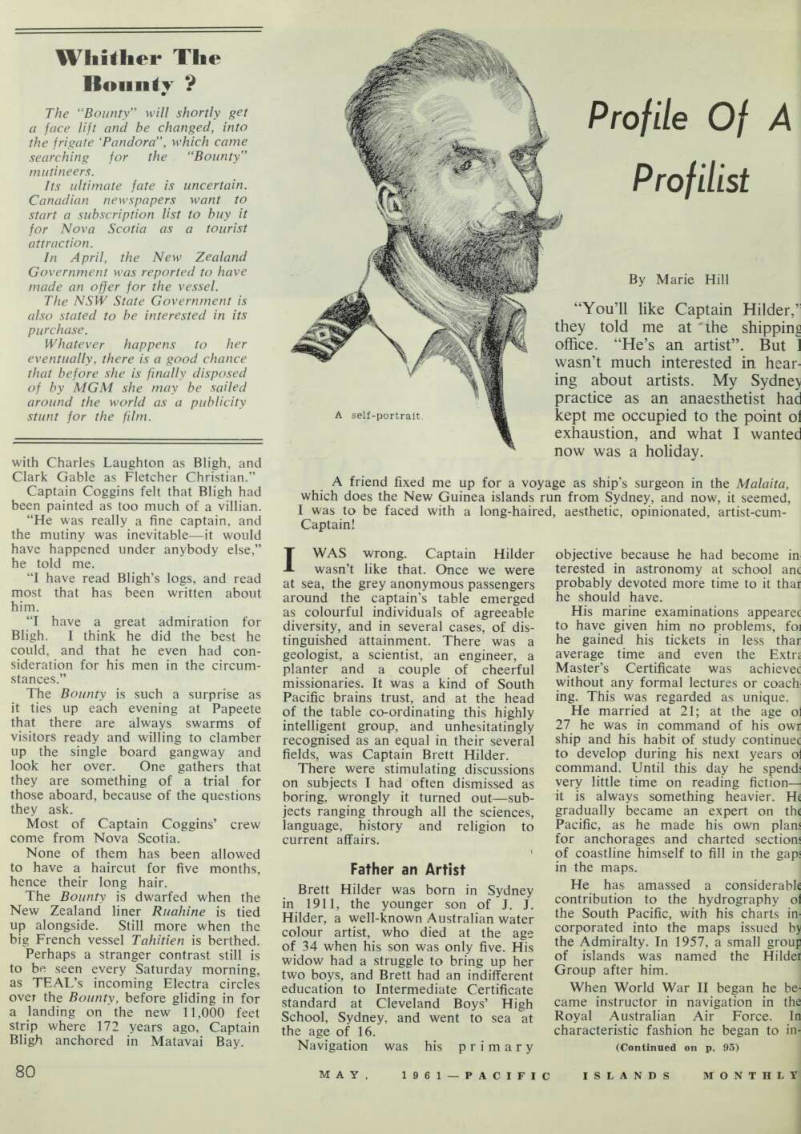
A self-portrait.
vent and modify his course of in struction as he went along.
He was also called on to investi gate a series of air crashes, and made such a good job of it (after indulging
in some hair-raising practical experi ments to test his theories) that the RAAF ear-marked him as permanent president of Courts of Inquiry into aircraft crashes.
But his determination got him out of that, and war’s end found him with the rank of Wing Commander with extensive experience with a Catalina squadron laying mines in the waters of North Australia.
Back at sea after the war he acquired a new reputation as an authority on hurricanes, which was merely one of his many interests.
He has been interested in the method of working the ancient navi gation stones set up in ages past by
latives of Arorae (and has come /ith the only explanation so far 2d); he has made an extensive :tion of shells and talks of even specimens by their complicated names (and has constructed beautiful works of art from , including a pearly galleon ntically detailed); he makes a lot iderwater swimming expeditions, g which he collects tropical fish returns them to a Sydney ium in special tanks (he knows about fish because he corn ed a trawler once, and has been haling expeditions off Norfolk); ves volcanoes and is always in ating them; and a current topic absorbs him is that of marine florescence and its possible re ship to radar (he has contributed ific papers on the subject).
The Viking Hilders 3ther subject of major interest ptain Brett Hilder is genealogy e has compiled a record of the * family of the dimensions of an e. He can trace his own lines ly back to the 1600’s, and has a pile of information of Viking •s and Anglo-Saxon Hilders. has a Dutch wife, a grown-up nd three blonde daughters. He Dutch, as well as some French, and Pidgin, with a ring of various Polynesian and esian languages, all of which him in his anthropological He is always publishing 5 in various types of journals on it variety of subjects, lis conversations he is full of >tes and he is having a racy if autobiography published in n. t Hilder does not remember been taught to draw. He ;s the profiles of Pacific peoples ■e regularly seen in PIM with :hing block lightly held in his nd, and with complete concen lon’t care how many people me, so long as they don’t joggle ow,” he says.
Iraws them in pencil, then pro i shabby school-room paint box egins to spread big sloppy ills of paint over the sketch in arently haphazard manner. ;rcolour is his favourite \ but he also does pen and ink ions, sculpts in stone and md makes designs for postage He has had several water exhibitions in Sydney, Mel and New York (where Rocke •ought a lovely painting of a ?irl’s head for his own private >n). he Captain’s table, on the
Malaita nobody is intimidated by this formidable list of Brett Hilder’s achievements. Certainly he talks a lot —on history, the arts, sciences—de scribes at length exploits or episodes extraordinary, heroic or funny, analyses, theorises and speculates, yet he never sounds like the club bore.
This is partly due to his casual, direct manner of speech, rich in Aus tralian slang, and delivered in an accent peculiarly endearing to fellow Australians. It is also partly due to the fact that being essentially gregari ous he enjoys the discharge of his social obligations as captain.
As the shipping agent said, you like the captain.