143 Visitors
pp. 79-97 · Read in the full issue
The Night We Had 143 Visitors
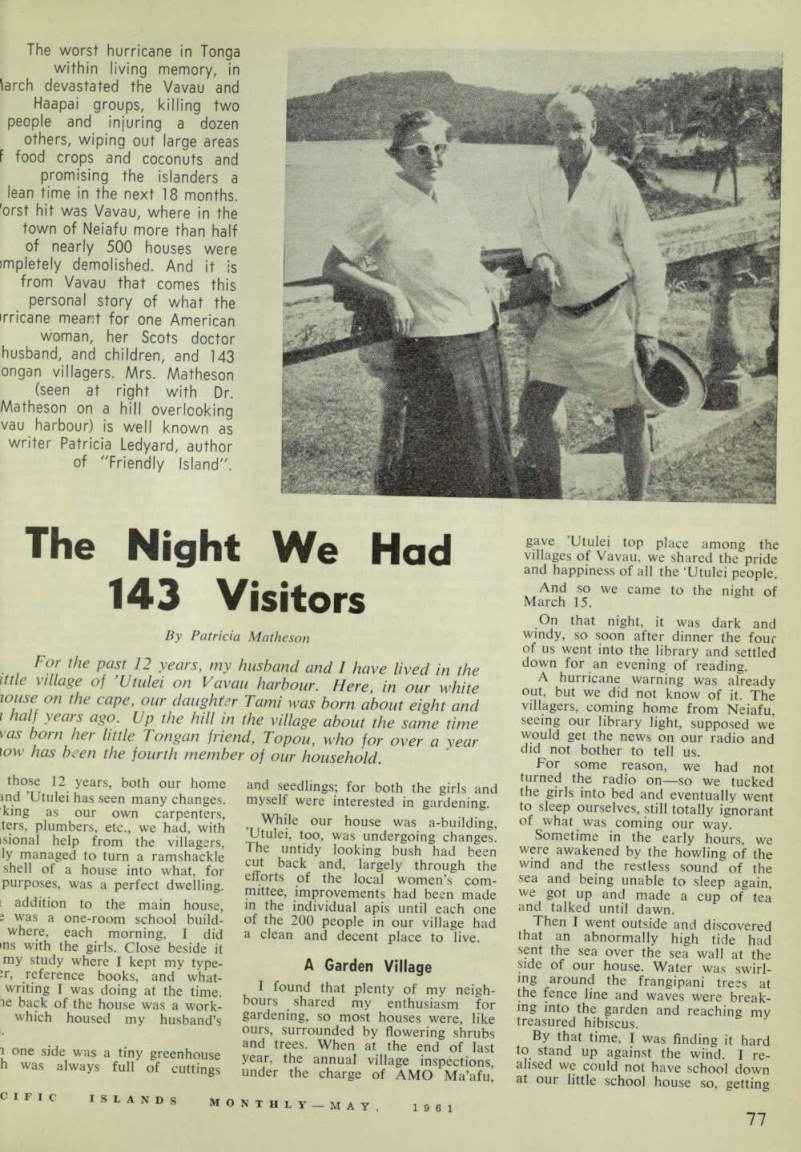
The worst hurricane in Tonga within living memory, in \arch devastated the Vavau and Haapai groups, killing two people and injuring a dozen others, wiping out large areas F food crops and coconuts and promising the islanders a lean time in the next 18 months. r orst hit was Vavau, where in the town of Neiafu more than half of nearly 500 houses were impletely demolished. And it is from Vavau that comes this personal story of what the irricane meant for one American woman, her Scots doctor husband, and children, and 143 ongan villagers. Mrs. Matheson (seen at right with Dr.
Matheson on a hill overlooking vau harbour) is well known as writer Patricia Ledyard, author of "Friendly Island".
By Patricia Matheson
For the past 12 years, my husband and have lived in the title village of ’Utulei on Vavau harbour. Here, in our white louse on the cape, our daughter Tami was born about eight and r half years ago. Up the hill in the village about the same time vas born her little Tongan friend, Topou, who for over a year low has been the fourth member of our household.
those 12 years, both our home md ’Utulei has seen many changes, king as our own carpenters, ters, plumbers, etc., we had, with isional help from the villagers, ly managed to turn a ramshackle shell of a house into what, for purposes, was a perfect dwelling. 1 addition to the main house, 2 was a one-room school build where, each morning, I did •ns with the girls. Close beside it my study where I kept my type 2r, reference books, and what writing I was doing at the time, ae back of the house was a work which housed my husband’s I on e side was a tiny greenhouse h was always full of cuttings
and seedlings; for both the girls and myself were interested in gardening.
While our house was a-building, Utulei, too, was undergoing changes.
The untidy looking bush had been cut back and, largely through the efforts of the local women’s com mittee, improvements had been made m the individual apis until each one of the 200 people in our village had a clean and decent place to live.
A Garden Village I found that plenty of my neigh bours shared my enthusiasm for gardening, so most houses were, like ours, surrounded by flowering shrubs and trees. When at the end of last year, the annual village inspections, under the charge of AMO Ma’afu,
gave ’Utulei top place among the villages of Vavau, we shared the pride and happiness of all the ‘Utulei people.
And so we came to the night of March 15.
On that night, it was dark and windy, so soon after dinner the four of us went into the library and settled down for an evening of reading, A hurricane warning was already out, but we did not know of it. The villagers, coming home from Neiafu, seeing our library light, supposed we would get the news on our radio and did not bother to tell us.
For some reason, we had not turned the radio on—so we tucked the girls into bed and eventually went to sleep ourselves, still totally ignorant of what was coming our way.
Sometime in the early hours, we were awakened by the howling of the wind and the restless sound of the sea and being unable to sleep again, we got up and made a cup of tea and talked until dawn.
Then I went outside and discovered that an abnormally high tide had sent the sea over the sea wall at the side of our house. Water was swirl ing around the frangipani trees at the fence line and waves were break ing into the garden and reaching my treasured hibiscus.
By that time, I was finding it hard to stand up against the wind. I re alised we could not have school down at our little school house so, getting
a big plastic bag, I tumbled all the school books and papers into it and ran into the main house.
His Roof Was Going Shortly after breakfast, one of the village men came asking for nails with which to fasten down his roof.
From him we learned for the first time that there was a hurricane warn ing out.
As the sea was too rough and the wind too high for my husband to make his usual daily trip across the harbour to Neiafu hospital, he began to nail up our windows and I took the girls into the dining room and began school.
Half-way through arithmetic, tree branches started banging against the house and the roof above our heads shook with what sounded like a thousand cannon balls, but was, in reality, all our avocado crop which the wind had stripped from the tree and flung against the house.
The girls were beginning to be frightened by the noise, our young house girl who had come in earlier, had commenced to cry, so I gave up school and took the three of them off to my bedroom where I found a jigsaw puzzle and set them to work ing it.
My husband was looking out the front window to the beach where our boat, and one belonging to the ’Utulei church, were pulled up right to the fence to be safely out of the reach
of any high tide. As we watched, the wind lifted the church boat—a heavy 16-foot dinghy, and carried it over our boat, as lightly as if it had been a piece of paper. It came to rest with one side leaning so heavily against our boat that we feared another gust of wind might make the two smash .against each other.
The front door had been boarded up so we ran round through the back and down to the beach where, after a few moments tugging, we managed to separate the boats. We might have spared ourselves the trouble. When next we looked out, both boats had disappeared, (We found them after the storm, in several hundred pieces!) The Family Comes We had not been long back in the house when our neighbour who’d borrowed the nails, came to ask if he could come and bring his family.
While he was on his roof, trying to nail it down, he’d seen that the walls were starting to collapse and had screamed to his family inside the house to jump out.
Just in time, his mother-in-law, his wife and their five children all leapt from a window and he jumped from the roof. They ran to the church, but had no more than reached it when it, too, began to collapse.
We brought them in and I found warm clothes for the children, who were soaking wet and shivering with cold and fright.
Shortly afterwards, our kitchen door opened again and another family whose house had collapsed came to ask for shelter. It was then about 11 ©clock and we heard from our radio that the centre of the storm was due to pass over Vavau about noon.
By the time it had passed, our door had opened many times and had let in 143 of the 200 people who live in our village. (Of the rest some crowded into a tiny Tongan house which stood throughout the storm and the others spent the time shelter ing in water tanks).
The House Suffers Some of the people carried sewing machines, primus stoves, Bibles and other precious possessions, but most of them came with nothing but the soaking windtorn clothes that covered them.
Accommodating so many un expected guests was somewhat of a problem particularly as our own house had, by then, suffered consider ably.
In the noise and confusion of the storm, we could not know exactly
(Continued on p. 93)
when it was that the roof was ripped off our bedroom and its walls col lapsed, but that room was gone com pletely long before dark.
The library roof followed soon and we had some busy moments dur ing which the children who were in the house shifted all the books to what—at the time, seemed a safe spot. (They were to be moved foui times before the storm was over).
In the meantime, my husband saw that the front wall of the living room was beginning to fall in. As the liv ing room is a large central room, he knew that, if it went the whole house would have gone.
He and the men brought in heavy timbers (the ground was conveniently littered with them) and braced the wall. All during the night, shifts of
leaned against those timbers to :t the room. r chimney fell down early so we not able to light our big stove, brtunately there was no other ge to the kitchen and we had our is and plenty of kerosene. :ding 143 unexpected guests is vhat of a problem. Luckily, we ust bought a case of milk and able to make hot drinks for Dne, had, too, a good supply of rice we cooked a great pot of it, a bit of fish and filled a heap late for each family. ir everyone had been fed, we V down—our 143 visitors filled ining room, the hallways, the room and the living room! ; four of us were in the guest which had several inches of on the floor and more dripping ough the ceiling every minute, ut the twin beds together and )wn with our clothes on. id Tami’s blonde head snuggled it one of my shoulders and i’s black one against the other, held on to us as tightly as they and soon, in spite of the storm, ttle eight-year-olds were asleep, le two of us, sleep was impos- From far down the harbour, we hear each fresh blast of the roaring up like some gigantic jr. n there’d be a moment of calm e whole house would shake and From outside came the thud ling trees, the howl of wind, ikle of broken glass. . . 36 Terrible Hours us the storm lasted about 36 (after the centre had passed ind seemed as strong as ever mch of the damage that was was done then). r as not until Saturday morning was able to get across the ir to Neiafu to buy supplies y household, and it was not Monday that our 143 guests )ff to search for the pieces of and iron that had been their and to put together for them some temporary shelters, beauty of Vavau has gone, irden I treasured is a tangled
•f wreckage.
t is more serious, all the food lave been destroyed. The bread ees lie uprooted on the ground erywhere coconuts have fallen, is no shade because the leaves one from every tree and bush, help comes, the people of will, when the three weeks’ of food that is at hand, has dc faced with starvation, beauty of Vavau has gone, but
its spirit has not. Already shelters are up. Already spaces have been cleared and whatever can be planted, has been planted.
And everywhere, friend greets friend, Tongan and papalangi alike, with a heartfelt, “Malo mo’ui”— thanks for being alive!