Magazine Section
pp. 77-101 · Read in the full issue
Pacific Islands Monthly
The Mysterious Spoof Of " Captain Lawson"
By a Staff Writer
Ever hear of the moolah —the Papuan tiger? Or Mt. Hercules, 32,000 ft. Papuan peak?
They are the creations of Captain J. A. Lawson who wrote Wanderings in the Interior of New Guinea, published by Chapman and Hall, London in 1875, and thereby created a mystery that has remained unsolved for 86 years.
Today no one is able to positively identify the mysterious Captain; nor to decide whether the publication of this book was a deliberate spoof, perpetrated with the connivance of the publishers. Or whether the author was an opportunist trying to cash in on the great interest there was, at that period, in strange explorations.
publishers of the book, a re - putable firm, gave it all the arks of authenticity with a coloured production of “Mt. Hercules”, as a ontispiece, and with a folding map the back marked with dates, lati des, rivers, mountains and cem ents. The book is a collector’s piece -but copies turn up with reasonable equency and it is not yet officially garded as “scarce”.
In 1880 Lawson published another »ok called The Wandering Natura t—A Story of Adventure. This is carce”, and probably non-existent, le Mitchell Library in Sydney has me, and it is believed that the only lown copy was destroyed in London iring the blitz.
The RM's Father The story of Lawson with the per nial question that he and his mythi l wanderings pose, has been re shed at intervals since 1875. Within ; last few months, Mr. Walter W. me, of the Book Collectors’ Society Australia, has written at some igth on the subject in the newssheet the Society, and in asking who ptain Lawson was, pieces together summary the source of most that 5 been published on the mystery n and his books.
Mr. Stone writes: ‘My interest in the book was first •used some years ago when, in con sation with a retired New Guinea gistrate, Mr. Armit, the talk turned books about that country. He men icd “Captain Lawson” and his nderings in New Guinea and said t it had been written by his father a leg-pull—and with the conni ice of the publishers. I did not
follow the matter up as I had not read the book at the time but shortly after wards, on acquiring a copy, found that it belonged to the “Imaginary Travels” section.
“The narrative, which begins in Sydney, where the urge to explore New Guinea first overtook Lawson, was perfectly straightforward and un adorned with fanciful language. He
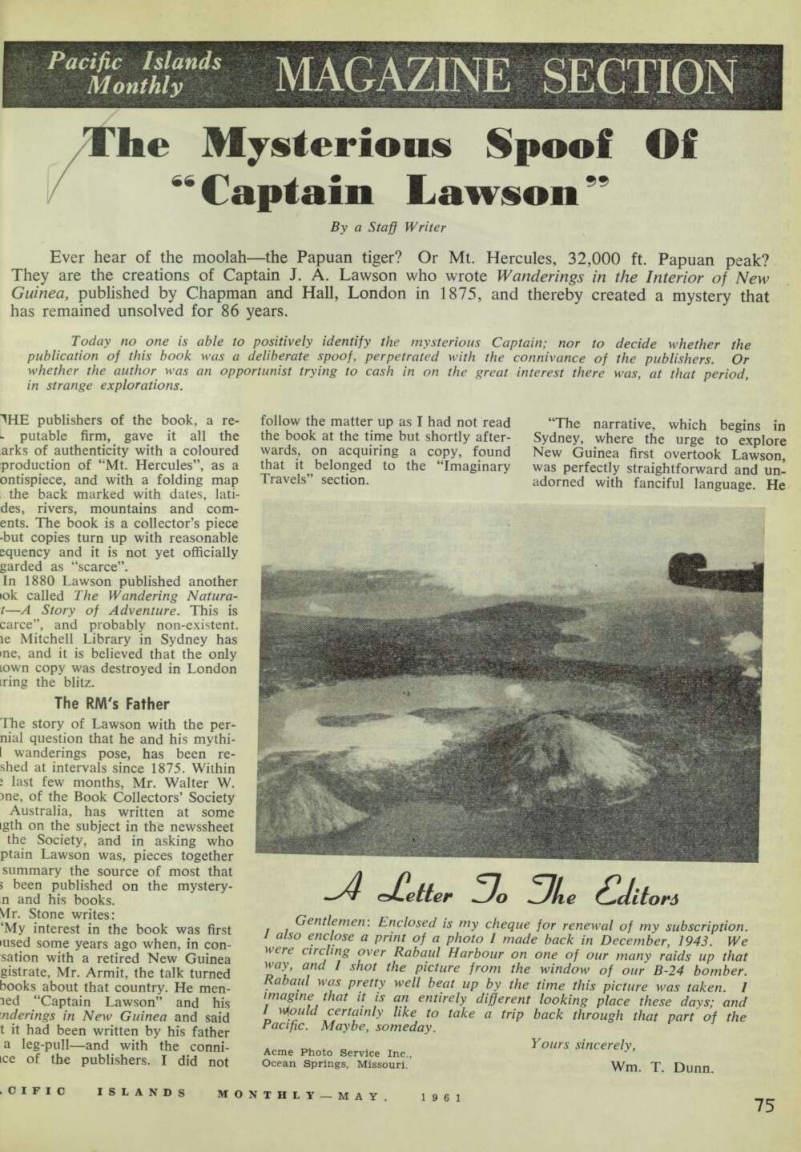
A Letter To The Editors
Gentlemen : Enclosed is my cheque for renewal of my subscription.
I also enclose a print of a photo I made back in December, 1943. We were circling over Rabaul Harbour on one of our many raids up that way, and I shot the picture from the window of our B-24 bomber.
Rabaul was pretty well beat up by the time this picture was taken I imagine that it is an entirely different looking place these days; and I would certainly like to take a trip back through that part of the Pacific. Maybe, someday.
Acme Photo Service Inc., Ocean Springs, Missouri.
Yours sincerely, Wm. T. Dunn.
did let himself go when he described the snow near the top of Mount Her cules as ‘being arranged in all manner of fantastic patterns, like the frosting on top of a gigantic bride-cake’.
“His fight with a moolah, the Papuan tiger (unseen since 1872 when Lawson ‘killed one with a lucky dagger thrust’) is reminiscent of Jack Harkaway at his best and is told with that hero’s usual restraint.
“Of his assistants and porters on his trip, all coloured men, only two survived. Aboo, the Papuan, was paid off on reaching his native village.
Billy, an Australian aborigine, dis gusted Lawson during the latter’s pro tracted dysentery attack of two months duration, by avoiding his master who heard that ‘he was almost constantly in a state of beastly intoxi cation’. Lawson so far forgave Billy as to pay his fare back to Sydney.”
Mr. Stone goes on to refer to articles in the Sydney Sunday Herald, in 1953, in which the question of the authorship of the book was raised and for which Miss Mander Jones, then Mitchell Librarian, had compiled a list of references to the Captain and his book, dating from 1875.
What They Said Here they are, in brief; Geographical Magazine, Vol. 2, 1875: This journal took the book as gospel and stated: “We understand that the author brought back to Eng land several trophies of the chase, and we trust that he will be persuaded to exhibit them and read a paper at an early meeting of the Royal Geogra phical Society”.
The Times, in reviewing the book at the same period, was of the opinion that “the work appears to be an ima ginary account.”
The Athenaeum, in its review, April 17, 1875, did not believe it either. Their reviewer asserted that, according to the Admiralty Charts, the spot assigned to Houtree, the Papuan village Lawson said he used as a base, would be situated in the sea.
To this Lawson came smartly back, in the issue of May 1, saying that the Admiralty had never made an accu rate chart of Papua, anyhow (an as sertion that is still true of many parts of P-NG and adjacent waters in 1961).
The Athenaeum was not to be put off. It challenged Lawson to produce the moolah skin. Lawson replied, still on the offensive, but ignored any ref erence to Papuan tigers and their skins.
Captain John Moresby, RN, who had been in New Guinea waters in
1873 (a year after Captain Lawson’s alleged adventures), then weighed in with his two cent’s worth—and Law son rebuked him for his disbelief but paid tribute to Moresby’s discoveries as “equal to his own”.
The next reference to Captain Law son does not appear for many years.
Then, in the September, 1905, issue of an English journal called Notes and Queries, an Edward Smith went on record claiming that he had dis covered the author of Wanderings in New Guinea —a Huntingdonshire cripple who, “unable to compete fairly in life with other young men, dabbled in books when not wandering about with his gun”.
Mr. E. A. Petherick, a noted collec tor of Australiana, saw this item and asked Smith through the columns of
Notes and Queries for the name c the cripple. The reply is not recordec although Petherick wrote at the tim that he had laughed heartily wit Fred Chapman, of the publishin firm, at those who had taken Wandei ings seriously, and added: “I have note that someone said the author Wc a Lieutenant Robert Armit.”
In November, 1951, in Monthi Magazine, published in Queenslan< the Rev. William H. Macfarlane, wh had been a missionary in the Torn Strait Islands for many years, wroi that, at the end of 1933, when he w; visiting Port Moresby, he had met government official who haile originally from Cooktown. He he happened to mention Wanderings i New Guinea and the government ofl cial had laughed. “My father was tf author,” he said. “He wrote it for joke—someone bet him he couldr produce a fictitious travel book th would take in English readers.” (Mi Jones wrote to Mr. Macfarlane askh for the name of the Governme official, but he replied that he cou not remember it.) After the Sydney Sunday Hera articles in 1953, Mr. Stanley .
Greenland, pre-war Inspector of tl Papuan Native Affairs Departmei wrote to say that he understood th Lawson, whoever he was, wrote tl book for a £lOO wager made in I London club.
That is as far as Miss Jones’ nol tions went—although it is perha worthwhile recording that in a sm; booklet called Explorations in Ni Guinea, issued by Oxford Universi Press and reviewed in PIM a couf of years ago, Lawson is lumped with “cunning people” who wrote fictitious explorations from Euro] hoping to make money. They say ! identity was never known.
(Continued on p. 97)
But that, in two of the three books that H. H. Romilly wrote, brief refer ence is made to “Lawson” and his book. In 1883 Romilly notes that “Mr. A”, one of two “Commis sioners” of Australian newspapers, had arrived in NG, and that “ ‘A’ deserves to be eaten” for having earlier written a book under the name of Lawson. In 1889 he makes some joking remarks about Wanderings but does not mention the author.
Mr. Stone ends his article saying: “The important thing to be noted about the quest for ‘Lawson’ is how unreliable verbal evidence is after a lapse of but a few years. Pether ick’s note should have some substance as he was a great collector of material relating to Australia, and his library was one of the important acquisitions made by the National Library—be fore it went to Canberra. Petherick jokes with the publisher about the book, writes as though he knew him well enough to ask how the author was, and yet can only come up with “somebody” in support of a notation he has made.
I, myself, relied on Mr. Armit’s word, always hoping that I’d have a chance to meet him again. He died somewhere about 1950.”
It seems likely that the Armit re ferred to as a “Resident Magistrate” and a “Government official” was Mr.
L. P. Armit, whose last job be fore retiring from the Administration of Papua was as chief clerk in the Department of Government. At an earlier period he may have been a
Rm Or Arm.
I met him during the war at meet ings in Sydney of the Pacific Terri tories’ Assn., where I went on busi ness and he probably for something to do. He was an elderly, mouse-like (Over)
vho looked and acted as though 'hole world had collapsed be him—as it probably had. ause he was attracted to literary —through his father who, he lad been a correspondent for the >n Times —he occasionally came ny office. ing these sessions, he might have told me of the alleged •ship of Wanderings in New a (which I had then not heard ut all I recall now is that his had first gone to Papua to an exploration financed by the newspaper of Melbourne, m a mutual friend, I later i that the whole Armit family, illy of Cooktown, Qld., was in Port Moresby before World , and that they had been very -as well they might have been y were supported by nothing than Armit Snr.’s earnings h freelance journalism. Lionel the son, married late in World ' and returned to Port Moresby, he had a house, about 1946.
Lawson into Armit '/ does the picture of the re ble Captain Lawson and his rings fit into this background? ould judge that Lionel Armit )orn about 1887—about 12 after Captain Lawson’s book iblished in London. It is ob that “Capt. Lawson”, or a ti, was in London in 1875 to the reviewer in Athenaeum— months in those days to get an by mail from Australia. Was Snr. in London at that time? - were English-born, it is pos lat he was, and that he wrote iginary adventures years before ng to Australia and founding ly. But if he was, as I have surmised, from a family in wn, it seems unlikely that he her in London or the author book.
Argus expedition took place ', the year of the abortive an n of Papua, by the Queensland iment, and a year before the an ti by Britain that stuck. Little ded about it except in a few lies that were printed at the the now defunct Argus. pears that Armit was the ex 1, or the only European in it, it he was chosen because, al he had not been to Papua, been a policeman in Queens d used to tough assignments, s that he explored the Astro mge that parallels the coast f Port Moresby; and, if you
look at the map of Papua, you will see also that due north of Ihu on the Gulf, there is the Armit Range.
Whether Armit explored here also, or whether it was subsequently named after him by other explorers, I don’t know.
But could Armit have written a fic titious account of adventures in Papua and then, years later, followed it up with the real thing?
After 86 years, it may be im possible to find out who Captain Law son really was. But it shouldn’t be too difficult to find out whether Armit Snr. could have been the culprit.
There are many people still alive who remember the Armit family of Port
Moresby; and a search of the births, deaths and marriages registers of Cooktown, Qld., in the third quarter of the 19th century, should provide some leads.
It is hard to believe that the news paper reporters of 1875—mild though they might have been in comparison with today’s—would have left the Lawson controversy alone. Perhaps the mystery was solved—as Romilly’s brief treatment of it seems to suggest —and the solution subsequently for gotten.
In which event it may not be Cap tain Lawson who remains the mystery, but the reason for the split-personality of “Mr. A.”