Women Are
pp. 61-65 · Read in the full issue

Sudneysider Goes Walkabout
People
It S doubtful if this should belong to the Walkabout series s it concerns, primarily, a prolonged sitabout and hangabout! uve days ot it, at the early April inaugural meeting of Parma- Jew Guinea reconstituted Legislative Council. P
OM the point of view of the people who sat in the Press :ry (which also has been recon ted since the October meeting so ) give pressmen a better view and :r listening facilities) it was about dullest and most unspectacular ing since 1951. id this, notwithstanding the fact at least three of the elected bers have proved themselves, in >ast, capable of throwing political b-shells and producing verbal technics. it, although it made mostly deadly ling, it was undoubtedly the right >ach in the current P-NG mood et us go forward together”. The ber for New Britain, Mr. John per, said that he had been in ted by his electorate to “take it , and if other elected European bers had not been similarly in-
structed by their electorates, they acted like it.
But with individualists like Messrs.
Downs, Chipper and Hurrell in the European “opposition”, future meet ings are unlikely to be conducted in this atmosphere of church-guild knit ting-bee. Some day we may even look back on the first meeting of the new Council as a honeymoon—while it lasted.
In the prevailing gentlemanly at mosphere it was impossible, without some hind-sight, to see any political personalities emerging. This, is doubly so in respect of native members, be cause in common with most Mel anesians they have the God-given gift of being able to pull a meta phorical shutter down over their faces.
What goes on behind this look of utter blankness can sometimes be nothing; but it is not always safe to bet on it.
John Guise, native elected member for Eastern Papua, stood out as cer tainly the most articulate of the six native elected members. Probably, also, he is the most able and, some say, the most potentially dangerous, if for no other reason than because, politically, he is completely lacking in a sense of humour.
A/lan With The Mostest The only personality boy, amongst elected and nominated natives, was Kondom Agaundo, elected member for Highlands. He’s got a number of claims to fame and is one of the few members of any existing British Par liament who has nine wives (and the umpteen children that go with them).
He is a small, gnome-like man and outside his nine wives (or is it seven?) no one is likely to suggest that he is handsome. He says himself that his
English is non-existent and that his Pidgin is bad, and in this he speaks nothing but the truth—his Pidgin is terrible and as he speaks down in his chest in a low monotone, exceedingly hard to follow. But Kondom’s humble sincerity and his obvious loyalty to the Government surround him like a rosy pink cloud.
This cloud of virtues could, of course, smother his value as a pol itician, but if he escapes this fate he could be of value to the Council as his naive manner evidently hides an inner man of considerable character.
Kondom comes from near Kun diawa, in the Eastern Highlands, and as I’ve been told it, he was orphaned early. Two uncles looked after his interests and considerable lands until he was of an age to manage things for himself—which was just before the outbreak of the Pacific war.
Administration penetration of the Highlands areas was very slight up to that time, and the Highlands were, m fact, closed to non-Administration Europeans until some time after the war. E. Highlands, therefore, had had slight contact with Europeans, and when Civil Administration ceased to exist in 1942, the local lads simply reverted to type and smartly.
Only Kondom remained, as they say, “true to the word”. By force of personality he kept his own people loyal to the Administration and such of the new ideas of peace, law and order that had penetrated to Kun diawa before the balloon went up— not an easy task, we imagine, when the Europeans who had propounded those ideas were now at war them- SdveS - (Over)
[?]n Chipper, one of 12 elected members [?]s new Legislative Council, who is noted plain speaking, was instructed by his [?]e to "take it easy" during the Council opening.
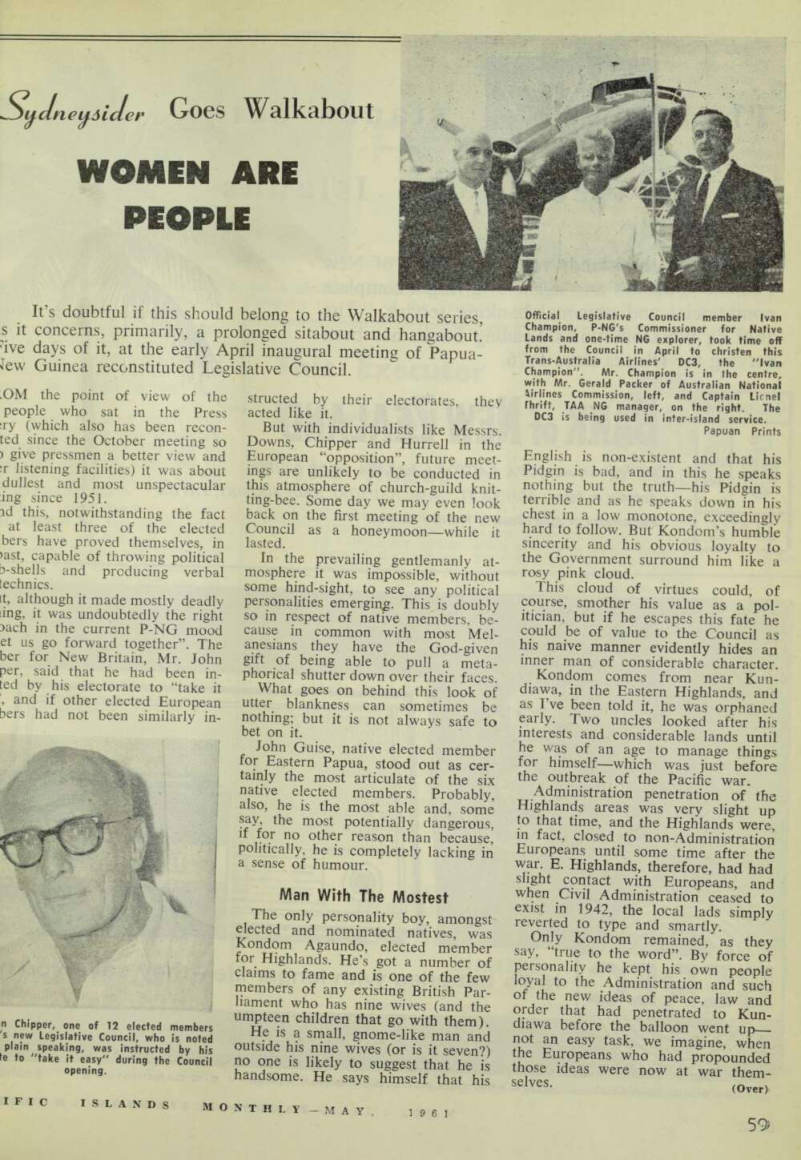
Official Legislative Council member Ivan Champion, P-NG's Commissioner for Native Lands and one-time NG explorer, took time off from the Council in April to christen this Trans-Australia Airlines' DC3, the "Ivan Champion". Mr. Champion is in the centre, with Mr. Gerald Packer of Australian National Airlines Commission, left, and Captain Lionel Thrift, TAA NG manager, on the right. The DC3 is being used in inter-island service.
Papuan Prints
hen peace and the Administra returned to Kundiawa after the they found Kondom and his le ready to carry on where they left off in 1942 and from thereon
ever was forward-looking and
ressive, Kondom was for it and meed his people in the right tion.
Council, Kondom made two en speeches. He had apparently ipted to learn the first one off mrt, but along the way “lost his and what he said was all but y incomprehensible. made better headway at the d attempt a few days later, he spoke off the cuff. He did nderstand English and his Pidgin )ad, he said. He could not read apers and bills that were put on esk each morning, so he could Jturn to his people and tell them was in them. But even this, he sted, unfortunate as it was, was a passing phase. He would die anyway, and after him would children who could read and and make themselves under in any company. bably the most interesting angle e native representation in the Council is not the fluency of Guise or the humility of Kon \gaundo—or even Yin Tobain >f New Britain, and his affec or the Pidgin phrase “bugger but the fact that the electoral i could have thrown up six who, in total, represent such ate views.
No Steam Rollers ; hows that the P-NG natives ot more sense than many people lem credit for; and that it pre even through the extraordinary locutions of the electoral col stem of voting with which they a contend in the first steps s representative government, i in the days when, as a tion member put it, the P-NG five Council was little more
than a glorified debating society, the European residents of the Territory
were well served by their elected rep resentatives who carried out a thank less task in the face of public in difference. The six present members give every indication of carrying on that job so well begun.
The four from the New Guinea side I’ve known, personally, for years; all are pre-war residents and all have become men of substance in the New Guinea community by hard work and ability. Three of them have been MLC’s on previous Councils—two of them briefly, when each made a maiden speech that rocked the Legco of that particular day to its founda tions.
Such shock tactics were out at this meeting, perhaps because they believe
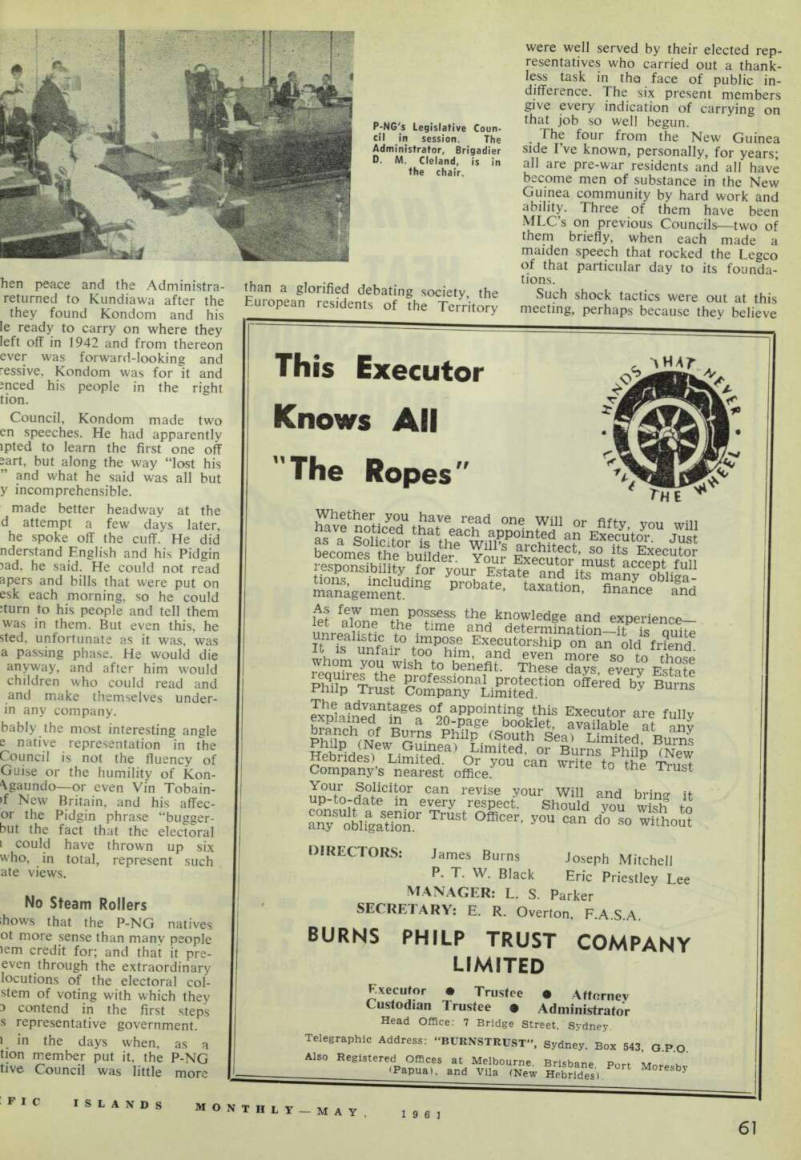
P-NG's Legislative Coun cil in session. The
Administrator, Brigadier
D. M. Cleland, is in the chair.
it there are more ways of crushing peanut than using a steam-roller.
The fourth member of the team ►m the NG side doesn’t need to irn caution. He has it built in. He’s ul Mason, coconut planter, dis guished ex-Coastwatcher and now litician.
His new role is not yet run-in. and ;n at the end of the session I think was still wondering how be got nself into it. He says quite frankly t all he wanted to do in the New inea Islands electorate was organ opposition to the candidate the 1y had put up—and he found him hoist by his own petard.
J aul went to the Solomons as a of 14, and his life ever since has n spent lone-handing on coconut ntations and out-stations. Even ing the war, which brought mass ng to most men, he became a istwatcher, isolated behind Jap ;s in Bougainville. a result of this background he generally slow to translate his ughts and feelings into words— lough quick thinking has saved his k many times. t was typical that he made his den speech in Council near the
end of proceedings and that it was brief, sound and well based on over 40 years experience in the Pacific.
I doubt if during the life. of this Council, we can expect fiery oratory from Paul Mason, but his influence will be considerable.
Finally, this Council has two women members. They are not the first, as some people with short memories seem to think; that honour belongs to Mrs. Doris Booth, who was a member of the first two Coun cils up to 1957. But it is the first time that there has been a Papuan woman member.
The two members, Mrs. Roma Bates and Miss Alice Wedega, pre sumably are there to hold a watching brief on “women’s interests”, Even to day, when women overseas are crash ing the sound barrier or holding top diplomatic and scientific posts, it is a peculiar Australian belief that they still belong to some sub-species, fit only to care for babies.
Neither of the new members had a chance to show her paces at the April meeting, but here’s hoping that before this Council quits this life, in 1964, they prove that women are also people.