Australia Finally Tips Its Hand
pp. 19-147 · Read in the full issue
On West New Guinea
From our Canberra Correspondent Australia has no direct or indirect military commitment with the tch in West New Guinea, BUT if a shooting war should break out ween the Indonesians and the Dutch we can scarcely expect to »id being involved.
lAT is the clear implication of the policy statement which the Prime lister, Mr. Menzies, made to Fed- Parliament after his talks with Indonesian Minister for National euri t y, General Abdul Haris ution, in April. wice in his statement Mr. Menzies )hasised that Australia had no tary commitment with the Nether 1s over West New Guinea, md in a third reference he said there was no military commit it “beyond those involved in the irter of the United Nations,” lut he amplified these statements. 1 General Nasution could hardly e failed to have perceived the sage and carried it back with him Djakarta.
What He Said his is what the Prime Minister I: “Armed conflict in West New nea, whether arising from mass ision or limited guerilla episodes ited by armed infiltration, would sent Australia—in common with er countries—with a grave problem.
Any such conflict could certainly be ignored by the United Nations.
It would engage the attention — )fu! or otherwise—of the great vers.
It would threaten world peace, could well bring disaster to th-East Asia by its encouragement Communist activity and interven- If military conflicts arose from se differences new and grave blems would arise for many ons, including our own.
For this reason, the renewed as mces of peaceful pursuit of Indo ia’s claims made by General ;ution are of such profound ins tance and international value.”
Clearest Yet ir. Menzies’ statement was the irest and most forceful exposition Australian attitudes toward West v Guinea that has ever been made.
The pity is that the Government waited so many years before making it.
Indeed, the Deputy Opposition Leader, Mr. Gough Whitlam, went so far as to say that had our policy been stated with similar clarity and vigour in the 1950’s we would have secured much more international support than we have.
Here, for the record, is the Gov ernment’s view on self-determination, which is the fundamental point at issue between Indonesia and Aus tralia. It is as outlined by Mr.
Menzies in his statement to Parlia ment. • Our policy in our own New Guinea territories is—by steady de grees and to the limits of our financial and administrative capacity—to pro mote the advancement of the people so that ultimately they will choose for themselves their own constitution and their future relationship with us.
We will respect their choice, what ever it may be.
This policy arises from our sense of responsibility, which cannot be suddenly or prematurely abandoned if our trusteeship is to be honourably performed.
• Having regard to these undoubted facts, Indonesia cannot reasonably ex pect Australia to take—nor will Aus tralia take—an initiative in a pro cedure designed to lead to handing over of sovereignty and the abandon ment of the right of self-determina tion in West New Guinea.
That is why Australia is most definitely not prepared to put pressure on the Netherlands to negotiate for the transfer of sovereignty and the abandonment of self-determination.
We recognise Dutch sovereignty and we approve the Netherlands policy
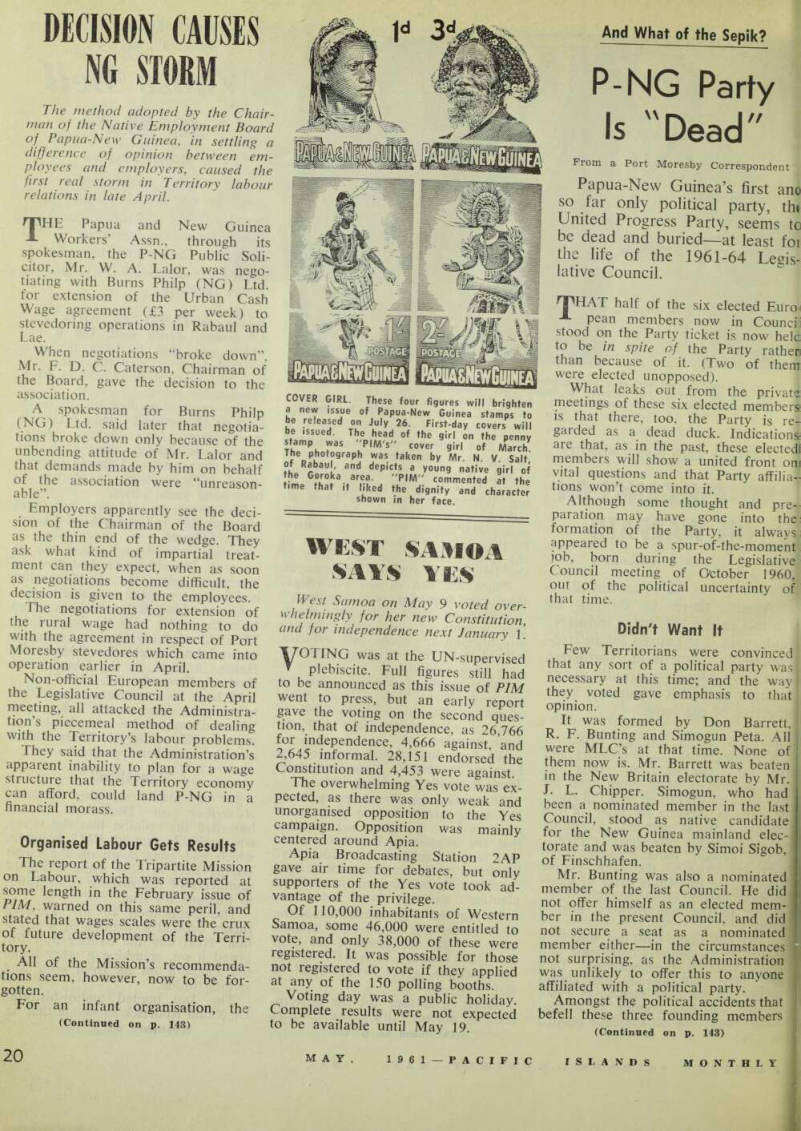
Mission
Conference
Two members of the BSIP Legislative Council, Rev. L. Alafurai, and Francis Bugoto, were among 70 mission repre sentatives from Angli can, Methodist, Lutheran, Presbyterian and LMS churches which met in Apia in early May to discuss common problems. This photograph was taken in Sydney while they were on their way to the conference, which was regarded as a milestone in Protestant co operation in the South Pacific.
of ultimate self-determination.
If Indonesia regards this as par tisanship, we point out that it favours the recognition of sovereignty and the objective of self-determination, to both of which Australia is inevitably attached. ° The Netherlands, as the sov engn power, will quite freely make its own decisions, which we will re spect. • We are on most friendly terms with Dutch; we are also close to and friendly with Indonesia.
When West New Guinea has been discussed in UN we have supported sovereignty and domestic jurisdiction.
Sovereignty is basic for Australia, no less than for others, including Indonesia.
Not Hostile to Indonesia None of this, said Mr. Menzies, was hostile to Indonesia, and it ought not to be thought so.
The Prime Minister said that Gen eral Nasution had put the proposi tion, “with great force and obvious sincerity”, that West New Guinea was part of Indonesia and that there was no more reason for granting self determination to it than to any other social group or geographical area in Indonesia.
General Nasution, in his farewell Press interview in Sydney, announced, somewhat negatively, that his visit to Australia had “not been a failure”.
But a careful study of the Prime Minister’s statement suggests that General Nasution failed in his basic mission.
To quote the Prime Minister; “Gen eral Nasution said that ... in any discussions between the Netherlands and Indonesia about West New Guinea Australia should be strictly neutral.
“Australia should not support and encourage the Dutch either generally or in the UN. This, as he made clear, was the great thing he wanted to establish with us.”
(Continued on p. 145)
that were the General’s sole n, then Mr. Menzies’ statement the endorsement of it by the ition Leader, Mr. Calwell— not make very happy reading karta, luse the Prime Minister made r to him that Australia sup- Dutch sovereignty, believed was proper to do so in the
UN, and believed that Dutch and Australian policies in West and Eastern New Guinea were broadlv similar.
On that ground the General said correctly that the Indonesian people would not be “wholly satisfied with the Australian attitude”.
But on practically every other ground, General Nasution should have gone home feeling well pleased that his visit had been a success.
He made a remarkably good im pact on the Australian Government and appeared to get closer to the
Prime Minister than the Indonesian Foreign Minister (Dr. Subandrio).
Those in the know say that Mr.
Menzies tribute to the General’s frankness and personality was no idle compliment.
And in Mr. Menzies own words: He has left Australia after faith fully and ably representing his country, with, I am certain, a con fidence in his own mind that, while his visit may not have changed our policies, it has certainly made a powerful contribution to our common understanding and goodwill.”