Pacific Shippig Adn Cruising Yachts
pp. 99-113 · Read in the full issue
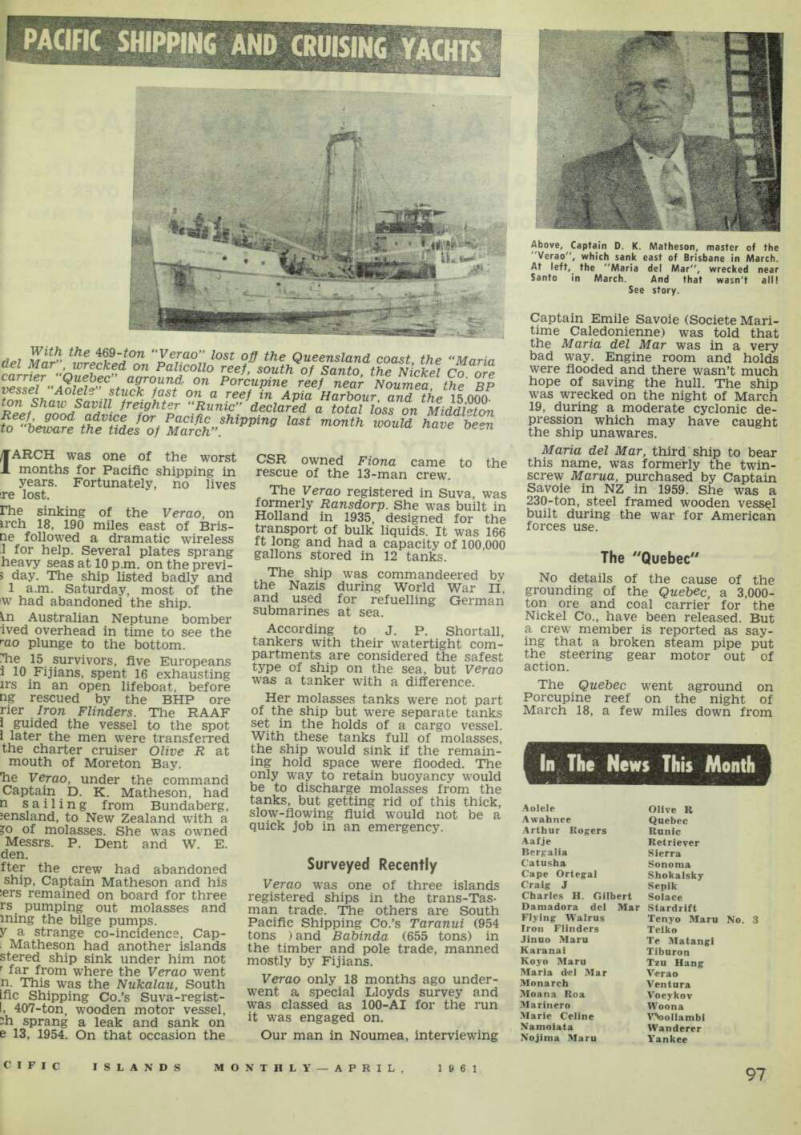
wsseT' “Aolij*” Porcupine reef near Noumea, the BP to%eZ% tTTdetZf Z%V’ ShiPPinß laSt month would have iesn
I ARCH was one of the worst months for Pacific shipping in years. Fortunately, no lives re lost.
Hie sinking of the Verao, on irch 18, 190 miles east of Bris tle followed a dramatic wireless .1 for help. Several plates sprang heavy seas at 10 p.m. on the previ -5 day. The ship listed badly and 1 a.m. Saturday, most of the w had abandoned the ship.
Vn Australian Neptune bomber ived overhead in time to see the rao plunge to the bottom. ?he 15 survivors, five Europeans i 10 Fijians, spent 16 exhausting irs in an open lifeboat, before tig rescued by the BHP ore ner Iron Flinders. The RAAF i guided the vessel to the spot I later the men were transferred the charter cruiser Olive R at mouth of Moreton Bay. ■he Verao, under the command Captain D. K. Matheson, had ti sailing from Bundaberg, Jensland, to New Zealand with a =° of molasses. She was owned Messrs. P. Dent and W. E. den, fter the crew had abandoned ship, Captain Matheson and his :ers remained on board for three rs pumping out molasses and ining the bilge pumps, y a strange co-incidence, Cap i Matheson had another islands stered ship sink under him not r far from where the Verao went n. This was the Nukalau, South
ific Shipping Co.’s Suva-regist
l, 407-ton, wooden motor vessel, fli sprang a leak and sank on e 13, 1954. On that occasion the
CSR owned Fiona came to the rescue of the 13-man crew.
The Verao registered in Suva, was formerly Ransdorp. She was built in Holland in 1935, designed for the transport of bulk liquids. It was 166 ft long and had a capacity of 100,000 gallons stored in 12 tanks.
The ship was commandeered by the Nazis during World War n, and used for refuelling German submarines at sea.
According to J. P. Shortall, tankers with their watertight com partments are considered the safest type of ship on the sea, but Verao was a tanker with a difference.
Her molasses tanks were not part of the ship but were separate tanks set in the holds of a cargo vessel.
With these tanks full of molasses, the ship would sink if the remain ing hold space were flooded. The only way to retain buoyancy would be to discharge molasses from the tanks, but getting rid of this thick, slow-flowing fluid would not be a quick job in an emergency.
Surveyed Recently
Verao was one of three islands registered ships in the trans-Tas man trade. The others are South Pacific Shipping Co.’s Taranui (954 tons ) and Babinda (655 tons) in the timber and pole trade, manned mostly by Fijians.
Verao only 18 months ago under went a special Lloyds survey and was classed as 100-AI for the run it was engaged on.
Our man in Noumea, interviewing
Captain Emile Savoie (Societe Mari time Caledonienne) was told that the Maria del Mar was in a very bad way. Engine room and holds were flooded and there wasn’t much hope of saving the hull. The ship was wrecked on the night of March 19, during a moderate cyclonic de pression which may have caught the ship unawares.
Maria del Mar, third ship to bear this name, was formerly the twin screw Marua, purchased by Captain Savoie in NZ in 1959. She was a 230-ton, steel framed wooden vessel built during the war for American forces use.
The "Quebec"
No details of the cause of the grounding of the Quebec, a 3,000ton ore and coal carrier for the Nickel Co., have been released. But a crew member is reported as say ing that a broken steam pipe put the steering gear motor out of action.
The Quebec went aground on Porcupine reef on the night of March 18, a few miles down from
Above, Captain D. K. Matheson, master of the "Verao", which sank east of Brisbane in March.
At left, the "Maria del Mar", wrecked near Santo in March. And that wasn't all!
See story.
Noumea and only a mile or two off the coast in a lagoon. The vessel was empty and heading for the port of Thio to load nickel ore Bad visibility may have contributed to the accident.
The Quebec was refloated on March 21. with the help of a sistsr ship, Caronte, which off-loaded an amount of nickel ore into the after hold of the Quebec, which thus lifted the bow considerably. The Quebec was drawn off the reef and towed to Noumea for temporary re pairs and then headed for Syd ney for drydocking. • STUCK FAST: The Burns vessel Aolele was reported as ituck hard and fast on a reef in harbour, Western Samoa, on blarch 26.
She is aground in almost the ame place as the Union Company’s teamer Waitomo was stranded last r ear.
Heavy seas were pounding the lort side as efforts were made to ree the Aolele from the reef. • RUNIC FOR SALE: Grounded •haw Savill freighter Runic which ias been declared a total loss on Ilddleton Reef, 120 miles north of •ord Howe Island, is up for sale.
The ship went aground on Feb jary 19, and had defied all efforts ) move her. Holds and engine room re full of water. Valuable radar luipment, compasses and chron meters will be recovered from the lip.
Runic was launched in 1950 for le UK-Anstralian-NZ run and re lacement of the 13,587-ton vessel is rpected to cost over £3,000,000.
The boom defence vessel Karangl, hich was chartered from the AN to shift the Runic returned to fdney with boiler trouble. The /dney tug, Woona, and the Bris me tug, Wooree, which early went the stricken ship’s aid, have re rned to Australia.
• The Mothball Line:
nerican President Lines have re ntly purchased a P-2 type vessel 946 vintage) for use on the San ancisco-Orient passenger trade. present in mothballs, the ship 11 be converted to a modern ssenger liner. The Line paid 200,000 for the vessel.
Fhe P-2 class of ship is about 00 tons gross and 11,800 tons dead ight with a pair of steam tur les driving a single shaft. They J substantially smaller than the itson Line Pacific liners, Mari ta and Monterey. * FOR SALE: The Damadora del ' r (former Australian coaster mar a) purchased by Captain /oie in 1956, is reported to be up sale. She is a 751-ton steel, gle-screw vesel built in Glasgow 1937.
• Ships Change, Nam F C
h 7' A ivt ’ h the three vessels of the Matson-Oceanic Company which have created the trans-Pacific cargo service in post-war years are now being replaced, their names will re main on the run. vo" 1 ? 10 - lar Ks r c “ 3-t yP e ships now replacing them are taking over the will thus become the third vessels of the company to bear these names.
The original Sierra, Sonoma, and Ventura were twin-screw coal burning steamers built in 1900 so are most unlikely to still remain afloat under other names.
Sierra was at one stage named Gdansk. They were units of the Oceanic Company fleet which
merged with Matson Line, and were sold in 1934.
The names were not taken up again until 1947 when the war time-built C-2-type ships Stokes, White Squall, and Todd, were acquired and renamed Sierra, Sonoma, and Ventura respectively.
The C-3-type ships now replacing these three are actually about the same age as the C-2’s, but they are larger and faster.
The latest Sierra— first of the three to appear south of the Line— was built as Sea Centaur, in 1945, and became Hawaiian Banker when purchased by Matson two years later.
The new Sonoma was launched as Burleigh and was re-named
Hawaiian Pilot, and the new Ven tura was launched as Hanover and became Hawaiian Wholesaler.
All were built in 1944-45 and were part of a fleet of 18 similar ships on the Hawaii-US West Coast Mat son service.
They have a dead-weight capacity of approximately 12,500 tons as compared with the C-2’s 10,600 tons.
They are also fitted with large re frigerated containers which can be quickly discharged through side ports or hatches.
They have tanks for the carriage of molasses and are also equipped to carry raw sugar from Hawaii.
• Lamb Liner For Sale: The
Dne-time Australian coastal pas senger vessel Woollambi the Sydney newspapers still list her as Delfino though she was renamed nonths ago—lying idle at an up larbour Sydney mooring for a long :ime past, is now offered for sale it a figure of £350,000, according :o the listings of a leading Sydney
ship-broking firm.
The owners, Asian & Pacific Ship ping Company of Hongkong, are said to be withdrawing entirely Torn the livestock trade.
Formerly Westralia of the Suddart Parker Line, this ship was :he second of two large passenger vessels to make a rather brief ap- Jearance in an entirely new trans pacific trade—the transport of live stock from New Zealand and Australia to the United States.
The Panama-flag Hongkong )wned 6,923-ton Catusha —formerly ; he British ship Cavina, made a run Tom Tauranga, NZ, to San Diego n mid-1958 with 1,225 steers, of vhich 109 died during the 30-day voyage.
A coal-burner consuming 85 tons per day, this former banana carrier in the West Indies-UK trade was totally unsuited to the livestock trade and in fact went to the Hongkong shipbreakers after this single voyage. She was 35 years old.
Delfino , a motor vessel, now listed as of 6,388-tons gross—she was measured at 8,174-tons when in the passenger trade entered the Sydney-San Diego lamb trade in 1959.
She proved quite satisfactory after stock accommodation, ventilation and feeding problems had been solved following the first voyage.
In later voyages losses were in significant—but other problems ap parently killed the trade and her
owners were reported to be in financial difficulties recently.
Reason for the recent name change is unknown, but it may have been at the request of the American stock man, James Delfino, who had organised the importation of the stock in the case of both vessels.
With the ship out of the stock trade the Delfino association ceased.
Now 32 years old, Woollambi cannot be very far from the breakers’ hands.
• For Lighterage Duties:
The 584-ton 35-year-old steel twin screw Australian coaster Bergalia was recently purchased by Societe du Chalandage of Noumea for use as a cargo lighter on the New Caledonia coast. (Over)
The "Woollambi"—she was formerly the "Delfino" and people still stick to the old name [?]—is still in Sydney for sale for a reputed £350,000. See below.
The new owners handle most of the cargo lighterage work at the main ports of that French territory.
A collier operating on the New South Wales coast under the owner ship of Coastal Coal and Shipping Co. of Sydney, Bergalia was a coal burning steamer.
• Mothership Plans For
1961: Japanese tuna mothership fleet operations in South Pacific waters in 1961 will be the same as last year. The Taiyo Company will send three expeditions, Nippon Suisan will send one, and the jointly owned company, Hokkaido Gryogyo Kosha will send one. As in recent years, Taiyo’s Tenyo Maru Wo. 3 with 45 longliners will leave Japan in early May and will return acme late August.
Nippon’s Nojima Maru with 45 ongliners will head south about nid-May and end her cruise early September.
Taiyo’s Koyo Maru with 55 long iners and Hokkaido’s Jinyo Maru vith 45 longliners will both arrive >n the scene early in September ind will operate until late Novem )er.
Taiyo’s Tenyo Maru No. 3 will hen come south on her second :ruise—the same as last year—and dll operate until mid-March of 962.
In addition to the mothership leet harvest there is to be added he catch of the many independent ongliners operating from Japan and hat of the shore bases at Pago >ago and Pallikulo.
Mothership longliners must perate west of a line passing up he central Tasman Sea along 160 ] to 25 S, thence eastward to 170 E nd north to the Equator. The order line thus passes just east f the New Hebrides.
As usual, it is expected that the lothership fleets will commence perations just west of the Gilbert nd Ellice Islands and, as the outhern winter progresses, gradu lly move south, west of Fiji, to a outhern limit of about 30 S —with le longliners ranging as far south s the latitude of northern New ealand.
There will be the usual mother lip visits to Suva for bunkering, atering, and transfer of fish to jfrigerated vessels for transport ) the United States, Hawaii, and apan.
• Pleasing Purchase: Mr.
Bambridge’s Namoiata the >rmer New Zealand coaster Foxton, -has been very busy since she itered the French Polynesia inter land trade late last June.
In the 153 succeeding days the >9-ton twin screw wooden vessel ad spent 126 days at sea and aly 27 in port. She had cruised >,969 miles, calling at 135 islands ;tween which she had moved 354 issengers and 1,280-tons of copra.
The main engines had been operat ing for 2,107 hours.
The owners have lately been in vestigating the purchase of another vessel to share the load.
• Second Russian Visit:
Said to be a weather research ship, and of the same type as Shokalsky which called late in December, the Russian naval auxiliary Voeykov made a brief call at Suva for bunkers and supplies in February.
She reported her last port as Vladivostok.
A vessel of about 3,500-tons gross,
she carries considerable radar equipment for keeping track of balloons and rockets launched from the ship—or any Russian sputniks or space ships which happen to be launched in her direction.
• Another In Trouble: The
6,909-ton British freighter Cape Ortegal, on charter to British Phosphate Commission, suffered damage at Makatea Island, French Polynesia early in March. Approach ing the phosphate cantilever load ing berth to commence loading a cargo for New Zealand, the Lyle
Shipping Company vessel grounded on the edge of the steep-to reef.
She got off again, but the damage was sufficient to prevent her load ing and to send her off to Honolulu for dry docking and repairs, and to cause the termination of the charter.
• Hurricane Delays: Dur
ing the March hurricane weather around Tonga and Western Samoa the Japanese cargo vessel Daisen had to shelter when approaching Apia. The vessel carried a large cargo of Japanese cement for Western Samoa and arrived with it a week late.
The cargo vessel Trevaylor from London direct to Apia with general cargo, had to cancel her call at Apia during this same bad spell of weather and discharged her cargo at Suva, where it was trans-shipped by another vessel to Apia.
• LONG WAIT: “If anyone is thinking of paying a visit to the Cook Islands they had better make sure they have a return passage”, said a NZ Department of Island Territories official recently. “There is a waiting list of several hundred people there trying to get to NZ”.
To make things worse, the Moana Roa missed a round trip to the islands in February. The ship had some hatch cover modifications made in NZ at the end of February.
Its previous covers were too slow and had to be made to operate faster so as to protect fruit from sudden rain in the islands.
• Trans-Tasman Cable: The
laying and maintenance of the
trans-Tasman cable, which will be part of the trans-Pacific cable will be done by two cable ships, the Monarch and Retriever.
Monarch is the largest of its kind in the world and was used to lay the trans-Atlantic cable.
She is scheduled to leave Sydney in May, 1962, with a full load of cable on board. She will steam non-stop across the Tasman to Auckland, paying out cable all the way. Laying a cable in a single operation is a terrific job.
In the old days cables had to be laid piecemeal. The cable ships laid all the cable they had on board and then returned to port to get more and start again. The sec
tions of the cable were joined at sea.
But a cable of such expense and importance cannot be laid without provision for its maintenance, especially now that traffic has in creased so much. As part of the project a new cable repair ship, the Retriever, was launched from the yards of Cammel Laird and Company at Birkenhead, England, last December.
The Retriever is the first cable repair ship designed to handle coaxial cable with rigid repeaters as well as ordinary telegraph cable; and to recover it for repair at great depths.
She is due to be commissioned in April, and probably about this time next year she will be based at Suva and used for maintaining COMPAC cable and other telegraph cables in the area.
• The Things They Do: The
things they do during fishing re search have often been reported m PIM, for fishing is a real science in the South Pacific these days.
This report of the US Fish and Wild Life Service, dealing with a recent cruise of the Charles H.
Gilbert from Honolulu down through Christmas Island to Tahiti and the Marquesas, is another example of the things the backroom fishing boys studies of tuna schools: Seven skipjack schools and two mixed schools of yellowfin and skipjack were fished for experi
mental purposes. Motion pictures
of the tuna were obtained from a stern underwater observation cham ber during fishing. Tape recordings of sounds received by an underwater hydrophone positioned in the nsn ing area were obtained at five hsn ing stations. Biological sounds (porpoise noise and squid noise) were transmitted via this hydro phone from one fishing station.
That exclamation mark is ours.
• Facts You Didn’T Know;
Tanker fleets now comprise more than 30 per cent, of the worlds merchant shipping, and the fleets are growing in number and in dividual size. Oil is now the largest single commodity in volume carried oetween countries, and each day more than 17 million tons of crude ail and petroleum are at sea. Three Thousand tankers carry these :argoes, and their average size is 18,000 tons dead weight, but nearly 200 of them are 40,000 tons or more.
The two largest, one of 104,520 tons and the other of 106,400 tons, :ame from Japanese shipyards in :he last two years. Two more of :hese giants, each of 106,500 tons, ire being built in the United States Still larger tankers will be pro luced in the next two years. Two L30,000-ton vessels have been ordered n Japan. They will be more than
950 ft long, 141 ft wide, and 73 ft deep, and each will be capable of carrying two million tons of crude oil a year.
About 400 new tankers are either under construction or on order, and in terms of carrying capacity the new tonnage will be about 50 per cent, more efficient ton for ton than those built before the war.
Tankers now travel much faster than their pre-war predecessors and save time in port with better pumping facilities. Japanese designers expect that the running costs of their 130,000-ton tankers will be 30 per cent, lower than the operating costs of even the post-war 45,000-ton tankers. ,„ A
• Another Mishap: A 7,000-
ton British freighter, Inchstaffa, was towed into Rabaul, New Guinea, on March 30 after suffering a major engine breakdown north of Townsville.
The freighter was towed by the Ardee, a 6,000-ton vessel on the Hongkong register which trades between Japan and Australia.
Ardee answered Inchstaffa’s distress call and began the arduous five days tow of the disabled vessel, Latest advice was that Ardee was standing by to see if Inchstaffa’s engine could be repaired in Rabaul, but if facilities there proved insufflcient, the tow will resume to another port—possibly even as far as Hongkong.
• Visited By The Stork:
The New Guinea coastal vessel Sepik in March was the scene of the birth of triplets. The vessel was
travelling between New Ireland and Rabaul, when the first two babies were born to a native woman on an old copra sack on the deck—with two Chinese, Kam Yin Lee and John Wong, acting as midwives. The Sepik called at the Duke of Yorks, where it picked up Sister J. Barrett, who delivered the third baby aboard while the Sepik continued to Rabaul. Triplets are rare among New Guinea natives. (Later; One of the babies died in a Rabaul hospital on March 22). \r i j
JNCWS 01 inilSlllg YdChtS
o • CRAIG J, 20 ft ketch of Los Angeles, with Dayton J. La Londe i o ne handing, was wrecked on Cape Karikari in the extreme northeast 0 f New Zealand on the night of March 2-3.
La Londe got ashore but the yacht, one of the smallest to cross the Pacific in recent years, is a total loss.
The yacht was built in California in 1942 and the present voyage commenced on June 4, 1959.
Craig J, which was not fitted with any motor, was the cause of inquiries when sighted on March 28-29, 1960, during the course of the air search for the missing Tongan tuna longliner Teiko. The yacht, which had cleared Apia on March 20, was in the general area where any survivors from Teiko might well have been.
Later Craig J was the cause of a warning to yachtsmen in general by the Fiji authorities as the result of an unauthorised call
Displaying commendable confidence, Mr. Dick Meredith, well known Apia businessman and fishing enthusiast, recently accomplished the first voyage ever from Apia to Pago Pago by a small boat with an outboard motor. It's an 84 mile sea voyage between the two points, but the 40 mile stretch separating the islands of Upolu and Tutuila is regarded as treacherous.
Mr. Meredith used this 18 ft Seafair Phaeton, and twin 40 hp Johnsons. Mr. Meredith (on the right) was accompanied by (from left) A, Stanley, J. Hunter and T. Yandall, all of Apia. Fishing and boating with outboard glass boats is becoming popular in Western Samoa.
Photo: Samoana
at Matuku which is not a port of entry in that Group. This little yacht reached Sydney, May 27. 1960.
Bound for Auckland at the time of the disaster, La Londe had estimated that he would not approach any land before 9 a.m. when he turned in for a sleep soon after midnight, leaving the yacht to sail herself—the usual custom.
The yacht struck the rugged coastline at 5.30 a.m. La Londe got ashore in a pair of shorts and walked 15 miles to the nearest road, where a motorist took him to the town of Kaitaia.
During the course of the cruise Craig J had been dismasted four times, and was aground near Noumea after sailing for Sydney last year.
So ends another lone-handed cruise. • SOLACES voyage round the worid mdudmg the 11-months’ rebuilding operation at Palmerston Island following stranding there in
November, 1954, has been told by owner Commander Victor Clark DSC, RN (Rtd) in the book On the Wind of a Dream, which should be on sale in the UK by the time this appears. Hutchinson is the publisher • STARDRIFT, no details avail able, is outward bound for the Pacific from Dover with dentist ex journalist Bill Howell, who formerly cruised to the Pacific in Wanderer II in 1951-52. Covering that cruise Howell wrote White Cliffs to Coral Reefs. • YANKEE (Mk. Ill) and the Irving Johnsons have been having a wonderful cruise through the waterways of Europe and will be off again for more when this appears
The big shallow-draught yacht'
specially designed for this type of cruising as well as for ocean work was lying at Ischia, in the Gulf of
Heading For A
New Life!
"Maui Pomare"—she'll probably be renamed "Mayflower" when this appears—looking spick and span in the colours of her new owners, Australia-Pacific Shipping Co. (HK) Ltd., prior to departure from Auckland in April.
The grey hull is now white, the buff masts and upperworks are yellow ochre, the waterline scarlet. The white-centred blue square on her funnel bears the initials of her owners, APS.
The 34-year-old fruit ship was to tow the 37-year-old, 465-ton New Zealand coaster "Herekino" to Hongkong direct; a job that would take not less than a month—and perhaps a lot longer. Photo: J. P. Shortall
Naples, in January and the Johnson were back home in the US on lecture tour. • TZU HANG and Miles an Beryl Smeeton of England, at Ibiz in the Balearic Islands through th northern winter months, were to fc on the move again in March, firs for the Greek Islands and the through Suez to the Indian Oceai Miles has just completed his thir book which will soon be in th hands of the publishers. • TE MATANGI and the Fergu sons of Nevada, based on Aucklan for many months past—thoug Jacques and Lonny returned to th US leaving Jack in charge for th time being—should be on the mov again by May, heading back fc Tahiti, then perhaps westwar through other Island groups an back to Auckland by next summer • TI HURON, of Santa Barbari and owner Ed. Vessey, were sti in Auckland in March. • MARINERO, 38-ft ketch o; Coronado, Cal., with Floyd an Doris Christenson, were in Papeet in January. Plans unknown. • AWAHNEE is in Sydney afte sailing 20,000 miles through th Pacific from San F rancisco wit Dr. Robert L. Griffiths, a vet er inary surgeon, and his 11 year-old daughter, Melouise. Navi gator was Mrs. Lindsay Higgin assisted by Maynard Cohick, 22, linotype operator, who joined th crew in Hawaii, and Lyle Hine a motor racing engineer, from Cali fornia.
Awahnee competed in the Trans
The Hepworths' "Arthur Rogers".
Tasman yacht race and finished seventh in the held. Dr. Griffiths had not done any extensive deep water sailing before. The 53-ft yacht left in early March for the return trip through the Great Barrier Reef. • Recent visitor to Honiara was Captain T. Hepworth, whose ketch, the Arthur Rogers, has been sail ing the South Pacific for the last 10 years. The official BSIP monthly news-sheet in February gave these facts about his present existence: The captain’s home is on an island 100 yards long and 100 yards wide, mown as Pigeon Island, where he md his family settled after many fears of cruising.
After the war he and his wife iecided to buy the Arthur Rogers, it that time the Falmouth pilot poat. They sailed in easy stages Tom England to New Zealand via Panama and Tahiti with various :rews including a crew of five girls.
N. Y. B. Crealock, who accompanied hem for part of the trip, wrote a >ook about the voyage entitled, Towards Tahiti”.
Mrs. Diana Hepworth, former ashion model in London, a keen linghy sailor and expert carpenter described by her husband as a sea ook with long hair) enjoys life on hgeon Island in spite of its isolation, nd the fact that the nearest tiedical dresser is three miles away y canoe. So too does their two ear-old daughter Natasha, who ravelled with them on the ketch ntil she was 12 months old.
• Marie Celine, Of Nan
acket, schooner, arrived Honolulu ebruary 22, according to the dpper, 13 days out of Tai-o-hae, larquesas. • AAFJE, 60-ft schooner, left for an Francisco from Kauai, Hawaii, i early March.
• Flying Walrus, 37-Ft
ketch of Vancouver, BC, which arrived Papeete in early February from the South, was sold by John and Diane Wells to Warren and Molly Roll, of Honolulu. Boat will remain there for the present. • ON THE WAY: A young Eng lishman, Godfrey Decker, is reported to have sailed from Hobart on March 30, for NZ, in a 20-ft yawl (not named). This is the second leg of his voyage, which originated in Adelaide, SA.
Apanui", the 296-ton German-built New Zealand coaster which Captain Hugh Williams of Rarotonga, purchased from the Northern Steanships Company for April delivery. Coptain Williams "Dobiri" and the new purchase were expected to sail in company from Auckland for Rarotonga about mid-April. "Apanui" will be the first vessel in class with Lloyds to enter the Cooks inter-island trade following the promise of a Government subsidy for classed ships as a move to improve safety standards.
Photo: J. P. Shortall
"Quebec" ashore on Porcupine Island, New Caledonia. See page 97. Why the island is so named is evident from the photograph. The strange trees are called Auracaria cookii, named after Captain Cook who cut down some of them for spars when he first visited the Isle of Pines, which is not very far from Porcupine Island. They proved useless for his purpose, and they were not of much use to the "Quebec's" captain either, although the vessel was refloated on March 21.