Is Interesting
p. 89 · Read in the full issue
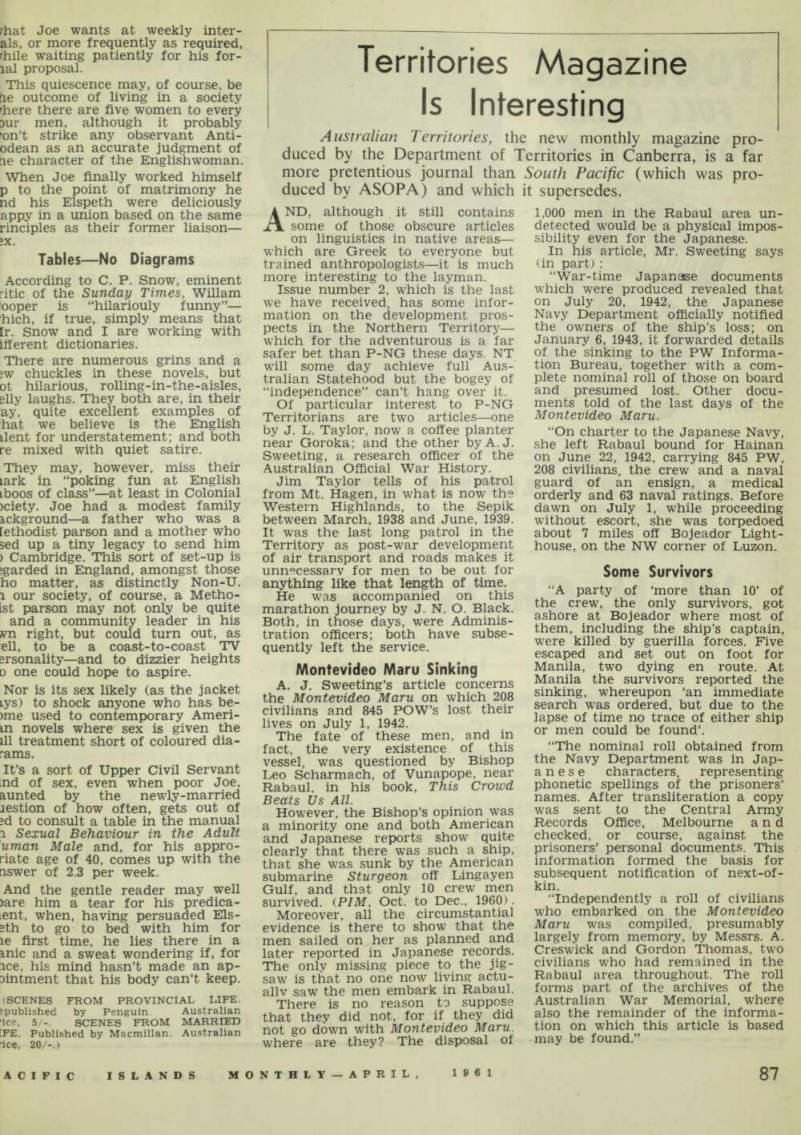
Territories Magazine Is Interesting
Australian Territories, the new monthly magazine pro duced by the Department of Territories in Canberra, is a far more pretentious journal than South Pacific (which was pro duced by ASOPA) and which it supersedes.
AND, although it still contains some of those obscure articles on linguistics in native areas— which are Greek to everyone but trained anthropologists—it is much more interesting to the layman.
Issue number 2, which is the last we have received, has some infor mation on the development pros pects in the Northern Territory— which for the adventurous is a far safer bet than P-NG these days. NT will some day achieve full Aus tralian Statehood but the bogey of “independence” can’t hang over it.
Of particular interest to P-NG Territorians are two articles—one by J. L. Taylor, now a coffee planter near Goroka; and the other byA.J.
Sweeting, a research officer of the Australian Official War History.
Jim Taylor tells of his patrol from Mt. Hagen, in what is now the Western Highlands, to the Sepik between March, 1938 and June, 1939.
It was the last long patrol in the Territory as post-war development of air transport and roads makes it unnecessary for men to be out for anything like that length of time.
He was accompanied on this marathon journey by J. N. O. Black.
Both, in those days, were Adminis tration officers; both have subse quently left the service.
Montevideo Maru Sinking
A. J. Sweeting’s article concerns the Montevideo Maru on which 208 civilians and 845 POW’s lost their lives on July 1, 1942.
The fate of these men, and in fact, the very existence of this vessel, was questioned by Bishop Leo Scharmach, of Vunapope, near Rabaul, in his book, This Crowd Bedts Us All.
However, the Bishop’s opinion was a minority one and both American and Japanese reports show quite clearly that there was such a ship, that she was sunk by the American submarine Sturgeon off Lingayen Gulf, and that only 10 crew men survived. ( PIM , Oct. to Dec., 1960).
Moreover, all the circumstantial evidence is there to show that the men sailed on her as planned and later reported in Japanese records.
The only missing piece to the jig saw is that no one now living actu ally saw the men embark in Rabaul.
There is no reason to suppose that they did not, for if they did not go down with Montevideo Maru. where are they? The disposal of
1,000 men in the Rabaul area un detected would be a physical impos sibility even for the Japanese.
In his article, Mr. Sweeting says (in part) : “War-time Japanose documents which were produced revealed that on July 20, 1942, the Japanese Navy Department officially notified the owners of the ship’s loss; on January 6, 1943, it forwarded details of the sinking to the PW Informa tion Bureau, together with a com plete nominal roll of those on board and presumed lost. Other docu ments told of the last days of the Montevideo Maru.
“On charter to the Japanese Navy, she left Rabaul bound for Hainan on June 22, 1942, carrying 845 PW, 208 civilians, the crew and a naval guard of an ensign, a medical orderly and 63 naval ratings. Before dawn on July 1, while proceeding without escort, she was torpedoed about 7 miles off Bojeador Light house, on the NW corner of Luzon.
Some Survivors
“A party of ‘more than 10’ of the crew, the only survivors, got ashore at Bojeador where most of them, including the ship’s captain, were killed by guerilla forces. Five escaped and set out on foot for Manila, two dying en route. At Manila the survivors reported the sinking, whereupon ‘an immediate search was ordered, but due to the lapse of time no trace of either ship or men could be found’.
“The nominal roll obtained from the Navy Department was in Jap anese characters, representing phonetic spellings of the prisoners’ names. After transliteration a copy was sent to the Central Army Records Office, Melbourne and checked, or course, against the prisoners’ personal documents. This information formed the basis for subsequent notification of next-of kin.
“Independently a roll of civilians who embarked on the Montevideo Maru was compiled, presumably largely from memory, by Messrs. A.
Creswick and Gordon Thomas, two civilians who had remained in the Rabaul area throughout. The roll forms part of the archives of the Australian War Memorial, where also the remainder of the informa tion on which this article is based may be found.”