The La Perouse Men
pp. 80-97 · Read in the full issue
Theory on a Fascinating Subject A Clue To The Fate Of The La Perouse Men
By C. Jack-Hinton
The fate of the vessel which the survivors of the La Perouse expedition constructed, and in which they set sail from Vanikoro as explained in R. A. Langdon’s excellent article, is a fascinating one.
D’URVILLE himself, after his visit to Vanikoro, in 1828, concluded that they would have directed their course towards New Ireland in an attempt to reach the Philip pines or Moluccas, following the known routes either of Carteret or Bougainville.
That they would have followed the route of Bougainville rather than Carteret seems likely in view of the prevailing winds and known coastlines.
As D’Urville wrote, “it was then the only route which offered any chance of success to a vessel as in secure and as ill-equipped as they would have been able to construct on Vanikoro, for one must assume that the French had been singularly weakened by fever and their con flicts with the natives”.
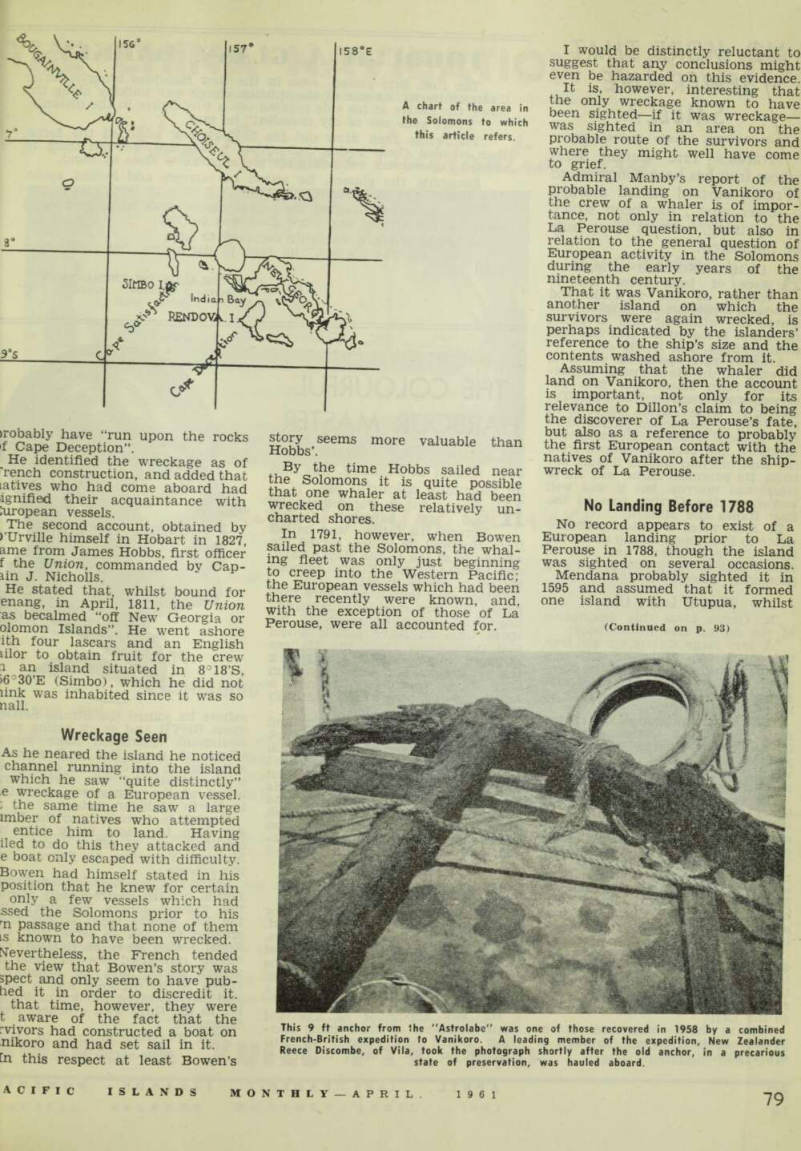
He added that he considered it most likely, if any traces were to be found at all, that they would be found on the west coast of the Solomons, “in the vicinity of the space known by the name Bay of Indians, between Capes Deception and Satisfaction”.
This was the part of the archi pelago of the Solomons which Shortland had discovered in August, 1788, the name “Indian Bay” having been given by him to the apparent bay between “Cape Deception” (Rendova land “Cape Satisfaction” (Simbo).
Only a Coincidence?
It may be nothing more than coincidence that the only references to wreckage being sighted during the years immediately following the departure of the survivors from Vanikoro, relate to this particular section of the archipelago men tioned by D’Urville.
Captain George Bowen stated in a deposition to the Justice of the Peace at Morlaix that, whilst sail ing from Port Jackson to Bombay in command of the Albemarle, in December, 1791, he saw “upon the coast of New Georgia” (by which he meant the whole archipelago of
the Solomons) “pieces of the wreck of a ship floating upon the water”
He had seen the wreckage “by the help of a great fire lighted upon the land near the middle of the night of the 30th December, 1791” and that, without this fire, he would
irobably have “run upon the rocks if Cape Deception”.
He identified the wreckage as of 'rench construction, and added that stives who had come aboard had ignified their acquaintance with luropean vessels.
The second account, obtained by rUrville himself in Hobart in 1827, ame from James Hobbs, first officer f the Union, commanded by Cap lin J. Nicholls.
He stated that whilst bound for enang, in April, 1811, the Union as becalmed “off New Georgia or olomon Islands”. He went ashore ith four lascars and an English lilor to obtain fruit for the crew i an island situated in 8 3 18’S, >6°3o’E (Simbo), which he did not link was inhabited since it was so nail.
Wreckage Seen
As he neared the island he noticed channel running into the island which he saw “quite distinctly” e wreckage of a European vessel. : the same time he saw a large imber of natives who attempted entice him to land. Having iled to do this they attacked and e boat only escaped with difficulty.
Bowen had himself stated in his position that he knew for certain only a few vessels which had ssed the Solomons prior to his r n passage and that none of them is known to have been wrecked.
Nevertheless, the French tended the view that Bowen’s story was spect and only seem to have pub ned it in order to discredit it. that time, however, they were t aware of the fact that the :vivors had constructed a boat on nikoro and had set sail in it. [n this respect at least Bowen’s
Story seems more valuable than Hobbs’. ®y the time Hobbs sailed near the Solomons it is quite possible that one whaler at least had been wrecked on these relatively un charted shores.
In 1791, however, when Bowen sailed past the Solomons, the whal ing fleet was only just beginning to creep into the Western Pacific; the European vessels which had been there recently were known, and, with the exception of those of La Perouse, were all accounted for.
I would be distinctly reluctant to suggest that any conclusions might even be hazarded on this evidence.
It is, however, interesting that the only wreckage known to have been sighted—if it was wreckage— was sighted in an area on the probable route of the survivors and where they might well have come to grief.
Admiral Manby’s report of the probable landing on Vanikoro of the crew of a whaler is of impor tance, not only in relation to the La Perouse question, but also in relation to the general question of European activity in the Solomons during the early years of the nineteenth century.
That it was Vanikoro, rather than another island on which the survivors were again wrecked, is perhaps indicated by the islanders’ reference to the ship’s size and the contents washed ashore from it.
Assuming that the whaler did land on Vanikoro, then the account is important, not only for its relevance to Dillon’s claim to being the discoverer of La Perouse’s fate, but also as a reference to probably the first European contact with the natives of Vanikoro after the ship wreck of La Perouse.
No Landing Before 1788 No record appears to exist of a European landing prior to La Perouse in 1788, though the island was sighted on several occasions.
Mendana probably sighted it in 1595 and assumed that it formed one island with Utupua, whilst
(Continued on p. 93)
A chart of the area in the Solomons to which this article refers.
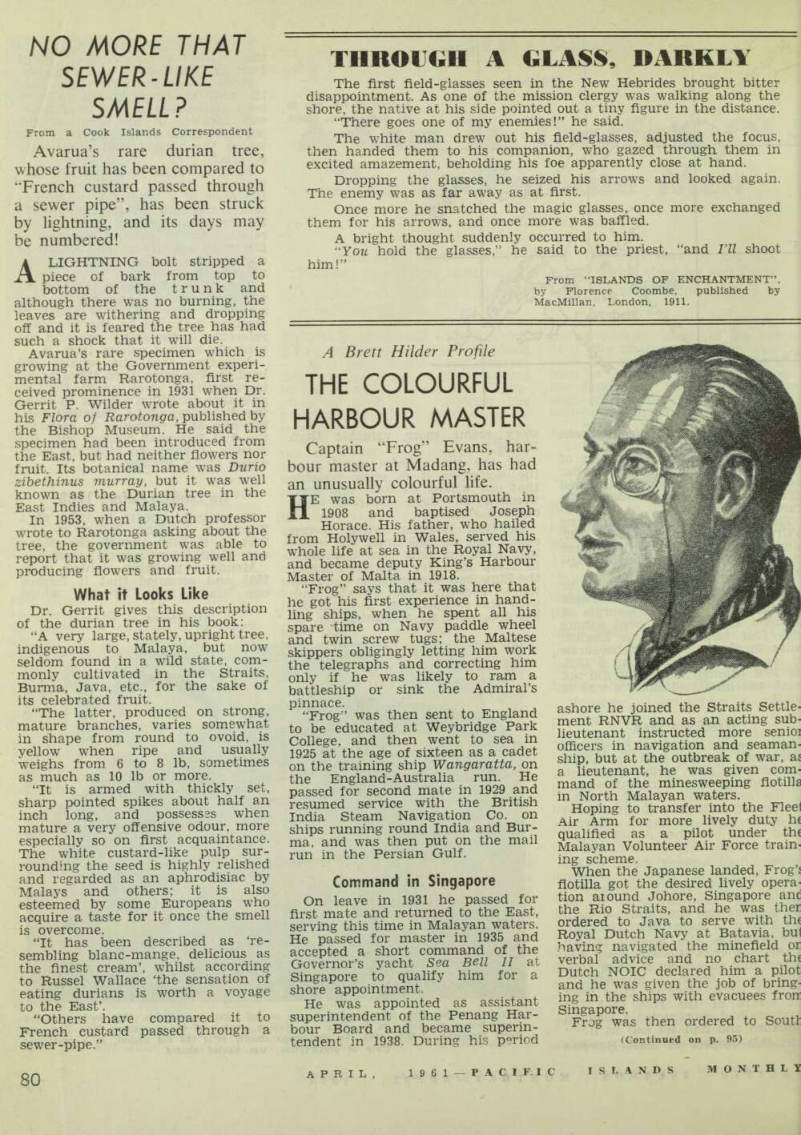
This 9 ft anchor from the "Astrolabe” was one of those recovered in 1958 by a combined French-British expedition to Vanikoro. A leading member of the expedition, New Zealander Reece Discombe, of Vila, took the photograph shortly after the old anchor, in a precarious state of preservation, was hauled aboard.
arteret certainly saw it in 1766 ad named it New Alderney or .
Following the shipwreck of La erouse in 1788 it was subsequently on by Captain Edwards in August, 91, when he named it Pitt’s land; by Captain Bond in 1792; i D’Entrecasteaux in 1793; by aptain Hogan in 1796; possibly \ Captain Simpson in 1801; by ’Urville in 1823 when sailing with aptain Duperrey in the Coquille, id by Dillon in 1826.
On none of these occasions was landing made, and it is possible at other vessels may similarly ive sighted the island, particularly lalers, which were considerably ore active in Solomons waters the early years of the nineteenth
century than is generally supposed, If the whaler referred to by Manby did visit Vanikoro, then, that it was the first vessel to visit Vanikoro after La Perouse, is probably indicated by the apparent absence of any other reports, Even allowing for the notorious failure of whaling skippers to pro vide reports of their activities and discoveries (other than some from New England who briefly published the results of their voyages in the Boston press), it is unlikely that any European would have landed at Vanikoro without noticing some trace of La Perouse, traces which were immediately apparent to Dillon and Manby’s whaler, In view of the considerable interest in the fate of La Perouse,
it is even more unlikely that he would have failed to publicise his discovery.
As Mr. Langdon has pointed out, the position of relative in significance into which Manby’s re port has been pushed, is due primarily to D’Urville’s irritation and his attempt to discredit its authenticity.
Nevertheless, the record of Manby’s report does exist, and ap pears to be the only record of a probable landing prior to Dillon in 1827.
Such considerations do not, how ever, exclude the possibility of a previous landing; particularly by a whaler, of which no record exists, though they would seem to exclude its probability.
From 1944 he was sea transport officer in Holland, Belgium and Germany, ending active Naval ser vice at Cuxhaven in January, 1946.
After this war service Frog re turned to Malaya, but found still no peace. Back in Penang he re organised the ferry service to the mainland, and as an auxiliary police officer he “jungle bashed” and saw action in various parts of Malaya, attached to the military forces for five exciting years. He was awarded the VRD, and the General Service Medal, Malaya, in 1949.
In 1951 he tried very hard to settle in Australia, but could find no suitable employment. He tried his hand at various shore occupa tions in turn, until in January, 1953, he was appointed manager of the
Papua and New Guinea Shipping Service.
He had the difficult job of re organising and then closing down this service the next year, and for the excellent job he made of it was awarded the MBE.
He was appointed harbour master at Port Moresby in 1955, and transferred soon afterwards to Madang, where he has been serving ever since, and again doing a very fine job. He is still a Lieutenant- Commander on the supplementary
Rnvr.
Since he has left Malaya he has written some amusing short stories of his adventures, some of which have been published in Blackwood’s
and other magazines.