Politician Need?
pp. 73-75 · Read in the full issue

What Does A Native
From our Canberra Correspondent Do Papuans need formal education to be politically effective?
r[REE Australian National Uni versity Research workers dif fered on this point at a forum irganised by the Canberra New Guinea Society on: “New Guinea— rast or Slow?”
The head of the Department of ’acific History, Professor Jim )avidson, told the forum it was prong to assume that an effective lolitician must have a high level of
formal education.
He was replying to one of the main speakers, Mr. A. H. Healy, a research scholar at the school who recently spent some months doing field work in P-NG.
Won't Justify Hopes
Professor Davidson challenged a claim by Mr. Healy that it was doubtful whether any of the mem bers of the Hanuabada Local Gov ernment Council who had stood for the Legislative Council would be “able to justify the hopes of those electing them”.
Mr. Healy said that none of the present Hanuabada councillors had any but elementary education.
He said that if education had been allowed to develop years ago throughout the Territory and the people given Local Government as soon as they were ready for it, they would now be in a better position to fend for themselves.
Professor Davidson said that if the Hanuabadans disappointed their electors it would be because the Government was not giving them a lead and because they had not had the opportunity of acquiring the sort of knowledge a politician needed.
Mr. Healy replied that the argu ment that Local Government councils were giving the people the sort of political training they needed did not hold water.
The Local Government councils were an Administration instru mentality.
Not Political
It was possible that the councils might give Papuans some training in the mechanics of administra tion, but they provided no oppor
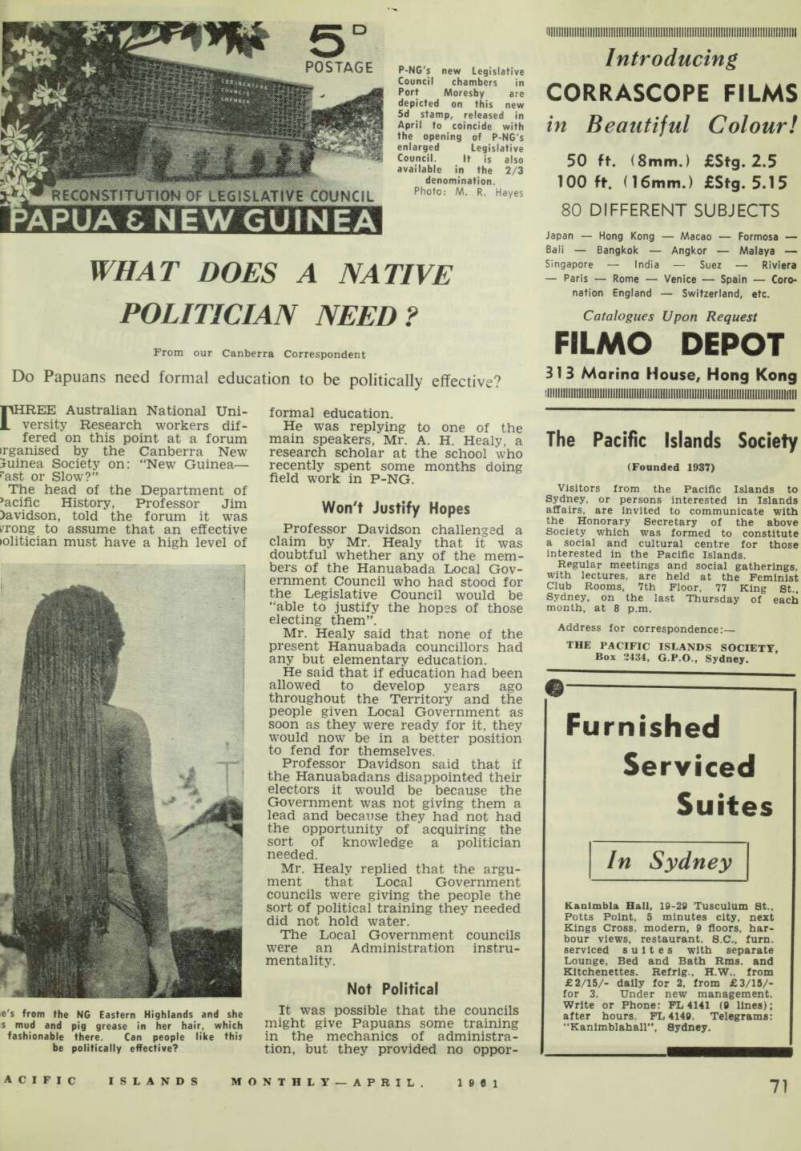
[?]e's from the NG Eastern Highlands and she [?]s mud and pig grease in her hair, which fashionable there. Can people like this be politically effective?
P-NG's new Legislative Council chambers in Port Moresby are depicted on this new 5d stamp, released in April to coincide with the opening of P-NG's enlarged Legislative Council. It is also available in the 2/3 denomination.
Photo: M. R. Hayes
tunity for Papuans to exercise political functions.
Although a politician might not need a high level of education he must have a certain amount if he ivas to profit from his other jxperiences.
The other main speaker, Dr. A. j. Epstein, an anthropologist and i former student of Professor Max >luckman, recently spent a year mong the Tolai people of the Jazelle Peninsula, possibly the most ophisticated and most prosperous eople in P-NG. He is returning d Rabaul in April.
He also criticised the Local Gov rnment Councils as a means of iving Papuans political experience The Councils, although useful, did ot cope with national or territorial roblems which transcended the irely village level, he said.
Conservatives
Members were drawn mainly from ie conservative elements of village ciety and no Tolai had emerged 10 had been able to command ly substantial following.
There were recent signs that new okesmen were emerging, and as tisions increased younger spokes m would appear. rhese would be no longer content work within a paternalistic imework of Government, and they uld be unimpressed by the Gov iment’s policy of “even develop ing’. rhey would not want to wait ile the backward areas of P-NG ight up with the Gazelle imsula.
The Main Points
)ther points made in the forum luded:—
’ Retiring Age: Mr. Healy
i that lack of co-operation be ien Administration services at the age level might be due to officers ) were “too old or too old moned” for co-ordinated effort, hese men had been brought up the pre-war tradition of direct -man administration, allure to adjust ideas and hods quickly could be strous. his lack of co-ordination was marked contrast to attitudes in British colonial service, where ages were much lower than
P-Ng.
POLICIES : Mr. Healy bitterly eked the even-development nes of Territories Minister I Hasluck as unreal.
Caste inevitably involves risks,”
said. “But does it involve ter risks than the policies at ent being followed?” istralian policies differed from e followed by Britain in post- Africa, but were similar to 3, of “one or two former ual powers”.
Mr. Healy did not develop this point specifically, but his other references made it clear that Belgium was one power he had in mind.
NS J ON u S: Dr - Epstein said tnat land shortage was already causing social tensions among the Tolai, especially with the develop ment of larger cocoa areas The activities of the “more enterprising or the more grasping” m competition for land threatened the unity of kinship groups of native society.
Since the population was likelv to double itself in a generation social tensions caused by land pressure would mount.
BSIP customs men are to go into uniform-one based on that worn by the British Navy in the tropics It consists of white shirt and shorts and peaked cap with distinguishing shoulder badges and buttons
Anti-Tb Campaign
In French Polynesia
IN Tahiti on a four months visit is Dr. Hillel Beham, sent by the World Health Organisation to re-organise and aid French Oceania’s programme against tuber culosis.
Ninety per cent, of the popula tion has come forward to take anti tubercular tests, and persons under 20 years of age—3o per cent, of the population have been vaccinated with BCG as an anti-tubercular measure.
Last year a total of 1,287 school children were vaccinated together with some 400 newly-born infants.
Anti-tubercular programmes con tinue in the outer islands the Marqueses, the Australs and the Tuamotus. It is hoped that by 1970, tuberculosis will be completely con trolled. For TB sufferers there is a modern programme of treatment and control together with free drugs and free medical consultations.