The Suva Shopkeepers
pp. 67-69 · Read in the full issue

Were Nervous
From a Suva Correspondent Nervous shop owners put up wooden shutters and con servative elements deplored the fact that permission had been given for a march of unemployed through Suva streets on March 7. But the march passed off quietly and the eye-brow raising was reserved for the lone European who occupied the front rank with Fiji trade union leaders.
PHE stranger was Dr. B. L.
Bernard, a visitor of a few weeks only to Fiji, and a self onfessed member of the British 'abian Society.
He also attended the meeting in be Century Theatre that preceded he march, when he advocated that omething constructive should be ut before the Government.
He was for freeing credit and a rogramme of works, such as build ig municipal baths, major roads, tc., to keep men employed.
The meeting, which had heard Ir. Mohammed Tora speak in Inglish and Fijian on the unem loyment situation for 40 minutes, heered Dr. Bernard loudly, and )st no time in appointing him to a eputation of unemployed and lembers of the Wholesale and Re lil Workers’ General Union, which lanned to wait on the Acting blonial Secretary, Mr. Eric Beving >n, and present him with a number f resolutions.
So Dr. Bernard became one of the )0 or 700 who joined the “unem- Joyed” march —although “unem loyed” was not quite correct as ir as the marchers were concerned, Dr many of them were in work. In ict, the Union delayed the march ntil after 5 p.m., so that members DUld join after knock-off time.
The few nervous shopkeepers who barricaded their shops no doubt feared a repetition of the events of December, 1959, when there were two days of rioting.
At the front, a steady 20 yards ahead of the marchers, was a police
car, just ahead of the front rank were a dozen or so sturdy police men, while large numbers of police patrolled the length of the march.
The Police Helped
Mr. Tor a, as union president, had earlier told the theatre meeting that the Commissioner of Police, Mr. R. H. T. Beaumont, had told him he would provide police “to help with the march”, in spite of Tora’s protests that the police were not necessary.
The police “helped” to such an extent that some onlookers reckoned that there were more police than unemployed.
Mr. Bevington met the deputa tion at the Government offices, heard their views (with Dr. Ber nard expounding freely on a num ber of plans to solve the problem), promised nothing—except to pass
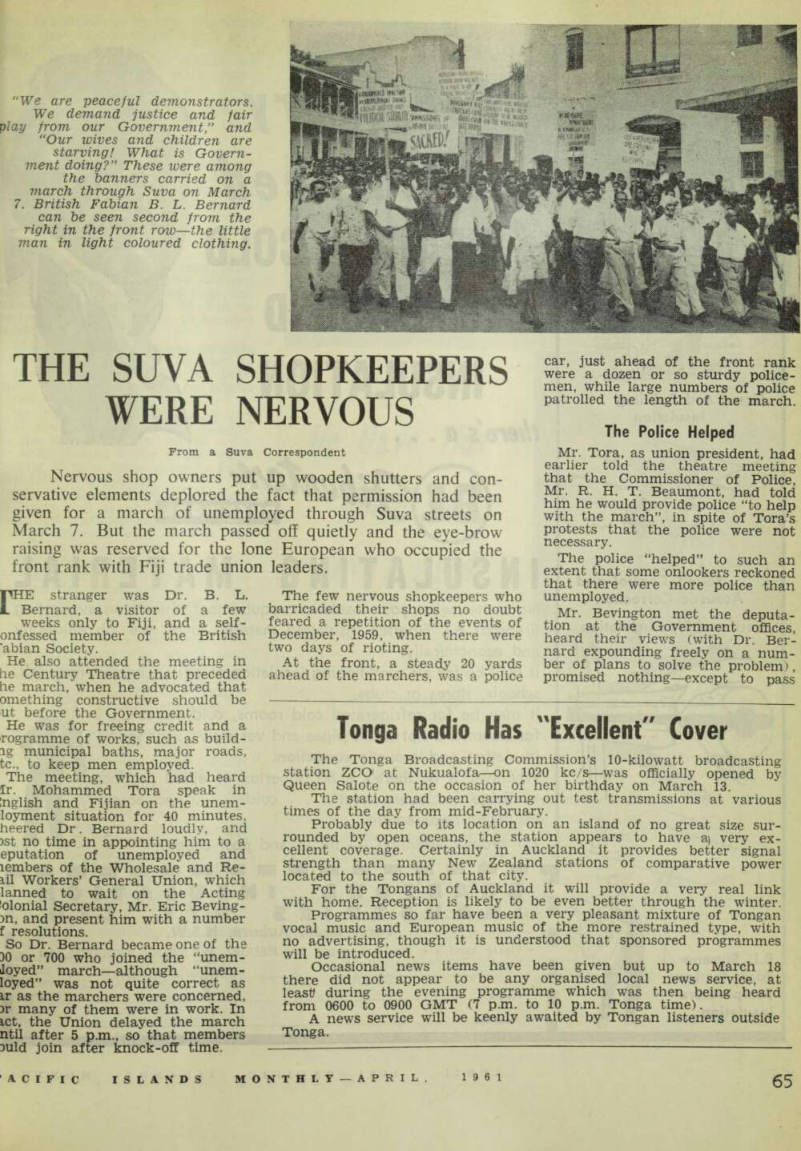
“We are peaceful demonstrators.
We demand justice and fair play from our Government” and “Our wives and children are starving! What is Govern ment doing?” These were among the banners carried on a march through Suva on March 7. British Fabian B. L. Bernard can be seen second from the right in the front row—the little man in light coloured clothing.
the resolution on to the Governor next day—and virtually had it eat ing out of his hand.
He then agreed to go outside the Government Buildings, where about 1,500 men had gathered, and make a short speech. He again repeated his promise to pass the resolutions on to the Governor who, at the time, was in Lautoka.
In fact, Mr. Bevington did an ex cellent piece of public relations work, something which is all too often lacking among departmental heads in Fiji in their dealings with the public.
Serious Problem
Although this march may have turned out to be a bit of a damp squib, there is no doubt that the unemployment problem in Fiji is serious. And it is likely to become worse.
With a stagnant economy, in spite of much lip service on the need to attract new capital, little has been done, and it is difficult to see bright times ahead.
Mr. Bevington told the delegation that Fiji was overdrawn in London to the extent of £2,000,000 in order :o keep current works going, while loping to raise more loans in Lon don later this year.
The UK has guaranteed £5,000,000 n loans and grants between now md 1964 for the continuation of he development work in Fiji, but t still won’t be enough.
The delegation suggested to Mr.
Bevington that Australia and New Zealand be asked to take unem ployed from Fiji for contract work, this suggestion is not likely to neet much favour from trade unionists in those two countries, )articularly Australia, where local inemployment is a much discussed übject—although few people seem o be without jobs. In New Zealand here is a chronic shortage of abour, both skilled and unskilled, nd a man seeking work can vir ually write his own ticket.
The delegation also asked for un mployment benefits of £2 a week or married men, and £1 for single aen—without suggesting where the aoney might come from.
A demand was also made for the eplacement of the Commissioner of iabour, Mr. John Amputch, with omeone who had a more “realistic nd sympathetic” approach to the jaemployment problems—a demand hat was perhaps unfair to Mr. Am tutch, who has devoted a lot of ime to the problem, admittedly nthout much success.
Where Mr. Amputch has merited nticism *s in his apparent reticence bout wb vt he has tried to do for he growing army of unemployed— ut that is probably only another xample cf poor public relations on ae part of his particular depart lent.