Milestone
pp. 59-61 · Read in the full issue

Report From
Tahiti
It Was An Aviation
Milestone
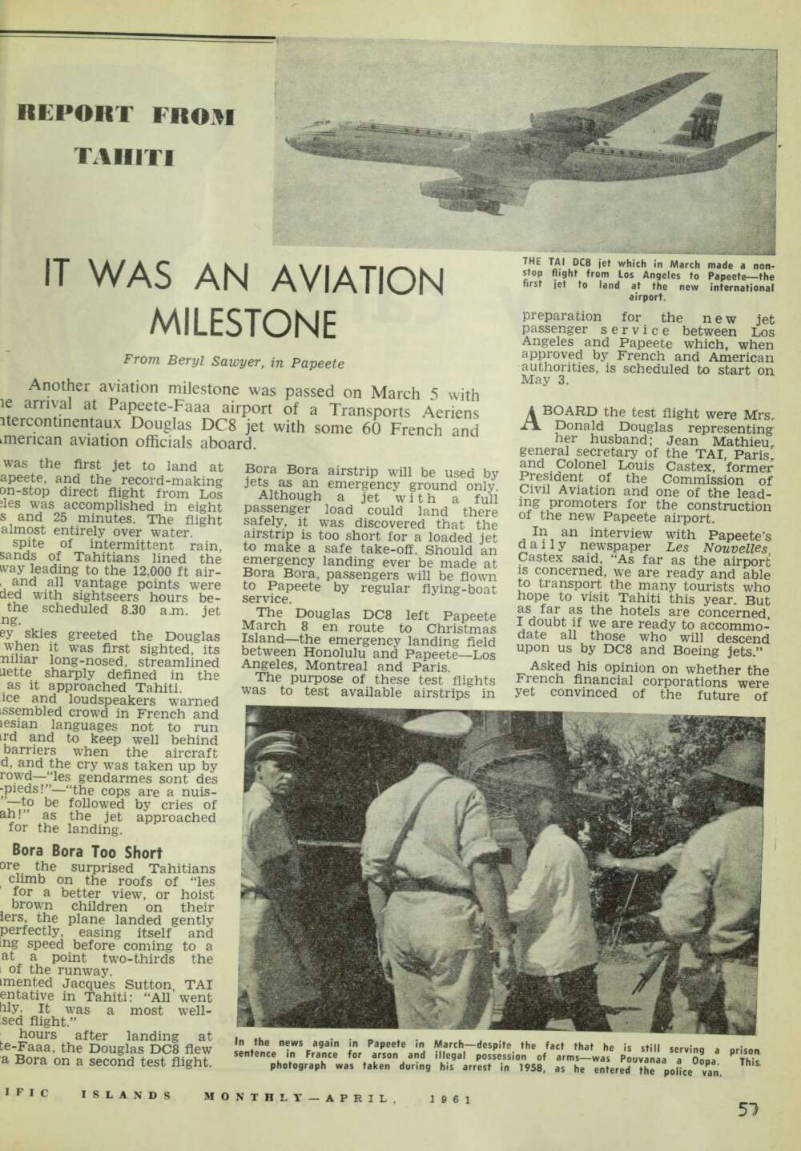
From Beryl Sawyer, in Papeete Another aviation milestone was passed on March 5 with ie arrival at Papeete-Faaa airport of a Transports Aeriens itercontmentaux Douglas DCS jet with some 60 French and American aviation officials aboard.
was the first jet to land at apeete, and the record-making on-stop direct flight from Los des was accomplished in eight s and 25 minutes. The flight almost entirely over water. spite of intermittent rain, sands of Tahitians lined the way leading to the 12,000 ft air > an d all vantage points were ded with sightseers hours be the scheduled 8.30 a.m. jet ng. ey skies greeted the Douglas when it was first sighted, its nihar long-nosed, streamlined nette sharply defined in the as it approached Tahiti, ice and loudspeakers warned ssembled crowd in French and lesian languages not to run ird and to keep well behind barriers when the aircraft d, and the cry was taken up by rowd —“les gendarmes sont des -pieds!”— “the cops are a nuis —-tp be followed by cries of ah!” as the jet approached for the landing.
Bora Bora Too Short ore the surprised Tahitians climb on the roofs of “les for a better view, or hoist brown children on their lers, the plane landed gently perfectly, easing itself and mg speed before coming to a at a point two-thirds the ■ of the runway, imented Jacques Sutton, TAI entative in Tahiti: “All went my. It was a most well sed flight.” hours after landing at te-Faaa, the Douglas DCS flew a Bora on a second test flight.
Bora Bora airstrip will be used by jets as an emergency ground only.
Although a jet with a full passenger load could land there safely, it was discovered that the airstrip is too short for a loaded jet to make a safe take-off. Should an emergency landing ever be made at Bora Bora, passengers will be flown to Papeete by regular flying-boat service.
The Douglas DCS left Papeete March 8 en route to Christmas Island—the emergency landing field between Honolulu and Papeete—Los Angeles, Montreal and Paris.
The purpose of these test flights was to test available airstrips in
preparation for the new jet passenger service between Los Angeles and Papeete which, when approved by French and American authorities, is scheduled to start on May 3.
Aboard the test flight were Mrs, Donald Douglas representing her husband; Jean Mathieu r general secretary of the TAI, Paris and Colonel Louis Castex, former President of the Commission of Civil Aviation and one of the lead ing promoters for the construction of the new Papeete airport.
In an interview with Papeete’s daily newspaper Les Nouvelies Castex said, “As far as the airport is concerned, we are ready and able to transport the many tourists who hope to visit Tahiti this year. But as far as the hotels are concerned I doubt if we are ready to accommo date all those who will descend upon us by DCS and Boeing jets.”
Asked his opinion on whether the French financial corporations were yet convinced of the future of
THE jet which in March made a non stop flight from Los Angeles to Papeete—the first jet to land at the new international airport.
In the news again in Papeete in March—despite the fact that he is still servina a sentence in France for arson and illegal possession of arms—was Pouvanaa a Oopa. This photograph was taken during his arrest in 1958, as he entered the police van.
hiti’s tourist industry, Colonel stex replied that they are still decided and were “failing to look sad”. The shock would come later en the regular jet flights would ng thousands of tourists each sk to Tahiti.
Lsked if a tourist industry for tiiti was desirable, Castex stated .t, in view of a recession in the
ra and phosphate industries,
rism was not only desirable, but the utmost importance to the ire of Tahiti.
Want French Investments [t is to be hoped that Tahiti will 'act major investment companies referably French,” he added rench Deputy Claude Roux ed that, in his opinion, tourism aid become the number one re •ce of the territory to offer more • to Tahitians. e announced the arrival in iti shortly of M. Landry, director lITO (Society for the Financing Developing of Tourism) who Id study the possibility of new ■1 construction in French Poly a.
MOTHER “first” for Tahiti was the arrival of two bright red helicopters, the first ever to be in the skies of Tahiti, icy were Sikorski HSR-3 planes i the United States cruiser iy Vale, on a mercy mission fly a sick crew member to Papeete ital for emergency surgery, ission accomplished, the heli er crews flew low around ;ete and the neighbouring dis s for a bird’s eye view of Tahiti.
D yet another “first” for Tahiti!
Hie first dance marathon— in d naturally a Tahitian ure” dance—was staged at the tian roadhouse “Lafayette”, m couples took part, ter two and a half hours of stop dancing to orchestra and ograph the judges were ex ted. But the dancers were not. wever, two couples who were i on their bare feet by centi > had to retire from the st. The winners—all 18 of —each received a welcome
; of iced champagne.
been election time once again Papeete, this time for a new esident of the Territorial As y. The results produced some s! a first vote, Pouvanaa a Oopa, ■ r leader of the Leftist party— -assemblent Democratiques des ations Tahitiennes (RDPT), s now serving the third year eight year gaol sentence for and the illegal possession of and forbidden to live in te until 1974, gained 17 votes. defunct Queen Pomare IV i nine votes, and Jacques a, outgoing President, one. a second vote, Pouvanaa a
TOters W who S a?s'n b J m , ne &rd h c°ount SO oSrto & XtoS by a majority vote for Councillor Franz Vamzette of the opposition Democratic Union (UTD) IT’S Ipqc pcrcrc nnH u lettuce for the average Tahitian family with dozSPand lettuce a T S 3M 12 francs (£l/10/-) a pound francs An average workman earns from 200-300 francsa dav R h P still buy 1 a pound d half of fresh tu y na a fo^40 nd fra a nc d s (4/“«1 string of eight red schnappers for 60 francs (6/-).
PAp'P'prp-pu hncm’foi u *l4.
APEETE s hospital, built as a military hospital in 1844 and used as a civilian hospital from 1854, is finally to go! Funds have been provided for a new one.
The present hospital consists of a surgical unit, a tuberculosis ward with 70 beds, general hospital wards with 280 beds and a newly constructed throat, ears and eyes ward with eight beds.
There are at present eight doctors and surgeons headed by the Chief of the Health Department, Dr. a^ d a , st aff, mainly Tahitians, of 85 male and female nurses and orderlies. Newly recruited staff members have a two-year training . an sxtra year of additional training before they can diplon ? as ’ mak mg them eligible to accept nursing
P osts a ‘ Papeete hospital, Taravao h ° SPital " Mamao DiSpenSar y- Not Larae Enouah „ 9 9 But the hospital is neither large enough or modern enough to take care of local patients and the needs of a growing population A i thou B? l the plans for a new “ odern hospital,, to be built at Mamao just outside Papeete, have seen5 een a PP r oved, it will be three or four years before th e hospital is “» d and read y receive P —T The new hospital will be a single' building with five storeys—the highest building yet planned in Tahiti. There will be emergency' wards, an out-patients department Pharmacy, X-ray centre and four large surgical wards on the top floors— served by an elevator, (This will be elevator number two f° r Papeete, for elevator number one is still doing veteran service at fhe old Grand Hotel in down-town Papeete).
The new hospital, which will be the central hospital for 111 of French Polynesia, will have 350 beds plus a private section for those able to pay Everyone hopes the new hosnital will attract top surgeons able to deal with delicate operations so as to eliminate the present ’ costly journey to Paris by patients needing complicated surgery. s