The Raft And The River
pp. 80-99 · Read in the full issue
Basil Hall Recalls Some of the Good Times in Fiji and Papua A raft and a river are a good combination when coming down hill—but they are not much good when you are going up hill.
WE had been going up hill for the previous ten days, crossing some tangled country as we followered the Wainimala River towards its source in Viti Levu, Fiji, In a day’s march we might only cover a dozen miles, because half of the miles were stood up on end.
We met spurs of 1,500 ft, followed by the sliding plunge leading down to the river again.
Thunder storms rock’n’rolled among those hills.
But at every village, school children stood grinning under flags, There was the baby welfare hut to inspect before we accepted the yaqona offered by the older men, who always had something to say about that river.
Dhmr lc P\/or\/+hinn KlVer IS tveryining Everything hinged upon the river, for it formed a highway down which the banana crop found its way to market, and the authorities were at pains to keep the channel clear.
Now the time had come when we proposed to use it also. The rafts required were waiting at Lutu, a tiny village on the western edge of the province of Tholo East.
A bush knife and a clump of bamboos are the only things necessary to make a raft.
When it is tied together with a
few fathoms of liana vine it will carry about half a ton. The ones we used were a trifle more elab orate, as well they might be since they set us back 10/- apiece.
They had a bow of sorts besides a midships section some five feet square, above a main deck that was constantly awash. The current sup plied the motive power, while a boy at either end kept the contrivance in mid-stream, The river was in spate, and in a matter of moments our flotilla was slipping along at a fair clip.
We gathered it green (or brown) and we took it often, With one of the party casting for Ika N’droka (of the perch family) with a Devon, and myself waiting for duck with the kind of gun that sheds its fore-end without notice, we Stormed along in a cloud of spray, or sometimes even poled placidly through some wider reach,
A RrnarlciHp
n uiuauiiuc Every now and then, the Devon would foul the bottom and throw our line-ahead formation into a dog’s breakfast of colliding rafts and yelling crew boys, As a brace of astonished duck took off in a climbing turn, my own shouts would sometimes send the
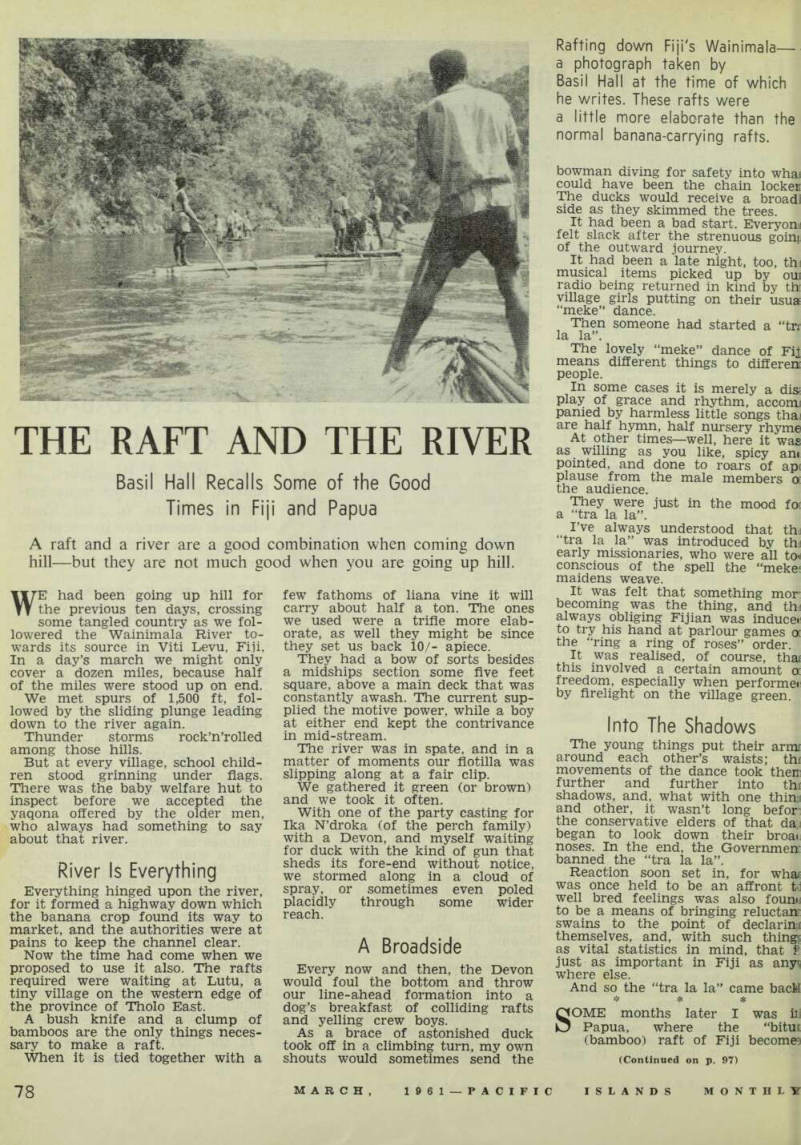
Rafting down Fiji's Wainimala—
a photograph taken by
Basil Hall at the time of which he writes. These rafts were
a little more elaborate than the
normal banana-carrying rafts.
bowman diving for safety into whai could have been the chain locker The ducks would receive a broad! side as they skimmed the trees.
It had been a bad start. Everyone felt slack after the strenuous goinij of the outward journey.
It had been a late night, too, thj musical items picked up by oui radio being returned in kind by thr village girls putting on their usua “meke” dance.
Then someone had started a “trr la la”.
The lovely “meke” dance of Fii means different things to differenr people.
In some cases it is merely a disc play of grace and rhythm, accomi panied by harmless little songs thaj are half hymn, half nursery rhyme At other times—well, here it was as willing as you like, spicy am pointed, and done to roars of ape plause from the male members oc the audience.
They were just in the mood foe a “tra la la”.
I’ve always understood that thj “tra la la” was introduced by thj early missionaries, who were all to* conscious of the spell the “mekee maidens weave.
It was felt that something mor becoming was the thing, and thj always obliging Fijian was induces to try his hand at parlour games oc the “ring a ring of roses” order.
It was realised, of course, that this involved a certain amount oc freedom, especially when performer by firelight on the village green.
Into The Shadows
The young things put their armr around each other’s waists; thr movements of the dance took them further and further into thr shadows, and, what with one thinu and other, it wasn’t long befon the conservative elders of that da,j began to look down their broaij noses. In the end, the Governmem banned the “tra la la”.
Reaction soon set in, for whae was once held to be an affront td well bred feelings was also founu to be a means of bringing reluctanr swains to the point of declaring themselves, and, with such things as vital statistics in mind, that ii just as important in Fiji as anyv where else.
And so the “tra la la” came bacM * * * SOME months later I was ill Papua, where the “bitut (bamboo) raft of Fiji becomes
(Continued on p. 97)
"baubau tupis” in the Motuan tongue.
Apart from that, the idea is just the oaxne. it was another patrol involving a walk oi miles or so north-east of Pori Moresby, towards the 12,000 ft peak of Mount Obree. There it was intended to strike the upper reaches of the Kemp Welsh River, down which rafts would return us to the coast.
The going was hard in some places. The pack ponies of Fiji would never have managed tracks requiring both hands and feet.
A walking stick was enough for me to carry, but those Koiari carriers—women as well as men— made nothing of their 40-lb loads and seemed delighted with the few sticks of tobacco or spoonful of salt, that was legal payment for a day’s work.
It happened to be the time of yam harvest, and the feasts and dancing that go with it put all thoughts of rafts entirely out of mind.
When the rafts did appear, they lacked the finish of those used in Fiji. But they were just as buoyant, and, without rapids to contend with, paddles took the place of poles.
The Kemp Welsh River was dif ferent as well.
It was hot and windless; silent and empty except for the screams of cockatoos.
On each raft there was someone armed. Each police boy had a Martini Henry rifle and three rounds of ammunition.
The two Europeans had Service .303’s, and any crocodile basking on a mud bank was certain of a fusilade.
It was nice to relax and leave it to a current flowing in the right d ; rection.
But that was about all the two patrols had in common.
What had been a picnic in Fiji was a job of work in Papua; a job made easier admittedly by a river road that always runs down hill.