Magazine Section
pp. 77-78 · Read in the full issue
Pacific Islands Monthly
Tahiti Was Never
Like This
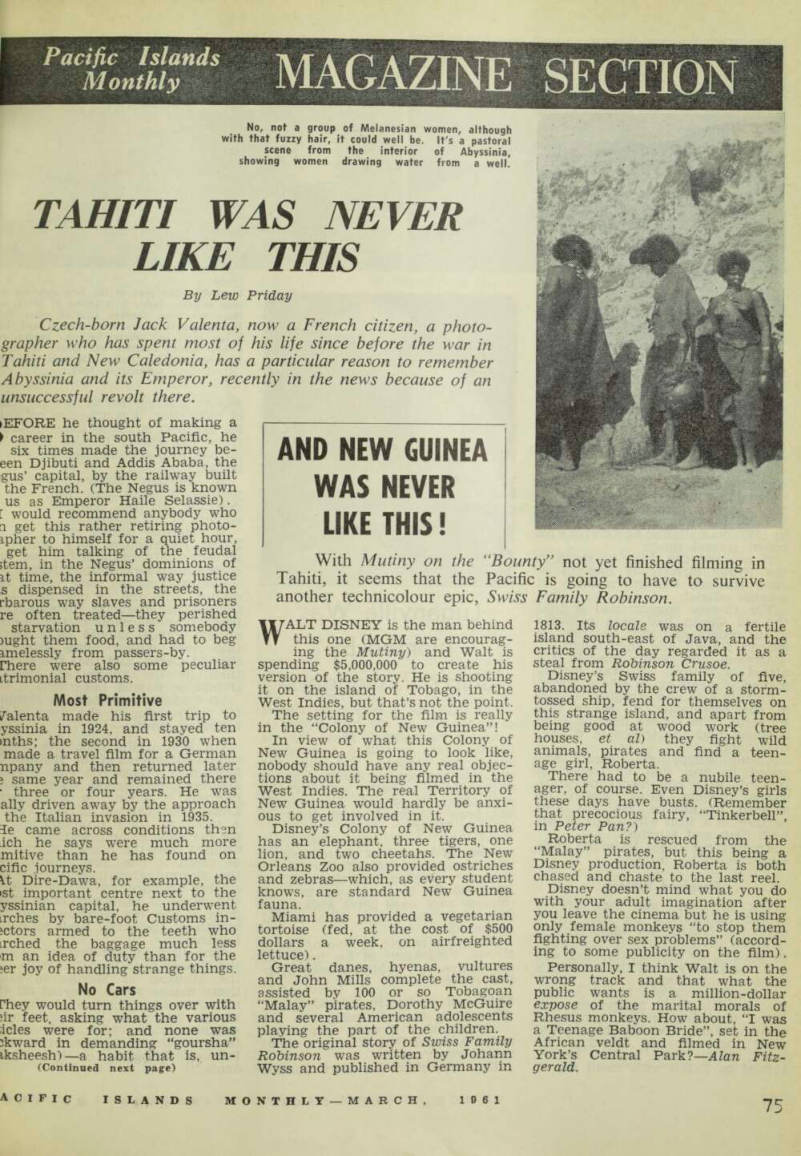
No, not a group of Melanesian women, although with that fuzzy hair, it could well be. It's a pastoral scene from the interior of Abyssinia, showing women drawing water from a well.
By Lew Friday
Czech-born Jack Valenta, now a French citizen, a photo grapher who has spent most of his life since before the war in Tahiti and New Caledonia, has a particular reason to remember Abyssinia and its Emperor, recently in the news because of an unsuccessful revolt there.
►EFORE he thought of making a ► career in the south Pacific, he six times made the journey be een Djibuti and Addis Ababa, the gus’ capital, by the railway built the French. (The Negus is known us as Emperor Haile Selassie). [ would recommend anybody who i get this rather retiring photo ipher to himself for a quiet hour, get him talking of the feudal item, in the Negus’ dominions of it time, the informal way justice s dispensed in the streets, the rbarous way slaves and prisoners re often treated—they perished starvation unless somebody night them food, and had to beg imelessly from passers-by. rhere were also some peculiar itrimonial customs.
Most Primitive i/alenta made his first trip to yssinia in 1924, and stayed ten »nths; the second in 1930 when made a travel film for a German npany and then returned later ; same year and remained there • three or four years. He was ally driven away by the approach the Italian invasion in 1935. le came across conditions then ich he says were much more mitive than he has found on cific journeys. \t Dire-Dawa, for example, the •st important centre next to the yssinian capital, he underwent trches by bare-foot Customs in ;ctors armed to the teeth who irched the baggage much less m an idea of duty than for the ‘er joy of handling strange things.
No Cars Phey would turn things over with ;ir feet, asking what the various ides were for; and none was Jkward in demanding “goursha” iksheesh)—a habit that is, un
(Continued next page)
fortunately, also prevalent in civil ised France.
There were no motor cars in 1924, and Europeans were expected to hire servants on the spot, and remove their baggage on mules and horses.
Currency was the Maria Theresa dollar.
Once, when I was engaged on a chrome mining venture in New Caledonia with Mr. Valenta, he told me that Ras Tafari, who was then Regent (he was crowned Emperor in 1930) had allowed him to take his photo several times.
It was not the thing to speak to the Negus directly—it had to be done through the intermediary of a court official.
The current rumour had it that the old Queen had been poisoned at his orders, and that was how he became Regent and then Negus.
Anyway, the Negus himself was afraid of poison, and was accom panied at meals by an official taster.
Valenta also photographed several of the ceremonies in which this Emperor, who claims descent from Solomon and the Queen of Sheba, took part.
Among occupations Valenta en gaged in was that of trader in leonard, otter and black-and-white goriza monkey skins, which he shipped to Europe. He was also partner in a firm which turned out both soap and sausages.
At different times he made trips into the wilder interior.
Despised Whites
The Ethopian was then always making difficulties for the white man and looking for opportunities to break any contract —he pretended to despise the white race, and was even then angry about the Emperor’s Western innovations.
Altogether my old friend prefers the Pacific. That preference also rules out his early homeland.
Czechoslovakia, which he visited after the war, but found it no longer to his taste, so that he re turned to Tahiti with small regret.