They're Taking The 'Bush'
pp. 67-69 · Read in the full issue
Out Of Flying!
From a Special Correspondent
Australia’s Department of Civil Aviation in February ook the first step to remove Papua-New Guinea aviation from he “bush” school of “flying-by-the-seat-of-your pants”.
IE department brought in new safety standards for the old Douglas DC3 workhorses in the ritory. They will now have to •y reduced payloads.
CA’s plan is to bring Territory ig into line with the aviation lirements of mainland Australia, fhat this is likely to mean to Territory is increased costs to et the reduced payloads, ivil Aviation Director-General, Don Anderson, warned in Feb ry that the Territory could not e added aviation safety “on the ap”. He challenged P-NG air s to try and absorb the cost by e efficient operations, the airlines can’t do this, Terri people, particularly those in more remote areas, will, of rse, have to foot the bill.
Doesn't Always Know r lth this fact in mind, there are of people in the Territory who going to argue that DCA doesn’t lys know what is best for avia anyhow, and that passengers not really going to get any
benefit from the new regulations.
Nevertheless, many of them are going to have to admit, too, that aircraft in the Territory since the war have been carrying out a
special kind of flying not seen on the mainland, and that it was in evitable that the hand of progress would catch up with them.
Just how safe things have been, or how much safer they will be, is probably a moot point that nobody is going to be able to prove one way or another.
All we know is that, despite the far greater risks which DCA says have existed in the Territory, there have been very few accidents.
And, of course, it was the Depart ment of Civil Aviation which agreed to special P-NG techniques in the first place.
A Different Country
When aviation was reorganised in P-NG just after the war, the then Regional Director of Civil Aviation, small, active John Arthur, agreed that progress would be held back if his department insisted on standards required elsewhere.
P-NG was a different kind of country, and many of the ex wartime men who were flying in it knew this very well, and knew what their aircraft were capable of in that kind of country, despite what the text books might say.
The department allowed the all important DC3’s to carry signifi cantly higher weights than they would be permitted in Australia.
With few roads, it was impera tive that aircraft get into many areas that had no other form of transport. And ideal, textbook air-
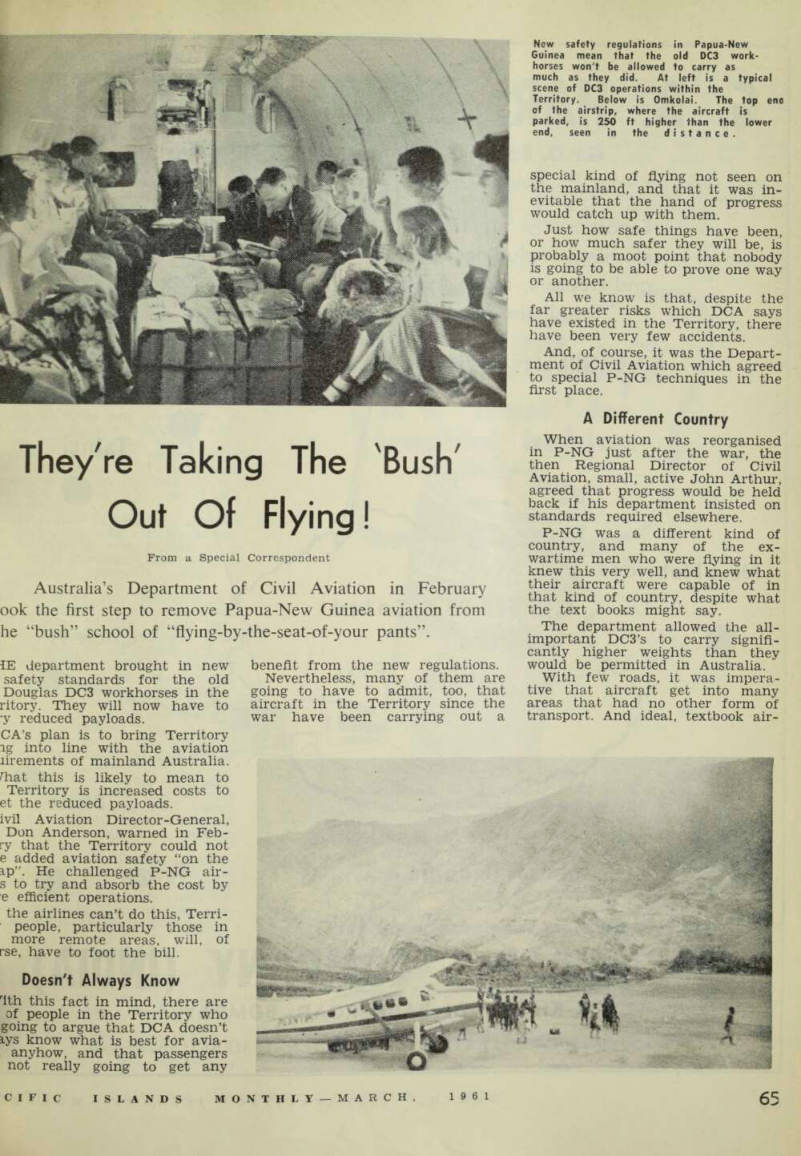
New safety regulations in Papua-New Guinea mean that the old DC3 work horses won't be allowed to carry as much as they did. At left is a typical scene of DC3 operations within the Territory. Below is Omkolai. The top ena of the airstrip, where the aircraft is parked, is 250 ft higher than the lower end, seen in the distance.
rips could not always be built be ■use of the type of country into tiich the aircraft were flying.
Some airstrips, in fact, had almost do-or-die approach. They were lilt on mountain tops and bill ies, so that brakes would have to applied immediately on landing prevent the aircraft from rolling ,ck down hill.
Hold on to Your Seats!
Among the more tricky, better lown airstrips are Wau, with a 11 of 200 ft in a length of 2,620 (an eight per cent, slope); and nkolai, with a fall of 250 ft in !00 ft—a slope of 13.4 per cent. > add to the fun one side of Om lai is a sheer drop of 1,500 ft into ravine.
Tapini, 2,150 ft long, has a seven r cent slope, with a hump at one d to make it even harder. It is ilt on a mountain side, with a ir-raising approach along a Hey.
Df the three, only Wau is a DC3 ip, but it never appears to worry :al pilots. Visiting pilots have netimes come to grief—the latest ing a team in an RAAF DC3. A liting Bristol freighter also bit 5 dust there on one famous occa n during a demonstration flight.
For a long time now the depart ing has been recognising that the rritory is passing from the de opmental era. It has tightened here and there as opportunity rhe real chance came when Aus trian airlines moved into the area t year and Papua-New Guinea :ame, in effect, an extension of stralia’s domestic civil aviation twork. fhe two main Territory opera 's, Trans Australia Airlines and mdated Airlines (now owned by isett-ANA), have been given air e licences in place of their pre us special charter licences.
Boots-and-AII
Vith a boots-and-all competition passengers and freight now de oping in the Territory, this has med the ideal time to really mp down. (Tie airlines hope to make such tnes as Lae, Madang and Goroka well known to the sun-seeking
Australian tourist as Cairns and Townsville.
One benefit for passengers from this switch from charter to licence services is financial security. In the event of accident, Territory airline passengers will now be able to re cover the same damages as passen gers in Australia. For a man with dependents, this could be worth £7,500.
DC A, behind the scenes, has been expecting some kind of reaction to its tighter requirements to come from Territory operators.
Huge Transport Plane
For New Guinea
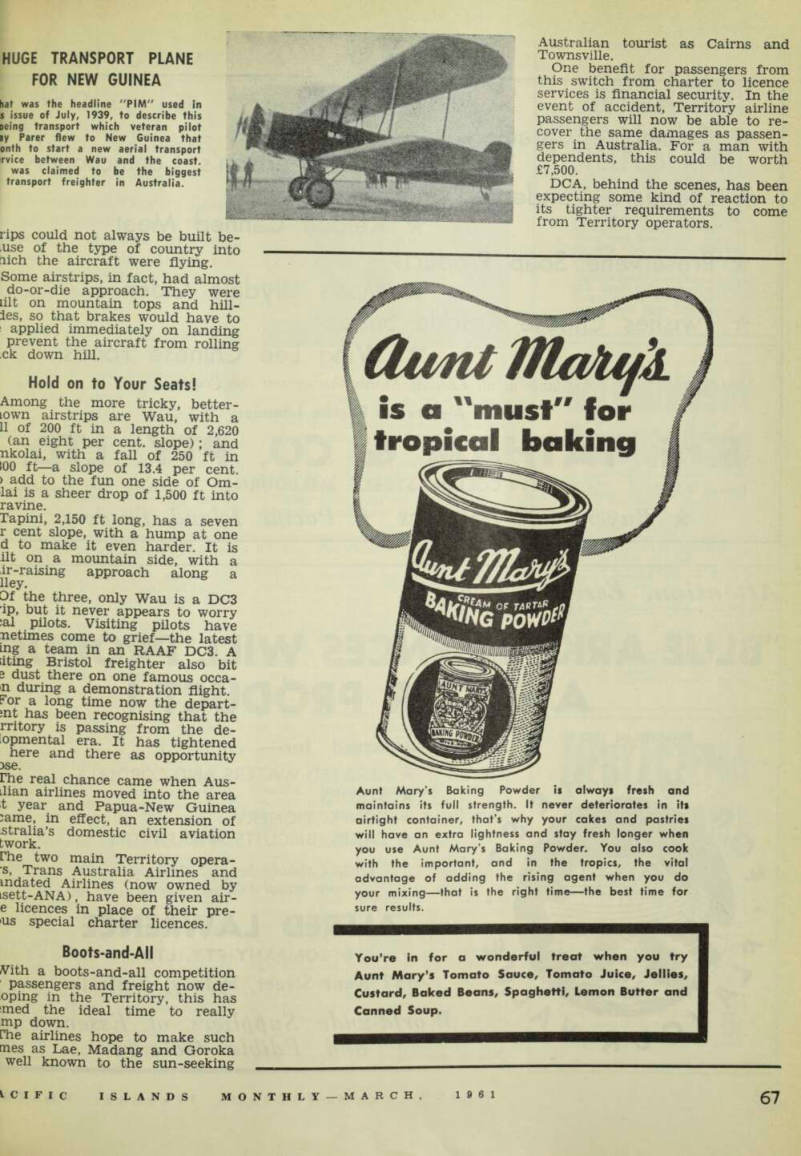
That was the headline "PIM" used in [?]s issue of July, 1939, to describe this [?]eing transport which veteran pilot [?]y Parer flew to New Guinea that [?]onth to start a new aerial transport [?]rvice between Wau and the coast. was claimed to be the biggest transport freighter in Australia.