Fiji's Sugar Industry Under A
pp. 29-147 · Read in the full issue
Trustram Eve Microscope
From a Staff Writer in Suva Fiji, facing the problems of over-population and a mal adjusted economy, has endured many official inquiries.
Nowadays, at the suggestion of another “commission”, the average resident is inclined to roll his eyes and scream.
r[EY keep on coming, and they do nothing,” he says, gazing in frustration upon the now dere ct Burns Report.
But this new sugar inquiry is a ;tle different. Within hours of its >ening at Lautoka, on March 1, had the issues lined up, the in rested parties on their toes, id the Gujeratis looking very oughtful.
This is due mainly to the breezy ertness and competence of the airman, Sir Malcolm Trustram r e, a 70-years-old, distinguished leen’s Counsel, from London. He es not miss a pass.
Phat large section of Indians who e tired of being led around by e nose by regulations-bound npany men, unscrupulous politici s, and calculating traders are iking at him with great respect, d growing hope. rhis inquiry, ordered at the end the year by the Colonial Office, the urgent request of the Gov lor, is trying to sort out the momics of the Fiji sugar industry.
Disputes between the CSR and the
janised cane-growers paralysed 1'
i industry in 1960, so that only •tion of that year’s magnificent le crop was cut, and the crush season was reduced from seven about 3i months, to the great comfort of all classes. ’he CSR wanted to reduce the 3e it paid for cane, on the ground t the price was uneconomic in ition to the world market; while growers insisted that the com fy was well equipped to pay a i higher rate. ach side pleaded inability to *7 on. The argument deadlocked industry. inally, to start the industrial iels moving, the CSR offered to the 1959 rates. A section of the vers accepted—a large section ised. The cane-growers’ ranks t. The mills reopened, but dy, one by one, in the September od; but finally the recalcitrants J Al ? atel group) surrendered— of mighty trouble “next tie Government ordered the in y, to ascertain the basic facts he industry, so it could dispense ihanded justice—if need be, i force. 1 parties have co-operated, by gmg all available data—much t confidential —to the Co m non. Especially the CSR. The
attitude of the latter suggests it has nothing to fear.
Backbone of CSR Finance
The Indian cane-growers have charged the CSR with grabbing far too large a proportion of the profits of the industry, by one pretext and another. The CSR has retorted by publishing its Fiji profits year by year—
which is something the people of Fiji had not previously seen. The profit from milling, once half a million, is moving towards vanish ing point.
The canegrowers said that the re turn demanded by the company on
its investment was fantastic, be cause the assets had been heavily written up. The company replied by disclosing its Fiji assets and show ing the actual writing-up of the assets in 1957 (as the result of in dependent valuations made by ex perts) —namely—
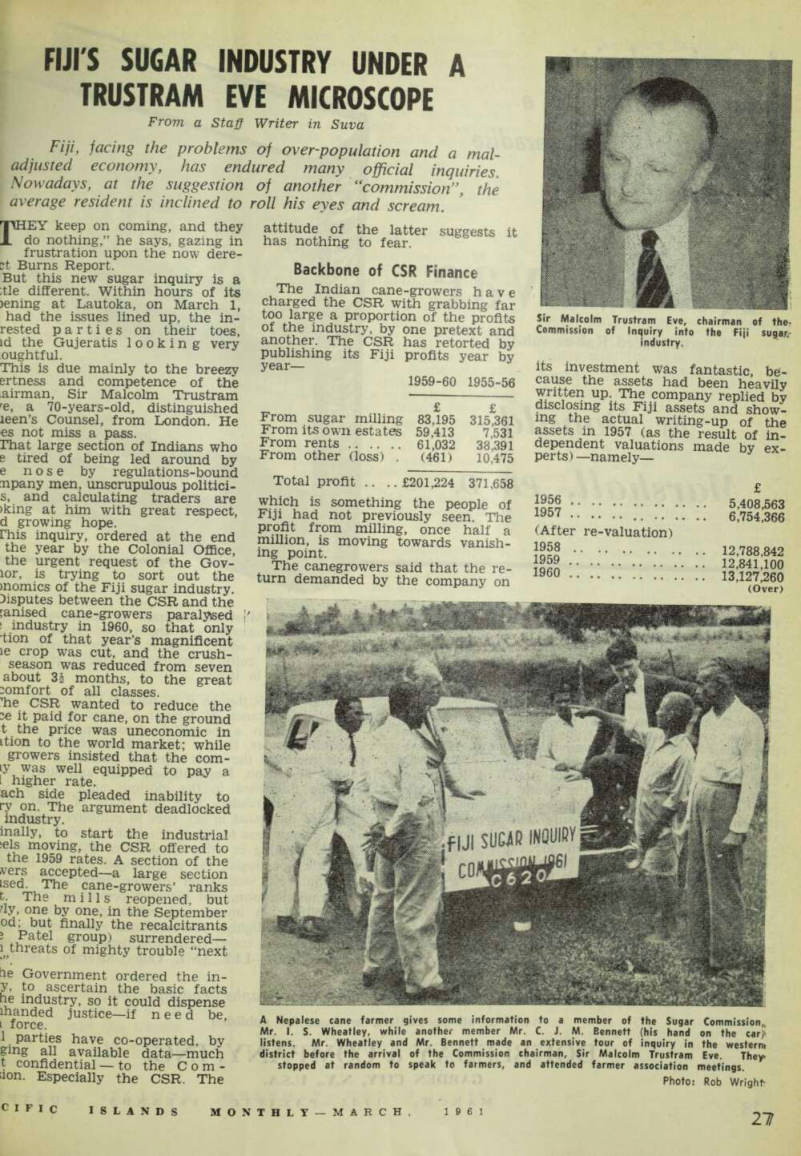
A Nepalese cane farmer gives some information to a member of the Sugar Commission, Mr. I. S. Wheatley, while another member Mr. C. J. M. Bennett (his hand on the car) listens. Mr. Wheatley and Mr. Bennett made an extensive tour of inquiry in the western district before the arrival of the Commission chairman, Sir Malcolm Trustram Eve. They stopped at random to speak to farmers, and attended farmer association meetings.
Photo: Rob Wright
Sir Malcolm Trustram Eve, chairman of the Commission of Inquiry into the Fiji sugar industry.
1959-60 1955-56 £ £ From sugar milling 83,195 315.361 From its own estates 59,413 7 531 From rents 61,032 38*391 From other (loss) . (461) 10,475 Total profit .. ..£201,224 371.658
£ }?fS 5,408,563 1957 6,754,366 (After re-valuation) 12,788,842 12,841,100 1960 13,127,260 (Over)
There could be no answer to the jrinciple involved here. It is already oo well known that corporations irhich do not re-value their assets o keep pace with inflation, sooner t later inevitably fall into the jaws f the modern take-over monsters.
I
The Share of the Farmer
Then the CSR carried the war ito the sugar-farmers’ camp. They ave produced a lot of figures and rguments, with a view to showing lat the average Fiji-Indian cane rower, so far from being a down •odden serf, actually is a gentle tan in comfortable circumstances— regular fixed income (from his me at the mills’ guaranteed price), well-built house, a car and often tractor, and at least a proportion ' his children at secondary schools ■ at NZ or Australian universities.
“And why shouldn’t they?” fiercely ;mand the argumentative Indian wyers (all lawyers delight in argu ent; and each group of cane owers before the inquiry seems to ive a quota of Indian legal men).
The grave and earnest officials in e CSR corner (why do CSR man ors in Fiji so rarely smile?) reply at the price paid by the miller r cane is the chief factor in the st of producing a ton of sugar; id the price which sugar can com and in world markets is deter ined by the price accepted by untries with the lowest produc m cost.
If the CSR in Fiji is to be com lled to pay for cane at rates cal lated to maintain the cane-farmer the style to which he has be me accustomed, then (says the >R) the company cannot derive )m the sale of Fiji sugar the pro to which it claims it is entitled.
Charging fiercely into the middle these arguments come the repre
sentatives of the canegrowers in Mr. Patel’s group (rather extreme) Mr. Bayly’s group (moderate), Mr’
Lakshman’s group (mostly mill workers) and the Fijian growers’ group (somewhat aloof and disil lusioned) ; and with ingenuity and figures, and data, from overseas brought in by experts whom they have engaged, they are attacking the CSR, hip and thigh.
That write-up of £6m. to £7m in the company’s working capital is a subject of much argument.
Dominating Figure
The outstanding figure, in all this clash of arms and wits, un doubtedly is Sir Malcolm Trustram Eve. His memory is as merciless as his logic, and his sense of humour never departs.
Indian advocates are very partial to generalities—they like to intro duce sweeping assertions and then, before they can be challenged, ride them to a triumphant conclusion.
But such tactics avail them nothing with this skilled English lawyer.
“But just a moment, Mr. Soandso,” he mildly interposes. “What is your evidence of that? The official statistics do not support you—look at page Umpteen”—and the 70years-old memory rarely fails, and the experienced old eye twinkles as the unhappy advocate, bereft of his premises, struggles to regain his argument.
It is not a dull inquiry—on the contrary, it is a delight for those onlookers who know the history and background of the sugar industry in Fiji.
Some of the sidelights are most interesting.
Money-Lending Sharks
For example, the CSR produced a series of statements and figures to show how a horde of unscrupulous Indian moneylenders, sharp traders and cunning solicitors prey upon the cane-growers.
The CSR declares that, while a substantial proportion of the growers are comfortably independent, an equally large proportion are habitu ally in debt—first, because they try to acquire farms without enough capital, and then through bad man agement.
To mortgage future expectations is a characteristic of very many folk in Fiji, Indian and otherwise.
The financing of dependable primary producers is a function of the average bank, and their legit imate charge is 6 or 7 per cent, per annum. But banks are wary about very many Indian growers—the im provident kind, who are a risk any where. , , So the banks lay off the hard cases, and then the whole tribe of money-lending sharks step in; and they use all kinds of cunning in evading the law, which says that no more than 12 per cent, per annum
(Continued on p. 145)
y be charged for “accommoda i”. ’he CSR says that, by sheer :kery, many Indian farmers are ipelled to pay as much as £5 per 0 per month in interest, and it e details of how excessive debts interest are added to the in jst-bearing principal, until the etched farmer is tied up beyond r hope of recovery. ’he company argues that this d of enslavement of farmers by neylenders places a perceptible [ embarrassing and unnecessary den upon the industry, he Commission may, or may not ept the company’s arguments; it certainly showed a lively in ;st in learning how one section the industry is financed. This is new thing, of course—the Burns »ort dealt with it at length, and 1 acid comment.
'. is very likely that the sugar liry will give the Colony exactly it the Colony needs —a skilful convincing analysis of the lomics of the sugar industry, he aim of the Government aably will be attained—namely, expert summary will be of such haracter that it will be impos -3 in future for either side of this 1 industry to again hold up pro tion for months, while each ises the other of practices based ?reed, cunning and political am m. nd then, what? Shall we then e peace in the sugar industry? r e shall see. Much depends upon the temper and the motives of men, from both sides, who dead ed the industry during most of ' and (b) the ability of the Fiji eminent to keep control over Colony’s major industry, so that vidualistic liberty shall not be e subversive licence.