Telephone Call
p. 24 · Read in the full issue
Mountbatten's Visit
Story Of A Suva Telephone Call
By a Staff Writer
It was late in the evening of
Thursday, March 2. A telephone
rang in the residence of a well known Suva man. 1 I AM not going to say which tele phone—but you will find the number among the first dozen names listed in the Suva telephone book.
The caller asked for Mrs. Blank.
Presently, Mrs. Blank responded.
“This is Mountbatten speaking,” said a quiet, cultured English voice.
“Do you remember me?”
The lady gasped. “Yes, yes, of course, I do. But I cannot imagine how you remembered me.”
The caller laughed—that engaging chuckle that is characteristic of the famous British leader and his even more famous nephew.
Three Decades Ago
He told Mrs. Blank that, although more than three decades had passed since he visited Fiji as a young aide, with the then Prince of Wales (re member young Edward’s tour just after World War I?) he had never forgotten his charming dance partner at a Suva Government House ball.
Naturally, the lady was flattered.
Perhaps the setting had some thing to do with it. That evening (March 2) a gorgeous full moon lent enchantment to the view over Suva from Government House hill.
Perhaps it was the dinner. A number of distinguished officials met Admiral of the Fleet Earl Louis Mountbatten at the Governor’s hos pitable board, and the distinguished visitor was in the mood to exchange airy badinage with old comrades of the Services. They say that that famous leg-puller, Ratu Edward Cakobau, had his own leg well pulled.
Whatever the cause, Mountbatten’s kindly action, based on a pleasant memory of Suva of many years ago, will never be forgotten in one Suva household.
Most Informal
The official who controlled Mount batten’s visit to Suva embarrassed the Governor. Many Suva groups— especially Services groups would have liked to meet the famous man who has so deeply influenced the Royal Family and the post-war Em pire. But the ukase went forth: “His Lordship will see such-and-such groups between 6.15 and 6.30”—0r some such time.
The groups met him briefly, 2 scheduled. But his Lordship swej protocol aside. He spotted a knot c ex-servicemen, with medals up, an in one minute he was among then and among them he stayed, e? changing reminiscences of wars i many theatres, while his wretche aides panted impotently in tb background.
It was the same at Nausori aii field next morning, when the bi limousine swept in to let his Lore ship catch a chartered Heron fc Nadi. His Lordship was supposed t step out and walk through a line c perspiring officials, to the aircraft; Not Mountbatten. He got out th wrong side of the car, and strod over to a be-ribboned group of e» servicemen, led by Maurice Scot: daredevil flier of World War I.
They met last somewhere east c Baghdad, when war conditions de finitely were sticky; and both re membered the occasion.
He kept the plane waiting whil he heard one of Mr. Scott’s les risque stories, and told one of hi own, and while he learned th origin of most of the more notabl of the ribbon shown by those men Mountbatten’s visit to this sma capital was very much a privat! occasion, and he dealt with British Commonwealth defence matters, a : they affected Fiji, in about te:; minutes.
But the occasion will not soon ft forgotten by some servicemen—am by one much-envied matron of Suva
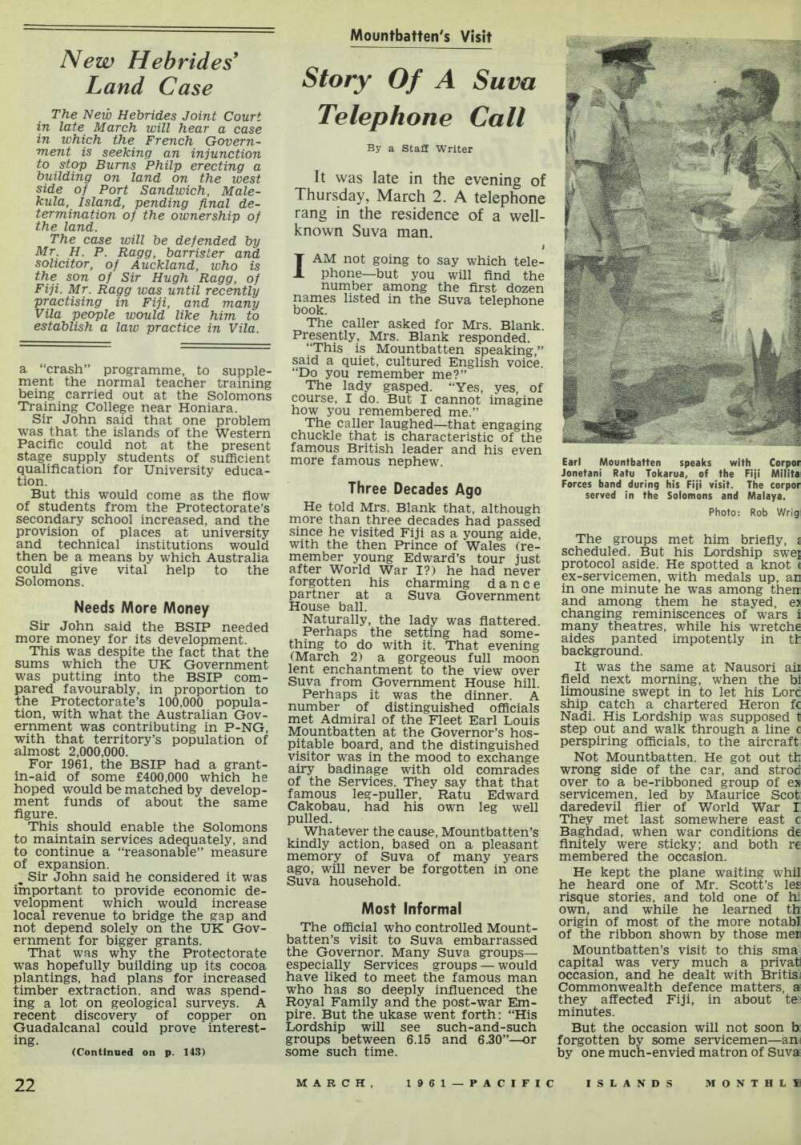
Earl Mountbatten speaks with Corpon Jonetani Ratu Tokarua, of the Fiji Milita[?] Forces band during his Fiji visit. The corpon served in the Solomons and Malaya.
Photo: Rob Wright