Solomons "Is Together"
pp. 23-145 · Read in the full issue
Sir John Gutch Looks Back—and Ahead
Future Of New Guinea And Solomons "Is Together"
By a Staff Reporter
Native-dominated governments of Papua-New Guinea and the British Solomons may one day choose to bring their terri tories together in some kind of association, and it would be a good idea if their present administrations keep the possibility of such a development in mind.
THIS is the view of Sir John Gutch, retiring High Com missioner for the Western icific, who says he personally »uld like to see some kind of as flation, although, he stresses, the ;imate decision would eventually a matter for the people them ves.
Sir John Gutch was speaking in dney in February, en route to ndon on retirement after spend- I his last five years in the Colonial rvice as WPHC.
He and Lady Gutch spent three eks in Australia visiting friends, d later went on to New Zealand ' a holiday tour, from where they II board a ship home via the nama.
Can't Predict Targets Sir John said he was unable to edict any target dates for the lergence of native-dominated gov iments in the islands.
He said he was unable to predict iat form of association the terri *ies might decide on, if they de led in favour of one at all; whether would, for instance, be as strong a federation.
But personally he believed that e territories had common problems, d interests, and that their stinies would be together one day.
Developments in New Guinea were und to have an impact on the itish Solomons.
Tf the type of co-operation which at present being undertaken by NG and the BSIP were continued d extended, the Melanesian people the two territories would become aware of one another, d thus some type of association uld emerge fairly naturally,” said r John. ‘Australians for this reason should very interested in the kind of -operation which is already going . That northern island chain is ry important to Australia.
“Because of Australia’s position id influence in the South Pacific, e must clearly play a leading part shaping the future of the Mel lesian people.
“The Australian people ought to be more aware of possible future de velopments than they are. I would like to see them more conscious of the Solomons and what it is doing, and what it can do.”
Australia Can Help
Sir John said there was already an increase of administrative co operation between islands of the Western Pacific High Commission and Australia in various fields, in cluding that of education, which was very important.
Australia could probably help more in the sphere of education in the Western Pacific than in any thing, and had already expressed her readiness to give help under arrangements arising out of the Commonwealth Education Confer ence of 1959.
At present a man each from the
J New Hebrides and the BSIP were at Australian secondary schools under scholarships provided by the Commonwealth Government.
Some technical students from the Solomons were also at present undergoing technical training at Malaguna, Rabaul (the Protectorate paying for them).
Arrangements were in train for Australia to supply an instructor for some months to give teacher train ing to local teachers in the Solomons.
This was something in the nature of
Sir John and Lady Gutch, aboard the Matson liner "Monterey" in Sydney in February shortly before they sailed for New Zealand.
They made a brief NZ tour before going on to London.
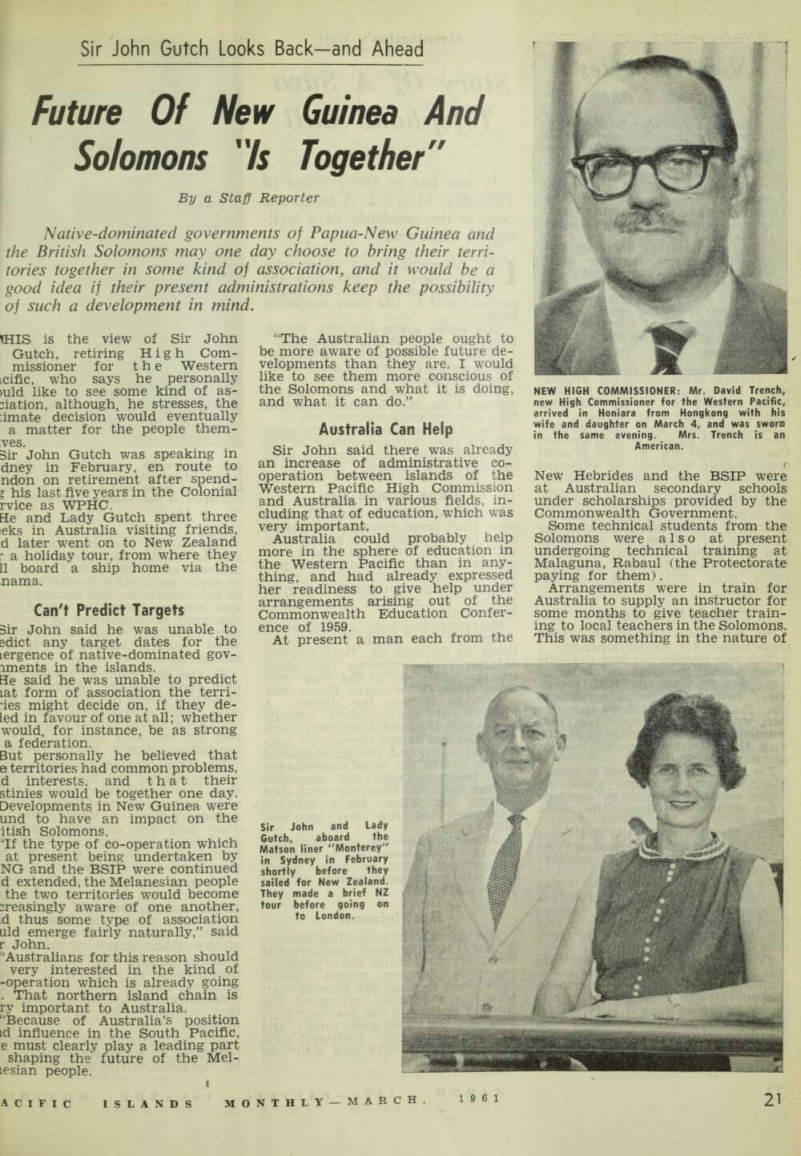
NEW HIGH COMMISSIONER: Mr. David Trench, new High Commissioner for the Western Pacific, arrived in Honiara from Hongkong with his wife and daughter on March 4, and was sworn in the same evening. Mrs. Trench is an American.
a “crash” programme, to supple ment the normal teacher training being carried out at the Solomons Training College near Honiara.
Sir John said that one problem was that the islands of the Western Pacific could not at the present stage supply students of sufficient qualification for University educa tion.
But this would come as the flow of students from the Protectorate’s secondary school increased, and the provision of places at university and technical institutions would then be a means by which Australia could give vital help to the Solomons.
Needs More Money
Sir John said the BSIP needed more money for its development.
This was despite the fact that the sums which the UK Government was putting into the BSIP com pared favourably, in proportion to the Protectorate’s 100,000 popula tion, with what the Australian Gov ernment was contributing in P-NG, with that territory’s population of almost 2,000,000.
For 1961, the BSIP had a grant in-aid of some £400,000 which he hoped would be matched by develop ment funds of about the same figure.
This should enable the Solomons to maintain services adequately, and to continue a “reasonable” measure of expansion. „ Sir John said he considered it was important to provide economic de velopment which would increase local revenue to bridge the gap and not depend solely on the UK Gov ernment for bigger grants.
That was why the Protectorate was hopefully building up its cocoa plantings, had plans for increased timber extraction, and was spend ing a lot on geological surveys. A recent discovery of copper on Guadalcanal could prove interest ing.
(Continued on p. 143)
Political progress in the BSIP, he said, was at the moment “smooth” but real interest would develop later Inauguration of the Protectorate’s first Legislative Council had been carried out most successfully in De cember.
The Legco's Future
Some critics had said it was ahead of its time and some that it should have had elected members right away (the present composition is 11 official and ten unofficial, six of the unofficial being Melanesians. All members are nominated).
Such criticism was to be expected, but he didn’t believe the critics were right. The Council had not been appointed before it was needed, and he hoped that an elected element could be introduced within the next five years or so, preferably after some experience had been gained in elections to local govern ment councils.
He said the Gilbert and Ellice Islands Colony was now working towards appointment of its first Advisory Council. He thought it might be established in the course of a year or so.
The New Hebrides Condominium was a different, “more difficult” problem.
Sir John said he presumed that constitutional progress would take the course of developing the Ad visory Council (which was estab lished in the New Hebrides in 1958) into a body with legislative functions.
But the precise shape of such future development had not yet been de cided, and what it would be he did not know.
It was important, though, that something be worked out between the British and French.
Drink Question
In the social sphere, Sir John said that the question of native drinking was still important.
It had been under discussion in the New Hebrides and the GEIC, and steps had already been taken in the BSIP, where a large number of Melanesians could now drink beer under a permit system.
The granting of permits had been greatly liberalised in the last twelve months.
It was on the cards that, within the next 12 months, the permit system would be removed so that all islanders in the BSIP would be free to drink beer.
The question of liquor would probably come up at the next meet ing of the BSIP Legco in April, but this would be a matter for the new High Commissioner, Sir John said the question was one that had caused him much con cern, but he had come to the con clusion that liquor restrictions were a mistake for two reasons: Firstly,
because if Melanesians couldn’t drink beer they would get hold of something worse. Secondly, it would increasingly be regarded as discrim ination if they were not allowed to drink as Europeans could, and it would build up resentment.
“I don’t think any island territory can stop the native people from drinking if they want to drink. The matter of lifting the restrictions has to be faced some time, and in my opinion it is best to face it before resentment and ill-feeling have been built up.” [See “What Are We Doing About Goodwill?” p. 33].