The Fijians Grimly
pp. 21-147 · Read in the full issue
No Solution of Troubles in Sight
The Fijians Grimly Hold The Balance
From R. W. Robson Suva, March 6.
An announcement by the Fiji Government on February 28, that it proposed to introduce a little constitutional reform by admitting four non-official Legislative Council members to be supervising “members” of selected Government departments, has been received with general disappointment.
lOLLOWING the virtual collapse of the Burns plan—the result of stubborn and uncompromising position by the Fijians—it was ped that something really positive •uld be done by the Colonial Office meet the Colony’s clamant need.
A.s has been so often pointed out recent years, the Colony is being tried steadily towards economic mble by over-population and der-development. [t has everything except a control in—plenty of good land, com inities (some of them) able and ?er to work, an equable climate, isonably quiet political conditions.
But the population is now over ),000; and, with Indian birth :e at a phenomenal 42 per Dusand a year, and the Fijian ■thrate at 31 per thousand (also narkably high), it is increasing 3idly. 3o also is unemployment, and blic discontent. rhe call is upon the Government, ice the Government cannot itself plement the Burns plan, and is thout the high-powered Develop ;nt Commissioner recommended the Burns Report, the Govern ;nt must find its own way out of increasingly dangerous situation.
The Governor's Plan Afhen it was announced that Sir rmeth Maddocks had, ready for ease, a constitutional reform plan, pes rose. It was thought that ected men of Fiji might be ad tted to that section of the Gov iment which makes policies and rcises real executive power, rhe Governor’s plan is very iple. r our non-official men will be ected from Legco and (if they are t already there) added to Executive uncil. As “members” they will >ervise certain administrative de rtments—but they will have no thority. :f they have criticism, construc e or destructive, they must carry to Executive Council. Then, they ist strictly support whatever de ion is reached by Executive Coun , whether they personally approve not.
As Executive Council is dominated by the Colony’s three top bureaucrats (Governor, Colonial Secretary and Finance Secretary) the Legco “mem bers”—either alone or as a quartet —really will have no authority; they are necessarily “yes-men”.
It is provided that if they will not accept Executive Council de cisions, they must resign.
"To Become Ministers"
After a certain period (an official explanation says “three or four years”) the system (it is hoped) will produce a number of men com petent to accept posts as Ministers in charge of Departments, with a Minister’s usual duties and respon sibilities.
But it is indicated that the majority (and therefore the policy making and executive power) in
Exco still would remain with the Colonial Office’s top bureaucrats.
Thus the innovation of these “members” would have no impact whatever upon the Colony’s present serious situation.
The Colony needs planning, and drive and ruthlessness now in its Government, to deal with an urgent and peculiar situation.
And all the governmental authority is concentrated in the hands of the Governor (Sir Kenneth
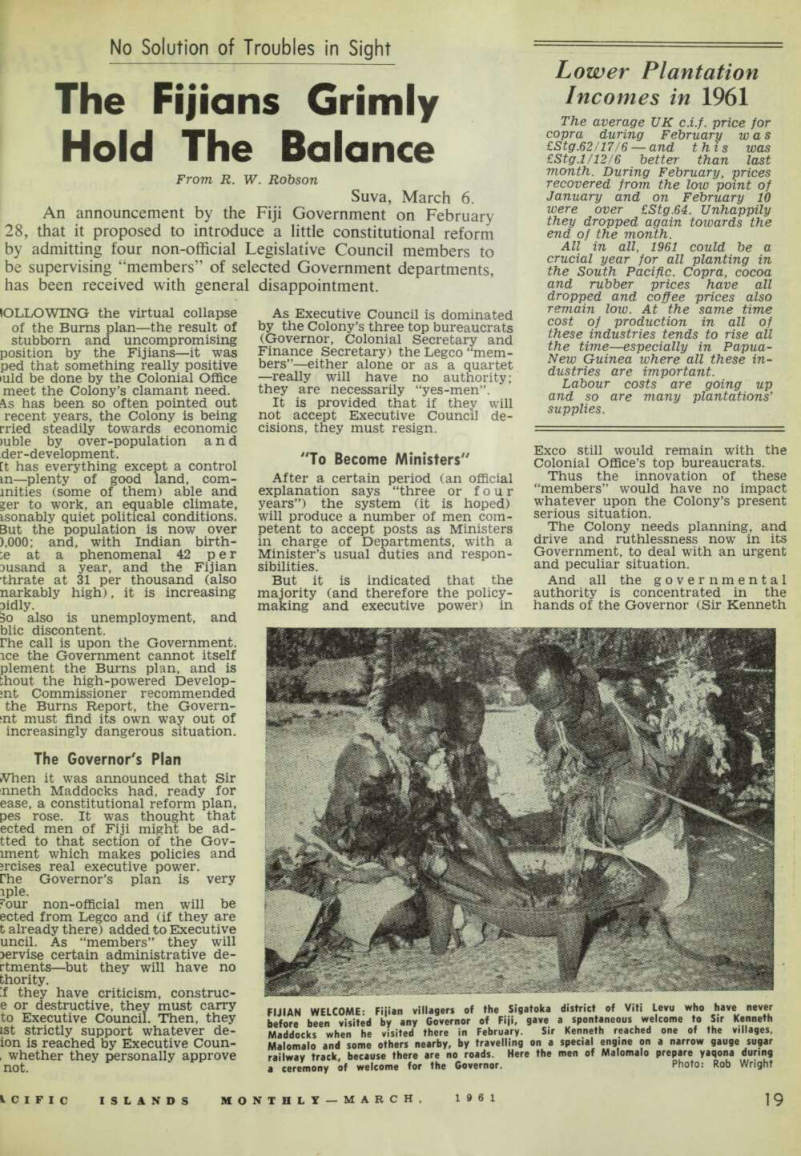
FIJIAN WELCOME: Fijian villagers of the Sigatoka district of Viti Levu who have never before been visited by any Governor of Fiji, gave a spontaneous welcome to Sir Kenneth Maddocks when he visited there in February. Sir Kenneth reached one of the villages, Malomalo and some others nearby, by travelling on a special engine on a narrow gauge sugar railway track, because there are no roads. Here the men of Malomalo prepare yaqona during a ceremony of welcome for the Governor. Photo: Rob Wright
Maddocks, who spent most of his official life in West Africa and never saw Fiji before 1959), Mr. Macdonald (Colonial Secretary) and Mr. Bev ington (Finance Secretary).
Messrs. Macdonald and Bevington are Colonial Office career men, who have spent many years in and around the Pacific: but they are not trained for the rough-and-tumble of politics—and it looks now as if rough-and-tumble politics is the only thing that will give Fiji what it wants.
The “member” idea might have served admirably in Fiji if intro duced 10 or 20 years ago. In Malaya it has been a success, and has led on to the introduction there of the Cabinet system. But, while Malayan conditions in some respects re semble those of Fiji, they lack the growing urgency now behind Fiji’s problems.
Here it is again a case of too little being proposed too late.
Silence and Suspicion
The Fiji Times, expressing critic ism and disappointment, urged that the Governor’s “reform” proposals be postponed for a while, and that efforts be directed towards the early assemblage of an All-Fiji Consti tutional Convention.
It urged that all classes should be given an opportunity of discussing the Colony’s problems, and of co operation with the Governor in de vising a form of government which would preserve Colonial Office supervision while giving the people of Fiji a much larger and more useful voice in the government.
But nothing came of it. There is not one solitary move among the communities towards national unity.
In 1959, during the Burns in quiry, there were signs that Fijians and Indians might get together, for the common good; and hopes were high that all communities would unite to promote good feeling and development.
It would have been so easy. This Colony, under direction and control, could support three times 400,000 people in comfort and peace.
And then came the disastrous sugar deadlock of 1960, and clear evidence of the bitter, uncompro mising and unscrupulous machina tions of an influential section of the
(Continued on p. 143)
Indian community against all other sections and classes.
The whole of the Fijians, and a large proportion of the Europeans, were immeasurably shocked by that disclosure—and from that moment (say, mid-1960) all hopes of imple menting the Burns plan, or of bring ing all the communities into some authoritative form of self-govern ment, practically disappeared.
The Fijians, as a community, are now aloof, suspicious, and grim.
Who can blame them?
Something About Indians
The belief now is widely held here that something even more urgent than economic dislocation threatens this Colony; and that is the danger of an attempted take-over by a ceaselessly-working section of the Indians, mainly Gujeratis.
The plan is to dislocate the CSR sugar industry (and the very fed-up CSR could probably be persuaded to depart); to establish “co-operative” sugar-mills; to get possession by fair means or foul of the sugar lands; and to run Fiji for the benefit of certain classes of Indians.
There may be little evidence of such a plot, consciously made; but certain Indians have said far too much, at the wrong times, so that the fear is abroad.
So the Fijians have withdrawn behind a wall of silence; the non official Europeans adopt an unshaped policy of wait-and-see: and the official British bite their finger nails and wonder why they ever were born to be Colonial Office ser vants, anyway—and how many more years to retirement.
Fijians Have the Last Word
It is a most depressing situation and, if it were not for the Fijians, I should say that all the advantages lie with the calculating Indians.
But they do not. The final word lies with the Fijians—and with other sections of the Indians.
It is not sufficiently realised and appreciated that there are far more classes of Indians than those which became prominent in the 1960 troubles. There are wise and re sponsible Indians here—but they
nd to be pushed into the back ound.
One is inclined to say that there 11 be no real progress made wards self-government in Fiji til the Indian community puts its use in order, and shows a sense collective responsibility. Then, it ly be guardedly accepted by the iians. Until then, although a :tion may plot and squawk and el its neighbours, the community sition will be sternly maintained, tfr. Patel and his friends did far ire in 1960 than they had planned, e effects now are seen, in a sort political stalemate. forecast the adoption of the vernor’s “member” system, in de ilt of anything else.
Jut it will serve no real purpose, relation to today’s troubles. >o far as the latter are concerned, Te simply is no solution in sight, the moment.