Pacific Shipping And Cruising Yachts
pp. 103-117 · Read in the full issue
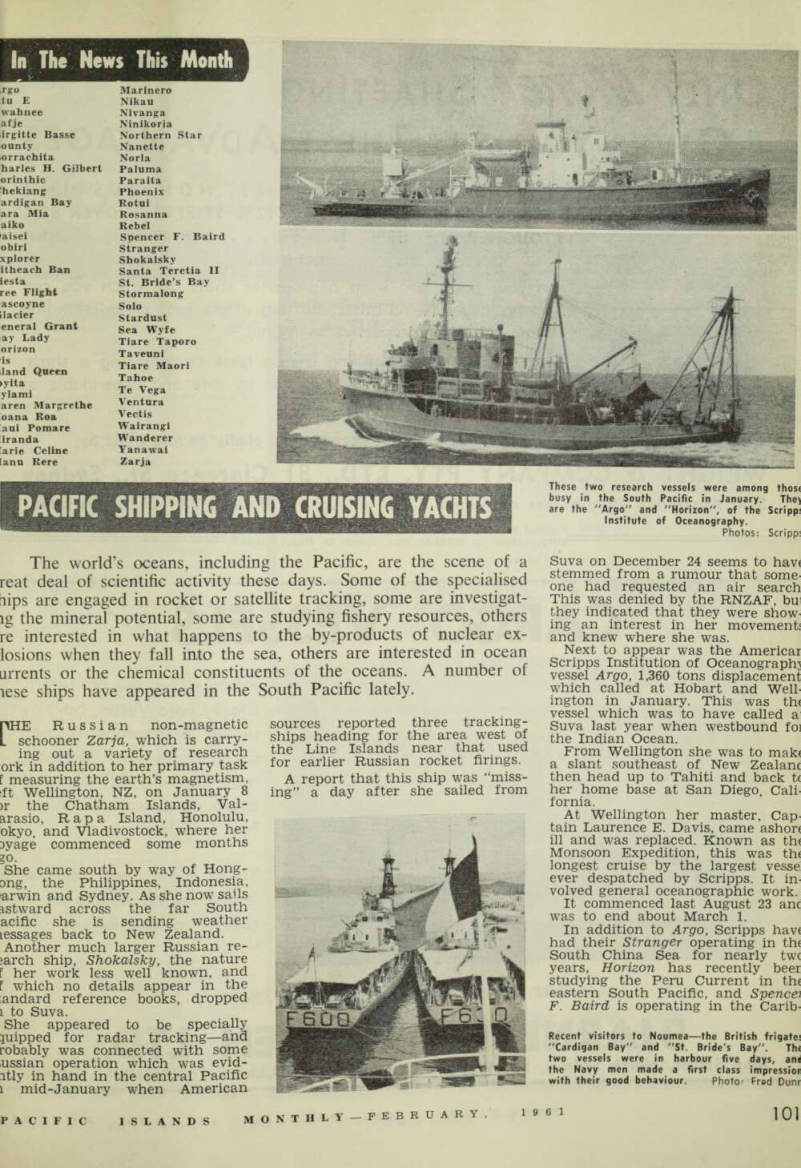

The world’s oceans, including the Pacific, are the scene of a reat deal of scientific activity these days. Some of the specialised hips are engaged in rocket or satellite tracking, some are investigat ig the mineral potential, some are studying fishery resources, others re interested in what happens to the by-products of nuclear ex losions when they fall into the sea, others are interested in ocean urrents or the chemical constituents of the oceans. A number of lese ships have appeared in the South Pacific lately.
CHE Russian non-magnetic schooner Zarja, which is carry ing out a variety of research ork in addition to her primary task I measuring the earth’s magnetism, ift Wellington, NZ, on January 8 )r the Chatham Islands, Val arasio, Rapa Island, Honolulu, okyo, and Vladivostock, where her Dyage commenced some months ?o.
She came south by way of Hong ang, the Philippines, Indonesia, arwin and Sydney. As she now sails astward across the far South acific she is sending weather tessages back to New Zealand.
Another much larger Russian re jarch ship, Shokalsky, the nature f her work less well known, and F which no details appear in the ;andard reference books, dropped i to Suva.
She appeared to be specially
juipped for radar tracking—and
robably was connected with some ussian operation which was evid itly in hand in the central Pacific i mid-January when American
sources reported three tracking ships heading for the area west of the Line Islands near that used for earlier Russian rocket firings.
A report that this ship was “miss ing” a day after she sailed from
Suva on December 24 seems to hav( stemmed from a rumour that some one had requested an air search This was denied by the RNZAF, bui they indicated that they were show ing an interest in her movement* and knew where she was.
Next to appear was the Americar Scripps Institution of Oceanography vessel Argo, 1,360 tons displacement which called at Hobart and Well ington in January. This was th( vessel which was to have called a 1 Suva last year when westbound foi the Indian Ocean.
From Wellington she was to mak( a slant southeast of New Zealanc then head up to Tahiti and back tc her home base at San Diego, Cali fornia.
At Wellington her master, Cap tain Laurence E. Davis, came ashore ill and was replaced. Known as the Monsoon Expedition, this was the longest cruise by the largest vesse: ever despatched by Scripps. It in volved general oceanographic work.
It commenced last August 23 anc was to end about March 1.
In addition to Argo, Scripps have had their Stranger operating in the South China Sea for nearly twc years, Horizon has recently beer studying the Peru Current in the eastern South Pacific, and Spencei F. Baird is operating in the Carib-
These two research vessels were among those busy in the South Pacific in January. They are the "Argo" and "Horizon", of the Scripps Institute of Oceanography.
Photos: Scripps
Recent visitors to Noumea—the British frigates "Cardigan Bay" and "St. Bride's Bay". The two vessels were in harbour five days, and the Navy men made a first class impression with their good behaviour. Photo: Fred Dunn
>an. All these vessels have called ; South Pacific ports in the past.
The US Fish and Wildlife’s harles H. Gilbert returned to onolulu in December from her ith cruise—to Fanning, Christmas, apeete, Rangiroa, and most of the ain islands in the Marquesas. The )ject was mainly to blood-type ,na in a study of the separate tuna amilies” in the Pacific, a method checking on migration character tics of this valuable commercial :ean fish. The Island calls were to Ilect small baitfish for the tuna >hing operations.
The cruise has indicated that the na colonies found in French jlynesian waters have no connec m with those found round the awaiian Islands and therefore tat fishing activities in one of ese two areas would not effect ;h densities in the other area.
By similar methods there is proof at North Pacific tuna do migrate itween eastern and western areas.
In the Tasman Sea, in January, e Royal Australian Navy’s frigate ascoyne, with a group of CSIRO ientists aboard, was carrying out ean-mass studies to determine e borderline along which Antarctic id sub-tropical waters meet. Best >hing possibilities usually exist ong such borderlines.
To the uninitiated, all sea water ay seem alike but in fact there no grealt mixing between the ajor water-bodies of the ocean id they can each be identified by lemical and temperature differ ices.
• A Lump Near Tonga: A
lip of another kind, the U.S. avy’s icebreaker Glacier, southl and for the Antarctic by way of aw Zealand—one of whose heli pters looked in on Tom Neale at iwarrow in November—seems to ive made an interesting discovery 0 miles southeast of Tongatapu. here the existing navigational larts show 4,000 fathoms—24,ooo
ft of water— Glacier’s electronic sounding gear found a mere 50 ft.
This is an area of underwater volcanic activity and it is possible that a major eruption has taken place there comparatively recently.
There was, for example, the re port of a vast area of pumice in the area extending 900 miles northeast ward from a point about 150 miles from Auckland made by the master of the liner Corinthic in January last year.
The shoal is well off ordinary shipping tracks between main Pacific ports.
If it rises from surrounding depths of 4,000 fathoms it represents a pretty considerable undersea moun
[?] harles H. Gilbert", the US Fish & Wildlife [?] rvice's Honolulu-based research vessel which [?] de her 50th cruise in December. The 188- [?] craft makes voyages as far south as Tahiti.
Photo: US F & WL
n and could well become another Icon Island of eroding pumice, netimes above and sometimes be [ the surface as alternate volcanic ivity and sea action play their :t.
► Jets For Reef Work: In
cember we mentioned new types ships now coming to the fore— ; Cushioncraft/Hovercraft type, i the hydrofoil.
The same month, Mr. S. G.
Bryan, Resident Agent of Mani i Island in the Cooks —where ire are no wharves and all cargo 5 to be boated through a shallow f passage between ship and shore vas in the South Island of New iland looking at another type of ft which is certain soon to fill aluable place in the Islands.
This is the water-jet nropelled >al-draught vessel, developed by . C. W. F. Hamilton and now in •duction in New Zealand and irseas. The secret of the mil ton jet is the highly efficient ign of the water pump which lws water in and projects it out tin in such a way that it pro es tremendous push and man ivrability to the boat.
There are no propellor blades to fer damage and this type of craft i operate in a few inches of water.
To very large units suitable for ps have yet been produced, but re is no reason why they could
not be should the demand arise. The present main Islands application would seem to be for cargo lighters and pleasure craft. • BP RESHUFFLE: There were reports in January that Burns Philp (South Sea) Co. of Suva might soon transfer one of Fiji’s largest and best-known vessels, the 434-ton, 23-year-old Yanawai, to the New Hebrides area, where pre sumably there is more work avail able for her than in Fiji waters.
It was also reported that the 248-
ton, 51-year-old former New Zea land coaster Nikau, which BP’s acquired in July, 1956, and trans ferred to the New Hebrides after an initial period in Fiji waters, was for sale. • NOW SHE HAS A NAME: The Gilbert and Ellice Islands Govern ment’s new ship, now on order in Hongkong and due for delivery be fore the end of the year, is to be named Nivanga.
Similar to the handsome Nini koria, but with more passenger
commodation, the new ship is esumably being built by the same rd —Hongkong & Whampoa Dock I.
Ninikoria, built 1958, is a steel ssel of 288 tons gross, powered th a pair of those popular 144 p, BL3 Gardners. She had the >tinction of being cut in half and igthened by 8 ft 9 ins. after dergoing her delivery trials. • FOR BRAVERY: For jumping the rescue of a young girl who d fallen overboard from the -tholic Mission vessel Santa retia II on the night of October 1959, the Resident Commissioner the Gilbert and Ellice Islands, '. M. L. Bernacchi, recently pre ited the Certificate and Insignia the Queen’s Commendation for ave Conduct to Te. Tiaon Nabuti, crew member of the vessel. The 3ident took place some miles off liana Island while the ship was der way.
• Those Banno Ships:
cording to English shipping irnals, the Banno organisation of aka paid SUS3OO,OOO each for the o 3,805-ton, war-time-built log ic supply vessels now named liko and Daisei (see last month) tich will soon enter the company’s uth Pacific services. The sub [iary Hongkong company regis 1 :- Jd as owners, is given as Oceania
.vigation Company.
» Sold To Denmark: Aus
ilasian Petroleum Com p a n y’s 11-known Port Moresby-registered puan Explorer, built in Holland 1952 as Hanne Sven, has been d to Basse & Co. of Copenhagen, nmark, and renamed Choky. °IM has no information as to lether the ship is remaining in e Pacific or returning to Euro an waters. This 507-ton modern
steel vessel was purchased by APC about 1953 and renamed. Over the past two years the company has been steadily disposing of its New Guinea-based vessels.
The Basse company of Denmark is not entirely unknown in the South Pacific. The Anchor Company of Nelson, NZ, purchased one of their vessels, Birgitte Basse in 1954 and she called at Papeete on her delivery voyage. • SAME SHIP: Last July we reported that Societe Tahitienne de Navigation of Papeete had purchased the small Hawaiian inter-island vessel Island Queen for use in the French Polynesia trade.
We now learn that this ex-sub chaser has been renamed Rotui and is operating between Papeete and the Australs
• Longliner For Pago
PAGO: The Van Camp Company which operates the tuna cannery at Pago Pago has purchased a Jap anese tuna longliner to be based and registered there for use as a vessel for the training of Samoans.
Up to now practically all fish canned has been supplied by Jap anese and Korean vessels, The training craft was due to arrive by January and was to be named Atu E —the call made by Samoans when they sight a school of bonito.
Our Pago Pago despatch does not indicate the size of the vessel, which is assumed to be second-hand and to have possessed a Japanese name.
The new owners organised a com petition to select a Samoan name, and it was won by Toavalue Leau and Leta Faiivae, who chose the
AROTONGA: A recent visitor in Rarotonga is the 85-ft Latter Day [?][?] ints' Mission vessel "Paraita". The passengers included Elder [?] hn Longden who is the supervisor of the LDS Polynesian Missions, [?] d Joseph R. Reeder, who has become the first president of the Rarotongan Mission, which is now a separate mission.
Photo: R. D. Moore
SUVA: The wharf at Suva, like so many other South Pacific wharves, always appears to have either a feast or a famine of shipping. Over the Christmas-New Year period the wharf was very busy. Here in the background is the cruise ship "Rangitane", behind her, out-of sight, is the "Matua", while busy smallships take up all the foreground.
Photo: Rob Wright
le name. They share the prize of :ases of canned tuna. he ship will fly the American
Joy It A Again: The 70-Ton
;el Joyita, much in the news since », may again put to sea as a local ;ist cruise vessel, according to 'iji report. She has been lying ;he beach at Ovalau Island, just ;h of Levuka, since she was 3d there in January, 1960, after inding on Vatuvula reef near :ogai in the previous November, one-time motor yacht has suf d a series of mishaps since she t missing and was found with her passengers and crew in a jrlogged condition in October ember, 1955.
MORE BANANAS: Although and Territories Department’s na Roa is still using dunnage the stowage of bananas—when carries them—the Union Com -7 has successfully landed banana oes in New Zealand without se, which is designed to improve nation but takes up a lot of able space and involves a lot of i loading and discharging time, seems probable that all future ina cargoes coming in per Union pany ships will be without dun-
For Treasure Hunters;
>ne who feels that he is in a ion to put his finger on any lining gold bullion from the iral Grant wreck at the Auck- Islands far south of New Zea is now free to make applica
tion to the New Zealand Govern ment for search rights.
The lease held by the last wishful thinkers has now expired.
All that is known with reasonable certainty is that the ship is com pletely broken up and scattered and that the sea is rarely calm in those southern latitudes.
Two rival expeditions, one organ ised in Auckland and the other by an Australian in the UK in 1954-55, both met trouble of one kind or another and never went near the islands.
No one who has made a close study of the situation holds the slightest hope of any expedition proving a financial success, but un doubtedly others will “give it a go”
in the future.
• Save That Diary: Mrs.
G. B. Beaver, of 139 Onewa Road, Northcote, Auckland, possesses a collection of papers which could be of great historical interest to Fiji and other Islands areas. They were written by her father, Captain Alexander Barrack, and cover the story of 30 years of his eventful life up to the time of his death in 1888.
His association with the Islands commenced in 1851 and he settled in Fiji in 1869 at Savusavu, bringing with him from Sydney what is thought to have been the first steam launch to be seen in that group. Ho became a leading cotton planter and figure in Fiji where his descendants are well known today.
[?] schooner "Tahoe" has finally returned to [?] ey after four years of Islands cruising, [?] page 113 for details. Here is the "Tahoe" [?] e South Pacific with Fred Sheppard (left) [?] Reg Blake. Sheppard left the yacht in [?] land some time ago to return to Canada.
• New Life For Levuka;
With increased copra buying activity on the part of Japanese in terests in Fiji, the port of Levuka on Ovalau, abandoned by overseas shipping in post-war years since virtually all copra has been crushed in Suva, may take on a new lease of life.
Recently (as reported in Jan.
PIM ) the China Navigation vessel Chekiang loaded 400 tons of copra there, the first shipment of what is now expected to be regular con signments from that port.
• The Matson Switch: Last
month we reported that the present Matson-Oceanic Company war-time built C-2 freighters on the trans pacific run would soon be replaced.
In January, Ventura was probably on her last trans-Pacific run.
Soon the larger C-3 type vessels, now in use on the Pacific Coast-
Hawaii service, and all bearing th prefix Hawaiian, will take over.
These are ships of about 8,00 gross tons, a speed of about 17 knoti and a cargo capacity of about 12,50 tons deadweight. They carry 1 passengers The C-2 ships will b sold or scrapped.
• Away From Hurricanes
Captain Hugh Williams took hi 135-ton Dobiri south to Auckland i: January, for refit. Also getting awa from the Cooks for the hurrican season was the Donald 173-to; schooner Tiare Taporo, which wen to Papeete.
Only the Taveuni remains, an therefore transport between t h Cooks is severely restricted, an some islands may not see a shi; from six to seven months.
January to March, which als happen to be the hottest months o the year, are the hurricane seaso: in the Cooks, although fortunate!
The two-masted schooner "Tiare Maori", which caught fire in Papeete in January, seen her (left) at Rarotonga with the "Taveuni" (mer [?] tioned below). "Tiare Maori" recently ha [?] undergone a thorough overhaul in dry dock An underwater diving expert said in January that refloating would present difficulties because of the extent of the damage. See opposite page for details.
re has not been a hurricane there ce 1946.
Jevertheless, onshore roofs are r ays made secure every year me are tied down with wire e); dangerous trees are removed I emergency organisations such nedical squads, repair gangs, etc., sh up on their tactics. .Iso during the hurricane season the Cooks most Government de tments work shorter hours—the usually lasting from 7.30 a.m.noon and from 1 p.m to 3 p.m.
Destroyed By Fire: The
-masted wooden staysail schooner re Maori —ex Henrietta, ex E. W. ipps, ex Serena, ex Aurora —one the last true schooner-rigged >els still trading in the South ific, caught fire off the Fareute ways in Papeete on January 4 was sunk in six fathoms by the er pumped aboard to extinguish blaze. he schooner had been in Papeete many months following a seri engine breakdown and await the slipway which she had just Le off at the time of the fire. The se of the fire has not been re ;ed. launch owned by the MGM film ; engaged in the Bounty film ;d as fire-boat with her water ips. his schooner, currently regist l as a yacht at Nassau, Bahamas, e to the Cook Islands trade at end of 1956, having been pur sed by her owner-master, Walter ohnson, Jr., from the film com- V, which shot Around the World Eighty Days. There she appeared the paddle steamer Henrietta, r much disguised from her true Jarance. ie was built in California in and at one stage, just prior nd after World War 11, she he ed to the Scripps Institution of mography. She was originally
built for Mr Cliff Durant of Durant T ir ßu^ e ’and r Lew?s er ston? g « ? IrVing sivelv n dLeS St succesrp J ’ T t o xt , , me u.S. Navy put her to work as a weather ship during the war.
Of 169 tons yacht measurement and 121 tons gross, this staysail schooner has been listed as for sale for some time past. The registered owners South Pacific Trading Co.
Ltd. of Vancouver, BC, advertised itiLaf £ f the T lr , sh ° re facil “ hyn Island a few months ago.
V een mainly en- Panppt-p 1 w, 11 m K d^ un i s frc T] Papeete to Rarotonga, but she paid
a visit to Auckland in Mav iq«V7 v. The vessel is understood to hive been insured and presumably the insurers will now decide whether she can be economically salvaged, Otherwise she will probably hav6 b il br i? ke J l up to avoid °hstruct lng the harbour,
• Moan A Roa’S Command-
Mr. R. A. Fraser, who took com mand of the Moana Roa on January }, 6 following the sudden death on the bridge of Captain John Hare ( See p. 105) is a Scot.
He has been with the NZ Island Territories Department’s shipping section since he went to NZ with
Wellington Harbour Board pilot inch some years ago.
Hr. Tony Thomson, son of ptain Andy Thomson, of Raro iga, now becomes chief officer in >ana Roa.
► New Guinea Survey: The
lN began work in January on the gest peace-time survey pro imme undertaken in New Guinea, e survey vessel HMAS Paluma 1 operate continuously in the New inea area for some years, return ' to Sydney only for an annual It. during the first year the Paluma 1 work mainly in the Port resby-China Strait area, i’here has been no surveying in sv Guinea waters for 13 years. ( ' GOING EAST: NZ Island Terri les Department’s 1,215-ton, 33r-old Maui Pomare, laid off the )k Islands run late last year, and which tenders closed on De iber 31, was reported sold to a
agkong shipbroking and charter
company in January and was ex ted to head for there in February March to commence a new life, is believed that the ship will not scrapped but will be based in ■mosa. Other details were not im diately available.
ews of Cruising Yachts
TE 36-ft schooner Tahoe, which was last mentioned in PlM’s columns in November, has illy returned to Sydney after r years of Islands cruising, ner Reg Blake had something dligent to say to The Sydney ming Herald on Islands cruis generally. He also mentioned t he had met and married a pear-old Tongan girl, who would rtly join him in Sydney. He has ided to give up cruising and ;le.
He added: “The biggest problem confronting one on an extended cruise is the problem of crew. The cruise is only as good as the crew you sail with.
“In the four years we had more than 20 different Europeans and six natives as crew, yet few were easy to live with in cramped quarters, week after week.
“I have no regrets; I think it was all well worth while.
“But it’s wrong to get the idea that you could go to Tahiti and
pick bananas and coconuts from the
trees. You’ll find they cost 6d each.
“I saw a great change within
three years at Tahiti as a result
of commercialisation.
“If anyone wants to find romance
and natural beauty there, go soon
or it will be too late.” • THE TASMAN RACE: As expected, not all the yachts which initially entered for this event crossed the starting line at Auckland on January 28.
The New Zealand yachts CARA MIA,
Rosanna, Vectis, And Wairangi Had
withdrawn for various reasons by mid- January, but an American yacht which had just cruised down through the Islands, Dr. R. C. Griffith’s 53-ft cutter AWAHNEE, which arrived at Auckland from Tonga on Christmas Eve, had been accepted as a late entry—making a total of 15 entries as of January 20.
With the above alterations the list of entries is as given in last month’s “PIM”.
Those which have been seen in the Islands are AWAHNEE, BOUNTY, and FITHEACH BAN—but yachtsmen in at least one other yacht have cruised the Islands in other yachts in the past—the Halvorsens and Terry Hammond in
Norla.
As this section of “PIM” went to Press on February 6, the first yachts had just reached Sydney. NOLA was declared provisional winner, although line honours went to the Sydney cutter SOLO.
• Sentence Reduced: Dr. Earle
Reynolds who sailed his 50-ft ketch PHOENIX into the forbidden Marshall Islands American nuclear test zone in
[?] recent visitor to Wewak, New Guinea, was the 600-ton Dutch vessel "Sungei-Bila". One of her crew members was charged with murder following the death of the chief officer.
Photo: D. W. Hawksley
July, 1953, has had his two-year gaol sentence reduced to six months probation by the US Court of Appeals at San Francisco.
The earlier sentence was suspended pending the appeal and Dr. Reynolds, under bail of about £5OO, and his family have been living aboard the yacht at Hiroshima, Japan, since last June. Dr.
Reynolds has had a teaching appointment at a school there.
Most people in the Islands will recall the PHOENIX cruise which commenced from Hiroshima in 1954.
Aboard then were Dr. and Mrs. Reynolds, daughter Jessica, 9, and son Ted, 15, and three Japanese university students, Niichi Mikami, Motosada Fushima, and Mitsugl Suemitsn.
Fushima and Suemitsu had returned to their studies in Japan and were not aboard at the time of the incident which received world wide publicity.
• Wanderer Ex Gracie S, The
67-year-old schooner which American actor Sterling Hayden sailed to Tahiti and into the headlines in 1959, has been sold to Joe Price, of Bartlesville, Oklahoma, and will soon appear in the Islands again under the command of Omer Darr, former owner-master of the big steel schooner-yacht TE VEGA, now in the Caribbean but well remembered in the Pacific—if only as featuring in the Cinerama film, “South Seas Adventure”.
WANDERER was to sail from Sausulito, California, for Pitcairn, Mangareva, the Tuamotus, Tahiti, and Noumea with cost sharing crew members, each of whom was putting up about SUSI,9OO for the four months’ round trip. • STORMALONG, 43-ft San Diego schooner with Will and Bess Hungerford aboard, is at present in the Hawaiian Islands and planning to head south for
French Polynesia within the next monl or two. • MIRANDA, 50-ft motor cruiser i Wellington, NZ, made a fast seven d: run across to Sydney, arriving the December 26. With owner W. Edmunc's* was Mr. L. Tattersfied (formerly of CA, Nadi), W. McQueen, J. Morgan, Granger, A. H. Campbell, and R. Kyle.
This craft should not be confused wii the Wellington 33-ft ketch of the san name which cruised to Tahiti and tl Cooks in 1957-58, with John O’Donnell i command. • NANETTE, 28-ft ketch of Whangan with C. Capon lonehandling, which clean her home port December 22, arrived i Lord Howe Island on January 5, en rou to Australia. Future plans unknown. • FIESTA, 72-ft schooner of Panam arrived Honolulu, January 13. Aboai were owners Martin and Ann Vitous< and children Georgina 10, Clinton 3, Ter 1 and a guest, Nina Lucas, of Tahiti.
FIESTA left Papeete December 8 wii stops at Huahine, Bora Bora, Christmi and Fanning Island.
FIESTA is to remain in Honolulu for year and return to Fanning Island for proposed scientific programme to be bas* there. • MARIE CELINE: Owned by Mr. \ Williams, who was first-mate on the la: cruise of Irving Johnson’s YANKEI departed Papeete, Tahiti, January 4 f< Honolulu via Moorea. The yacht ws sailed by a hired crew, the owner havir left for Djakarta by plane a few weel previously. • KYLAMI: Left Papeete for Honolul in December with the owners, Mr. an Mrs. Ted Mangles and their 13 year ol son aboard. They have been cruising 1 Polynesia for the previous 11 months. • AAFJE: Owned and skippered by M and Mrs. Robert Gaylord left Bora Bora o December 26 for Honolulu. The yacht, 58-foot staysail schooner, is a former D pilot boat, and before the last war hi the headlines on one occasion when i was seized by a charter party and murder committed on board. • FREE FLIGHT, 34-ft ketch, owne and skippered by Ron Linderman, lei Papeete for Honolulu and the US Pacifl coast early in January.
The "Fiesta", Panama-registered, although s[?] has never been in that area. She is own[?] by an American and is now back in Honolu[?] See below.
KAREN MARGRETHE, of San Diego, , owned by Fred and Virginia Daven , left French Polynesia for Fiji or ja late December. They had with i their year old daughter, Circe, yacht is a 38 ft, double ended ketch in Scandinavia. The Davenports members of the Coronado Yacht Club the Seven Seas Cruising Association.
BORRACHITA, of Santa Cruz, Cal., owned and skippered by Ed Dreis, Bora Bora for Fiji in November. Stan Dillard, a Canadian, sailed as crew, yacht was built by Ed Dreis, and is -ft. fibreglass cutter. He hopes to 11 a new diesel engine in Fiji and continue cruising westward.
REBEL, Auckland yacht owned by Smith and his wife, left Papeete for lulu in November and planned to e in Canadian and US waters after time in the Hawaiian group.
STARDUST, the US converted nile which has been in and out of news for the last couple of years, y left Papeete for Honolulu early lecember with a charter party of leans aboard. The party was a ig and diving company and they ted to spend some time in the lotus and the Marquesas to film •water diving scenes. The ship is ted to have had quite a lot of le with French officials in Tahiti.
SEA WYFE, of Seattle, US, 38-ft ner built and sailed by the owner, Ashford, has been cruising in esia since July, especially the ird Islands and Tahiti. In Papeete nuary he was still undecided whether >uld go on to New Zealand or return iwaii.
HANU RERE, 38-ft schooner from ort Beach, US, arrived Papeete via larquesas in December. Aboard were ■s Wesley and Louise Herr and their ■ son, crew member Jim Bell and iptain of GAY LADY who had joined acht in the Marquesas. iAY LADY, 32-ft cutter from raia arrived Papeete January 2 from larquesas skippered by Phil de Vita his wife Helen who had left the Rere. (The captain of GAY LADY joined the crew of MANU RERE— bove).
IARINERO, owned by Floyd Christen ed his wife Doris, was in Papeete nuary. With them is their year >n Keith, and they expect to be in te until April, awaiting the birth elr second child. They will then
continue their cruise to the Cook Islands, Tonga, Fiji and Australia. The Christen sons left their home port San Diego on April 17, 1960, and have been in French Polynesian waters since June.
It is Mr. Christenson who has supplied most of the Papeete yacht news in this issue, and in a letter from there on January 10, he takes to task previous correspondents in “PlM’s” Cruising Yacht Section for incorrect spelling of yachts’ names. The trouble is, of course, that most of our correspondents are better yachtsmen than they are spellers, and even when their spelling is OK, thel»handwriting is usually terrible. We’re thinking of starting a fund for supplying sea-going typewriters to cruising yachts men.
Hot Jazz
[?]disabled Jap fishing [?] "Toyo Maru No. [?] which recently [?]t some time in [?]ul awaiting engine [?]rs. She attracted [?] of attention from [?]es as she played [?] jazz over her [?]ifier system. [?]res sat on the BP [?] wharf for some [?] to listen to the Jazz.
Photo: M. R. Hayes