Magazine Section
pp. 77-101 · Read in the full issue
Pacific Islands Monthly
The Rich Island of Kar Kar
There’S No Place
More Desirable
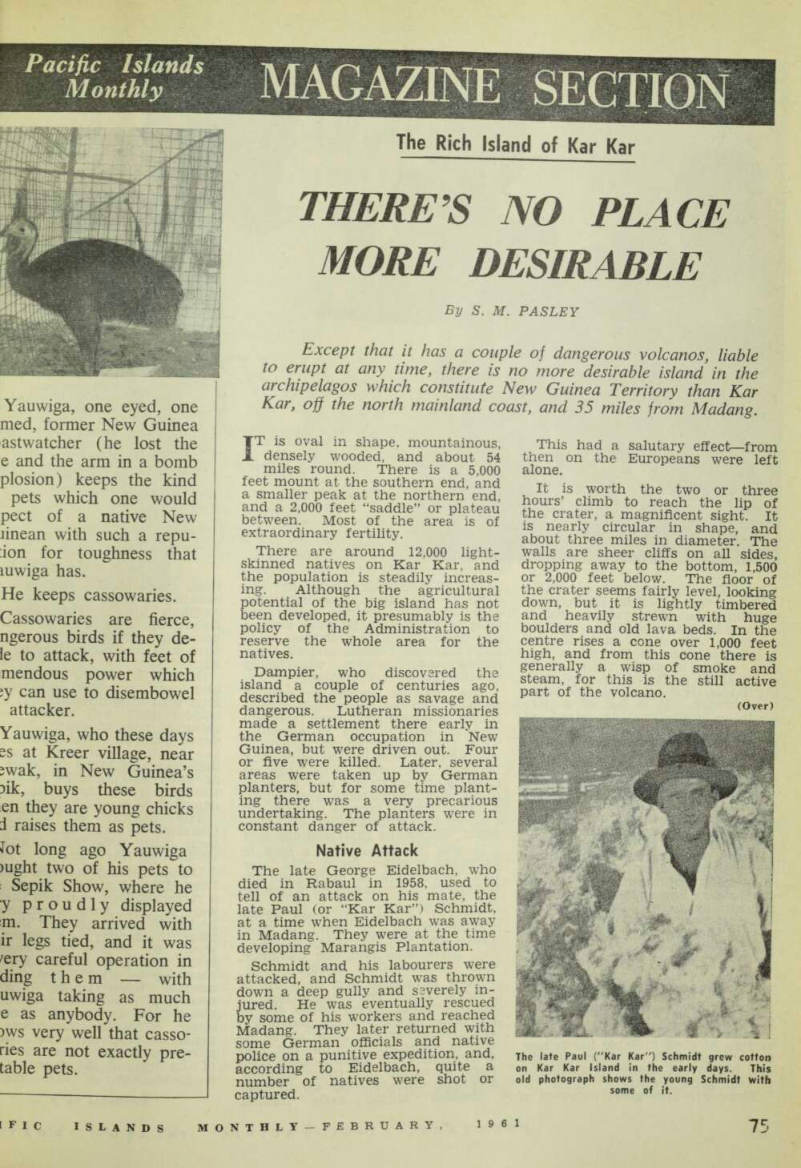
Yauwiga, one eyed, one med, former New Guinea astwatcher (he lost the e and the arm in a bomb plosion) keeps the kind pets which one would pect of a native New linean with such a repu ;ion for toughness that mwiga has.
He keeps cassowaries.
Cassowaries are fierce, ngerous birds if they de le to attack, with feet of mendous power which 5y can use to disembowel attacker.
Yauwiga, who these days £s at Kreer village, near ?wak, in New Guinea’s sik, buys these birds en they are young chicks i raises them as pets.
Jot long ago Yauwiga mght two of his pets to Sepik Show, where he y proudly displayed m. They arrived with ir legs tied, and it was 'ery careful operation in ding them with uwiga taking as much e as anybody. For he )ws very well that casso ries are not exactly pre table pets.
By S. M. Pasley
Except that it has a couple of dangerous volcanos, liable to erupt at any time, there is no more desirable island in the archipelagos which constitute New Guinea Territory than Kar Kar, off the north mainland coast, and 35 miles from Madang.
IT is oval in shape, mountainous, densely wooded, and about 54 miles round. There is a 5,000 feet mount at the southern end, and a smaller peak at the northern end, and a 2,000 feet “saddle” or plateau between. Most of the area is of extraordinary fertility.
There are around 12,000 light skinned natives on Kar Kar, and the population is steadily increas ing. Although the agricultural potential of the big island has not been developed, it presumably is the policy of the Administration to reserve the whole area for the natives.
Dampier, who discovered the island a couple of centuries ago, described the people as savage and dangerous. Lutheran missionaries made a settlement there early in the German occupation in New Guinea, but were driven out. Four or five were killed. Later, several areas were taken up by German planters, but for some time plant ing there was a very precarious undertaking. The planters were in constant danger of attack.
Native Attack
The late George Eidelbach, who died in Rabaul in 1958, used to tell of an attack on his mate, the late Paul (or “Kar Kar”) Schmidt, at a time when Eidelbach was away in Madang. They were at the time developing Marangis Plantation.
Schmidt and his labourers were attacked, and Schmidt was thrown down a deep gully and severely in jured. He was eventually rescued by some of his workers and reached Madang. They later returned with some German officials and native police on a punitive expedition, and, according to Eidelbach, quite a number of natives were shot or
captured.
This had a salutary effect—from then on the Europeans were left alone.
It is worth the two or three hours’ climb to reach the lip of the crater, a magnificent sight. It is nearly circular in shape, and about three miles in diameter. The walls are sheer cliffs on all sides, dropping away to the bottom, 1,500 or 2,000 feet below. The floor of the crater seems fairly level, looking down, but it is lightly timbered and heavily strewn with huge boulders and old lava beds. In the centre rises a cone over 1,000 feet high, and from this cone there is generally a wisp of smoke and steam, for this is the still active part of the volcano. (Over)
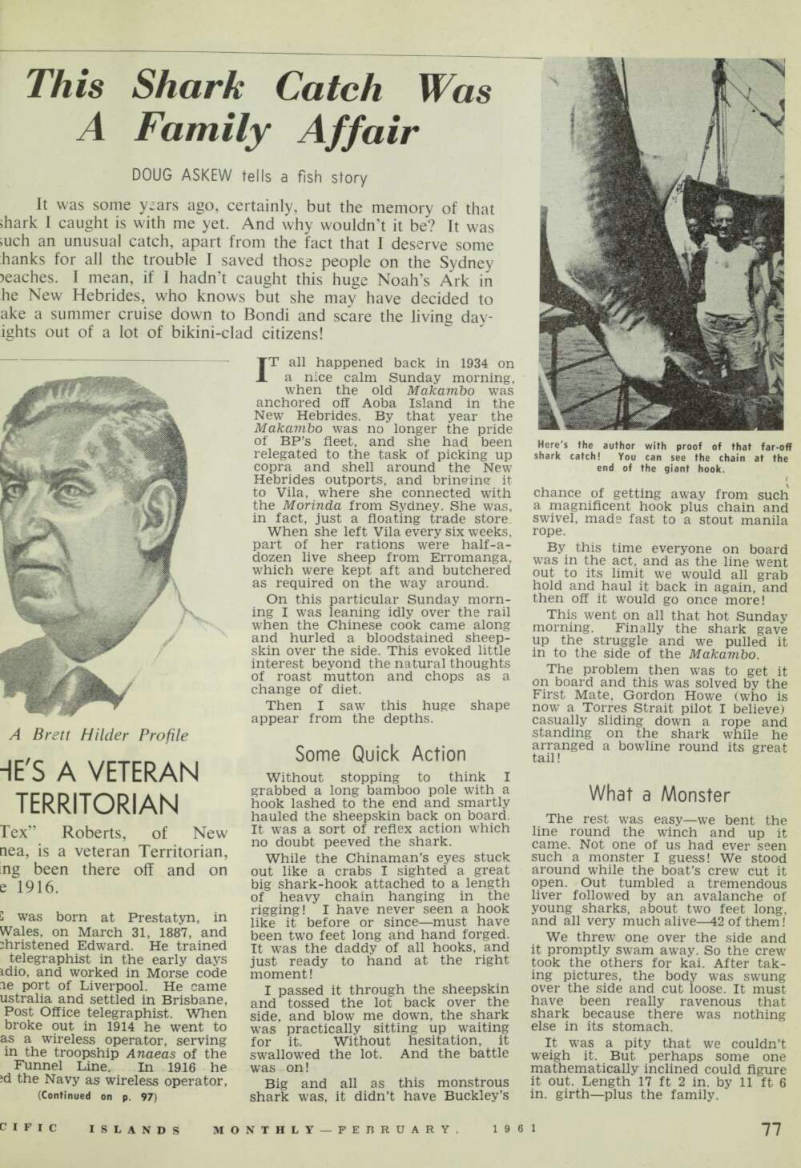
The late Paul ("Kar Kar") Schmidt grew cotton on Kar Kar Island in the early days. This old photograph shows the young Schmidt with some of it.
Kar Kar has two other notable craters. One is Kavilo Harbour, at the south end of the island; and is a large circular bay with a narrow entrance. The other is at Kurum Mission station, on the south east side. This is small, rising at its edges about 60 feet from surround ing levels, and is about 200 yards in diameter. It is full of a par ticularly brass-throated breed of frog, whose constant chorus, day and night, causes extreme irritation to newcomers.
From the beach to the lips of the crater, all around the island, the soil is wonderful. It is mostly rich black volcanic loam, very deep and extraordinarily prolific. No where else in these islands in there such a variety of big and better bananas. Taro and most other tropical vegetables grow quickly and easily to huge size. Natives can clear and plant a garden almost anywhere. Coconut palms there surpass those of any other part of the Territory. Some planta tions bear up to two tons per hectare per year, which is “tops”.
Enormous Trees The virgin land —which is, of course, the great part of the island —is very heavily timbered with a variety of good millable hardwoods.
These trees grow to enormous size and would cut many thousands of feet of good timber.
There are also great numbers of
beautiful softwoods, including the valuable breadfruit and inevitable galip—the nuts of the latter are most highly prized by both natives and Europeans as a first-class table nut. Hibiscus, crotons and all other shrubs and flowers climatically suitable grow in profusion.
The natives generally are a healthy and sturdy people, light brown in colour and, prior to World War 11, cheerful and co-operative.
They then numbered about 9,000 — now about 12,000. Once dangerous, between the wars they became friendly and quiet; but they retained many strange customs and super stitions which are a source of concern to Administration and Mis sions. Especially marriage customs.
It was the custom for a man to exchange a sister for a wife. Or, more accurately, a man gave his daughters in exchange for wives for his sons.
Thus, if a boy had three sisters and no brothers, he could get three wives; and if a family consisted of, say, three sons and one daughter, only one son could marry.
This, of course, led to a lot of trouble, apart from polygamy, as many women, having borne one or two sons, hoped to have daughters: and if another son came along, he was not wanted, and did not live.
Government and Missions both tried hard to stamp out these customs, but with little success up to 1940.
Besides killing male infants,
these people had a strange learn: towards suicide. It was fail common for one of them—me frequently a woman after ] domestic quarrel to go into t bush and commit suicide by han ing.
Sorcery (“poison”) was rampai and was practised by the c men with little difficulty. It is ve seldom they will admit such thing as natural death. Even in death from some well known illne the native believes that t deceased was killed by some de or other evil, brought about by sorcerer or by the spirit of soi departed man.
The practice of sorcery w punished by law, and there ha been many prosecutions and co victions on Kar Kar.
One plantation manager was co fronted by 14 of his labourers fre a certain village, and told that th were in great trouble because th had been mixed up in a disgustij piece of sorcery. A youth ag about 12 years had died. I father and uncle exhumed his bo some weeks after burial; and h accused these young men, ai several others working on anoth plantation, of having caused 1 death. This of course was hoi denied. However, the two c parties persisted. They cut off o of the arms of the dead lad, ma a great stew of taro and ri(
(Continued on p. 99)
And What
Offers?
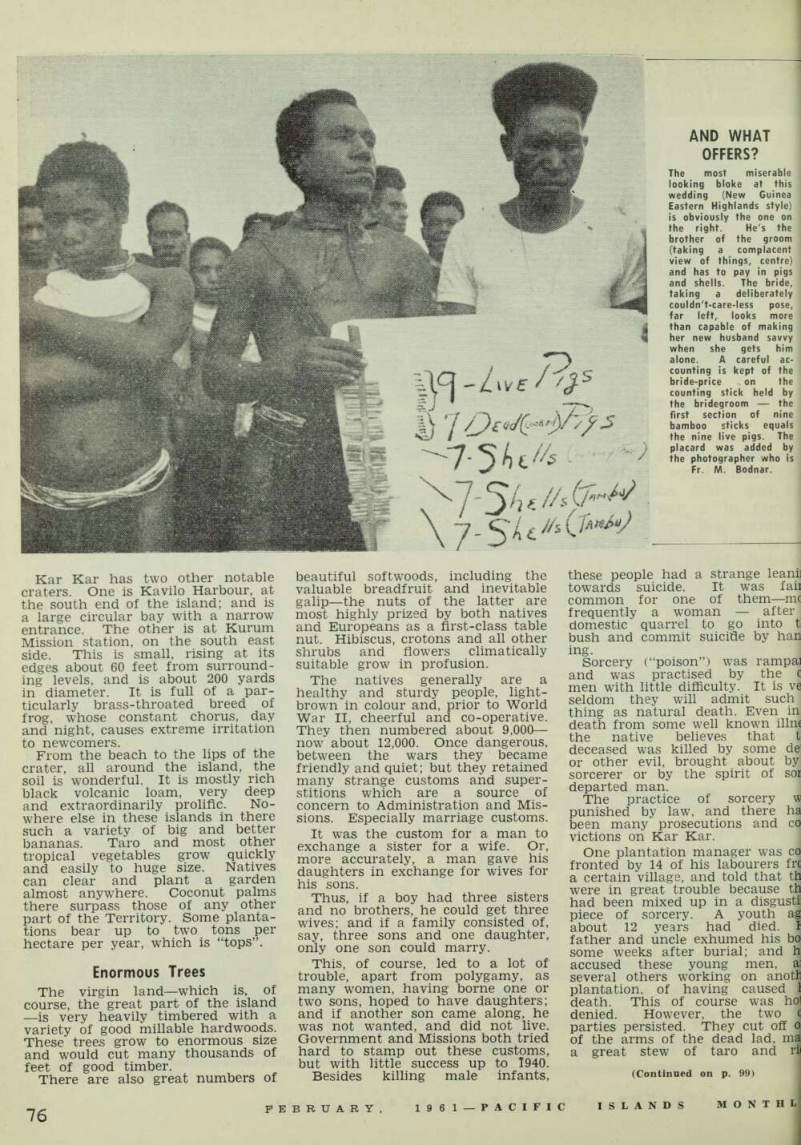
The most miserable looking bloke at this wedding (New Guinea Eastern Highlands style) is obviously the one on the right. He's the brother of the groom (taking a complacent view of things, centre) and has to pay in pigs and shells. The bride, taking a deliberately couldn't-care-less pose, far left, looks more than capable of making her new husband savvy when she gets him alone. A careful ac counting is kept of the bride-price on the counting stick held by the bridegroom - the first section of nine bamboo sticks equals the nine live pigs. The placard was added by the photographer who is Fr. M. Bodnar.
d squeezed some fluid from the m into the pot. They then allenged the young men to eat is stew, stating that if they were locent nothing would happen, t if they were guilty they would o die. rhe young men partook of this w, and none died. The matter s reported and a patrol officer s sent to investigate. Fortun :ly he had a sound knowledge of tives; and took the two elderly itlemen off to Madang for a etch in gaol. An inexperienced cer would have gaoled all the mg men as well, because they o took part in “sorcery”. [Tie use of real poison was not heard of. On one occasion a dical officer exhumed the bodies two labourers who had died in ange circumstances. He found ces of poison, which eventually 3 traced: and it was found that tain natives had extracted this son from the spine of a rare i, and had put it in the food the deceased.
Tie Administration has refused let the natives sell any more d because they say they haven’t 'Ugh. However, the late George rray (pre-war Director of •iculture) stated that cocoa Id be grown almost to the top the crater. He also thought t Ar a b ica coffee could be grown the top, starting above what he ed the banana line—that is
where the bananas ceased to grow 900 to 1,000 feet above sea level Very few villages or gardens are established more than a mile in land. There are thousands of acres of good land available.
Lots of Cocoa Kar Kar is now producing a lot of cocoa and copra from established plantations, and a good deal of copra from village groves; and these are being increased. Cattle and horses do well on the island and there are thousands of pigs Nature, after providing such a surfeit of growth and wealth on this island, evened up the score by also providing a great variety of snakes. These are very numerous, mostly of the coconut or carpet variety, and harmless except as egg
and chicken stealers. There are lot! of large pythons and constrictor! and a few, though very few, viper! or adders.
The disposition of the native! seems to have changed in the lasi few years. Some of them worked But money did not mean anything because nature had provided all their needs, and a mild pleasant climate in which to enjoy them Now, however, with Government sponsored co-operatives, they are becoming more money-conscious The people seem to have lost their spontaneous friendliness and have adopted a sullen and surly attitude towards others.
Rich Kar Kar is an island few New Guinea people seem to know much about it. But it should be visited more often.