[?]Ie Mystery Of The
pp. 51-53 · Read in the full issue
Captain Peter Dillon the first man to discover the fate of La Perouse? Some doubts are raised in this article.
[?]Ross Of St. Louis
By R. A. Langdon
TER the French navigator La 3 erouse sailed from Botany Bay n his ships Boussole and Astro in March, 1788, no white man saw him again; and nearly 40 > passed before the mystery of iisappearance was solved.
Irish seaman, Capt. Peter n, has always been given the t for being the first to learn La Perouse’s ships were sed at Vanikoro. t there is evidence to suggest he was beaten to it. lile doing some research on ’erouse recently I came across em which suggests that Dillon
may have been anticipated by the captain of an English whaler.
The item, reprinted from a French paper called Constitutionel, was published in the Asiatic Journal for October, 1825. This was eight months before Dillon collected his first relics of the La Perouse ex pedition ‘ The ltem reac *s: — “Admiral Manby, of the English Royal Navy, has recently arrived in Paris with the news, which is strongly supported by presumptive evidence, that the place where the intrepid Peyrouse with his brave
crew perished 40 years back is now known.
“An English whale ship has dis covered a long and low island sur rounded with innumerable rocks be tween New Caledonia and New Guinea, at nearly equal distance from those islands.
“When the inhabitants came on board, they perceived that one of the chiefs had, as an ornament, a Cross of St. Louis hanging from his ear.
“Other natives had swords upon which was marked the word Paris, and some medals of Louis XVI were seen in other hands.
“When they were asked how they became possessed of those articles, one of their chiefs, of about 50 years of age, answered that when he was a boy, a large vessel was wrecked in a violent tempest upon a coral reef, and that all the men that were in her perished.
“The sea cast upon the shore of their island several chests in which was found the Cross of St. Louis, along with many other things.”
The Asiatic Journal went on to say that during a voyage around the world which Admiral Manby had made, he had seen several medals of the same sort which La Perouse had distributed among the natives of California,
It All Fits In
The article added that the Cross of St. Louis was then on its way to Europe and was to be “placed in the hands of Admiral Manby”.
Regarding this item, it is interest ing to note that: • The location of the island— about half-way between New Cale
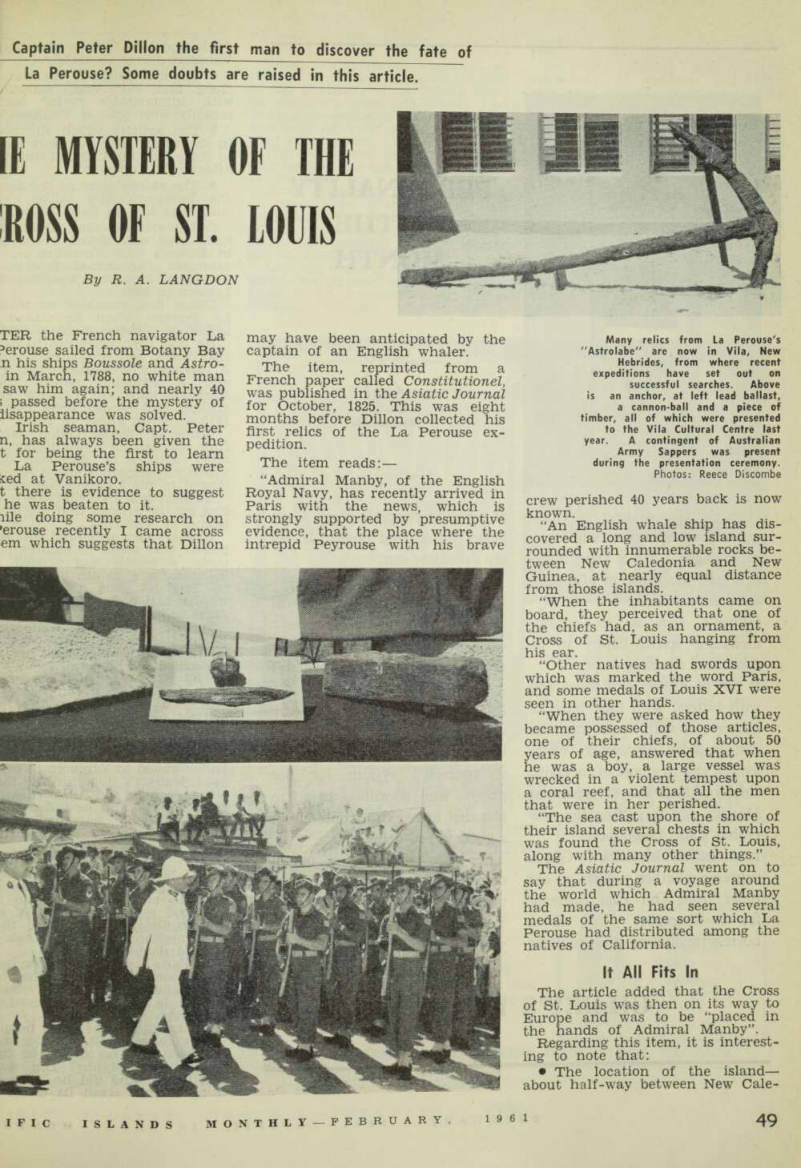
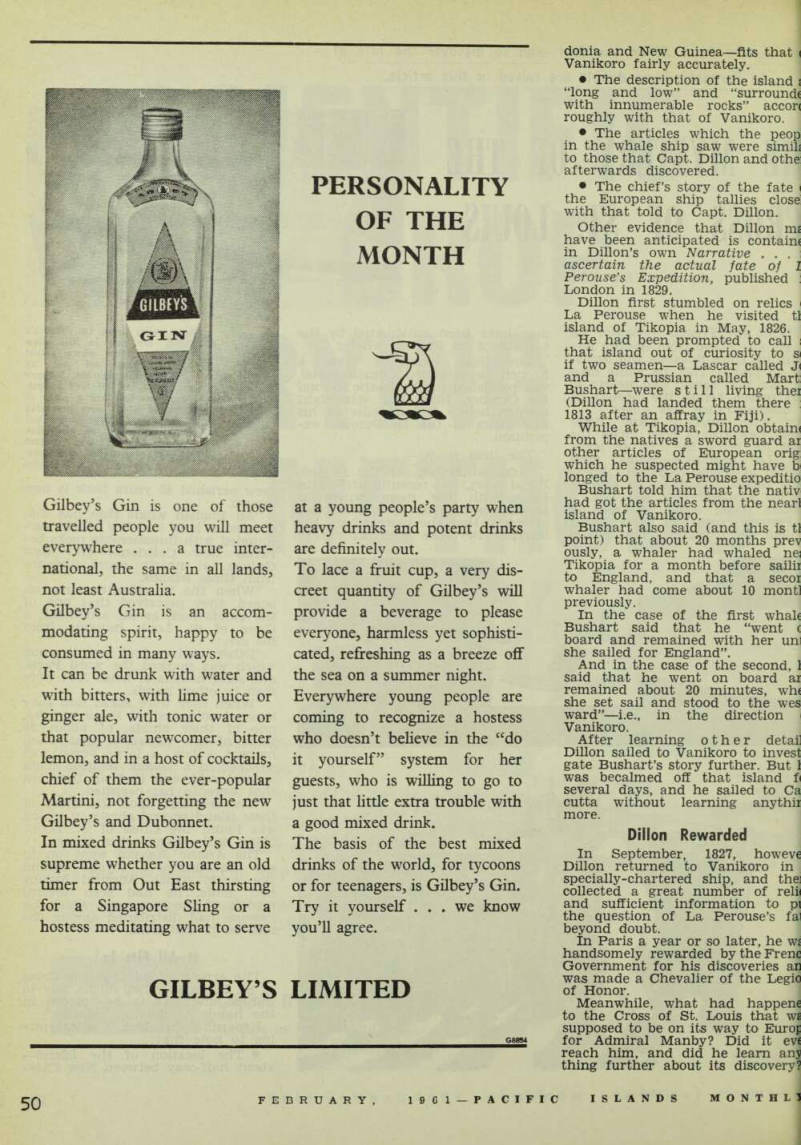
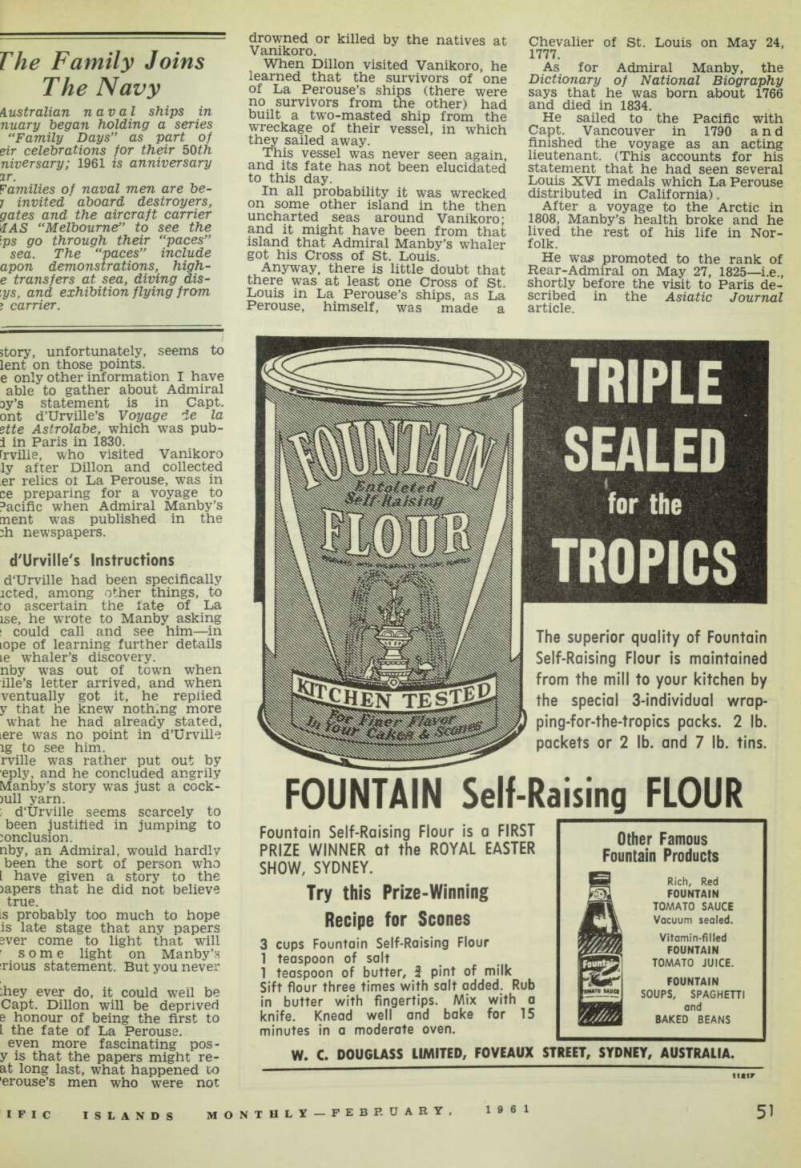
Many relics from La Perouse's "Astrolabe" are now in Vila, New Hebrides, from where recent expeditions have set out on successful searches. Above is an anchor, at left lead ballast, a cannon-ball and a piece of timber, all of which were presented to the Vila Cultural Centre last year. A contingent of Australian Army Sappers was present during the presentation ceremony.
Photos: Reece Discombe
donia and New Guinea—fits that < Vanikoro fairly accurately. • The description of the island s “long and low” and “surrounde with innumerable rocks” accon roughly with that of Vanikoro. • The articles which the peop in the whale ship saw were simils to those that Capt. Dillon and othe: afterwards discovered. • The chief’s story of the fate ( the European ship tallies close! with that told to Capt. Dillon, Other evidence that Dillon m£ have been anticipated is containe in Dillon’s own Narrative . . . ; ascertain the actual fate of 1 Perouse’s Expedition, published i London in 1829.
Dillon first stumbled on relics < La Perouse when he visited tl island of Tikopia in May, 1826.
He had been prompted to call i that island out of curiosity to si if two seamen—a Lascar called J( and a Prussian called Mart: Bushart —were still living thei (Dillon had landed them there : 1813 after an affray in Fiji).
While at Tikopia, Dillon obtaim from the natives a sword guard ar other articles of European orig: which he suspected might have b longed to the La Perouse expeditio Bushart told him that the nativ had got the articles from the nearl island of Vanikoro.
Bushart also said (and this is tl point) that about 20 months prev ously, a whaler had whaled nes Tikopia for a month before sailii to England, and that a secor whaler had come about 10 montl previously.
In the case of the first whale Bushart said that he “went c board and remained with her uni she sailed for England”.
And in the case of the second, 1 said that he went on board ar remained about 20 minutes, whe she set sail and stood to the wes ward”—i.e., in the direction i Vanikoro.
After learning other detai] Dillon sailed to Vanikoro to invest gate Bushart’s story further. But 1 was becalmed off that island f( several days, and he sailed to Ca cutta without learning anythir more.
Dillon Rewarded
In September, 1827, howeve Dillon returned to Vanikoro in specially-chartered ship, and the: collected a great number of reli( and sufficient information to pi the question of La Perouse’s fal beyond doubt.
In Paris a year or so later, he w£ handsomely rewarded bytheFrenc Government for his discoveries an was made a Chevalier of the Legio of Honor.
Meanwhile, what had happens to the Cross of St. Louis that ws supposed to be on its way to Europ for Admiral Manby? Did it eve reach him, and did he learn any thing further about its discovery?
story, unfortunately, seems to lent on those points, e only other information I have able to gather about Admiral ay’s statement is in Capt. ont d’Urville’s Voyage de la ztte Astrolabe, which was pub i in Paris in 1830. rrville, who visited Vanikoro ly after Dillon and collected er relics of La Perouse, was in ce preparing for a voyage to Pacific when Admiral Manby’s naent was published in the ch newspapers. d'Urville's Instructions d'Urville had been specifically jcted, among other things, to to ascertain the fate of La ise, he wrote to Manby asking i could call and see him —in tope of learning further details le whaler’s discovery, nby was out of town when file’s letter arrived, and when ventually got it, he replied y that he knew nothing more what he had already stated, tere was no point in d’Urville ig to see him. rville was rather put out by eply, and he concluded angrily Manby’s story was just a cock mil yarn. ; d'Urville seems scarcely to been justified in jumping to conclusion. nby, an Admiral, would hardly been the sort of person who I have given a story to the )apers that he did not believe true. is probably too much to hope is late stage that any papers ever come to light that will r some light on Manby’s Tious statement. But you never :hey ever do, it could well be Capt. Dillon will be deprived e honour of being the first to I the fate of La Perouse. even more fascinating pos y is that the papers might re at long last, what happened to 'erouse’s men who were not
drowned or killed by the natives at Vamkoro.
When Dillon visited Vanikoro, he learned that the survivors of one of La Perouse’s ships (there were no survivors from the other) had built a two-masted ship from the wreckage of their vessel, in which sai^ a way.
This vessel was never seen again, an( its fate has not been elucidated to this day.
In all probability it was wrecked on some other island in the then uncharted seas around Vanikoro; and it might have been from that island that Admiral Manby’s whaler got his Cross of St. Louis.
Anyway, there is little doubt that there was at least one Cross of St.
Louis in La Perouse’s ships, as La Perouse, himself, was made a
Chevalier of St. Louis on May 24, 1777. J As for Admiral Manby, the Dictionary of National Biography says that he was born about 1766 and died in 1834.
He sailed to the Pacific with Capt. Vancouver in 1790 and finished the voyage as an acting lieutenant. (This accounts for his statement that he had seen several Louis XVI medals which LaPerouse distributed in California).
After a voyage to the Arctic in 1808, Manby’s health broke and he lived the rest of his life in Nor folk.
He was promoted to the rank of Rear-Admiral on May 27, 1825—i.e , shortly before the visit to Paris de scribed in the Asiatic Journal article.