Of NG Wage Problem
pp. 43-45 · Read in the full issue
P ublic Service Is 'Crux' Of NG Wage Problem
Concurrently with Papua-New Guinea’s New Year labour >ubles (see January “PIM”), the Tripartite Mission on ibour Matters in P-NG issued a report which turned out to a far more sober and sensible document than we are used getting from hit-and-run experts who visit the Territory.
S members of the Tripartite lission, as they called them 3lves, were drawn from Aus n employers’ organisations, the J and the Australian Depart of Labour and National Ser nbers of the mission were: A. M. Simpson, past-president, iated Chambers of Manufac and Adelaide Chamber of lerce; A. L. Blake, treasurer and president of the Australian 3il of Employers’ Federations; A. E. Monk, president of the alian Council of Trade Unions; W. P. Evans, vice-president alian Council of Trade Unions, general secretary of the Fed l Engine Drivers’ and Fire- Association; and H. A. Bland, secretary to the tment of Labour and National mission was accompanied by T . B. Wilson, of the Department
of Labour and National Service; Mr. N. Thompson, of the Depart me n t of Territories, and Mr.
F. D. C. Caterson, chairman of the P-NG Native Employment Board.
The mission was in the Territory be tween September 27 and October 15.
Main Points
Some of the most important points the mission made in its report were: • Attitudes of mind of the bulk of Europeans in the Territory did not appear to have adjusted to the increasing tempo of change; ® It would be unwise to under estimate the importance of main taining the morale and confidence of the European entrepreneur, planter and agriculturalist since the speedy development of the Terri tory is heavily dependent on outside capital; • Investors must be given some confidence that any investments they make which can be shown to be important to the economic ad vancement of the Territory shall “not be in peril” (some evidence was found of withdrawal of and defer ring of investments); • The whole problem of economic development of the Territory re quires urgent examination.
The principal matter that engaged the Board’s attention was the emergence of employer and em ployee organisations, in an in dustrial relations sense.
Of employers’ organisations they had this to say: It is true that some of the employer organisations became involved in the recent proceeding of the Native Employ ment Board and ultimately were in a position which bore some resemblance to processes of collective bargaining. . . .
However, we detected a sense of frustrated resignation that causes members of these organisations to believe that, in due course, the Administration will, and taking scant heed of what they may think, decide what if any machinery is required for handling industrial relations.
Generally speaking they see themselves as the prospective sacrifices to pressures originating outside the Territory and only occasionally did it appear that individuals felt that they might influence the course of developments and believe possible that a set of circumstances could be fashioned in which there would be a place for Europeans working in co-operative partner ship acceptable to the indigenes and the Europeans alike.
On the employees’ side, the mission found to exist, beside the Public Service Association, a Papua and New Guinea Workers’ Associa tion, and various welfare organisa tions. The Workers’ Association they found was the only one re sembling an embryo trade union.
"Appropriate Unionism"
No objective observer, reports the mission, could conclude that trade Unionism in the Australian pattern, would necessarily be appropriate for the Territory. And for numerous reasons that it sets out—one of them being that few P-NG natives have any idea of what trade union ism means—the mission feels that nothing should be done at present to force the growth of trade unionism.
The natives should, instead, be encouraged to develop the sort of institutions that appeal to them, or fit in with their pattern of culture.
Nor should Europeans be dis couraged from joining these associa tions as their interest would en courage co-operative participating in the political, social and economic development of the Territory.
The problem that kept recurring most during the mission’s investi gations in the Territory was a wages policy most appropriate to the Territory.
Crux of Problem The native workers were mostly on the inquiring end over that—but not just because they couldn’t see why a native truck driver should be paid less than a European truck driver; but more often because they couldn’t see why a native in the Public Service should be paid so very much more than a native em ployed somewhere else.
The mission seemed to see the P-NG Public Service as the crux of the wages problem of the Terri-
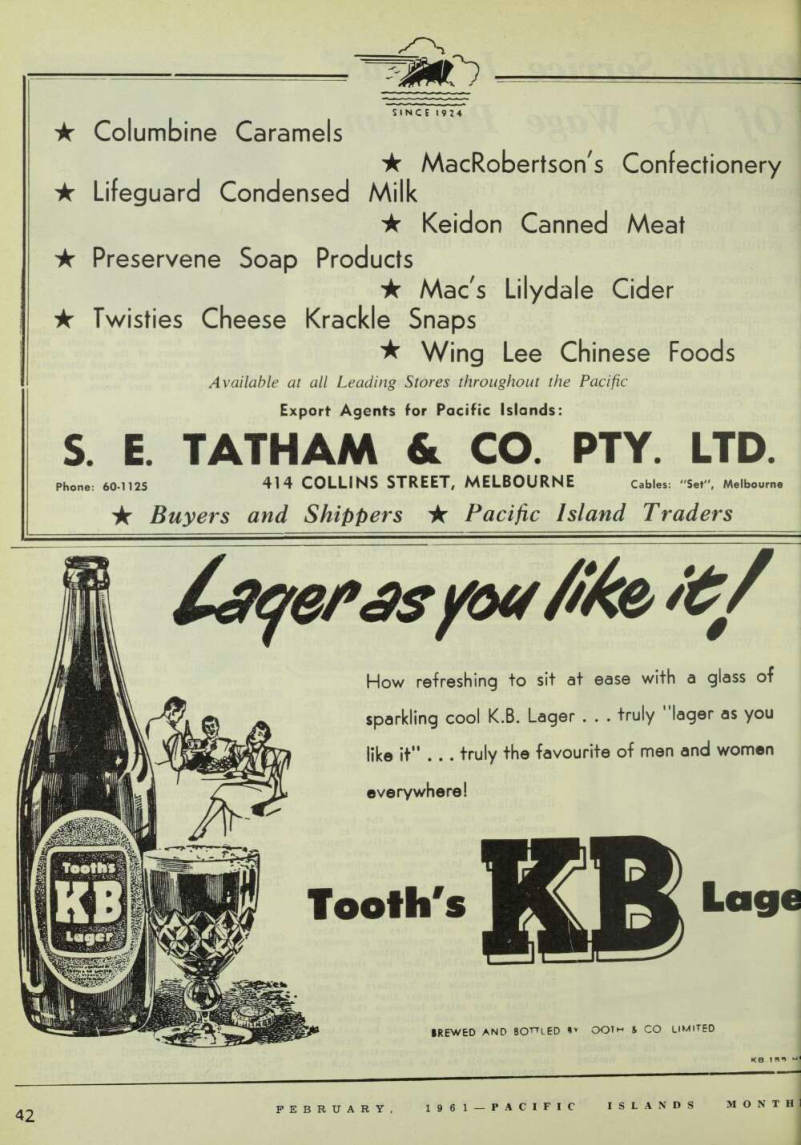
[?] Guinea labour mission visited this [?] tory at Goroka during its fact finding [?] the Territory surveying working conditions.
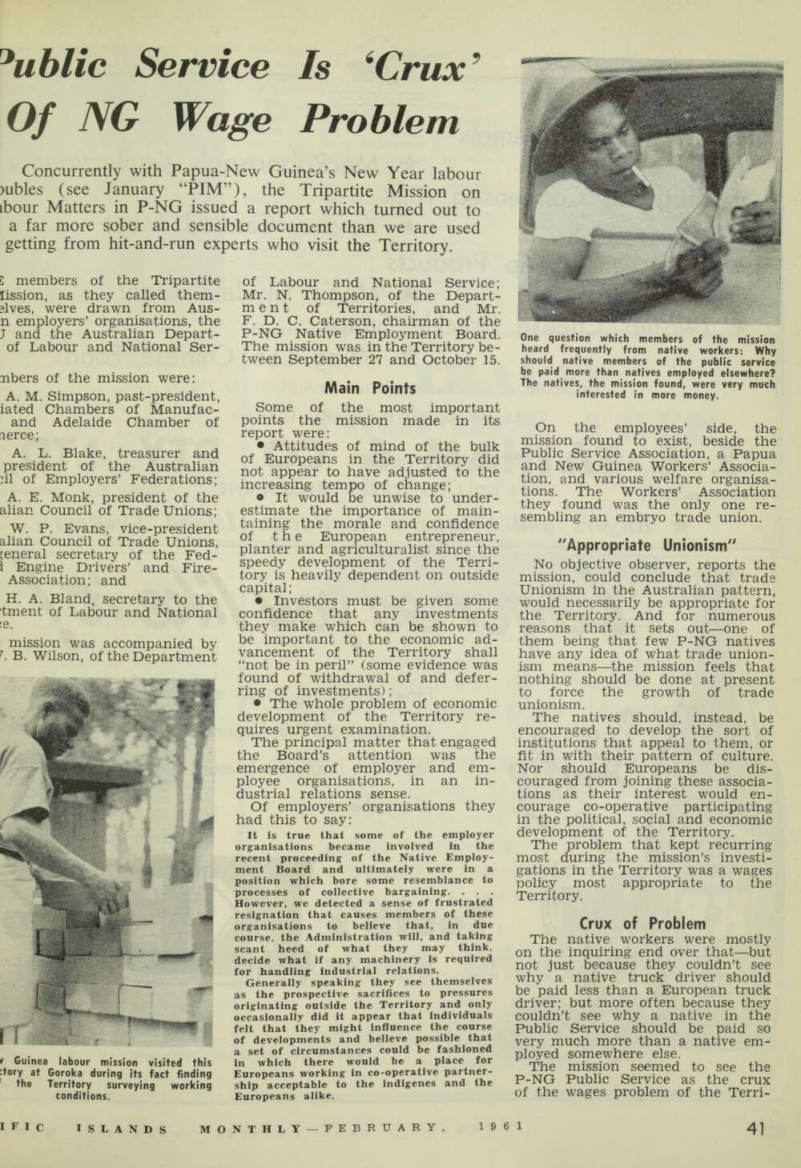
One question which members of the mission heard frequently from native workers: Why should native members of the public service be paid more than natives employed elsewhere?
The natives, the mission found, were very much interested in more money.
and it urged that the whole 7 structure of the PS be re ined from the viewpoint that, ately, it will be almost entirely tive Public Service.
J mission believed that all >ers of the PS should be paid ame salary for the same job, that ex-patriate employees d be paid, in addition, com tory allowances that would at them to the Territory “pend lativisation”. 5 mission seems to see nothing good in what it mistakenly the “indentured system”, ienture is a term that has out of use in P-NG since 1945. es now work under “agree ’, from which all the old penal is of the indenture system have dropped to the extent that the employer must still as all his old obligations the em i can get out of most of his). reason that the mission did ike contract (or agreement) ', however, is because it felt n-over of labour every two does not make for efficiency
7 industry.
with that opinion few could ee. he same time, the mission saw obstacles to the smooth work the negotiated wage (i.e., the r week that now applies for led labour in Lae, Rabaul and Moresby), under present Terri ircumstances.
Same Old Problem mission makes the point that ages policy facing the Terri fy is not new—it has been in other places progressing Is self-government—and the act to keep in mind is that in P-NG must be related to ipacity of the Territory to i them. the present time, the Aus taxpayer is subsidising the
Territory—but at some stage the Territory itself must become “economically viable in a compet itive world”.
The mission, in the course of its report makes numerous observa tions—a few of which are based on a not very extensive knowledge of the Territory but most of which are penetrating and shrewd.
One of these concerned the lenient attitude of Administration labour in spectors when confronted with “em ployment by native entrepreneurs”.
“After all,” they say in their re port, “if we believe we should en sure that there be respect for the rights of native employees, the sooner native employers are treated like European employers the better.”
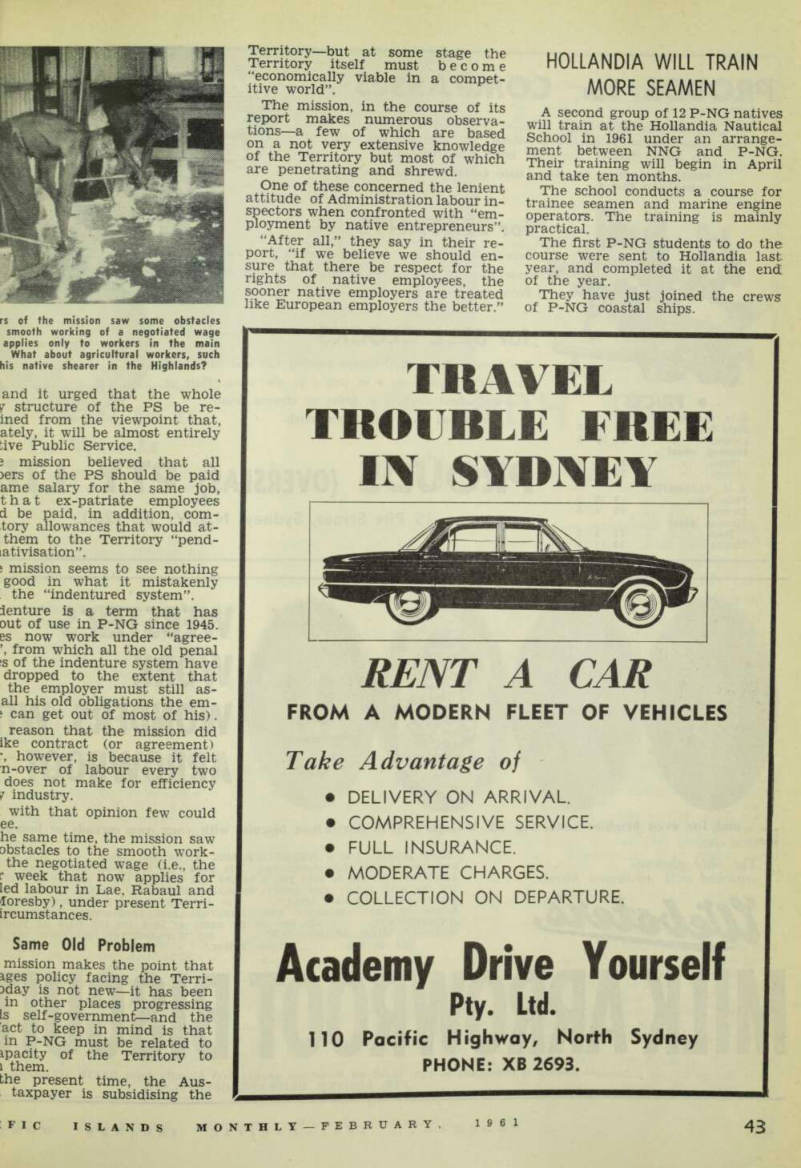
[?] rs of the mission saw some obstacles [?] smooth working of a negotiated wage [?] applies only to workers in the main [?] What about agricultural workers, such [?] his native shearer in the Highlands?