P-Ng Man Gaoled
pp. 22-143 · Read in the full issue
For Sedition
A young Papua-New Guinea Co-operatives officer who allegedl, told natives at a series of meetings that they ought to overthroi the Europeans and get immediate self-government was sentenced t two months gaol in February for having used seditious words.
SENTENCE was passed by the P-NG Chief Justice, Mr. Justice Mann, in Port Moresby on Feb ruary 1. Cooper, 24, a product of one of Melbourne’s best schools, and with an Arts degree at the Mel bourne University, had already been in custody two months awaiting trial.
An appeal against the sentei was lodged to the High Court February.
The case aroused wide interest P-NG. Cooper had pleaded ] guilty.
Cooper joined the Administrat: as a Co-operatives clerk in 1958, signed last October 14 and \ arrested in Sydney on November He was returned to New Guinea trial.
The seditious words were allegei uttered at three lunch hour me ings with a group of natives Madang last September. Accordi to crown evidence Cooper had asl the group to tell all the nat people to seize control in Madan He had suggested they break ii stores for guns and liquor and tl they destroy Madang airstrip, a send all white people home. Rus and China would help the native "No Offence"
Cooper’s defence counsel, Mr.
Staunton, submitted that under t laws of New Guinea no offence h been committed.
In convicting Cooper, Mr. Just: Mann said he was taking into co sideration the “rashness of yout in giving Cooper a light senten He wouldn’t give him a suspend sentence, because what had to
(Continued on p. 141)
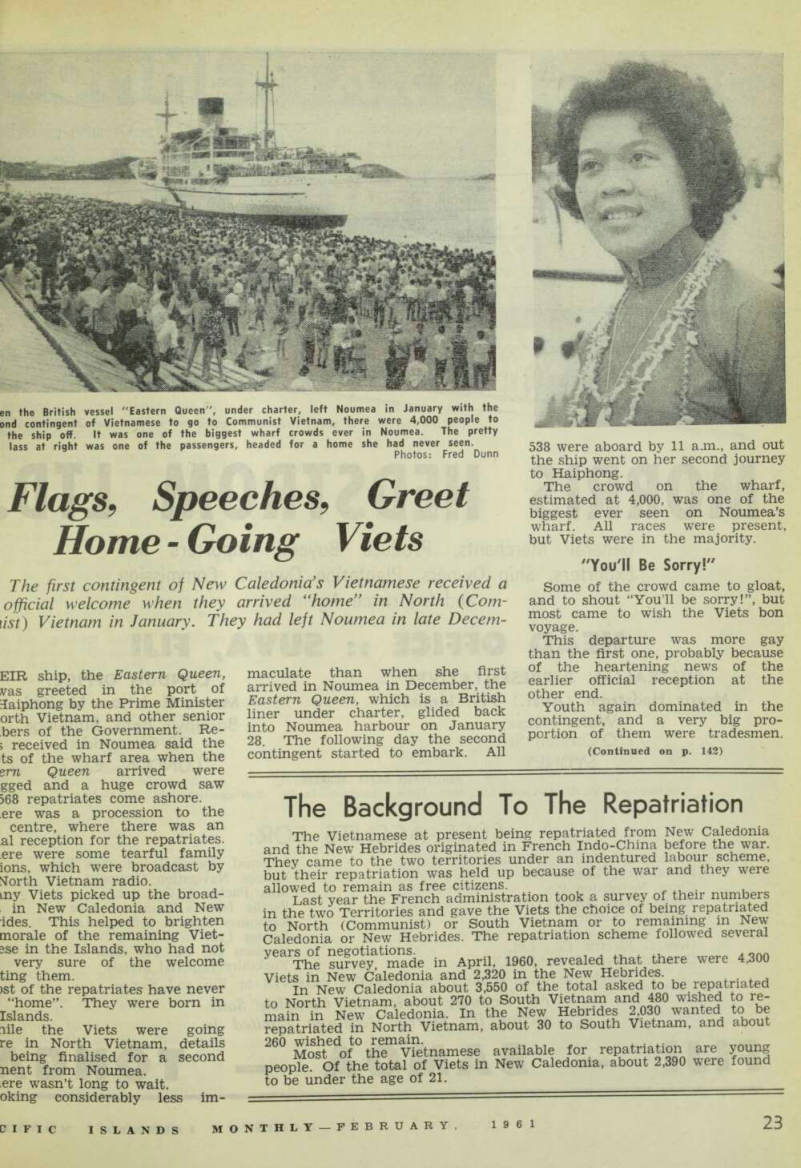
Brian Leonard Cooper.
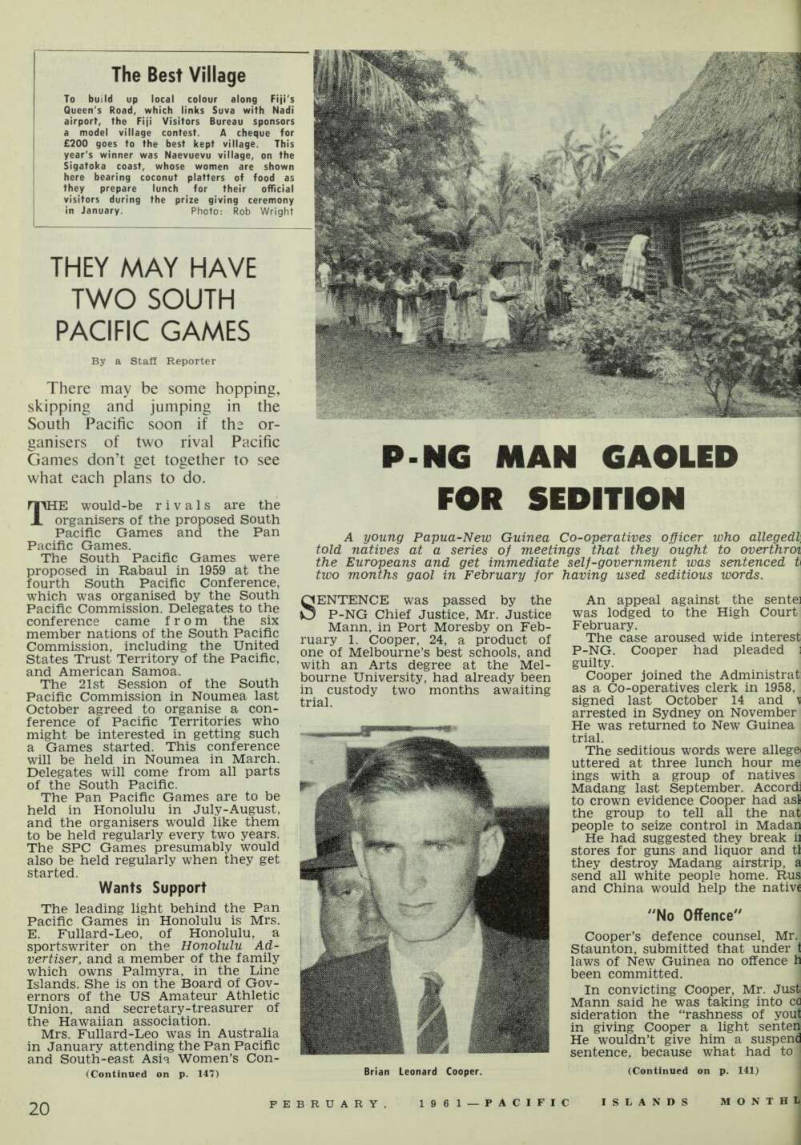
The Best Village
To build up local colour along Fiji's Queen's Road, which links Suva with Nadi airport, the Fiji Visitors Bureau sponsors a model village contest. A cheque for £200 goes to the best kept village. This year's winner was Naevuevu village, on the Sigatoka coast, whose women are shown here bearing coconut platters of food as they prepare lunch for their official visitors during the prize giving ceremony in January. Photo: Rob Wright
taken into account was what might have happened had Cooper not been reported.
He thought Cooper did not really expect to see an immediate armed uprising, but his intent was to start a movement which could cause the utmost embarrassment to the Ad ministration at a time when inter national attention was critically focused on the situation of prim itive people.
Cooper appeared to have been driven against his own interests by “fanatical zeal”, and mainly by in ternal pressures of his own tempera ment, said the Chief Justice.
Highlights
Here were some of the main points of the trial: • There was evidence that Cooper, in gaol in Port Moresby in Jan uary, had watched a number of Pacific Islands Regiment troops be ing marched to gaol following a riot in which they were involved, and had shouted out to police, “Remember South Africa, you dirty Fascists!” • A Commonwealth Security Officer, formerly working in the Territory, Mr. K. A. Donovan, told the court that he had interviewed Cooper in Wewak in 1958 and he had been quite satisfied with Cooper’s loyalty. o Patrol Officer Peter John Wright said Cooper had told him on occasions he would like the natives to rise up and throw the white man out of New Guinea.
"Exploiting"
o Wright also said that Cooper had told him the Government and Europeans generally were exploiting the natives. On another occasion Cooper had kept turning to Radio Peking despite his objections, and Wright had suggested to him that he should go to Russia if he felt
the way he did. Cooper had said he “might do that”. • A native Co-operatives assist ant, Keri Keri Hohora, said Cooper told him last March that it would be good to have a Communist Gov ernment in the Territory as the Communists all worked together and everyone got the same pay. • Under cross-examination, Keri Keri admitted that he himself be lieved he could get into trouble and be punished by the Administration for talking about self-government. • A leading native planter, Stahl Salum, of Madang, said Cooper had once told him, “All missionaries tell lies. There is no God. They are lying to you to get money to put' up churches.” Stahl gave detailed evid ence on what Cooper had allegedly said to the three meetings about overthrowing the whites.
Stahl said he had had a meeting with others to discuss Cooper’s talk, and they had decided not to spread it otherwise “big trouble would come up”.
Cooper, in his own defence, said that all the Crown witnesses must either have told untruths or had misunderstood his statements. He denied he ever urged natives to com mit an unlawful act or use any un lawful means to obtain a political end. He had not used the words in the terms set out in the charge.
He denied he was, or ever had been, a Communist. He was, he said, an atheist and he had pro-Com munist sympathies.
He suggested that the natives who had testified against him might have been trying to get him out of the way in case he found out who stole £2OO from the Co operatives trade store in Madang.
Other money had been lost in a rice milling account.
Three Methods
Cooper said he had outlined to the native meeting three methods by which natives could obtain self government.
One was to sit down and do noth ing and Australia would give them independence in 20 to 30 years.
A second way to seize power would be to seize the police, loot the stores, and burn aircraft but this was a violent method and it was no good.
He said the outside world would simply think of them as a lot of savages.
He said he had advocated to the group a third method of achieving self-government which was by or ganisation, and the planning of trade unions and political parties.
He had told them that they would have the moral support of the African countries in this.